Featured Post

SIX KEYS TO A LITERARY GENETIC CODE

In essays on the subject of centricity, I've most often used the image of a geometrical circle, which, as I explained here,  owes someth...

Showing posts with label walt disney. Show all posts

Tuesday, April 29, 2025

AN AESTHETIC OF NONSENSE PT. 3

 If, in my previous writings on the rationales for metaphenomenal fantasy, I've given the impression that nonsense-fantasy was a new creation, I should correct that by mentioning that a fair number of archaic tales invoke the rationale of "just because." In fact, in Chapter 7 of Susanne Langer's PHILOSOPHY IN A NEW KEY (which I referenced in yesterday's post), Langer begins her generally unflattering description of simple folktales with some examples from Melanesian lore. Her first example, for instance, involves a buffalo and a crocodile having a dispute, whereon they ask various other animals, or even inanimate objects like a mortar and a floor-mat, to judge the quarrel. The idea of attributing life even to clearly nonliving things seems to me more extreme than that of talking animals who behave like people, though both are examples of nonsense-fantasy. Another example of non-living things being given life appears in the (presumably much later) Japanese conception of tsukumogami.                                                       

The Aesop's fables offer a lesser range of nonsense-fantasy. Sometimes the animals therein are shown only doing regular animal activities, as in "The Dog and the Bone," with the exception that the animal may be given some degree of human intelligence. Other stories show such creatures like the Fox and the Stork dining together and using human utensils.                                                              
In the annals of literature, the example of Lewis Carroll's Alice-verse stands as one of the most sustained examples of pure nonsense-fantasy. However, L. Frank Baum's later Oz books might be termed "impure nonsense-fantasies." Sometimes Baum's world follows rough rules about what its system of magic can accomplish, with its witches and flying monkeys and prophetic hats. Other times, though, the world stretches to include a number of entities I'd consider "just because" fantasies, like the Hammerheads and the porcelain-people of China Country. I'd have to read more of the Oz books to judge whether the logic of magic or that of "just because" holds greater sway overall.                                                                               
As impressive as some of the nonsense-fantasies of both oral and written stories might be, those that appeared in early American cartoons might outdo them both by sheer preponderance. Felix the Cat, rated as the first major continuing character of those early short cartoons, might be exemplary here. I don't know if he's the first character in all fantasy who could break off a part of himself-- almost always his tail-- and just will it to become some other object, like a fishhook or a question-mark. But thanks to the popularity of Felix, animated cartoons became increasingly associated with the ability to transform themselves, or aspects of their universe, into anything they pleased.           
That acceptance of the "anything goes" propensity of cartoons of course didn't keep some animators from following the more circumscribed pathways of Aesop. Donald Duck debuts in the 1934 cartoon "The Wise Little Hen," which like its source material simply depicts its anthropomorphic creatures dressing like humans and doing human things.                                                                                   

 I tend to believe that the majority of Disney's stories about anthropomorphic creatures follow the Aesopian pattern, in which clothes-wearing ducks and mice and dogs go around doing all sorts of human things, not least the mouse named Mickey owning a non-anthropomorphic dog. Carl Barks is justly celebrated for creating scores of stories about Donald Duck and Uncle Scrooge having adventures indistinguishable from what humans might do in similar circumstances, with the protagonists' ducky nature being the only "nonsense" element. Once in a while, though, Barks did apprise himself of random nonsense elements, such as "Lost in the Andes," wherein Donald and his nephews encounter square chickens that lay corresponding square eggs. Some of Barks' stories might be considered another breed of "impure nonsense," in that they combine the base nonsense-fantasy of human-like animals with either scientific or magical rationales. Here's what I wrote about Barks' use of a particular type of magic in his story "Oddball Odyssey:"                                                                                                                                                                                                                       '
For her part, Magica provides exposition for the reader about her great new powers, about having "scrounged secrets" from old temples and caves that have given her control over the elements. Most interestingly, Magica advances a fairly sophisticated theory for the origin of the Greek pantheon: "those gods were more likely live sorcerers than figments of ancient dreams." This theory allowed Barks to have his cake and eat it too: he doesn't have to show his witchy villain garnering power from either old gods or, for that matter, Satanic sources. Instead, it's implied that ordinary mortals can generate magic powers from study of the universe's secrets, which is certainly an odd thing to find in a Disney comic book of the period.'                                                                                                                                                                                                                                                                                                           Thus endeth my short history lesson, though I expect to reference some of these observations in related essays,

Thursday, August 3, 2023

GENETIC FREAK-OUTS

I was barely reading any Marvel Comics in the 2010s, but I followed in a loose sense the consequences of the company's bizarre decision to play down the successful X-Men franchise and promote that of the never-successful Inhumans. I'm not sure I knew that plans for an Inhumans film were initiated in 2014, but I certainly saw the result that same year in the AGENTS OF SHIELD teleseries. The first season of that ill-conceived cockup had already been lousy, but the show reached new Heights of Stupid with an attempt to shoehorn the Inhumans concept (though not the familiar comics characters) into a secret agent format. After plans for a movie stalled, in 2017 the principal Inhumans of the so-called "Royal Family" appeared in an eight-episode ABC teleseries. The series proved a huge bomb, critically and commercially. I found in it but one virtue-- a strong performance by actor Anson Mount as the silent king Black Bolt. In my book that put the INHUMANS show on the same quality-level as AGENTS OF SHIELD, whose only strength was the casting of Ming-na Wen as agent Mathilda May.

All these idiotic machinations almost certainly came about because some genius in Disney Marketing decided that the company wasn't getting enough bang for its buck by playing up the X-Men franchise, since that property's movie and TV rights were then owned by Fox. I can imagine the conversation going like, "Hey, Marvel still totally owns the Inhumans, right? The fans will just accept anything we push at them as long as it has a bunch of weird, colorful people in costumes to help them (the fans) compensate for their drab lives." And once this blockhead came up with this genius idea, no one else could point out its fatuity, lest that person seem like he wasn't in favor of the company making more money. One hopes the genius got kicked to the curb for whatever monetary losses Disney suffered for the failure of the INHUMANS teleseries.


As I said, none of these Marvel machinations affected me back in the day, since I wasn't reading the X-books, or for that matter the FANTASTIC FOUR features that also got downplayed for an analogous reason. But when I recently caught sight of a TPB collection of a 2016-17 Marvel series, INHUMANS VS. X-MEN, I wondered if the story, written by Charles Soule and Jeff Lemire,  might signal some of the company's priorities during that historical moment. 

I also dipped into a handful of Inhumans stories published around the same time as IVXM, but I'm sure I've missed a lot of fine points about the execution of the Inhumans franchise. That means that any conclusions I make here are partial at best. But IVXM by itself sets up a situation that COULD have been used to shunt the Unwanted X-Franchise off Planet Earth and to play up the Inhumans, though this possibility does not actually come to pass by the end of the story. Overall the Soule-Lemire story conforms to the "Marvel heroes fight over a misunderstanding" trope, though I will say that, unlike a lot of multi-character crossovers, the writers manage to give most of the characters therein a "spotlight moment" or two. 

Perhaps more tellingly, IVXM attempted to "democratize" the process of genetic-diversity-with-superpower-benefits. The 1970s X-MEN capitalized on this trope far more than its 1960s iteration by disseminating that diversity over countless human cultures and ethnicities. By contrast, the concept of Marvel's Inhumans, as initiated in 1965, was that of an insular culture that had a thing for inducing mutations in its populace, even though the people came from the same stock as common humanity. Following the 1960s, most of the attempts at giving the Inhumans ongoing serials were hampered by the difficulties of endowing such exotic characters with any relatability. Some of the Inhumans stories produced in the middle 2010s, though, sought to modernize the franchise by introducing an assortment of younger Inhumans, sometimes termed "Nuhumans," who in my opinion were designed to compete with the more numerous and successful X-spawn.

I don't have enough information to render any aesthetic judgment on the various INHUMANS comics of this period. There may be some very good works in the actual books, whatever the motives of the marketing people who were responsible for the X-Men X-cision. Still, history will record that Marvel customers still wanted the X-Men, no matter how much the company pushed its favored franchise. Perhaps the fact that the comic-book version of Kamala Khan, originally retconned into an Inhuman as part of the "Inhumans First" project, is now being touted as being "both an Inhuman AND a mutant."

In 2019 Disney bought out Fox and now has the right to monetize any X-adaptations the company might want to do. I suspect, though, that the failure of the Great Inhumans Push will not teach Disney anything about the folly of trying to manipulate their customers' desires for entertainment purely to help the company's bottom line.


Saturday, May 6, 2023

TOMORROW ALWAYS DIES (AS HUMOR)

 Here's a post from one of the forums I visit, which I argued that when corporations and public schools endorse ultra-liberal causes, they're seeking to immunize themselves from frivolous lawsuits. To place things in context, my opponent argued that Florida's Parental Rights Act could encourage frivolous lawsuits. A separate opponent reprinted the following editorial cartoon from the odious ultraliberal Tom Tomorrow, to which I also made reference. All of Tomorrow's allegations are full of crap, but the SONG OF THE SOUTH lie is in the fifth panel.

_________


I may surprise you with a minimal agreement. Will the Parental Rights Act open up the possibility that some parents file frivolous lawsuits over minor kerfuffles? Yes, that is a distinct possibility.


But what you fail to mention is that American corporations, including the schools, are already constantly under the threat of frivolous lawsuits from grifters who want to use inclusivity to make money in court. Remember the winner who called himself Jessica Yaniv? No, that didn't have anything to do with public school, but you think schools don't worry, as much as any corporations, about getting so targeted?


In fact, Disney's apparent championing of LGBTQ representation may have a lot more to do with immunizing their corporation from such activist targeting than any high ideals. A few days back a poster printed a broadside from that stellar comics genius (sarcasm emoji) Tom Tomorrow. Tomorrow should remind everyone here that Libs frequently used to attack Disney for being too conservative (though in the forties through the nineties, they were generally more centrist). To that end Tomorrow brought up SONG OF THE SOUTH, claiming that the movie was constructed to portray Southern plantation life as happy for Black people. This was a lie that's doubly insulting because it can be so easily refuted, but Tomorrow, if he was ever a Classic Lib, has gone full Progressive. And yeah, I'm sure schools would like to get parents off their backs so that they can immunize themselves from frivolous suits by tossing out a few drag queen performances to please the activists.


P.S. Tomorrow also lies like a dog about Scott Adams, who has categorically stated that he made his "race remarks" as a hyperbolic method of provoking conversation. But guys like Tomorrow are not interested in conversation, only in dogma.


Tuesday, December 31, 2019

STAR WARS, NOTHING BUT STAR WARS

For my last ARCHIVE essay of the year, I thought I might put together something a little more accessible to the casual reader (if any) than the previous "Concrescence and the Kinetic Potentiality." And since this year I devoted several essays on my movie-blog to reviewing most of the as-yet-unreviewed-by-me live-action films in the STAR WARS series-- concluding with an analysis of the current RISE OF SKYWALKER-- I'll make the Lucasverse my last ARCHIVE subject for 2019.

In 1978, when Bill Murray sang the lyric in my title for an episode of SNL, he was playing the part of a lounge-singer making up lame lyrics to please an audience of barflies. The main focus of the schtick was to make fun of the way commercial performers tended to latch onto items of popular culture in order to sell themselves. In a different era, Murray might've constructed the same idea around, say, THE POSEIDON ADVENTURE.

And yet, though the comedian couldn't have known that the original 1977 film would be anything more than a flash in the pan, he could well have been aware that STAR WARS had garnered an adult audience far beyond anything seen in past SF-successes. I find it unlikely that the same schtick, done in 1968, could've sold the idea that a lounge-singer would've tried to appeal to a bunch of adult drinkers with insider references to any other fantasy-film, even a popular one like PLANET OF THE APES.

There had been a handful of fantasy-works in various media that somewhat escaped the "fantasy is for kids" cultural judgment. DUNE and THE LORD OF THE RINGS attracted an audience outside the world of hardcore SF-readers. The James Bond book-series and its attendant movie-adaptations trafficked in sci-fi gimmickery and villains that resembled the freakish fiends of the DICK TRACY comic strip. The fifties generated a handful of SF-films that enjoyed some qualified support from adult audiences, such as Howard Hawks' THE THING, and the late sixties mirrored that development with the first of the APES films (though later ones became more kiddified) and Kubrick's 2001: A SPACE ODYSSEY. Comic books remained a marginal medium despite adults' brief flirtation with the irony-drenched world of the 1966 BATMAN teleseries. Yet Marvel Comics changed up the game by introducing the formula of "heroes with problems," and while Marvel's penetration of "the real world" was minimal during its strongest creative era, its long-term influence on American culture would make possible the current hegemony of "superhero movies for all ages."

Yet, for all of these influences, the eventual validation of metaphenomenal entertainment for adults all comes down to "nothing but STAR WARS." In my review of the original film, I wrote:

...the religion of the Force works well in the first film because it's become the underdog in the galactic empire. Whenever the materialistic minions of the Empire mention the Jedi, it's only to sneer at the absurdities of their beliefs. To them Darth Vader's continued existence is little more than an indicator of the foolishness of having faith in anything but machines-- and the fact that Vader himself had taken on the semblance of a machine is merely a further confirmation of their world-view.
Luke Skywalker's existence defies the Empire's passion for "technological terrors," and whether or not Lucas meant him to be Vader's son at the time hardly matters. By inheriting Obi-Wan's mantle as the new embodiment of Jedi spirituality, he supplants Vader in the cosmos as Jacob supplanted Esau. This is the unlikely turnabout that Lucas teaches his audience to hunger for, and it plays as much a role in the franchise's success as the aforementioned love of pulpish extravagance. Indeed, without Lucas having crossbred the magic of fairy tales with the machines of SF, the furor over STAR WARS might have petered out over time like many other fannish enthusiasms, no matter how hard big corporations labored to keep them stoked.

George Lucas's scattershot research into fairy tales, archaic shamanism, and mythology clearly touched a cord in the American psyche, not mention the psyches of a great many other world cultures. And its popularity with adults was reflected in one of America's earliest instances of "political correctness," on which I reflected in my essay TRIBAL IN PARADISE:

STAR WARS was the test-case for racial representation. Not long after the film came out, I recall hearing a black comedian say something like, "Tell the truth, white people; you like STAR WARS because it means ya'll gonna leave alla us behind!" There may be more truth than humor in that statement, and Lucasfilms was quick to remedy the lack of POC in the SW universe by introducing Lando Calrissian in the second movie.

This wasn't pure tokenism, though. The Lucasverse as we now know it recapitulated a number of political attitudes, not least Lucas's favored trope of "lots of little good guys can beat a big bad guy." This is best illustrated in the first film in the Rebels' triumph over the Death Star. In addition, an early draft for STAR WARS would've also included a primitive tribe of Wookies beating a contingent of Storm Troopers, even though the story-idea didn't show up on celluloid until Lucas reworked the Wookies into RETURN OF THE JEDI's Ewoks. Reportedly Lucas was not entirely pleased that the only well-known black actor in the cast was "off-camera" in the form of Darth Vader's voice, but the appeal of James Earl Jones' baritone overcame those reservations. Thus I would surmise that Lucas probably didn't engineer the role of Lando Calrissian merely to profit from tokenism. He probably sincerely believed in a judicious forms of racial representation, much like that similarly-liberal toiler-in-fantasy-fields Gene Roddenberry. However, Lucas he didn't virtue-signal quite enough to head off his critics in 1999, when the buffoonish Jar Jar Binks was assailed for being a modern reincarnation of Stepin Fetchit.

The prequel series displeased a lot of viewers for a lot of reasons, but on the whole the series proved a success-- not just in terms of box office, but also in showing how thoroughly the viewing public had become enthralled with the Lucasverse cosmology. That said, even in the sixteen years between RETURN OF THE JEDI and THE PHANTOM MENACE, countless film producers sought to pursue the grail of the "Big Lucas Pay-Off," seeking to subject the once marginal genres of science fiction, magical fantasy and superheroes to the big-budget treatment. Television showed a similar transformation, though obviously Hollywood's Veblen-esque investment in conspicuous consumption didn't play so well on the small screen. Still, serials like XENA, HERCULES and BUFFY THE VAMPIRE SLAYER demonstrated methods of bringing in big ratings on a small budget. For all anyone knows, the increasing profitability of sci-fi and superheroes may have played a role in encouraging George Lucas to return to his long-neglected franchise.

There's not much doubt that the "Rise of the Box-Office Profits" motivated Disney to purchase the Lucasverse, but here too, it's hard to say if pure profiteering explained the whole megilla. In my essay FREEDOM VS. FREEDOM PART 4, I called attention to the way Disney strategists re-wrote Lucas's "Clonetroopers" scenario from the prequels in order to start off the new series with an appeal to racial priorities. Thus the first promo for FORCE AWAKENS opens with the sight of a Storm Ttrooper unmasking and revealing the face of a black man (or at least, a face whose ethnicity is less ambiguous than that of actor Temeura Morrison, who played the mercenary from whose cells all Storm Troopers were supposedly derived).
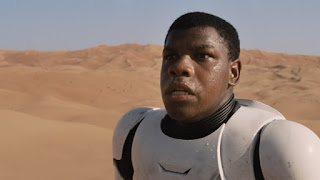


Now, with the Disney trilogy is complete, it's possible to state categorically that the company's vaunted commitment to diversity did not extend to making Finn a halfway interesting character. In my review of FORCE AWAKENS, I pointed out that this revelation could be seen as a war to replay what I called "the African Diaspora," insofar as Disney's white-clad troopers were abducted from their worlds and forced to serve the Empire/First Order. However, even if the persons responsible for crafting the Finn character had some such intention-- and the idea is re-emphasized anew in RISE OF SKYWALKER-- the producers failed utterly at making Finn even as compelling as a Lucas toss-off like Boba Fett. That said, other new characters in the Disneyverse-- Poe, Rose Tiko, Holdo-- were no better characterized, so Finn certainly wasn't singled out for half-assed treatment. The one decent new character, Rey, got most of her mojo from being tied to one of Lucas's legacy characters in a literal sense, and with others in a more symbolic sense.

It may be a measure of Disney's perceptions about the adult audience's investment in the Lucasverse that the company chose to virtue-signal the company's commitment to diversity. However, it should be noted that, even if Lucas and his collaborators might have been influenced by tokenism in crafting Lando Calrissian, they still managed to make Lando an interesting character despite the creators' possibly-monetary motivations.

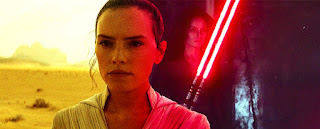
Even before SKYWALKER appeared in theaters, the first two films in the Disney trilogy were excoriated for their virtue signaling, though this criticism tended to focus less on people-of-color than on a perceived overemphasis of female characters. I feel that this criticism is partly justified in the cases of Holdo and Rose Tiko, who were such ciphers that I find them unlikely vessels of female empowerment. However, I will defend Rey against that charge. I don't think that Lucas's STAR WARS cosmos was ever directed exclusively to the male gender, and I think that Princess Leia stands as a major femme formidable, even if it's true that Carrie Fisher was less than entranced with her role. Rey has been accused by some critics of being a "Mary Sue" in terms of how easily she attains power and formidability. But while I might share some critics' concerns about the depiction of her path to power, I felt all three Disneyverse films succeeded in making her a vital character, one not defined by the gender wars. Thus, when Rey takes the name "Skywalker" at the end of SKYWALKER, I for one embraced that conceit. For me, the gesture demonstrated that, even when the new-verse was compromised by venal virtue-signaling, and dull diversity-concerns, it still was possible for people who weren't George Lucas to create at least one character that escaped such banal politicization.

Wednesday, May 27, 2015

STAN LEE: MAY 2015

I made it a point to see the Stan Lee Q & A panel when I visited Houston's Comicpalooza, and I'm happy to report that the session was a veritable Algonquin Round Table, filled with all manner of trenchant commentary and perspicacious observations.

No, of course I'm lying. Even for someone like myself, who has defended Lee on many occasions, the event amounted to nothing but an insubstantial schmooze-fest, with the famed Marvel editor fielding various softball questions from a predominantly young group of fans-- many of whom, I suspect, have had only nodding acquaintance with Lee's actual writing. And of those who may have read some of his signature Silver Age comics, I further suspect that they never read anything but his best-regarded Marvel work. I'd bet none of them were hardcore fans, who took an obscure joy in finding how Lee's 1940s "Jack Frost" demonstrated his early liking for Everett's anti-social Sub-Mariner character, or who groaned at some of Lee's lamer attempts at late 1960's "relevance." None of them, at least, asked about any of his specific comics stories. Most of the questions pertained to the recent Marvel movies, or, on occasion, about the Marvel cartoons of the 1980s. Lee, with customary forgetfulness, had no recollection that he'd done voice-overs for the 1980s SPIDER-MAN cartoon, and a question about an online comics-studies course, to which he'd lent his name, drew a blank.


It's almost axiomatic to note that Lee looked and sounded great for a man in his early nineties, and showed considerable mental agility in knocking back the softballs, at least when he knew what the questioners were talking about.  I'm sure that he managed to recycle many of his verbal routines from earlier sessions like this one, particularly all of his comments about his new career as the King of the Cameos. The joke about trying to get the Oscars Committee to institute a "best cameo" award drew one of the hour's biggest laughs.

Given that Lee didn't have an interlocutor on the level of, say, Mark Evanier to hold his feet to the fire, he was able to spout a lot of the same "foxy grandpa stories" he has always spouted for a general audience. In the essay cited, I defended the principle of such stories, and I still maintain that when some uninformed mook asks Lee how he created Spider-Man, the mook is probably happier to get a story about Lee seeing a spider on the wall than a long recitation of the very involved path by which the Spider-Man concept came into Lee's hands. On a side-note, this particular story may be one of Lee's oldest "foxy grandpa stories," since I can remember hearing him toss it out for rerun episodes of the 1970s SPIDER-MAN teleseries on the Sci-Fi Channel.

Also represented was the familiar tale that his publisher-- the name "Martin Goodman" never passed Lee's lips-- forced him to stick the initial Spider-Man story in a soon-to-be-axed anthology title. This is probably not the whole truth-- various fans have shown evidence that Goodman may have initially authorized a SPIDER-MAN title, and then backed out of the notion-- but whatever Goodman's reason, it probably wasn't simply that he "didn't like spiders."  But again, given that Goodman is not exactly known as a paragon of publishers, it's not overly troubling to see him used as a standard "dopey boss who takes the credit." And one of Lee's routines even had him admitting that when he became publisher, Lee ended up doing the same things Goodman had ordered him to do.

I was surprised that Lee did not include one of his most circulated grandpa-stories: that he was on the verge of leaving comics in the early 1960s, and that his wife talked him into doing comics his way-- thus making possible the "Marvel Age of Comics." If he truly hasn't reeled that one out for a long time, it could be because it reflects a bit too much negativity about the wonderfulness of working in the comics.

His most interesting (to me) statement came when a fan asked a predictable enough question, as to which of the Marvel movies he liked best. Lee may well have been asked this question many times before, so it's quite possible that he was recycling his answer as well. It's also likely that the answer was informed by the desire to avoid praising any film-franchises not owned by Marvel Studios, such as those of Spider-Man and the Fantastic Four.  But whatever his covert reasons, Lee claimed that his favorite Marvel movie was the first CAPTAIN AMERICA film, largely because he admired the "movie magic" that made it possible to put hunky Chris Evans' face on the body of the shrimpy actor playing pre-transformation Steve Rogers.  Opponents of Lee would seize upon this as an admission that Lee knew he wasn't as stunningly original as the guys who really created the Captain America concept. I would take the statement another way: that a small part of Lee is still a fan, and that part, when set apart from business considerations, still loves a great story idea.

If I'd had a chance to ask Lee a question, mine would probably have been, "What's it like to be regarded as the Walt Disney of the 21st century?"  For that was clearly how the couple-hundred fans regarded him. They didn't know particulars of his career or personal accomplishments: they only knew him as the keeper to the gates of wonder.  Granted, Disney ascended to his gatekeeper-position a lot earlier in life than Lee did, and Lee might never have got there, at least not to so many people, had it not been for the help of the movie-industry. And some might feel that the chief gifts of both men was their skill as entrepreneurs, rather than as creators. Nevertheless, they were both at the very least "point-events" around which the myths of a century coalesced. So, yes, corny grandpa-stories and credit-controversies aside, Stan Lee still deserves the love.


Thursday, August 19, 2010

RULES OF ESTRANGEMENT PT. 3

In part 2 of this series I took two of the examples provided in a Grant Morrison talk, X-MEN and LITTLE MERMAID, and used them as examples of different types of fantasy-fiction. Now I'll give those types names which I've swiped from the symbolism theory of Suzanne Langer: "discursive" and "presentational."

"Discursive fantasy" is the type for which X-MEN is a fair representative. As noted before, X-MEN was indeed conceived as a fantastic fiction grounded in certain rules by which the powers and actions of the protagonists could be explained. Grant Morrison asserts that the desire to rationalize fantasy was something typical only of reality-minded adults, but Morrison overlooks that not only was the original Lee-Kirby X-MEN explicitly created to be this kind of fantasy, it was also a fantasy aimed at a certain age-range of juvenile readers, roughly extending from middle-school to (early) high-school. Of course children in a younger age-range also encounter their fair share of discursive fantasies-- as well as non-fantastic fiction in this discursive mode. But whether one is talking about X-MEN or ISLAND OF THE BLUE DOLPHINS, casual impressions would suggest that "secondary school" juveniles do seem to favor rule-based discursive fictions more than do their "elementary school" kindred.

"Presentational fantasy" is the type of fantasy with which most children grow up, and this type is best represented by works akin to Disney's LITTLE MERMAID. Presentational fantasies do not draw explicit rules for their deviations from consensual reality of the audience: instead, they present every deviation as simply a *fait accompli,* something that happens because the author says it happens. As noted before there is no "rule" that establishes why fish can talk in the Little Mermaid world; they simply do. At the same time, MERMAID imposes on itself some limits on how many kinds of *fait accompli* the author can present. Disney's MICKEY MOUSE cartoons often present a world where some dogs walk on two legs and wear clothes while other dogs are cartoonized versions of real dogs. MERMAID makes a choice to give us cartoon-fish who can speak but don't otherwise emulate human beings by walking on their lower fins or wearing garments.

This form of limitation, common to both types of fiction and/or fantasy, is what I term an *expectation,* one which is created by the author and and which he expects the audience to interpret in a certain way. To simply, "expectations" can include all the "rules" conceived by discursive fictions, such as how Scott Summer's optic force-beams are generated from his eyes. However, "rules" cannot subsume the total set of expectations created by both discursive and presentational forms, for the limitation "LITTLE MERMAID fish can talk but they don't wear pants" is not expressed discursively, as a rule must be.

Now, I agree that all forms of fiction, even those that attempt to bend one's expectations, nevertheless generate expectations, if only in the sense of audience reception. Quoting narratologist Mieke Bal, Tim O'Neil calls this audience perception a "logic-line." Yet even though I have not read Bal, I suspect that she is speaking of "story logic." I see no place in Grant Morrison's Comicon speech where he advocated banishing story logic; he merely opposes the impulse to rationalize fantastic material, as per his X-MEN example. I'll be holding forth in more detail on the conflicts of logic and aesthetics in part 4.

To further complicate this introduction of "discursive" and "presentational" for types of fiction dominated by a certain approach, one can also use them for the approach itself, or, more properly, what literary criticism calls a "mode." This is an important distinction because neither X-MEN nor LITTLE MERMAID is purely discursive or presentational.

For instance, while the Lee-Kirby X-MEN may expend many discursive efforts to explain the logic of how its heroes function, there is a presentational side to X-MEN that descends from most other superhero serials. For instance, after the heroes save the day, they *must* be able to get away from the public back to lives of anonymity. This is not a logical consequence of any factor in the series proper, but it is as much a *given* as talking fish, or Morrison's desire not to worry about how old Batman and Robin are.

Similarly, LITTLE MERMAID may not expend much thought on the ways in which antagonists Triton and Ursula use magic, but there's the germ of discursive fantasy in this contest which isn't quite as "presentational" as the talking fish. One senses the potential for a "rule" in Triton being under Ursula's control once he surrenders his trident.

To be continued...