Featured Post

SIX KEYS TO A LITERARY GENETIC CODE

In essays on the subject of centricity, I've most often used the image of a geometrical circle, which, as I explained here,  owes someth...

Showing posts with label flash gordon. Show all posts

Saturday, October 25, 2025

INFLUENCE OF ANXIETY

 Response designed for a forum-post, context implicit.

____________

Because you and another poster raised the spectre of influence between the daughter of Sax Rohmer"s Fu Manchu (1912) and the daughter of Ming in FLASH GORDON of Alex Raymond (and all uncredited collaborators), here are my hot takes.


First off, there's no doubt in my mind that Ming derives from Fu Manchu, even though their specific characters are not very similar. The fact that both have disobedient daughters is one big factor, though surprisingly the big thing everyone knows about Princess Aura-- that she falls big-time for studly Flash Gordon-- is not initially a feature of Fu's daughter Fah Lo Suee.   


Now, the element of a female ally of Fu Manchu falling for one of the heroes is a big part of the first two books, published respectively in 1912 and 1916. Fu's beautiful slave-girl Karameneh inexplicably becomes enamored of Doctor Petrie, and thus helps Petrie and his cop-friend Smith out of some jams. In the second book Karameneh even shoots her master to save Petrie, and the only thing that saves her from the devil-doctor's vengeance is that Fu uses his former servant as a bargaining chip to compel Petrie's aid in the third book.

This book, HAND OF FU MANCHU (1917) also introduces Fu's daughter, though she's not given a proper name and is never disobedient to her father's will. Then there's a lacunae of about fourteen years, during which there are no official Fu Manchu novels (though the doctor kind of "guest-stars" in THE GOLDEN SCORPION). DAUGHTER OF FU MANCHU debuts in 1931, and here Fah Suee does get a name, and she does seek to wrest control of the Si-Fan from her father. However, she doesn't ally herself to any Englishman. In this and in the subsequent book, she implicitly uses drugs to make a young guy her lover, though there's no sense that she's in love with him.         

The sixth book, BRIDE OF FU MANCHU, again portrays conflict between father and daughter, though not over any romantic alliance of hers. Then finally, in April 1934, Rohmer starts serializing, in Collier's, THE TRAIL OF FU MANCHU, Fah stuns her dad by claiming that she's fallen in love with Fu's worst enemy, Smith. In two or three later books, this romance is mentioned, and at least once Fah helps the heroes out of a fix, but the plot is left hanging by the end of the series.


However, FLASH GORDON debuts in January 1934 and its first arc, in which Aura meets and desires Flash Gordon (even as Ming desires Dale Arden) finishes up in April-- which as noted is pretty much when TRAIL got started.

Of course, Raymond et al could have taken the element of the romantically traitorous daughter from a lot of places other than Rohmer. But Rohmer did use that element, albeit with a slave-girl rather than a literal relation, for whatever that might be worth.  


Wednesday, November 14, 2018

MYTHCOMICS: THE WITCH QUEEN OF MONGO (1935)

"Witch Queen of Mongo" marks the first sequence in which Alex Raymond seeks to expand on the formulaic characters of FLASH GORDON. But it's not the central character who gets the attention, but his faithful inamorata Dale Arden.

As I pointed out in my previous Raymond essay, Dale Arden's role in the series is one of the strongest deviations from the strip's putative inspiration, Edgar Rice Burroughs' JOHN CARTER series. It may be that Raymond chose to give his hero a female "comrade-in-arms" in imitation of the science-fiction strip with which FLASH was competing, BUCK ROGERS. Dale Arden is, admittedly, not an experienced warrior-woman like BUCK's Wilma Deering. Yet Dale is much more gutsy than any of Burroughs' Martian princesses.


For example, in the second FLASH strip, Zarkov, having built a spaceship to combat the onrushing world of Mongo, forces Flash and Dale  to board the ship, after which he sends them all speeding toward the enemy planet. Flash fights with Zarkov, and though the hero slugs the older man unconscious in the next panel, Dale is seen grabbing a lug-wrench so as to crown Zarkov if necessary. And while Flash is always the main hero in the ensuing sequences, Dale frequently shows more than a little initiative. When Flash and Dale are held prisoner by the Hawkmen's king Vultan, Dale pretends to make up to the monarch in order to protect her beloved. Early in the "Witch Queen" sequence, Dale is seen ray-blasing Mongo-monsters as ably as her boyfriend could. However, since she is a woman, her priorities are not quite the same as the hero's, and on that the main plot of "Queen" hinges.
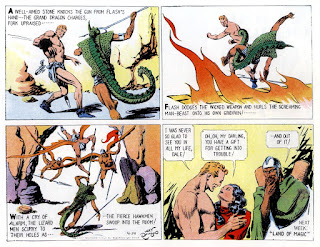


At the end of the sequence I termed "Tournament of Death," Ming awards Flash his own kingdom, but the hero has to tame it for himself. Flash, Dale and several Hawkmen provided by Vultan infiltrate this new domain, name of Kira. The first ten strips depict Flash's first efforts to extend his rule, in particular defeating a tribe of cannibalistic lizard-men. But at the end of the tenth strip, Dale takes issue with the male mode of continual conquest:

But Flash, if you keep finding new enemies, when can we hold our wedding?

This can't be dismissed as mere feminine pique, given that Dale was key to rescuing Flash from the lizard-men. Flash, being a man, gives Dale a sweetly reasonable answer that doesn't acknowledge her concerns (I suppose some today would call it "mansplaining"). Dale blows up: "I won't marry you now til you beg me to!"


As if summoned into being by this disavowal, Dale's next major romantic competitor, Azura the Witch Queen, enters the fray. Despite the slight similarity between the name of the queen and that of Ming's daughter, Princess Aura comes off as a poor second to Azura, an independent ruler with her own array of arcane weapons-that-look-like-magic. Azura appears before Flash's entourage, seeming to be such a "spectral figure" that the armed men are briefly cowed. Flash orders them to attack, but Azura has the situation in complete control. She uses explosives to trigger an avalanche, burying many though not all of the Hawkmen, while the queen uses sleep gas to take prisoner Flash, Dale and a Hawkman captain named Khan.

With the help of her soldiers, usually called "magic men" despite the fact that they too only use super-science weapons, Azura transports her captives to Syk, her "flame-guarded stronghold" (perhaps modeled on the folk-story of Venusberg). She seems to be unaware of Flash's intention to invade her territory, and is only interested in seducing him. Apparently her only reason for keeping Dale and Khan alive is to use them to keep Flash in line when he wakes up-- although it doesn't take long for Azura to take the next step: drugging the hero with a forgetfulness potion called "Lethium.."  Flash easily buys into the notion that this sexy witch-woman is his queen and lover.


Ar this point, Azura really has no reason to keep Dale and Khan alive, and Raymond doesn't even resort to the most logical excuse: that Azura takes sadistic glee in seeing Dale suffer when Flash no longer knows her. Both Dale and Khan are given servile jobs as servants, but aside from a scene in which a female servant lets Dale see Flash kissing Azura, there's no direct attempt to humiliate. However, though Flash doesn't know Dale as anything but a serving-girl, he objects to seeing a member of the weaker sex whipped for a minor infraction. This illustrates Flash's innate gallantry, given that he remembers nothing of his previous life.


Meanwhile, some of the Hawkmen under Flash's command weren't killed by the avalanche, and have sent for military aid to Vultan. Soon a small army of Hawkmen, accompanied by the peripatetic Doctor Zarkov, assault Azura's "magic-men."


The Hawkmen lose the contest, but Flash takes Zarkov prisoner and brings him into Syk. This proves costly for Azura, for with his super-science Zarkov slays several magic-men and cures Flash's amnesia. Flash feeds Azura her own potion, so that she forgets her evil ways-- temporarily at least-- and aligns herself with his rulership.


However, just to keep the pot boiling a little longer, Azura's generals stage a coup. Flash, Dale and Zarkov are forced to flee Syk, somehow leaving the Hawkman Khan behind in prison, and in the absence of the heroes, Azura's old identity returns. Zarkov then uses his science to give Flash a "super-power," turning him temporarily into an invisible man, even though Raymond draws him as a shadowy figure. Thus Flash invades Syk again, launching a "one-man war" on Azura and freeing Khan. However, Flash's invisibility begins to wear off. He takes Azura hostage and drags her into "the Tnnnel of Terror" to escape. This proves a mistake, for the tunnel is inhabited by "death dwarves."


Just as Flash and Azura stand on the edge of being overwhelmed by the dwarves, Dale and Zarkov show up in the Tunnel and drive away the nasty fiends. However, because Flash and Azura thought themselves on the verge of death, the queen begged the hero for a last kiss, and he obliged, just as Dale showed up. Thus the story comes full-circle, for although Dale has reclaimed her lover, he's displayed a certain amount of sexual infidelity before her eyes. At last Flash is able to smooth over the troubled waters by relating his transgression to his Manifest Destiny. When Dale asks Flash if he liked the kiss, "I liked it because it meant her friendship-- it meant that this bloody business was at an end-- that I had won my kingdom and the right to marry you."

However, Flash manages to find another new war that keeps him from getting married, which also brings the story back to Dale's original protest. When Flash announces the taming of his kingdom to Ming via radio, the Mongo emperor refuses to acknowledge Flash. In the following sequence, this begins Flash's first major martial assault on the empire of Ming, but "Witch Queen" in essence sets a pattern that would mitigate against marriage for the rest of the comic strip's history. In other words, Flash and Dale would perpetually have their virtue attempted by this or that powerful figure of Mongo. It's a virtual certainty that male readers enjoyed it whenever some beauteous ruler tried to seduce Flash, while female readers didn't get nearly the same vibe from Dale having to fend off unattractive seducers like Ming and Vultan. Still, there may have been some pleasure for women readers in seeing Flash prove his faithfulness again and again in spite of massive temptation, for, to my knowledge, Flash always remains devoted to one woman, despite not ever quite finding time to marry her.


Monday, November 12, 2018

NEAR MYTHS: "MAROONED ON MONGO," "TOURNAMENT OF DEATH" (1934-35)

In THE PLANET MONGO, Nostalgia Press's 1974 collection of the first two years of Alex Raymond's FLASH GORDON strip, the editors assigned titles to five sections of Raymond's work. I disagree with these assignments, for as I see it, these three years break down into three definable installments. I'm keeping their title, "The Witch Queen of Mongo," for the forthcoming essay, but the other two I've designated as "Marooned on Mongo," a title borrowed from the otherwise unmemorable 1996 TV-show, and "Tournament of Death," a title borrowed from one of the episodes of the 1936 serial. In all of the Raymond works I analyze here, I give Raymond sole credit for sake of brevity, though some if not all of the work was co-written by Don Moore.

_________

The comic strip adaptations of two prose creations-- Edgar Rice Burroughs' TARZAN and Philip Francis Nowlan's BUCK ROGERS-- launched what many have called "the Golden Age of Adventure Comic Strips." The two strips even debuted in American newspapers on the same day in 1929.  About five years later, King Features Syndicate invited artist Alex Raymond to create two ongoing strips, often if not always appearing together on Sunday pages, and both seemed to be biting the style of Edgar Rice Burroughs. JUNGLE JIM, though it concerned a white hunter rather than a ape-man, at least sought to compete with Tarzan's jungle thrills, though at no point was the former capable of eclipsing the latter. However, if it's true that King originally thought of doing an adaptation of Burroughs' John Carter of Mars, then there's not much question that Raymond'FLASH GORDON did indeed surpass the reputation of the Burroughs creation. (Additionally, King was possibly seeking to compete with the popularity of BUCK ROGERS, whom FLASH also excelled in popularity and repute.)


The sequence I've dubbed "Marooned on Mongo" is a long picatesque adventure that acquaints Raymond's readers with many of the colorful races of Mongo, and in this Raymond follows the lead of Burroughs's Mars books for the most part. Burroughs' Carter was an Earthman transported to a savage Mars inhabited by humanoids, one of whom, the "incomparable Dejah Thoris," eventually becomes Carter's wife. Mars's humanoids were largely characterized by skin-color-- red, white, black, and yellow-- though there were two quasi-humanoid races, the Tharks and the Warhoons, who were four-armed green monsters. In contrast, Raymond's Flash Gordon and his love-interest Dale Arden are both abducted to Mongo by crazed Doctor Zarkov when the scientist takes the two youths aboard his ship and tries to ram the hurtling planet Mongo to keep it from crashing into Earth. (The peril of colliding worlds is summarily dismissed and nothing more is said about the havoc Mongo's presence might be wreaking on Earth's solar system.) Mongo has a few humanoid races characterized by color alone, though the strips are inconsistent about depicting Ming, Aura and their congeners as "yellow," while Ming is the only one given a "Chinese Mandarin" image. However, Raymond was far more interested in creating humanoids with overt or implied animal natures: lion-men, hawk-men, and shark-men. Mongo is also, like Mars, rife with both primitive sword-battles and advanced technical gadgetry, underscored by sneaky court intrigues and romantic entanglements.


In contrast to John Carter's wooing of Dejah Thoris, the romance of Flash and Dale takes place somewhat on the fly, and is swiftly challenged by the ardor of Aura, daughter of Ming. In the "Marooned" sequence none of these four characters are very strongly characterized, and the attitudes of Ming and Aura toward the two Earthpeople reverse one another: Ming desires Dale and wishes to kill Flash; Aura desires Flash and wishes to kill Dale. In an early essay here, I discerned this as a "racial myth," but today I tend to think that this was just a surface imitation of the BUCK ROGERS strip, and that Raymond had little real interest in such matters. "Marooned" is largely a Cook's Tour of Mongo. There's nearly no social commentary on the various exotic tribes met by the humans, except insofar as many of them have grievances against Emperor Ming, who implicitly rules the planet with an iron hand.


"Tournament of Death," however, marks a transition in Raymond's work. Toward the end of "Marooned," King Vultan of the Hawkmen has been trying to make Dale his bride, and even comes to blows with Flash. However, when the floating city of the Hawks is imperiled, Doctor Zarkov saves the city with his scientific knowledge, and so Vultan befriends the three Earth-people. Ming and Aura then show up with their troops to seize the humans. So Vultan invokes "the ancient laws of Mongo," calling for a "tournament of death," in which Flash can compete to rise to the rank of rulership-- but only if Flash is the "last man standing" in the midst of dozens of ambitious warlords from all over the planet. It's with "Tournament" that Raymond abandons most of the storytelling tropes favored by Burroughs. Palace intrigue and romantic complications remained, but "Tournament" begins to portray Mongo with a sense of the pagantry emblematic of photorealistic book illustrations. In addition, Raymond advances Barin-- one of the rebel warlords seen in "Marooned"-- as a consolation prize for Aura. Though Aura makes one attempt to kill Dale during this sequence, she's overcome by Barin's charm and for the most part forgets her ardor for Flash, as well as deserting the cause of her father.


Though Aura's character diminishes in this sequence, Ming becomes a more majestic figure of evil here. He allows the tournament because he hopes to see Flash humbled before all Mongo. Instead, Flash wins in such a way that he allows his fiercest competitor Barin to live. But even though Ming is forced to assign kingdoms to both Flash and Barin, the wily emperor gives both of them wild, untamed domains, so that the two warriors will have to exert themselves mightily in order to attain their goals. It's at this point that Flash goes forth to conquer the lands under the sway of Queen Azura, "the Witch Queen of Mongo"-- which I'll consider in the next essay.


Monday, April 4, 2016

A QUICK AND DIRTY HISTORY OF TWO CAPED AND LIVELY GUYS

While preparing a long review of BATMAN VS, SUPERMAN for the film-blog, I found myself writing this "quick and dirty history" of how Batman and Superman were treated in some of the more significant live-action film and TV adaptations. When the review is completed, I'll link it to this essay.

_______


One of the things that proves interesting about the early live-action history of Superman and Batman-- that is, everything from the 1940s to the 1960s-- is the apparent symmetry.

Superman received exactly two multi-chapter serials, 1948's SUPERMAN and 1950's ATOM MAN VS. SUPERMAN. Batman also got two, BATMAN (1943) and BATMAN AND ROBIN (1949). Superman's first live-action teleseries (the radio serials being outside my consideration) appeared from 1952 to 1958. Batman's first live-action teleseries followed eight years later, from 1966 to 1968.


Yet in terms of reception, not all of them were symmetrical in terms of reception. All four serials and the 1950s Superman serials were entirely constructed as children's entertainment, in keeping with the established cultural belief that superheroes were only for kids. The 1966 Bat-series, however, was something of a game-changer, in that producer William Dozier chose a two-tiered approach (quote from this blog-source);

“After the meeting,” Dozier recalls, “I scurried around and bought maybe seven or eight different vintage copies of the Batman comic books, and felt like a fool doing it. I read them -- if that is the word -- and asked myself ‘What do I do with this?’ I thought they were crazy. I really thought they were crazy if they were going to try to put this on television. Then I had the simple idea of overdoing it, of making it so square and so serious that adults would find it amusing. I knew kids would go for the derring-do, the adventure, but the trick would be to find adults who would either watch it with their kids -- or to hell with the kids, and watch it anyway.”

Clearly Dozier approached the genre of the superhero in the mood of "jesting Pilate." He could hardly have guessed, though, that he would prove influential in making mainstream converts to the "superhero religion." Comics-fans of the 1960s were at best ambivalent about the teleseries, for reasons I've explored here,  Yet for years after the series' cancellation, reruns of BATMAN had a major effect upon mainstream audiences. To be sure, many adults didn't watch BATMAN in reruns, any more than they had during its original broadcasts. But others did watch the reruns, and remembered the show fondly, both for its comedy and for its "derring-do." It's my contention that in this way the Bat-series broke down the previously impenetrable cultural barrier between "adult stuff" and "kid stuff."


In the heyday of film-serials, Alex Raymond's comic-strip hero Flash Gordon outdid both Batman and Superman, garnering a hefty three serial outings as opposed to the two allotted to the caped crimefighters. That history was roughly repeated in 1977, when a distant relation of Gordon arguably became the first superheroic film-fantasy to captive adult audiences by playing the fantasy straight; the very antithesis of the Dozier strategy. The unexpected mega-success of STAR WARS did not engender Richard Donner's ambitious adaption of SUPERMAN in 1978, for according to Larry Tye that project had its genesis back in the spring of 1974. Yet the George Lucas film may have "primed the pump" for the Superman project, with "trusting in the force" paving the way for "believing that a man could fly." Yet despite the public's unprecedented acceptance of the Superman saga, of seeing a kiddie-comics hero given the "Hollywood Epic" treatment usually reserved for Bible stories and apocalyptic SF-tales, the Superman series was not a tide that raised all boats. Productions for Popeye, the Lone Ranger, and even a refurbished Flash Gordon remained no more than curiosities to the mainstream audience.


Tim Burton's 1989 BATMAN was in its way as much a game-changer as Dozier's 1966 teleseries. Some trenchant wit, whose name I've forgotten, pointed out that Burton like Lucas played straight the very elements that Dozier played with touches of ironic distancing-- though of course Burton injected more "adult" psychodrama than had been evident in any previous superhero adaptation (Burton memorably called his story-line a "duel of the freaks.") Comics-fans of the 1960s disparaged the BATMAN teleseries for not taking the character "seriously," but I don't think that any of them really wanted some dead-serious disquisition on superhero mythology. What they wanted, in my opinion, were adaptations that respected the source material. Despite any and all failings of Richard Donner's 1978 film and Burton's 1989 movie, and the great gulf between the themes of the two stories, both showed some degree of respect for some aspects of the original material, thus pleasing some if not all hardcore superhero-fans as well as mainstream audiences. From the success of Burton's BATMAN flowed a sometimes inconstant stream of generally big-budget adaptations in the 1990s, a stream that became more of an inundation in the 2000s with the successes of franchises for X-MEN. SPIDER-MAN and IRON MAN.

The fate of Superman and Batman in the 2000s was more of a mixed bag. Bryan Singer's 2006 SUPERMAN RETURNS failed to launch the character as a viable continuing franchise, for reasons I won't seek to explore here. In contrast, Christopher Nolan delivered literally what some comics-fans claimed to have wanted: a "dead-serious disquisition on superhero mythology," though Nolan's story-lines tended to reject superhero mythology in favor of the content of high-octane crime-thrillers. It's axiomatic to state, then, that Nolan's snowballing success with the Bat-franchise in 2005, 2008 and 2012 led to the "Nolan-izing" of the Superman franchise in 2013's MAN OF STEEL, as I discussed in this review. In that review, I expressed the hope that Zack Snyder's rebranding of Superman-- which I associated with an "impoverished aesthetic" would fail to become the dominant iteration of Superman.


I didn't really expect that my wish would come true in the near future. However, despite Snyder's directorial helming of BATMAN VS. SUPERMAN, and despite Christopher Nolan's perhaps-not-too-influential production-role, I have seen a modest improvement in the first live-action crossover of DC's archetypal protagonists.

More on that on the film-blog, hopefully this week.


Wednesday, May 16, 2012

THE FEMALE OF THE SPECIES PART 1

In PROOF OF EMBODIMENT I showed that it was bad logic to deem Superman's muscular visualization as simply "idealization," and concluded with this formula:

The best way to sum up the practical difference between true “idealization” and “embodiment”would be the following:

IDEALIZATION pertains to “things the hero does”
EMBODIMENT pertains to “things the hero is”

So let's look at the way Superman has been embodied:


And now the way his most famous female contemporary has been embodied:


Now, is Sheena automatically more "sexualized" than Superman?  Kelly Thompson's argument would say yes, simply because there's more flesh disclosed:

As readers of superhero comics we call ALL agree that most superheroes, both men and women, are subjected to the incredibly unforgiving spandex, latex, leather, etc. Spandex (etc.) is skintight and leaves little (if anything) to the imagination, but women are simply not dressed the same way that men are. Men, almost universally are covered from head to toe, while women are regularly subjected to: swimsuits, thongs, strapless tops, tops with plunging necklines, stiletto heels, boob windows, belly windows, thigh highs, fishnets, bikinis, and – apparently all the rage lately – costumes unzipped to their stomachs, etc. This is not equality.
Thompson's "almost" qualification clearly allows for the exceptions, one of whom she herself brings up:


In line with her understanding that form follows function where male heroes are concerned, Thompson defines this hero's costume (or lack of same) as functional:


When a male character has a crazy revealing costume it’s for a reason. Namor sometimes wears a Speedo. But that makes a certain amount of sense both from a job perspective (he lives in the ocean and is nearly invulnerable) and from a character perspective (he’s a known lothario and braggart who seems like he’d enjoy showing off his body)

At the same time, Thompson mentions another aquatic hero, Aquaman, as being one of those who does not wear a "crazy revealing costume," even though one would think that his oceanic existence would make a lack of clothes as much as a necessity as a similar existence does for Sub-Mariner.  Therefore, whatever factors contribute to Aquaman's being clad "head to toe," they don't seem to have anything to do with "function" in Thompson's sense.


Thompson goes out of her way to clarify that her problem with the male heroes isn't just their lack of sexy gear, but the fact that they don't expose more flesh:

Let’s look at ten of the (arguably) most popular marquee superheroes – Batman, Superman, Spider-Man, Iron Man, Green Lantern, Aquaman, Flash, Captain America, Wolverine, and Thor. Every single one of them are covered – almost literally head to toe. The most flesh you’d see on any of them are Thor and Wolverine’s arms. Scandalous!


However, one of the better-known male heroes who goes around wearing a good deal less than some females is curiously neglected by Thompson:


I would argue that the question of "function" is irrelevant to the question of the way in which a hero of either sex is embodied in terms of sexuality.  Not all aquatic heroes wear "crazy revealing costumes" in terms of how much flesh they reveal, nor do all aerial heroes, and so on.  Further, it's arguable that one artist may make the fully-clothed Aquaman more appealing than the nearly-unclothed Sub-Mariner, just as it's arguable that a fully-clothed heroine may be more appealing than a less-well-clad one than Sheena, above:


True, in this 1990s drawing by Jim Mooney of the character he rendered during the Silver Age, Supergirl's legs are bare like Sheena's, but I think it unlikely that any hetero reader capable of being turned on by the Mooney drawing would become less so because Mooney colored those legs so as to indicate the otherwise-invisible presence of leggings.

Throughout her argument Thompson frequently speaks of "sexualization" and "hyper-sexualization" as if they are one and the same, and nothing shows this confusion more than her attempt to lump in every aspect of superheroine costumes that show some degree of flesh-- like Wonder Woman's "swimsuit" costume in the picture seen above-- with those that really can fairly be deemed "hyper-sexualization" as per "thongs," "boob windows,"and "costumes unzipped to their stomachs."

And even though Thompson allows that a few characters might "enjoy showing off [their] bodies," she seems to feel that this would only be the case for those who are extreme extroverts, naming off both the Sub-Mariner and the White Queen as believable examples.  Yet because she recognizes no degree, something like the "belly window" becomes a symbol of hyper-sexualization whether it deserves to be or not. Here's the infamous Supergirl "belly shirt" that's been retconned out of existence:


Now, is it impossible for a real-life female-- much less a superheroine-- to wear such a costume without being an extreme extrovert/exhibitionist?  Of course it is.  I don't have a problem with Thompson's conviction that it gets monotonous when ALL heroines dress provocatively.  But the embodiment of Supergirl as a hot young girl who shows off one part of her body, the midriff, really should not be equated with this:


And incidentally, though Thompson doesn't address any of her female examples except White Queen as having their costumes justified by their character, the current Catwoman title does take pretty much the same approach as X-MEN's White Queen, making the long-time "heroic villainess" into a "danger junkie."  So one wonders whether this sort of characterization makes it OK under any circumstance for a female to display the old "costume unzipped to the stomach."

I suggest that though there's merit in Thompson's essential claim-- that female comics-characters are more egregiously hyper-sexualized than male ones-- her scattergun approach to all forms of sexualization robs her essay of any strong insights.  As discussed in EMBODIMENT, it's stunningly inaccurate to assume that male characters are less sexualized simply because they are dominantly "covered from head to toe."  What I believe Thompson truly objects to is the *feeling* of greater exposure for the heroines; the sense that they are always being subjected to the "male gaze" as promulgated by Laura Mulvey.  I'll address some of the problems with this tendency in Part 2.

ADDENDA: I should further note that though it would make a lot of "functional" sense for Hawkman or any aerial hero to be fully clad, as protection against the elements, the most likely reason Hawkman goes around half-clad is probably because his predecessors and inspirations, the Hawkman of Alex Raymond's FLASH GORDON, tended to go around without shirts much of the time-- and THEY probably did it because FLASH GORDON was imitating Hal Foster's TARZAN in its earliest years.  So again, male costumes are often designed with an eye to artistic style and/or previous inspirations rather than according to some pure functionalism.

Saturday, January 7, 2012

SYNCHRONICITY SIDEBAR

Before moving on to more theoretical matters re: synchronicity, I thought it might be appropriate to relate a couple of instances of my own quizzicial encounters with same.

One of them I mentioned on a 6-2-2003 post on the Forum that Deserves Not Mention:

...there aren't any appreciators of Jungian synchronicity here to my knowledge, but the way I found the above link is synchronicitous. Looking for a definition of "New Age," I typed in "definition of New Age," and the above link was about the second or third one I explored. As it happened, it's by Massimo Introvigne, whom I didn't know from Adam-12 before last week or so, when I read his article at the online SLAYAGE site. Since said article had a comics-connection, I posted a link to it here under "Vampires, superheroes and the Frankfurt School." And now a week later, I'm linking to something else Introvigne wrote on a wholly-different subject.

I just hope the Synchronicity Switchboard is just throwing this development my way to help convince you poor rationalist doubters, and not trying to tell me to quit my job and become a publicist for Massimo Introvigne. I have enough trouble trying to hype my own stuff.

Like most of my synchronous experiences, this was something less than a vision on the Road to Damascus (i.e., I probably never read anything else by Introvigne).  But I thought then, and still think, that it's a little odd to stumble across two disparate works by the same (not especially famous) author within the course of a week or so.  Others' mileage will vary on whether this example deserves to be filed under "more than coincidence."

Incidentally, eight years later the link to Introvigne's short historical writeup on the early hisory of the Frankfurt School is still good, and the essay's still recommended:

http://slayageonline.com/essays/slayage7/Introvigne.htm

An even less vision-worthy incident occured over the Xmas holidays.  My 13-year-old nephew has become a fan of certain kinds of "so bad it's good" cinema, as well as being a big STAR WARS fan.  Thus I took it upon myself to introduce him to the questionable joys of the 1980 FLASH GORDON, which I'd planned to watch anyway in order to review it here

The movie was a big success with my nephew, though others in the household weren't nearly as enthusiastic.  However, later that day my brother chose to bring up a favorite episode of SEINFELD on Netflix Streaming: "The Bubble Boy," which first aired on 10-7-92.  The plot revolves around Jerry and his posse getting roped into visiting a "bubble boy," with the black-comic outcome that George gets into an argument with the kid and nearly causes his death.  In a B-story, Jerry and Elaine get lost on the way and end up in a diner, where a waitress importunes Jerry to put his celebrity photo on the wall.  And there on the diner-wall with various other celebrities (whom I did not note down) is none other than...

...Sam J. Jones, sporting his classically-bad FLASH GORDON haircut.

"What is Sam Jones to me, or me to Sam Jones?"  Probably the real question should be who in the SEINFELD crew thought of sticking a photo of the not-terribly-successful actor on the diner-wall.  Could it have been Seinfeld himself, known for peppering the show's sets with Superman trinkets?  Or maybe it was just the luck of the draw; someone selecting stock photos at random, but only of actors who had no great reputation, to show that Jerry wasn't going to be joining any immortals on the wall.

I'm not sure if two Sam Joneses in one day trumps two Massimo Introvignes in the space of seven days.  I wouldn't say that I was "guided" to those particular experiences in the rather egotistical "the universe revolves around me" manner of certain types of Christians.  But I do think that whenever you encounter some particularly improbable set of apparent coincidences, it's worthwhile to do a little thinking about the nature of what we label "coincidence."

Friday, May 2, 2008

RAYMOND'S RACIAL MYTHOS II

Following up on some of the thoughts expressed in "Raymond's Racial Mythos," here's the most substantial item I could find in FLASH GORDON's first year that suggested the racial mythologizing that gives the strip its greatest claim to symbolic complexity. In the sixth 1934 FG strip, villainous Ming threatens to subject Dale to a "dehumanizing machine" which will make her like the races on the planet Mongo. He even specifically says "We on this planet," not just his own Chinese-looking race. He claims that Mongo has "progressed far beyond you Earthlings. The reason for our success is that we possess none of the human traits of kindness, mercy or pity-- We are coldly scientific and ruthless."

Since the dehumanizing machine never appears again in FLASH GORDON's first year, I doubt Raymond and/or Moore ever brought it up again. In terms of what mythicity the machine has, it clearly fits Joseph Campbell's "sociological" matrix of meanings, since the machine is a device to explain the contrast between the ruthless society of Mongo and the civilization of Earth, which in theory lives by the very traits Mongo renounces.

This opposition was certainly not original with Raymond and Moore. Since the rise of the "Yellow Peril" concept in Europe and the States, works in this category showed a particular fondness for portraying American characters as the salt of the earth-- essentially kindhearted despite being able to beat bad guys to jelly-- while the foremost representatives of the Yellow Peril, the Chinese, were often seen as both hyperintellectual and devoid of mercy. Raymond and Moore could easily have derived this conception from the early books in Sax Rohmer's FU MANCHU series; certainly they follow Rohmer's idea of naming a Chinese (or Chinese-looking) villain after an entire Chinese dynasty.

But just how complex is this sociological myth? Not very. Indeed, it may be the closest one can get to the state of null-mythicity without losing any claim to complexity whatsoever.

It's not just that the use of this narrative device is brief. I've noted in "Dragon Lady Dreams" that Milton Caniff put forth a single Sunday strip in which the Dragon Lady claimed to be a literal incarnation of a Chinese dragon. The explication of this idea occupies no more or less space than the bit about the dehumanizing machine does, and it too is a narrative element that is probably never visited again by the author. Yet I would say that the TERRY strip possesses a high degree of mythicity.

The reason is that the essence of symbolic complexity is its propensity to create resonances between different parts of a narrative, particularly one that develops in a serial fashion. The dehumanizing machine is a typical enough sci-fi device to explain a sociological disparity between Earth and Mongo-- the sort of thing Edgar Rice Burroughs might have used in similar tales-- but if FLASH GORDON kept coming back, again and again, to the sociological disparity, even if the machine itself never appeared again, then the resonance would have been consistently developed. And based on my scattered readings, I don't think that the strip does so in any significant way. Indeed, Raymond and Moore didn't even keep their own notion of the disparity consistent within the next few strips, for, as I noted earlier, Flash garners his first alien ally, the lion-man Thun, because he wins Thun's sympathy with the tale of Dale's imprisonment. Clearly not all races of Mongo have been dehumanized, and indeed many of those who look inhuman are more humanistic than the Asian-looking "Mongolese."

In contrast, the sociological myth of East vs. West is generally consistent in Caniff''s TERRY, and the one strip about the Dragon Lady's supposed inhuman credentials is merely a small part of that larger mythos, and her mythic characterization does not vary the way various FLASH characters change at the author's fancy. Therefore within TERRY's first year that strip expresses high mythicity while FLASH's remains pretty low at the start. That Raymond's art greatly improves over time goes without saying, but I would have to subject the rest of his oeuvre to further analysis before I could say whether or not Flash proves more than a mythic "flash in the pan."

Tuesday, April 29, 2008

RAYMOND'S RACIAL MYTHOS

As was the case with TERRY AND THE PIRATES, most of the material in Checker Books' 2003 collection of early FLASH GORDON (Jan '34 to Apr '35) is stuff I've read before in other editions. This early work is sometimes critically derided in favor of the more monumentalist-looking art produced by Alex Raymond in later years, but it's doubtful that the strip would have survived in its early stages without its rapid-fire offerings of serial-style danger and sexual titillation.

One thing that becomes clear from reading the early work of Raymond and writer-collaborator Don Moore is how much it stands in the shadow of Hal Foster's TARZAN. It wouldn't be impossible to view the early months as a sort of dumbed-down Tarzan, in which wild animals frequently pop up in the most absurd places (and with the most absurd anatomies, as per the "Tigrons," tigers with unicorn-horns). Now, without making a side-by-side comparison I can't say how well Foster's did in HIS first year as far as realizing the mythic quality of the Tarzan books, but he admittedly he had more to work with. Even though Edgar Rice Burroughs produced many a potboiler with both Tarzan and his own otherworldly superman John Carter, the early adventures of both prose-heroes start off with a high degree of symbolic complexity (in addition to also having lots of serial-style dangers and sexual titillations).

But FLASH GORDON doesn't come off as having much complexity in its early year. The strip's closest claim to any complexity comes out of what modern readers would find its most egregious absurdity: transplanting Earth's concept of "the Yellow Peril" to Mongo, the alien planet visited by Flash and his two-person chorus, ingenue Dale Arden and mad scientist Zarkov.

Raymond and Moore may have borrowed this notion from Burroughs, who had his John Carter butting heads with various adversaries, all pretty much humanoid but with yellow, white or black skins (though the black Martians are literally black, not just dark-brown). Another possible influence might be either the original novellas or the comic strip that gave readers Buck Rogers (1928 for the novellas, 1929 for the strip). The action of the novellas takes place entirely on a future-Earth conquered by the descendants of the "Mongolian" race, and the strip begins the same way. Toward the end of the second novella there appears a backtracking rationalization to the effect that the rapacious "Mongols" may have actually been alien-human hybrids, which serves to distance them from the ranks of real-life Asians. The strip takes a similar tack around 1930 or so, replacing the Mongolian opponents with clearly-alien "tiger-men." (This idea is tossed into the 1979 BUCK ROGERS teleseries, where an Asian-looking henchman named "Tiger-Man" serves the needs of villainous invader Princess Ardala.)

However, FG contains a Yellow Peril motif more typical of Burroughs than BUCK ROGERS: the motif of the tyrant who desires the white hero's woman (who, as in JOHN CARTER, may not actually be white herself) and the tyrant's sexy daughter who desires the white hero. This is a racial myth unquestionably directed at flattering the egos of a mostly-white American readership. Emperor Ming wants Dale, but she doesn't want him, only Flash. Flash fights Ming to save Dale, and usually rejects Ming's daughter Aura, though given her general sexiness there are naturally moments where the hero seems a trifle more conflicted in his refusal than Dale does. The manhood of the yellow-skinned Mongo-men is somewhat propped up when Aura is given a consolation prize in the form of Barin, a man of her own race, leaving old Ming odd man out.

However, despite the great fame of FLASH GORDON and the admirable skill with which it's drawn, on the basis of this first year I would not find the strip to have much mythic complexity compared to either the early Burroughs books or even the BUCK ROGERS novellas. Most of the "alien races," whether they look like humans or human-animal hybrids (Lionmen, Hawkmen), are much flatter than Burroughs' peculiar cultures, and even Buck's quasi-Mongols occasionally have something like a culture, however wrongheaded it may be. Thun, the Lionman who becomes Flash's first real alien buddy (making him a stand-in for JOHN CARTER's Tars Tarkas) actually befriends Flash after Flash shoots him down. But it's okay with Thun, 'cause Flash did it to protect Dale Arden. ????

Going by this estimation, FLASH GORDON may not be as low on the scale of complexity as, say, the original VALKYRIE tale in AVENGERS (which see), but it's pretty close.