In my previous essay I noted how the design of Bill
Everett’s Sub-Mariner showed considerable influence from Classical Greek
iconography. The Golden Age stories featuring the character don’t evince much
interest in Greek mythology as subject matter, however, and even Stan Lee’s
reboot of the character in the 1960s barely touches on matters Hellenic, except
for establishing at some point that Namor worships Neptune, the Greek god of
the sea.
However, in the late 1940s, Everett produced a new
character whose connections to Greek myth were more explicit, at least in terms
of her origins. This was Venus, first seen in VENUS #1 (1948), and, as her name suggested,
she was literally the Roman goddess of love, whose legend was at least partly
patterned after that of Greece’s love-goddess Aphrodite.
At present I've not yet read more than scattered reprints of Venus's adventures. My general impression is that most stories did not delve into her mythological background, and from what I've seen she seems to have chosen to live life on Earth as a mortal, since she doesn't display godly powers on a regular basis. The early stories seem to follow the pattern of supernatural comedies a la Thorne Smith, while the later period, concluding with VENUS #19, emphasized horror and science fiction thrills. With the termination of the magazine, the character disappeared from comics for
over twenty years. However, in the early 1970s Marvel Comics reprinted a few of
Venus’s adventures, which may have led to her brief revival in the pages of
SUB-MARINER #57.
During this period, Bill Everett had been given the
chance to essay the character he had originated, sometimes both
writing and drawing Namor’s adventures, sometimes working in tandem with writers like
Steve Gerber. “In the Lap of the Gods” is the best of Everett’s 1970s efforts, and may be his single most ambitious story. Not only did he bring together two of his creations for the first time, he used their “team-up” as a platform to address the subject of war.
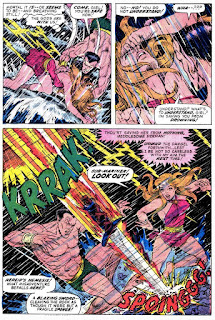
To be sure, the tale, like a lot of Golden Age
stories, depends rather heavily on coincidence. In the midst of a stormy sea,
Sub-Mariner beholds a “rocky pinnacle” rise from the ocean, complete with an
Andromeda-like maiden atop it, waiting for rescue. The rescue is interrupted by
a blazing sword from the heavens, which the reader—though not Namor—soon learns
was thrown by none other than Ares, the God of War. Namor has more pressing
problems. The rock-pillar starts sinking, and as he prepares to carry the
unidentified woman to shore, she suddenly morphs into a different woman.
Nevertheless, Namor takes her to safety ashore, and the woman, who calls
herself “Vicky Starr,” takes her leave without so much as a thank-you.

The scene shifts to Namor’s then-current
support-cast. One of them is Mrs. Prentice, who, in her youth during the 1940s,
was Namor’s sometimes lover Betty Dean. The other is Namorita, the daughter of
Namor’s cousin. In this story Namorita has become obsessed with campaigning against continued
American involvement in Vietnam. In contrast, Mrs. Prentice represented the Older Generation
that tends to trust in the government’s wisdom. During their exchange it comes
out that Namorita’s teacher at college is one “Vicky Starr,” who is also an
anti-war demonstrator. However, the morning paper alerts Namor’s cousin that
Miss Starr’s car was wrecked near the ocean, so Namorita calls upon Namor to
search for the missing teacher.
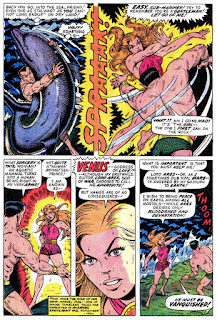
Namor, puzzled that the very woman he rescued has
gone missing, searches the area. A mysterious dolphin shows up and encourages
the Sub-Mariner to give chase. They end up at a “massive island” that has
apparently appeared from nowhere, and the dolphin reveals itself to be the
first woman Namor saw on the pillar. She reveals that she is Venus, Goddess of
Love, and that the island was conjured into being by her eternal opponent, the
God of War. Venus shows the Sub-Mariner how armed conflict has erupted upon the
new island, and, though the island’s inhabitants are never seen, Venus asserts
that if the island-war continues, “the pestilence of warfare will spread to all
nations.” Venus wants Namor’s help in
defeating Ares, though she never troubles to explain why she didn’t identify
herself to Namor the first time they met. Perhaps it would be charitable to
assume that she waited until Ares launched his scheme, the better to overcome
any doubts the sea-monarch might have.
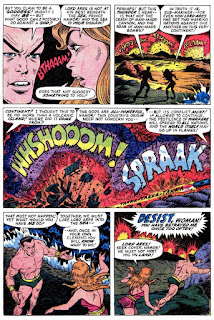
Ares shows up, and chases down Venus. He removes the girdle about her waist, which object gives Venus the power to
encorcel others with love-spells. (Why she doesn't use the girdle on Ares the first time she sees him goes unexplained, except that it would have shortened the story a lot and left the main hero with nothing to do.) The Sub-Mariner joins the fight, and though
Ares is said not to be at home in the sea, he gives Namor a pretty good battle
by shifting his shape into various sea-creatures, more like the Greek Proteus
than like the Hellenic war-god. Ares battles Namor to a standstill, but the key
to Ares’ defeat proves to be the recovery of the love-girdle. Once Ares is
exposed to its rays, he loses his resolve for battle, and obeys the goddess’s
command to end the conflict on the island. In fact, the whole island disappears,
and Venus once more morphs back into the identity of schoolteacher Vicky Starr.
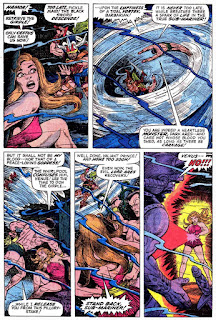
The final page, in which the name on Vicky's door is the same she used in her 1940s series, should probably be taken as a shout-out to the earlier series, rather than an attempt to launch the franchise again. As it happens, Everett died in February 1973, a.month after issue #57's January cover-date. Of course. the comic book probably appeared on newsstands two or three months earlier, and Everett had completed or semi-completed scripts and/or art that continued to appear in the title for a few months following his demise.

Now, the mere fact that Everett’s story conjures
with archaic myth-figures does not make it “mythic” in my definition. The
artist was probably aware of the story in which Ares and Aphrodite are
shown as lovers, though he quite sensibly leaves out inconvenient details, like
Aphrodite’s canonical marriage to Hephaestus, god of the forge. As William
Moulton Marston did before him, Everett uses the war-god and the love-goddess
to delineate opposing tendencies in the human soul. The Golden Age SUB-MARINER
stories don’t delve into the depths that WONDER WOMAN did, but it should be
noted that even though Sub-Mariner was a character formed in the crucible of
war, one can find instances in which the character, or his author, comments
upon the ultimiate foolishness of martial pursuits. HUMAN TORCH #5, in which Namor becomes puffed-up with
false glory and strives to conquer the globe, is probably the best example. In
the Golden Age, there was no necessity to concoct an “island of war,” since war
had already spread to almost every corner of the globe. Still, within the
context of the 1970s, the martial island serves to concretize the fears that
another World War might come into being, if humanity fails to “give peace a
chance.”
A few other touches add to the story’s mythic
density. I'm guessing that the 1948 Venus didn't have a love-inspiring
girdle, but regardless of the item's provenance, it’s a patent vaginal symbol, and its victory over Ares’ very
prominent sword may be seen as a renunciation of male bellicosity. I’ll also
point out that although Namor was always rather bellicose in his own way, he,
unlike a lot of Golden Age heroes, was frequently surrounded by female
characters who often (though not always) sought to ameliorate his ferocity.
The allusions to the continuing conflict in Vietnam could have dated the story,
but Everett strikes the right touch of outrage in Namorita’s desire to see the
madness end. There’s even a loose
imputation that American democracy is as vulnerable as any tyranny to letting
war get out of control, for while Mrs. Prentice places her faith in the democratic way, Namorita puts her faith in her cousin, the monarch of a sub-sea kingdom. “I never noticed anything very ‘democratic’ about Namor,’ fumes the young
mer-girl. It wouldn’t be hard to
see this story as Everett’s belated take on Marston’s love-war formula, in
which women of good conscience ought to be making the decisions, and strong men
are at their best when they serve as champions of peace.