Featured Post

SIX KEYS TO A LITERARY GENETIC CODE

In essays on the subject of centricity, I've most often used the image of a geometrical circle, which, as I explained here,  owes someth...

Showing posts with label supergirl. Show all posts

Tuesday, October 1, 2024

NEAR-MYTHS: DARK KNIGHTS OF STEEL (2021-2022)


I've not reviewed many of DC's "Elseworlds" projects-- which is what DARK KNIGHTS OF STEEL is, even though it does not use that tag-- because they tend to be no more than gaming-scenarios, where the creators move various characters into new positions for nothing but novelty's sake. An example of such an aesthetically nugatory work is 2015's DOOM THAT CAME TO GOTHAM. An awful lot of STEEL consists of just the usual aimless moving of franchise chess-pieces around for little effect, so in one sense there's not much that's special about this effort by writer Tom Taylor and artist Yasmine Putri (assisted by various artists drawing in her style).


The basic concept: Krypton still explodes, but this time Jor-El and his still pregnant wife Lara escape their doomed world and migrate to a "high-fantasy" version of DC-Earth. By "high fantasy" in this context, I mean that there's no necessary connection with anything in real-world history or with anything in regular DC-Earth, which theoretically is "our" Earth with superheroes and magical critters. The STEEL world is made up of assorted faux-medieval kingdoms inhabited by rough facsimiles of DC characters, and although magic is a regular presence, science is just barely getting started. 


Through assorted contrivances Jor-El and Lara ascend to the monarchy of one land after the deaths of the previous rulers, Thomas and Martha Wayne. In addition to Lara birthing Kal-El, she also births "Zala Jor-El," a.k.a. Supergirl, who seems to have been partly named for her "real" DC-Universe father "Zor-El." And then there's Bruce, who goes around in a Bat-helmet and is one of the few double-identity characters called by his superhero name. He's called a "bastard" in the genealogical sense, for reasons not revealed until halfway through the story, and the relationship of teenaged Bruce and teenaged Kal-El was the one or two elements that kept me curious about how the story would turn out.


The other thirty and forty characters are all spawned on the high-fantasy Earth and range from close approximations to the originals (John Constantine, "court jester" Harley Quinn, Princess Diana, Jefferson Pierce) to '"in-name only" congeners (The Metal Men, a bunch of knights who use the names of metals). We get two lesbian relationships, one more or less canonical (Harley and Poison Ivy) and one out of the blue (Diana and Zala), but they don't consume a lot of space. John Constantine gets the second longest arc, as he's responsible for a doomsday prophecy that seems to condemn the El Family. The prophecy appears to come true in such a way that three major kingdoms go to war, but Constantine eventually discovers that the menace behind the conflict is tied to a different flavor of DC-alien. I confess Taylor surprised me with his subterfuge here.

I said that the witty, lively relationship between Kal-El and Bruce was one of the things I esteemed about STEEL. The other is Putri's art. In a period when an awful lot of comic-book art is banal and ugly, Putri's designs possess a grandiose quality that reminds me of the strong fantasy-work of stellar figures like Richard Corben and Craig Russell, just to name two. Even when Taylor's just giving readers a jejune rehash of "How Oliver Met Dinah," Putri's art has an elevating quality foreign to most 21st-century comics art. I can see myself coming back to enjoy STEEL years from now, just to see how Putri gave the various DC heroes a "Brothers Hildebrandt" treatment.

Friday, January 8, 2021

MYTHCOMICS: “EYES OF THE SERPENT” (SUPERMAN FAMILY #174, 1975-76)


In one reminiscence Roy Thomas recalled that his one-time DC editor Mort Weisinger was the first person he Thomas heard use the term “mythology” for a corpus of comic-book stories, in particular the “Superman Family” titles over which Weisinger held sway for the entirety of the Silver Age. I would guess that this was just a convenient tag for the editor, that he probably cared little or not at all about what comprised a genuine archaic mythology, or what status if any modern-day stories might have as “myths.” Still, in the late 1950s Weisinger made some concerted effort to have his writers utilize far more fantasy/SF tropes in the Super-books than had previously been the norm. Not all such metaphenomenal tropes are automatically mythic in nature. Yet as it happened, many writers in Weisinger’s stable—Otto Binder, Leo Dorfman and of course Jerry Siegel—did manage to use these tropes to tell a handful of stories with a high level of mythic concrescence.


However, Weisinger was edged out of DC just in time for the debut of the Bronze Age in 1970, and the Super-books were parceled out to assorted editors. Julie Schwartz took custody of the two titles starring the Big Blue Cheese, SUPERMAN and ACTION COMICS. But though Schwartz’s Silver Age writers had also produced a respectable number of myth-stories, in the Bronze Age the editor favored in large part two writers given to penning very gimmicky, superficial tales: Cary Bates and Elliot Maggin. When three of the ancillary Super-features—SUPERGIRL, JIMMY OLSEN and LOIS LANE—failed to sell well, DC cancelled the individual titles and transferred their features to a portmanteau book, THE SUPERMAN FAMILY. As it happens, it was in this title that editor Schwartz and writer Maggin produced one of the few stories that can stand alongside the best myth-outings of Siegel, Binder and Dorfman.


The first page of Kurt Schaffenberger’s art for “Eyes of the Serpent” is a splash-page portraying a scene that does not literally occur in the story: Supergirl flying into combat against a giant winged dragon, while on the dragon’s back rides a green-scaled humanoid. The humanoid looks a bit like a frog-man, but Maggin’s caption makes clear that this fellow so viridian is also ophidian: “At the dawn of time, it was the acid tongue of a serpent that brought evil into the world—a serpent much like the one that now challenges Supergirl!” In this introductory sentence, Maggin establishes that in this world, he validates as real the story of the Garden of Eden, including Eve’s temptation by a serpent later identified with Satan. However, the story Maggin tells is about a serpent who is only “much like” the Biblical tempter, the better to avoid any accusations of mixing serious religious figures with the “let’s pretend” of a comic book.

As the story proper begins, the same serpent-man from the splash, Lord Beriak, stands in an indeterminate location (full of rocks and smoky vapors) along with other serpent-men, who give Beriak his assignment. He must journey from wherever the serpent-people make their home to a college in Florida, where the Kryptonian heroine works as a guidance counselor in her Linda Danvers identity. Beriak's purpose is that of “reasserting our dominance over the human race.” (Some influence from Robert E. Howard’s “serpent-men” stories seems likely, given that the snake-people are never identified as either aliens or supernatural demons.)


Once Beriak arrives in the fictitious Florida town of New Athens—where, for once, the locale plays a role in a Super-story—he takes on the appearance of a good-looking human male and contrives to meet Linda Danvers. Linda/Supergirl is somewhat attracted to the false flesh of Beriak, but she doesn’t immediately agree to date him. Since Beriak’s as-yet-unrevealed master plan requires him to gain mental dominance over Supergirl, he decides that she may become more pliable if he wears her down a little. To that end he summons a dragon from the vasty deep of the neighboring ocean and makes it run amuck in New Athens, so that the heroine will appear and bring the beast to heel. (Though dragons have some status in Bible lore, this critter is just another of DC’s countless convenient prehistoric survivals.)


While all this is going on, a mysterious young fellow named “Davy” appears at the college, and he like the serpent-man shows some ability with exerting persuasive mojo. The Davy character, created by Maggin for a three-part Green Arrow story in ACTION COMICS, is given no precise origin, but he’s clearly meant to be identified with the youthful David of the Bible, since Davy carries a lyre on which he can play enchanting music, and a sling with which he can cast stones, like the one David used to defeat Goliath. Maggin does not ever say that Davy is identical with Bible-David, who after all aged, sinned and died in the course of his narrative. But since the House of David was associated (in a roundabout way) with the lineage of Jesus of Nazareth, Davy is as associated with the powers of Heaven as the serpent-men are with the Devil.


In addition, in what may be the shortest foreshadowing in a comic book, an orange-picker falls unconscious after eating an orange in a local grove. The man is never seen again, though by customary expectations the reader would assume he’s okay once the threat of the serpent-men has been vanquished.


The disguised Beriak once more encounters Linda Danvers after her heroic other-self has driven off the winged dragon. This time, he places her under his mental thrall, at least enough that she accepts a date with him. As Beriak leads his victim to the slaughter, Davy follows along, sometimes playing the music on his lyre, though for reasons undisclosed the serpent-man can’t hear it. (Perhaps Maggin believed the legend that snakes can’t hear or thought that his audience would believe as much.)


Beriak takes his date to an orange orchard—possibly the same one where the unnamed man collapsed—and ramps up the Eden-references by getting Linda to eat one of the tree’s “forbidden fruits.” Whjen Linda eats the orange, it apparently puts her under Beriak’s total control. Beriak then reveals his scaly other self and makes the Girl of Steel perform a few super-feats for his amusement. Then he finally reveals his master plan. Beneath one of the orange-trees in the orchard—presumably the one from which Linda ate, just to keep up the parallel with the Biblical Tree of Knowledge—lies a “golden stone” called the Eden Rock. Once Beriak compels Supergirl to surrender her life-energy to the stone, this maneuver will give the serpent-race total dominion over humanity and all of its superheroic defenders.


However, Supergirl has been shamming: she caught on to his imposture early on. The two super-beings fight, and though Beriak gets the upper hand once, Davy is on hand to distract him with a handily-hurled sling-stone. Beriak finally recognizes Davy as an old foe of his Satanic species, and Davy uses his magic to keep Beriak restrained while Supergirl tunnels beneath the earth and destroys the Eden Rock, so that no one can use it again. Then, as the enemies square off again, Beriak’s fellow serpents, who are watching from afar, decide to call back their agent, commenting that he was stymied by “our old nemesis, the immortal singer David.” Supergirl and Davy converse briefly and the story ends with a minor coda at Linda’s workplace.


It would appear that the serial’s Florida setting was the only reason for Maggin to substitute an orange for the forbidden food, though to be sure some scholars don’t believe the Biblical fruit was an apple, either. Maggin doesn’t say why this particular delicacy is forbidden, or who forbade it, or why eating it doesn’t really affect Supergirl at all. Presumably the only parallel is an inverted one: unlike Eve, Supergirl resists the blandishments of the serpent, and so preserves her world in contrast to Eve losing Eden for herself and Adam.


As noted, since the Biblical David was not “immortal” like Davy, there can only be a symbolic connection between the two. Davy is what Carl Jung might have called a “puer eternus,” an eternal child—which is, to an extent, an archetype to which Youthful David subscribes as well. Bible-David has no connection with the mythology of Eden except in the sense that David provides a link between Adam and Jesus of Nazareth. In a larger sense, of course, the expulsion of the first Man and Woman from Eden leads to Christ’s sacrifice to redeem humanity, so the Fall foreshadows the Redemption, and the general defeat of Satanic evil. In addition, in Maggin’s scenario Davy is meant to be something of a destined warrior like David: able to overcome evildoers who seem far more powerful than he.


There is nothing paralleling the Eden Rock in Genesis. However, there are a few foundation-stones in the Bible and in later Judeo-Christian commentary. In the Zohar, God is said to have unleashed the flood—the instrument by which the Divinity eradicates almost all the sinning spawn of Adam and Eve—by moving a foundation-stone called the Eben Shetiyah. There is no firm evidence in the story that Maggin knew of this trope. But given that he was already juggling the myths of Eden, it’s not improbable to think he might work in one from the Flood-Myth, even if he does turn it into a standard comic-book gimmick, “the thing that makes all humanity bow down.”


Lastly and leastly, Beriak’s name doesn’t seem to have any strong forbears, Biblical or otherwise. There is a Canaanite deity named Berith or Baal-Berith, who later becomes a Christian demon, but in this case it’s just as possible that “Beriak” took no influence from this figure, that the serpent-man just has a nonsense-name. It’s of passing interest that “Berith” means “covenant,” which reference could take us back to Flood-mythology—but that’s not a holy hill on which I’d choose to make my stand.

Thursday, October 11, 2018

MYTHCOMICS: "THE PLANET OF OUTCASTS" (ACTION COMICS #322-3, 1965)

I've chosen to designate this two-part story by the title of the tale's first part, the other being the less evocative "The Kryptonian Killer." It's a story that probably even a lot of Silver Age enthusiasts barely remember, but it rises to a level of strong mythicity by describing an "ethic of evil" not unlike the one seen in the 1947 JUSTICE SOCIETY adventure "The Injustice Society of the World." Whereas the evildoers in the JSA story were cobbled together from other DC Comics features, "Outcasts" presents the reader with a world full of criminals, the Sisterhood of Evil (no relation to the DOOM PATROL's Brotherhood of Evil).

From this setup, one might expect something along one of the many Amazonian societies seen in popular culture. But the Sisterhood of Evil is the only one I've come across in which the female society is not formed with motives of resentment against the male gender. Oddly, this peculiarity may have come about because the story's author, Leo Dorfman, was following a narrative pattern established by the introduction of one of DC's most famous co-ed hero-groups, the Legion of Super-Heroes.

As all well-informed comics-fans know, the Legion first appeared in the SUPERBOY feature, one of the many "Superman Family" franchises under the editorial aegis of Mort Weisinger. The 1958 story, written by Otto Binder, focuses on three costumed figures, all of whom belong to a club of teen heroes in Earth's 30th century, who travel back to Superboy's time to invite him to join their organization. The story seems to have been a toss-off rather than an attempt to create a new franchise, but fans of the time wrote DC, demanding more Legion-adventures.

Writers under Weisinger's aegis were encouraged to recycle story-motifs frequently, partly in response to the editor's belief that the youthful comics-readership shifted every five years, as the kids got too old for funny-books. Thus it should be no great surprise that two years later, a Supergirl story, written by Jerry Siegel, reproduced the essence of the Binder story, only with the "Maid of Steel" in the role of club-applicant. One year later, Siegel wrote another Supergirl-Legion story, but instead of the heroine meeting the same three heroes she had before, she met three super-powered heroines like herself. (Technically, she'd met Saturn Girl before, but this was the first appearance for new Legion-members Phantom Girl and Triplicate Girl.) The story, titled "Supergirl's Three Super-Girlfriends," starts off implying that the future-teens are going to become Supergirl's new BFFs, though this idea gets quickly dropped as the heroine meets a new potential boyfriend, Brainiac 5.


I suggest that Leo Dorfman, given that he was as obliged as any other writer to recycle established motifs, was at least aware of the Legion stories. The opening of "Outcasts" starts out much like "Super-Girlfriends." Three costumed women-- each demonstrating a super-power, and each with a Legion-like code-name-- seek out Supergirl. But instead of representing a "foreign legion" of the future, the three super-women claim to come from the planet Feminax, "peopled only by girls, each of whom has one super-power." Supergirl never troubles to ask how this state of affairs came about, possibly because she's flattered to be invited to the planet's "first Supergirl festival."

However, the only thing the Feminaxians want to celebrate is Supergirl's capture. They resemble the Legion only in that the "thousands" of inhabitants have all come from disparate planets throughout the cosmos. However, they're all villains who have become "outcasts" because of their crimes. None of them have super-powers, and the three ladies who invited Supergirl-- whose real names are Ran-Kor, Tempra, and Lattora-- merely used trickery to fake their supposed abilities.. Ravenne, the perpetually veiled queen of Feminax, invited all the female super-crooks to her world to join a society "pledged to spread crime and wrong-doing throughout the universe." Ravenne also has recourse to technology able to distort the heroine's Kryptonian powers, so that she cannot escape Feminax or fight its criminal inhabitants.


The Sisterhood of Evil doesn't just want to humiliate Supergirl, though; they want to use her in their campaign to spread evil. Ran-Kor-- the only Feminaxian whose name suggests her malign nature-- gives Supergirl a story about how Ran-Kor wants to "quit the Sisterhood," and to that end will help the heroine escape. Supergirl just happens to be imprisoned in a building holding three comatorse super-heroines, whom Supergirl still may be able to revive.


It's a trick, of course. And as if to testify to the superior evil of Earth-women, the supposed super-heroines are actually three famous villainesses from Earth-history, whom Ravenne has plucked from their proper time-frames in order to serve the society of Feminax: Mata Hari, Lady Macbeth, and Lucretia Borgia. (I surmise Dorfman was less concerned with history here than the reader's ease of recognition.)


However, Ravenne, having used Supergirl to resurrect three female fiends, does so only with the aim of causing the trio to "infect" the Maid of Steel with their evil.


Supergirl is entirely dominated by Ravenne's hypnotic control, to the extent that she makes a Kryptonite cocktail with the skills of Lucretia Borgia. Ravenne's main target is Superman himself, but first the arch-villain has the heroine test the potion on two other subjects: Comet the Super-Horse and a villain from the Phantom Zone, name of Py-Ron. Both subjects appear to die horribly. and Ravenne gives the go-ahead for Supergirl to administer the poison to her cousin, and then, to herself.


Ravenne and her fellow conspirators celebrate the demise of the superheroes, though the three historical villains don't get to share the joy, since Ravenne hurls them back to their own eras, complete with mind-wipes. However, the celebration is premature. Dorfman's ace in the hole, his own creation Comet, wasn't slain by the poison, and he uses his telepathic powers to suss out what was going on. He alters the effects of the poison, so that Superman, Supergirl and Py-Ron all survive. Then Feminax pays the ultimate price for almost killing a fellow villain, While the heroes debate their next action, the villain with a fiery name-- who now possesses a Kryptonian's super-powers-- flies over the planet and creates a deluge that wipes out the thousands of nasty ladies. The story ends with a reaffirmation of goodness, as Supergirl says, "Let wrong-doers remember that evil is repaid by evil."


For a story that excoriates criminality, though, "Outcasts" lets evil come awfully close to winning. Maybe that's the main reason that the female villains are not seen as having turned evil due to male mistreatment, because that might have inculcated reader-sympathy. Rather, the Feminaxians live their lives by the motto of Milton's Satan-- "Evil, be thou my good"-- which justifies Dorfman's mass execution of the whole group (one lady-crook's deed is explicitly compared by Supergirl to the assassination of President Kennedy).

There are some myth-motifs that get lost in the wash. Toward the end, Ravenne reveals that she's an old hag beneath her veil, but Dorfman didn't give readers any reason to think she was some stunning young beauty.

More interesting is that as soon as the first trio of evil women fades from importance in the story, another threesome takes its place. I've stated that Dorfman probably started out with three super-girls because of earlier stories in the same vein. But there's no particular reason that there have to be three female villains from the past, and indeed, both Mata Hari and Lady Macbeth are not as fundamental to the story as is Lucretia Borgia.

Neopaganism asserts the existence of a "Triple Goddess" with three phases of "Maiden, Mother, and Crone." Dorfman isn't specifically invoking this trope, but he does have a "Maid of Steel" and a "Crone," at least. No one in the story is the mother to anyone else, though Mata Hari's reputation, unlike that of Supergirl, suggests some level of worldly experience. This, like the secret of Ravenne, would seem to be a motif that Dorfman tossed in without development.

Finally, it's interesting that Dorfman brought in Comet as Supergirl's savior. He is, as I noted here, a quasi-sexual figure for Supergirl even before she finds out that he's a sentient centaur. By herself Supergirl is not able to resist the power of Feminine Evil, but with the help of what Jung would call her *animus* figure, she enjoys the final victory. It is also amusing that, when she believes herself dying at Superman's side, Dorfman tosses in an amusing line that seems calculated to bring back memories of the death-scene in ROMEO AND JULIET:

"I'll lie down by Superman's side. Some day they'll find us here-- The world will know how we died together!"

Wednesday, October 10, 2018

NEAR MYTHS: "THE SUPER STEED OF STEEL" (ACTION COMICS #292, 1962)

This week's mythcomic will be a Silver Age Supergirl story in which the heroine's ass gets saved by supporting character Comet the Super-Horse. So I decided that before printing that one, I would touch on this quirky, unique 1960s character.

During the period when Mort Weisinger edited the "Superman Family" titles, no writer had any exclusive hold on the characters they created for DC Comics. Still, Leo Dorfman wrote all or most of the stories in which "Super-Horse" is involved with the main action, rather than being a supporting figure. From the beginning, Dorfman seems to have had a rough arc regarding where he wanted the Super-Horse stories to go, even if there was not really a proper conclusion to Comet's story. Dorfman probably never planned an end as such-- I feel sure Comet was mainly a story-device to keep food on the table, and when tastes moved away from the Weisinger-type story in the 1970s, the ultra-equine effectively went into comic-book limbo.


The opening image of the first Super-Horse story shows Supergirl happily astride her Super-Horse as they flee kryptonite rays from alien ships. In the story proper, this occurs only in one of the heroine's dreams, though the real event takes place one issue later.

First, however, Linda "Supergirl" Danvers suddenly gets horse-crazy while watching a western movie. Notice that though she's in high school at this time, she's supposedly more interested in the horse than in the cowboy.


Anna Freud, writing in 1926, carried on Big Sigmund's tradition by claiming that young girls liked horses due to "penis envy." There's no telling what Freudianisms were known to Leo Dorfman, but at the least I suspect he knew that juvenile books about horses-- BLACK BEAUTY, NATIONAL VELVET-- had proved enormously popular with young girls. He seems to have concluded that there was something erotic at the base of it, to judge from Linda's bedtime thoughts about getting "goose flesh" at the idea of sharing adventures with her own horse.

In the space of the story, Supergirl has three dreams about a super-horse helping her in some way. She names him Comet because he has a comet-like birthmark, though as a story-motif the birthmark won't become important until a few issues later. Then Supergirl encounters an identical horse at a real-life dude ranch, and the first story ends on an enigmatic note.


In the next story, Supergirl finds out that Comet is not just a horse, but a telepath, who proceeds to relate his origin via a mental voice. His lineage goes back to ancient Greece, when he was a centaur named Biron. (This seems to be a reference to one of the most famous centaurs in Greek mythology, Chiron.)


It's later revealed that Maldor, the sorcerer who tried to poison Circe, caused Biron to drink the wrong potion. Circe tries to make up for the blunder by using a magic potion that turns Biron the ordinary horse into a super-being. But Maldor has another scheme, using his magic to cause the super-horse to become imprisoned on an asteroid in (appropriately) the constellation Sagittarius. Biron languishes on the desolate asteroid for centuries, until 1959, when a rocket from Argo City happens by with its precious cargo.


Thus Biron becomes fascinated with the teenager aboard the rocket, and follows it to Earth. It's not clear why Biron waits a few years to contact the heroine, but he tells Supergirl that he read the minds of the alien scouts that were preparing for invasion. It's not clear why that would prompt Biron to invade Supergirl's dreams and construct an exact replica of what was going to happen when she attacked the aliens and the newly christened Comet came to her rescue. In this same issue, the aliens invade for real and things play out in reality just as they did in the dream, suggesting that Dorfman's Super-Horse had a little clairvoyance going for him, when it was convenient for the writer.


The rest of the Dorfman stories featuring the relationship of the heroine and her horse focus on the "romance with a secret identity" that had been DC's bread-and-butter since the debut of Superman. A couple of times Comet is temporarily transformed into a human being, in keeping with the original boon he wanted from Circe, and in one story, the transformation happens in werewolf-fashion, whenever a comet passes in the heavens. Because of this development, I hazard that Dorfman had always planned to have his super-equine transform in this fashion, but had to work his way up to that point. Otherwise, there doesn't seem to be any particular reason for the writer to presage the transformation with the comet-birthmark.

Whenever Comet does get the chance to become human, however temporarily, he immediately finds some reason to get into a lip-lock with Supergirl and/or Linda. I don't find this as transgressive as many comics-fans do, because he really isn't a horse, but a liminal being between human and horse.


However, I'll admit it's more than a little peculiar when Supergirl becomes jealous of Comet's attentions to another female. Granted, by this time she knows that he's not a real horse, but a transformed centaur. Yet in all the stories post-dating the big revelation, she doesn't really think of Comet as "a guy." So maybe what she's really jealous about is that another woman is getting the jollies that Supergirl usually gets.


As to the origin of those jollies, deponent saith not, except to observe that at no point in his career do you see cousin Superman fantasizing about riding a horse, regardless of gender.

ADDENDUM: I noted above that at fifteen, Linda/Supergirl seems a little old to form a crush on a horse rather than on a boy. However, I should also note that no one would have thought that the girl-readers of the feature would be that old, and THEY might indeed be of an age to have horse-crushes-- not that it's automatic with every young XX, but middle-school seems to be a little more likely for the crush to form.

Thursday, March 2, 2017

MYTHCOMICS: "LOIS LANE'S SUPER-DAUGHTER" (LOIS LANE #20, 1960)


This story was actually the second in a series of two imaginary "what if Lois married Superman" stories, which ran back to back in issues 19 and 20 of the LOIS LANE magazine. I presume from this that editor Mort Weisinger accepted an initial pitch for both stories, instead of choosing-- as he sometimes did-- to wait awhile to gauge audience interest. There may have been a sequel or two that followed, but these two were produced so as to be read back-to-back.

The first story from #19, "Mr. and Mrs. Clark (Superman) Kent," however, is not as symbolically resonant as the second one from #20, though both stories were written by Jerry Siegel and drawn by Kurt Schaffenberger. "Mr. and Mrs" is not much more than a "beware what you wish for" homily. Superman marries Lois Lane, thus supposedly fulfilling the dream she's cherished since she first met him (at least in Weisinger's universe), finds out her dream isn't all it's cracked up to be, for in public she's simply the wife of the hero's alter ego Clark Kent. The fact that he's Superman is of course kept secret from the populace, so that no one-- especially Lois' longtime rival Lana Lang-- knows that the superhero is off the romantic market. It's a pleasant enough story, but "Lois Lane's Super-Daughter" strikes a deeper chord.

About three years after this story appeared on newstands, Betty Friedan's THE FEMININE MYSTIQUE was published. Building on material the author had gathered during the late 1950s, Friedan sought to make clear that modern American women had become desperately, symtomatically unahppy due to the imposition of a "mystique" upon their lives; one that kept them from fulfilling themselves as rounded human beings. MYSTIQUE was a major influence upon Second-Wave feninism from that time on. But Jerry Siegel's "Super-Daughter" presciently taps into some of the same discontents, though obviously it does so within a juvenile context, and within the context of a continuing superhero melodrama.

A few fans of Silver Age Superman have wondered why, after Superman's cousin Supergirl appeared on Earth in 1958, he didn't "man up" and adopt her in his identity of Clark Kent. I don't think the question was formally addressed in the actual continuity, and I'm sure that the proximate reason the character did not do so was that his editor and writers didn't want him playing Adoptive Daddy in every story. But there was still a kernel of logic in Clark's reticence, for during this time-period social services personnel generally took a dim view of single men or women adopting children of any age. Given this state of affairs, having the teenaged Kryptonian placed in an orphanage to seek adoption by a bonafide married couple-- which eventually does transpire-- doesn't strain my credulity.

What's interesting from the story's beginning is that the moment Clark and Lois are married, Clark springs it upon her that he'd like them to adopt this teenaged cousin that he's never mentioned before.


Lois looks a little bit poleaxed by this revelation, but she's married "for better or worse," and when the adoption agency complains that she might not be able to handle a new child and a job, Lois does what anyone in the period would deem The Right Thing.


Keep in mind that this Lois is not the fire-eater from the Golden Age. Though it would be absurd to assert that the Lois character was thoroughly consistent, since her moods could fluctuate according to the needs of a given story, it is at least part of Weisinger's conception of Lois that she has an irreducible domestic side to her personality. Mort Weisinger may well have been the sort of man whom Betty Friedan criticized for wanting women to become wholly domestic once they became wives. Nevertheless, for the time, the demands of the adoption agency seems not unusual, and the strength of Siegel's story is that one does see certain disadvantages to the world of domestic bliss.

True, there's almost no trace of mother-daughter bonding in the story, except for minor scenes like this one:


But it probably would have been a little beyond Siegel's skill-set to be THAT attuned to the ways of modern women, and besides, the main thrust of the story is all about Lois's discomfort with this perky intruder who's been thrust into her domestic world before the former lady reporter has even had a chance to get used to her new husband. The problem is only aggravated by the fact that both Lois' husband and her de facto daughter belong to a world of super-powered endeavors to which Lois cannot aspire. Here's one of the tandem "super-feats" to which Supergirl alludes on the cover of #20:


Worse by far, though, is that Supergirl's powers make Lois's function in the household irrelevant.


There's an exquisite irony in this setup that I wonder if Betty Friedan could have appreciated, even without the fantasy-content. Lois sacrifices the "exciting life" she enjoyed as a girl reporter, but her reward is to be marginalized within the household that is supposedly her domain. Yet through it all, Lois masks her pain, a veritable Stella Dallas of the comic books, an icon of maternal martrydom. Yet, where Olive Prouty's character accepts her marginalization, Siegel's Lois manages to manifest her hidden hostility in one of the most roundabout ways ever conceived, even in a Mort Weisinger comic book.


Yes, that's right: not only does Lois "just happen" to whale on the backside of a robot who looks just like Supergirl in her secret ID, a snoopy women from the adoption agency literally invades Lois's private home just in time to catch Lois in the act of unleashing her fury at the (first) unwanted intruder. I particularly enjoy how tearful Lois is in the story's final panel, perhaps revealing just a touch of the schadenfreude she may be experiencing from Supergirl's "unhappy ending." Will Lois ever make things up to Superman? Well, maybe or maybe not, but either way, she won't have a fifth wheel getting in the way.

I should note that though a fair number of stories from this time-period contain hints at some sexual stirrings between the two super-cousins-- particularly "Superman's Super-Courtship"-- "Super-Daughter" actually works just as well without any such elements of sexual transgression as it would with it. I could see the story entering new terrain if it were ALSO about a nubile young adoptive daughter nudging out an older wife from the affections of the adoptive father. But mythically speaking, the story works quite as well as a melodramatic-- as well as comical-- look at the marital disadvantages of a former working woman in the era of the Comic-Book Silver Age.

Friday, August 14, 2015

MEETINGS WITH RECOGNIZABLE PRESENCES


Oh, East is East and West is West, and never the twain shall meet,
Till Earth and Sky stand presently at God's great Judgment Seat;
But there is neither East nor West, Border, nor Breed, nor Birth,
When two strong men stand face to face, though they come from the ends of the earth!

What Kipling describes in this quatrain is a sentiment akin to Francis Fukuyama's concept of recognition, as he extrapolated it from both Hegel and Hegel-commentator Kojeve. Kipling describes what Fukuyama might term a variety of *megalothymia,* in that it describes "two strong men" taking one another's measure. The quatrain is part of a longer poem, but by itself the final phrase does not specify whether or not the strong men standing "face to face" are allies or opponents. As I view the lines, the recognition of a commonality that derives from similar levels of strength is not dependent on whether the two strong men are allies or enemies. Further, this sort of recognition would be opposed in spirit to that of Fukuyama's countervailing tendency, *isothymia,* for this mode of consciousness specifies that all human beings share the same innate rights, regardless of their strength.

As I peruse the handful of "1001 myth" entries I've done since restarting the series in July, I see a common thread evolving, though I didn't consciously plan it. All of the entries for which I've recently claimed mythic status posit an opposition between two strong presences. In contrast to Kipling's wording, these presences are just as capable of being female as being male, and in keeping with my writings on focal presences, such presences would not even necessarily need to be human, or even sentient. In contrast, the opposing "null-myths" usually fail to exploit the nature of the conflict. I esteemed as mythic the final three issues of Dave Sim's CEREBUS in part because the author provided the protagonist with an opponent-- his own son Sheshep-- who symbolized all of Sim's animadversions to pagan culture, feminism, and (apparently) any sort of hybridization process. But I viewed the preceding CEREBUS sequence "Chasing YHWH" as "null-mythic" because it was no more than a barely-coherent diatribe against celebrity figures ranging from Carl Jung to Woody Allen (who in Sim's universe somehow became a Jungian, even though little if anything in the real Allen's ouevre reflects a Jungian outlook).

Now, at the end of my essay on Ditko's mythcomic "The Destroyer of Heroes," I quoted myself from the ETHIC OF THE COMBATIVE essay-series:

The shaman deriving power from his numinous presences, the warrior gaining supernatural presents or guidance from his patron god, the bondsman studying the ways of the mortal lord in order to overthrow him-- all of these participate in the ethical dimensions of the combative mode.  Thus "might" exists to continually challenge others to partake of its nature...This potency, to challenge one's own will to greater acts of agency, is the essence of the ethic that springs from the combative mode.

Having raised the topic of the combative ethic, I want to make clear that the trope of an author opposing "two strong presences" against one another is not solely associated with the actual combative mode. Certainly real combat-myths ranging from "Hercules vs. Antaeus" to "Batman vs. the Joker" derive their narrative tension from a physical, life-and-death struggle between hero and villain. Yet clearly it's possible to evoke the *megalothymia* of two opposed strengths without actually manifesting the combative mode, given that the totality of CEREBUS is a subcombative work.

Most of the other stories recently cited are stories that fit the combative mode without much elaboration: the aforementioned Blue Beetle tale, the Flash-Mister Element story, the FF-Red Ghost story, the Man-Thing/ ghost pirates story, and the Blackhawk "Dragon Dwarves" story. The two exceptions are instructive, though.

I surveyed the first three SPIDER-MAN stories together because they tied together in terms of the psychological myth evoked. The conflict of the first story is a mixed bag, for it's more "man vs. himself" than "man vs. man." By the story's conclusion Spider-Man has met and defeated a common burglar with the greatest of ease, which doesn't make for much of a combative situation, unless one chooses to view the burglar as a symbol for all criminals, as I discussed in a related topic here. The second story is more or less "man vs. nature" in that the hero must save Jonah Jameson's astronaut son from a malfunctioning space capsule, though it sets up an ongoing conflict by making Jonah Jameson a recurring thorn in the superhero's posterior. Only the third and last story surveyed pits Spider-Man against a villain who has his own special strength-- and of course, the Vulture was the first in a line of extremely durable super-villains, each of whom had an individual style and a great capacity for what I've termed "acts of agency,"

The first new entry in the current series, "Superman's Super-Courtship," features two characters who are dominantly combative types, Superman and Supergirl, but the story under consideration is not combative. As I demonstrated in the essay, the story's conflict pertains to Supergirl playing matchmaker for her older cousin, but in such a way as to reinforce her own ego, particularly by finding him a mate who looks like an adult version of herself. The conflict then is a comic one in which Supergirl more or less moves her cousin around like a chess-piece, much like the relationship discussed here between Cosmo Topper and the Kirbys in the 1930s film TOPPER. In the original film Topper's recently deceased buddies use their ghost-powers to force the fuddy-duddy to have fun, whether he likes it or not. Arguably Topper's ghosts do him more good than Supergirl does her cousin.

So here we have three subcombative stories that manage to create a tension between strong presences-- Cerebus and Sheshep, Spider-Man and Jonah Jameson, and Superman and Supergirl-- without actually entering the combative mode. Still, two of the stories appear in series that are meant to be dominantly combative, while the CEREBUS conclusion is a religious irony fashioned in part upon the model of Robert E. Howard's barbarian-fantasy.  So my conclusion here is that even if the combative mode is not strictly necessary to create a symbolic discourse between two or more "strong presences," its narrative pattern may influence even those narratives, like CEREBUS, that eschew the ritual of violence.

Thursday, July 2, 2015

MYTHCOMICS: "SUPERMAN'S SUPER-COURTSHIP" (1962)

For this first entry in my new series of “mythcomics,” I select an example of what I term “clansgression.” Readers of this blog may recall that this formulation takes in not only the phenomenon of literal incest, but all the sociocultural associations that have arrayed themselves around the phenomenon.


The story “Superman’s Super-Courtship” appeared in the June 1962 issue of ACTION COMICS, issue 289, by Siegel and Mooney, and edited by Mort Weisinger. This story was one of many during Weisinger’s tenure in which characters in the “Superman universe” sought to manipulate romantic alliances, either to the benefit of themselves or of some other person. “Courtship” wasn’t even the first time Supergirl attempted to play matchmaker for her older cousin Superman, but the story has garnered a little more Net-attention for its psychological content, as one can see here. The dominant reading for this story has been to focus on one panel seen herein, arguing that it provides what is currently called *squick * via the thirty-something Superman’s profession of lust for his teenaged cousin.


I won’t entirely disavow this interpretation. The story was written, drawn, and edited by men, and Mort Weisinger in particular isn’t known as a great bastion of feminist sensitivity. Nevetheless, “Courtship” is a Supergirl story, ostensibly aimed at juvenile girl readers, so the conscious intent of the story’s raconteurs was to play to the egos of girls, as the raconteurs perceived them. Thus the story might be better titled “Supergirl’s Super-Courtship,” since her decision to play matchmaker for her cousin is one that reinforces her own ego, more than doing anything for Superman.


Supergirl, in her secret ID as Linda Lee, sees a sad romantic film that makes her decide that since the Man of Steel can’t make up his mind about either Lois Lane or Lana Lang, he must need a new inamorata, one chosen by the Girl of Steel. Superman seems curiously compliant as he cooperates with her shenanigans, rather than undermining her efforts to “teach her a lesson;” this might serve as more evidence that the creators’ primary motivation was to validate Supergirl’s ego.


Supergirl tries three times to set up her cousin, and the first two matchmaking sessions are played for comedy. Even though Supergirl thinks to herself that her cousin doesn’t think one can change the past through time-travel—a repeated “rule” in the Superman-universe—the superheroine tries to do just that, after reasoning that her noble cousin deserves the most beautiful woman ever—none other than Helen of Troy. Technically, it’s Helen before she was either stolen by Trojans or married to the Greek king Menelaus; Supergirl arranges to have her cousin show up while dozens of suitors are courting Helen. Not only are no sparks struck from Superman’s meeting with Helen, the Greek princess gets royally pissed off at the super-duo’s intrusion. Helen is particularly miffed that Supergirl’s talents put Helen in the shade—which, psychologically speaking, is where a quasi-mother figure like Helen of Troy belongs.


Supergirl’s second attempt is firmly rooted in the Superman cosmos, drawing upon the superhero-team the Legionnaires, a group of teens dwelling in Earth’s 30th century. Supergirl takes it into her head that one of the superheroines in this group might be a match for Superman—though not as a teen heroine, of course. Supergirl draws her compliant cousin to a party in an era when where some if not all Legionnaires have grown to adulthood. Yet, while Supergirl researches Helen’s social matrix to get the lay of the princess’ land, the Girl of Steel doesn’t bother to find out first whether or not her second choice—Saturn Woman, known as Saturn Girl in her teen incarnation-- is married or not. This incident may have been a shout-out to Legion readers, who would have known that the character of Saturn Girl had a regular beau—to whom she would inevitably be married in adult life, given the expectations of the reading-audience.


When the two Kryptonians return to their own era, it’s then that Supergirl confesses her matchmaking scheme to her cousin. Throughout most of the story the reader isn’t privy to Superman’s thoughts; he’s only defended his intention not to marry as one of being dedicated to his superhero career. At this point he soothes his cousin’s bruised ego by telling her that he would only marry “someone super and lovable like… you!!” The “super” part of the equation refers back to a frequent trope in other stories: that Superman will not marry an un-super woman since she might be killed by his enemies. The “lovable” part of the equation might express some latent sexual feelings on his part. Altternately, it meant mean that he’s figured out that she’s playing Cupid to exorcise her own libidinous demons, and that he’s letting her down easily, with a not entirely germane discussion about how Kryptonian cousins cannot intermarry. In an extrinsic sense, editor Weisinger may have wanted this speech included, if he had received fannish suggestions about seeing the super-cousins married—though this is only speculation.


However, Superman’s attempt to end the conversation spurs Supergirl to new heights: since he’s said he would marry someone like her, she uses his “super computer machine” to find that there exists another superwoman—identical to Supergirl except for being an adult—on the planet Staryl.


Superman again complies with his cousin’s request; he seeks out Staryl and makes the acquaintance of superwoman Luma Lynai. In one of the hero’s very few thought-balloons, he thinks, “Can I find a girl [on Staryl] as wonderful as Supergirl?”—indicating at the very least that he isn’t blind to his cousin’s attractiveness, teenager or not. Sure enough, in the space of one panel Superman meets and woos Luma Lynai (who wears a costume not unlike Supergirl’s, though Luma chooses hot pants rather than a skirt). Superman invites Luma to visit Earth so that they can be wed if she likes it there—a whirlwind courtship, indeed! But Earth’s yellow sun strips Luma of her super-powers, which was the main thing that pulled her ahead in the race against Lois and Lana. As Luma tearfully returns to her own world, Superman seems only mildly disappointed at his loss of possible connubial bliss. For Supergirl’s part, she’s also tearful for having meddled in her cousin’s love-life. At the story’s close, she’s momentarily tempted to try the matchmaker game once more, but ends the story with the firm resolve not to do so. Yet arguably her adventure served its ego-boosting purpose: without indulging in literal incest, Supergirl “makes love” (in the juvenile sense) to her cousin through an adult doppelganger, and shows that, except for that pesky Kryptonian law, she might have been the best match of them all.        

Friday, September 26, 2014

VICTIMOLOGY 101, PT. 2

The book I mentioned in Part 1 of this essay-series is Mike Madrid's 2009 book on superheroines, entitled THE SUPERGIRLS.

In many respects I ought to like this book. The author appears to be a Silver-Age kid like myself. Just as I have devoted a blog to the topic of empowered female characters here, Madrid's introduction depicts the author as having an inveterate interest in comic-book super-heroines, if not for reasons identical to my own.
And unlike the only previous work on the subject-- Trina Robbins' GREAT WOMEN SUPERHEROES, a very detailed history of superheroines in comics, albeit with some major omissions-- THE SUPERGIRLS is an attempt to interpret the depiction of superheroines in cultural terms, as the book's subtitle indicates: "Fashion, Feminism, Fantasy, and the History of Comic Book Heroines." (Despite Madrid putting "fashion" first, possibly to appeal to academics, there's really very little about the specifics of fashion in fantasy or reality.)

Unfortunately, SUPERGIRLS is a prime example of an interpretative work laboring under a cloud of false victimology. I'm sure that Madrid must have in his mind some notion of the perfect superheroine, a figure that provides a "happy medium" between a type who is too wholesome and a type who is too oversexualized. But he does not succeed in depicting such a paradigm in the pages of his book. Thus, all through the pages of SUPERGIRLS, Madrid always seems to be carping at the imperfections of almost all those who have depicted comic-book superheroines, without establishing his grounds for true excellence.

The first two chapters don't raise many objections. Madrid divides the majority of Golden Age heroines into a few convenient, perhaps slightly oversimple, categories, and he devotes special attention to comparing and contrasting the two heroines who were arguably both the most influential and best-known comics-heroines; Sheena and Wonder Woman. However, even on page 2, he starts the victimology by claiming that "for now [i.e., 1947] women would have to be content to put on scanty costumes and assume a disguise in order to act like themselves." This sounds for all the world like one of many supercilious putdowns of patriarchy, easily countered by the observation that male superheroes are also predicated on acting like fools and diletttantes to camoflague their real natures. And if one should need a source for this observation, one can find it-- on page 5 of SUPERGIRLS, where Madrid himself admits that male superheroes had to "dumb themselves down" to mix with mortal kind.

However, when Madrid gets into the third chapter, entitled "The Girlfriends," he goes into victimology overdrive-- and both his logic and his accuracy go out the window. I'll try to keep my complaints to the most egregious examples.

Page 12-- Madrid asserts that the girlfriends of featured heroes-- the Hawkgirls, the Bulletgirls-- crusade against crime only to impress their boyfriends. It's one thing to believe this, but Madrid offers no textual proof of this species of victim-crying.


Page 36-- Madrid claims that in William Moulton Marston's WONDER WOMAN origin, "Hercules allows himself to be beaten by Hippolyta." That's not in any Marston origin I've read: as I remember, Hercules loses a fair fight, and then plots revenge through deception.


Page 56-- Madrid claims that "the most important female figure in [Batman's] world" is his "sainted, slain mother," despite the fact that the character rarely thinks about Martha Wayne at all in most of the Golden Age stories. This is a superficial Freudian reading put forth years ago by Michael Fleischer, but there's no evidence that the Oedipus Complex informs the Batman mythos. The idea that this complex is proven simply by the absence of lasting romantic relationships in the hero's life is a clear case of putting the cart before the horse: i.e., romantic relationships are *primarily* absent  from the series because they would interfere with the open-ended setup of the franchise, not because of Batman's personal trauma.
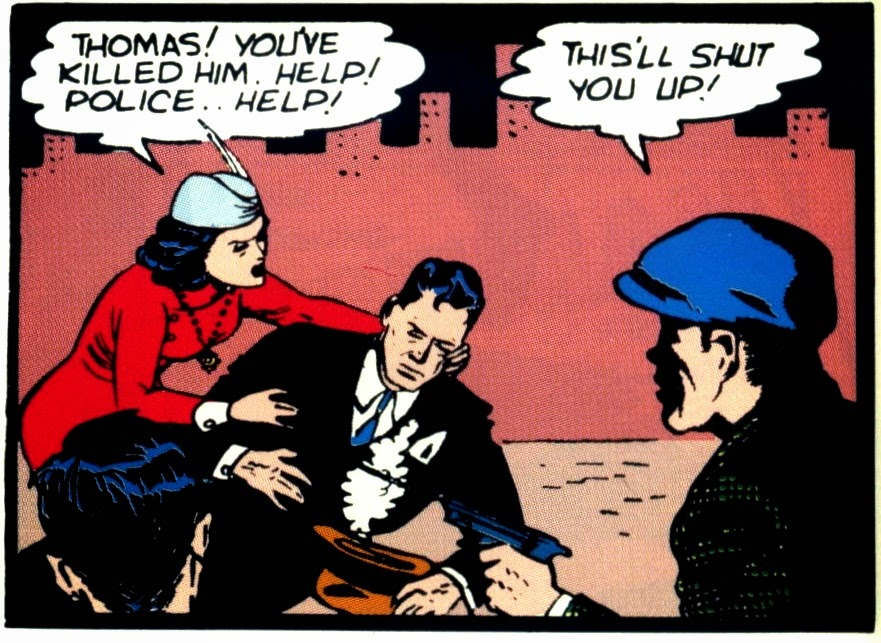


Page 92-- Madrid, having spent a long time chronicling the career of the Silver Age Supergirl, complains that she "didn't show any signs of ever growing up to be a Superwoman"-- apparently another carp about men keeping women down, even though by that time it should have been evident that both male and female characters did not age, given that the readerships were assumed to turn over every few years.


Page 98-- He tells us that the 1990s version of Supergirl "was clearly meant to be a male fantasy, and no longer a character to attract or inspire female readers"-- yet, he has just finished complaining that the tame Silver Age version, which he compares to singer Leslie Gore, also never reaches any sort of potential, even though she was putatively aimed at female readers. There's also, throughout the book, no dealing with the possibility that sometimes female readers enjoy sexual fantasies themselves.
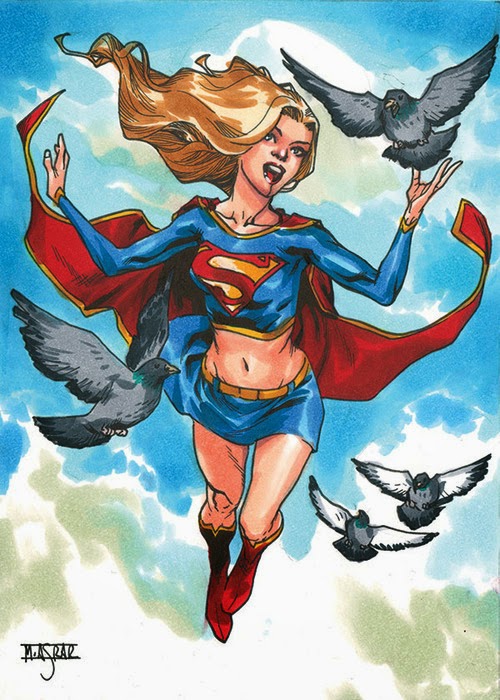


Page 103-- Madrid describes the Silver Age in very inaccurate terms, particularly when he claims that "Magic was a mysterious enemy, meant to be defeated." Granted, a lot of DC's Silver Age books are hot for science more than sorcery, but there are a fair number of magical heroes-- the Spectre, the Enchantress, Zatanna-- and I see no evidence that magic is despised, even by heroes like Superman, who numbered it among his vulnerabilities. This may be extrapolated from Madrid's view that all magic went out the window in the WONDER WOMAN book once Kanigher displaced Marston, but I don't think Kanigher used magic any less; he just didn't use it the same way Marston did.
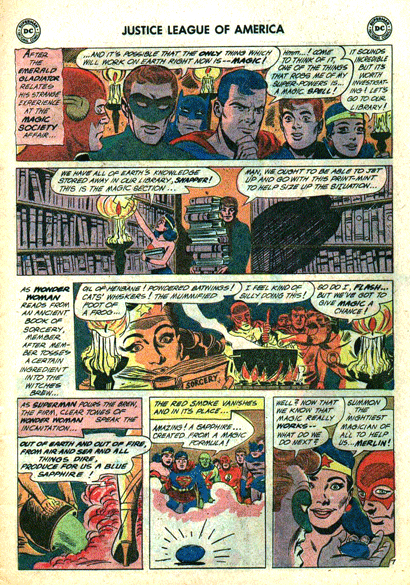


Page 105-- Madrid claims that there's a victim-based reading possible from the fact that Superman and Batman did not make regular appearances in the early JUSTICE LEAGUE title, griping that "Wonder Woman is not considered to be in the same 'league' as Superman and Batman." This too is better explained by extrinsic rather than intrinsic factors. Many pros and fans have attested that DC editor Mort Weisinger maintained, or attempted to maintain, a close hold on these characters, since he Weisinger edited all of the Superman books and arguably influenced the artistic direction of the Batman books even when they were 0being edited by Weisinger's associate Jack Schiff. It's been rumored, with whatever truth, that Weisinger lobbied to keep Superman and Batman out of the Justice League, and I for one find this a more likely explanation for the duo's early JLA absence than some mysterious pecking-order.

Page 112-- After claiming that the Invisible Girl's original powers are useless-- somehow overlooking that she defeats Doctor Doom in FANTASTIC FOUR #5 and engages him in single combat in #17-- Madrid claims that Sue Storm's force-field powers come about because "Reed has figured out a way to boost Sue's powers." Madrid doesn't bother to cite the issue number where this happened-- though he's careful to cite issue #12 as evidence of Sue's non-importance-- but the fact is that in FF #22, Reed only suspects that Sue has powers she hasn't used yet. The scientist's "nuclear-powered" measuring device *accidentally* stimulates Sue into manifesting her new powers, which are, like the powers of the male heroes, attributable to the original cosmic-ray accident they all endured.


Page 139-- Light Lass, Dream Girl, and the White Witch are said to thwart the sorcerer Mordru in a LEGION story. Apparently all short-haired girls look alike to Madird: 'twas Princess Projectra, not Light Lass.

Page 159-- Marvel's Black Widow is said to be facing "hard personal choices" when she deserts her romantic partnership with Daredevil to accept the more "prestigious membership" of the Avengers. Yet what the character actually thinks is not some feminist assertiveness: she accepts the membership because she wants to have time to think about her relationship with Daredevil! The Widow also only remains with the Avengers for two issues in this period; in all likelihood Marvel editors simply wanted an excuse to terminate the ongoing Daredevil-Black Widow relationship for one reason or another.

Page 189-- "Numerous stories focused on the world's obsession with learning Wonder Woman's secret identity in an effort to find her weakness."-- Gee, that's such an original notion. Uncover a superhero's ID to compromise said hero. I guess Wonder Woman must have been the first hero ever to have suffered such investigations. Or, if she wasn't the first, surely this only happens to female heroes, as a marker of the indignities they alone suffer.

Page 221-- "Out of style, Wonder Woman was also erased"-- Uh, yeah, and it was because she was going to be rebooted, as Madrid himself tells us on p. 208.

Page 249-- "The jungle antics [of jungle queens] ended in 1954"-- again, no, Atlas Comics kept jungle comics, including two jungle queens, going until 1957.


On the same page, Madrid has problems with the nefarious Catwoman becoming a "good girl." He overlooks that she only reformed during the years 1951-52, and that she went back to being a "bad girl" for three 1954 stories-- and it was at this point that she was excluded from the DC universe until 1966. Since she was "bad" at the time of her forced retirement, the goody-goody Catwoman did not "pave the way for Batman's new love interest, the more buttoned-up and sexless Batwoman."


These are others, but these examples of inaccuracy and false reasoning are the most egregious. If most of them had been simple matters of misperception-- remembering Light Lass in place of another heroine, for example-- I probably wouldn't have written this review. But most of these citations grow out of Madrid's pervasive victimology: his hectoring insistence that nearly everything ever done with comic-book heroines is wrong, wrong, wrong.
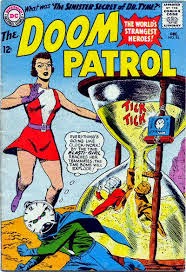


Well, with a few exceptions. Madrid does at least give props to the creators of THE DOOM PATROL for a gutsy lady crime-fighter-- which is more than Trina Robbins did, when she conspicuously omitted Elasti-Girl from her own book. But to elevate the model of Elasti-Girl, Madrid has to drag down the Marvel superheroines using pretty much the same knocks Robbins used in her book : they're too weak, they're too girly, they "pose and point."  Given that Madrid's whole project involves the "close reading" of the ephemera of comic books, one might wonder why he chose to read them so loosely.

Unfortunately, the only explanation I can devise is that he wanted to make comic-book heroines sympathetic for their having been so roundly victimized, whether they were turned into virgin schoolgirls (1960s Supergirl) or teeny-bopper whores (1990s Supergirl). But the question arises-- do we respect these heroines more for being victims-- or for being heroes, irrespective of gender? It is, unfortunately, a question Madrid doesn't even try to address.

Saturday, March 22, 2014

PERFECT STORMS OF SEX AND VIOLENCE

I mean, you’re willing to defend sex and violence from highbrow critics, but somehow slapstick is to be scorned? Come on now.-- Noah Berlatsky to me in this essay's response-thread.

There's no point in trying to reconstruct whatever tenuous line of logic Berlatsky used in making this remark, since it had almost nothing to do with the argument we were having on his essay-thread back in January.  Had I asked him at the time what "defense of sex and violence" of mine he was referencing, I don't imagine Berlatsky would have given me a straight answer.  But compared to some responses I've received from illiterate know-nothings, Berlatsky's summary, apart from its irrelevant aside about slapstick, is at least partly on the money.

It's partly misleading, as well, though. I don't defend *all* sex and violence; I defend the principle that it can be used well, like anything else in fiction.  In 2009 I gave an example of a piss-poor execution of the use of violence when I reviewed a hyper-violent comic book, BLACKEST NIGHT #1, and said:


my problem is not that [Geoff] Johns put these characters through the wringer. I like them all, but I don't mind seeing them travestied, if it's done with some imagination.
At the same time, I have defended the use of violence when it's been used just for kicks, if I think that some degree of imagination had been evoked, as with this once-infamous scene from SUPERGIRL #14:


I won't repeat the specific arguments I used to refute "highbrow critic" Dirk Deppey's interpretation.  But I will extend those arguments to observe that often when highbrow types object to this sort of hyper-violence, with or without erotic elements, they're taking issue with the very nature of popular art, which is generally characterized by its ability to deliver almost pure kinetic entertainment to any audience, or as one story weekly of the 1880s called it, "sensational fiction with no philosophy."
For highbrow/elitist critics the lack of philosophy in narrative is anathema, which may be why they so often pursue Sigmund Freud's strategy: claiming that one can read such entertainments in order to reveal latent meanings that show the philosophical underpinnings not of the work or its author but of the culture that formed both.  Usually this cultural substructure embodies some psychological or sociological opinions or practices that the critics do not like-- e.g., masculinism, fascism, and so on-- and so the identification of this alleged "latent content" takes the form of casting out the critics' personal demons.

While I've gone on record as saying that these and other deeper facets do exist, and that even the most barren seeming narrative does have some "philosophy," my approach is Campbellian rather than Freudian/Marxist.  SUPERGIRL #14 doesn't have many deeper facets, but those that are present relate to mythic tropes like "the Hero Gains a New Power," which is what's transpiring in the violent scene above when the titular heroine stabs her bat-attacker.

These distinctions apply to sex as much as violence, for though the two are separable kinetic phenomena both in the real world and the world of fictional narrative, they have an interconnectedness best expressed by George Bataille.

...of all forms of human might/activity, violence and sex are the perfect exemplars of competition and cooperation, and therefore of the thymotic tensions that pervade all human societies and cultures.  Further, violence and sex are also the primary sources of what Bataille calls "sensuous frenzy," which may be termed the perception that one's thymos has become so expanded as to escape the confines of one's body.-- A REALLY LONG DEFINITION OF VIOLENCE, PT. 3.

I've used the term "perfect storm" in the title, defined by Wikipedia as "a rare combination of circumstances will aggravate a situation drastically." The meaning is usually negative in the real world.  As I apply it to narrative fiction, it's a positive thing, referencing the ways in which the creative forces of an author, or set of authors, may combine elements of a narrative to create storms of sex and/or violence that sweep away the senses, and arguably promote the sense of the sublime.

Do people experience such storms in the real world?  It's obvious how the "swept away" metaphor applies to sex, but it can apply no less to certain experiences of violent conflict, or at least to people coveting glorious battle: one might recall my observation here that "an estimated 150,000 German soldiers went off to the trenches with [THUS SPAKE] ZARATHUSTRA in their knapsacks."  But such real-world tempests are limited to those who experience them, and they can be communicated to others-- usually for the purpose of engendering envy-- only through narrative, albeit not the narrative of fiction.

In contrast, the sensuous frenzies of fictional sex and violence potentially belong to everyone.  The vagaries of taste insure that even the kinetic scenes that are most celebrated at any given time will not please absolutely everyone, and in some other time they may fall out of favor. Further, there may be some danger in concentrating on the kinetic to the exclusion of other aspects, which makes certain aspects of Camille Paglia's criticism as problematic as the ratiocentric prejudices of the highbrows.  In criticism, too, one desires a "perfect storm," where all potential insights come together for a spectacular breakthrough.