Featured Post

SIX KEYS TO A LITERARY GENETIC CODE

In essays on the subject of centricity, I've most often used the image of a geometrical circle, which, as I explained here,  owes someth...

Showing posts with label steve gerber. Show all posts

Tuesday, September 24, 2024

MYTHCOMICS: "SWAN SONG OF THE LIVING DEAD DUCK" (HOWARD THE DUCK #10, 1977)


Prior to this essay, the only HOWARD THE DUCK issue I pegged as a mythcomic was issue #11, for the story "Quack-Up." In fact, I noted that the story was part of a longer arc, one that did not hold up as a mythcomic-narrative, which I still believe. I further asserted that I didn't think that HOWARD's superordinate creator Steve Gerber had emphasized the mythopoeic potentiality as much as the didactic and dramatic ones.

In the case of "Swan Song," the story immediately preceding "Quack-Up," I've given it a more sustained look for this essay. I've decided that though there is a lot of didactic content in "Song"  -- on the second page, the hapless mallard protagonist begins a rant about "socialization"-- there are also a fair number of myths in the mix as well. In this case, the two potentialities reinforce one another, as with the Silver Surfer tale I discussed in FORMAL AND INFORMAL EXCELLENCE PT. 2. 


So "Song"-- most of which is entirely in Howard's head after he suffers a traumatic mental breakdown-- begins with him emerging, fully adult (and unclothed except for his stogie) from an oversized egg. A giant hand tries to smash him, so he flees into a room and immediately begins discoursing about the socialization common to all societies, which Howard views as pure indoctrination. He takes refuge in an unfurnished room and encounters a bunch of miniature humans ("hairless apes," in Howard's parlance). The symbolism isn't that clear-- I guess the mini-humans are beings who have surrendered to indoctrination, and accepted a barren, confined existence.


But the next symbol could not be clearer: "Indoctrination in the Form of Monstrous Monetary Dominance," a.k.a. "Kong Lomerate," a.k.a. Gerber's publisher Marvel Comics-- though in 1977 we're a long way from that company being anything akin to a real conglomerate. Anyway, when Howard expresses surprise that a hairy ape could claim to be the owner of all these mini-humans, Kong voices the interesting sentiment, "It's because I'm not human that my word is law! I only exist on paper!" Of course, this is also true of Howard in 1977, and when Howard gives Kong backtalk, the gorilla-boss shows his authority by "cancelling" the abrasive drake. 

(Fun interstitial fact: HOWARD wasn't cancelled while Gerber was on the feature, but after he was fired from the company, neither the color comic, a subsequent black-and-white magazine, nor a comic strip lasted past 1981. Talk about killing the duck that laid the golden eggs.)


Howard's next dream-scene takes him to a mountain hut, seeking some motivating wisdom to carry him through his own cynical vision of existence. He meets another Gerber character, the short-lived superhero Omega, and they exchange a few inconclusive pleasantries. 


Another quick transition takes Howard to one of the main sources of his consternation: his maybe-girlfriend Beverly Switzler. But alas, it's not the Beverly he knows, but Surrealist Beverly, on loan from Rene Magritte perhaps. While Real Beverly only indirectly obliges Howard to act heroically, Surrealist Beverly exists to torment and humiliate him with her carefully contrived absurdity.


Then Howard thinks he wakes up, but no, it's as he says: "Welcome to my Nightmare Part 2." He meets "your friendly neighborhood Piano," almost surely selected as a precursor to the mallard's crisis of socially generated guiltiness. Spider-Piano suggests that Howard read a book-- the 1975 bestseller WHEN I SAY NO, I FEEL GUILTY-- but Howard, being something of a snob, refuses to accept counsel from pop psychology.


But Howard's a Marvel Comics character, so despite his estrangement from the heroic code of other characters, his nature keeps leading him back that way. First, he meets his own private "rogues' gallery." Then he meets another wisdom-dispensing acquaintance, Doctor Piano (who went by the name "Strange" when Howard met him in a DEFENDERS tale). But Howard rejects the doctor's advice re: altruism, and as if in reaction to Howard's pessimism, his counselor disappears. In his place appears yet another of Howard's adversaries, the Kidney Lady, who by no mean coincidence the duck will encounter in the real world of "Quack-Up." 


He also encounters LeBeaver, the goofball super-villain whom Howard refused to fight to defend Beverly. This time Howard tries to battle the evildoer, to perpetuate a "masculine stereotype"-- and as a result he ends up in a hell of his own creation, mocked by his old foes and Surrealist Beverly.   

Does Gerber's screed against socialization stand in terms of making a good didactic argument, a "formal proposition?" No, since I think Gerber posed questions and didn't answer them. But as an "informal proposition," which conjures with the chaos of random correlations, this particular song was one of Steve Gerber's strongest.


Thursday, April 21, 2022

UNTIMELY RUMINATIONS #2

Here's another blast from the past, taken from AMAZING HEROES #51 (1984), when Steve Gerber was hyping VOID INDIGO:

Gerber believes that contemporary examples of popular culture that attempt to recreate myths do not truly do so. "One of the qualities of myth is that it looks at both the light and dark sides of humanity, and the escapist mentality is incapable, really, of looking at the dark side...There's a certain ugliness in every one of us that we all have to face and confront at some time or another"-- and that, Gerber says, in myth we recognize and condemn in ourselves, therefore achieving a catharsis.

To be sure, the first sentence of this quote makes clear that Gerber isn't trying to define myth overall, unlike some of the myth-theorists I've critiqued on this blog. But he's also putting forth an overly rationalized notion of a supposed facet of myth, because it jibes with the particular work he's expousing. I wouldn't say that his observation is completely untrue. But the very mention of "catharsis" in this context makes it sound as if Gerber has a didactic view of myth-- which is ironic given that many of Gerber's works meet my definition of literary myths, precisely because they don't have an overly didactic organization.

I can see, though, why an intelligent creator like Gerber would become seduced by the Didactic Side of the Force, for as I noted elsewhere, the tropes of the didactic and mythopoeic potentialities not infrequently intermingle with one another:

Didactic discourse and mythopoeic discourse are not as intimately entwined as those of the kinetic and dramatic potentialities. The discourses can appear independently of one another, or they may intertwine within a narrative to support one another, or they may conflict with one another so as to confuse the narrative. 

Given that in the primary art of fiction there can be so many permutations in the interaction of these two potentialities, it's not surprising that they also become confounded within the secondary art of criticism.


Monday, February 17, 2020

CATEGORIES OF STRUCTURAL LENGTH PT. 3

After formulating my distinctions of the longest structural forms in Part 1-- the compact novel and the episodic novel-- I should point out that a partial reading may be deceptive.

Last year, partly in response to the release of the film ALITA BATTLE ANGEL, I read some of the chapters of the manga. I rated IRON MAIDEN as possessed enough concrescence to qualify as a mythcomic, which is naturally predicated on recognizing it as a "long arc," but the following long arc, KILLING ANGEL, did not qualify for the same status.

To date, I still have not re-read all of ALITA, but it occurs to me that when I do, the entire series might qualify as an "episodic novel," and thus as a mythcomic in itself. If I made that judgment, then the fact that KILLING ANGEL lacked a certain level of concrescence would not affect my judgment of the whole series, any more than a mythically-weak chapter of (say) MOBY DICK would affect my judgment of the whole book.

In some cases, if a given work or series of works has been left incomplete, it's hard not to make a partial reading. I stated in Part 1 that I could have considered the eleven issues of Jack Kirby's NEW GODS series to be an episodic novel, even if the author had not been able to craft an ending for the series many years later. The ending that Kirby used in HUNGER DOGS was probably very different from anything he might have written had he concluded the series in 1971. Yet I would say that the mythic discourse of those eleven issues was strong enough to view them as a technically incomplete but symbolically complete novel.

Similarly, Steve Gerber's VOID INDIGO only enjoyed one large-sized graphic novel and two issues of a regular-sized comic book, before hostile fan-reaction to the series encouraged publisher Marvel Comics to shut down the series. Possibly I might not have liked whatever ending Gerber might have designed for the series, but I felt that the early part of his discourse was strong enough that I deemed VOID also to be akin (to borrow Aristotle's metaphor) to the acorn that, under the right circumstances, has the power to give rise to an oak.

It's hard to state with precision exactly when the discourse is strong enough to subsume any weak elements. The Don McGregor long arc "Panther's Rage" in BLACK PANTHER #6-17 is one in which I did not find a strong enough discourse overall, though I critiqued two of the McGregor stories, "The God Killer" and "Thorns in the Flesh, Thorns in the Mind" as possessing the same strong mythicity as an isolated short story, even though they're part of a larger arc. On a side note, I would probably rate the entire "Panther's Rage" highly concrescent in terms of the dramatic potentiality, since I'm of the opinion that interpersonal dynamics were the main focus of McGregor and his collaborative artists.


Monday, September 16, 2019

MYTHCOMICS: NEVADA 1-6 (1998)

In general I didn't like a lot of Steve Gerber's post-Bronze Age work. The antic creativity present in such 1970s features as THE DEFENDERS, MAN-THING and HOWARD THE DUCK faded in favor of an often nihilistic sourness. Possibly this feeling caused me to quickly pass over NEVADA, a six-issue 1998 Vertigo series by Gerber and artist Phil Winslade. But now it seems to me one of Gerber's best accomplishments from the latter part of his career.


In a roundabout way, NEVADA arose from one of the author's more bizarre inspirations. The story goes that in 1977 Gerber missed his deadline for HOWARD THE DUCK #16, and that, rather than simply reprinting an earlier HOWARD story, he and some artists whipped together a series of illustrated meditations on life, the universe, and everything, sometimes through the eyes of the acerbic duck, sometimes from Gerber himself. One two-page piece allowed Gerber to express his absurdist take on the then-prevalent "obligatory fight scene," in which a Las Vegas chorus girl and her pet ostrich battled an animated lamp. Many fans didn't care for the stratagem-- one reader wrote simply "Next time go reprint"-- but supposedly Neil Gaiman opined that he'd actually like to see such a story. Twenty years later, Gerber and Winslade produced NEVADA, though not from Marvel, the publisher of HOWARD, but under DC's Vertigo imprint.


Like many Gerber protagonists, the Vegas showgirl Nevada, whose birth-name is not disclosed, would have no luck if not for the bad kind. She dances for her living at the tacky "Nile Hotel and Casino," has an assortment of cool, trippy friends, and shows her essential kind-heartedness by rescuing her pet Bolero (named for the Ravel ballet composition) from an ostrich farm. Though she has some ongoing hassles, like a rejected boyfriend who won't take "no" for an answer, she came to Vegas to start a new life. To be sure, we learn nothing about the old life except that at nine years she auditioned for a Christmas church play by portraying the Virgin Mary with a pillow that realistically showed the icon as "great with child," thus evoking the ire of Christians who didn't like too much reality in their religion. As if to satirize religion in general, her featured dance at the Nile is a re-enactment of the Egyptian story of Osiris' dismemberment, but given a snarky feminist denouement.


However, soon Nevada has bigger problems than a stalker (who, by the way, gets totally trounced by one of Bolero's deadly kicks). Some innocent tourists at the Nile get literally dismembered by an alien visitor from another realm, and Nevada finds herself the victim of time-slips, causing her to encounter cavemen or to witness a guillotine-execution during the Reign of Terror. Who's responsible? Is it Mister DeVesuvio, a mysterious crime-boss who has a glass tube in place of his head? (A similar character, Ruby Thursday, appeared in Gerber's DEFENDERS.) Or is it the drunken sot Odgen Locke, who once taught theoretical physics but now seems to be able to transform himself into an angel-winged warrior? But no, the real culprit is a cosmic event breaking down the boundaries between worlds, which incidentally makes possible the invasion of the aforementioned killer alien. Nevada actually meets and kills the alien, but there's an unnamed higher power who wants her special talents to be a "Rift Warrior," a defender of the cosmic order.


There have been dozens if not hundreds of reluctant heroes since the debut of Marvel Comics, but Gerber isn't interested in characters who make token protestations before easily acceding to the call of destiny. Through the author's Bronze Age work alone it's clear that Gerber enjoyed the allure of combative heroes while still feeling a lot of ambivalence about the use of violence, particularly sanitized violence, as a means of escape. Thus when Nevada's abducted by the "higher power" to put her through an ordeal called "the Hammer," we're not talking a few strenuous training-sessions with Master Yoda. Instead, Nevada goes through tons and tons of patented Gerber mindfuckery, leaving the reader wondering if her cosmic perceptor is on the side of the angels or not. But Gerber does make Nameless Higher Power the vessel of one essential nugget of wisdom: that most of sentient suffering arises from a hunger so great that it rises to the level of universal decay, not unlike the principle of entropy expoused by the villains in the Man-Thing tale "How Will We Keep Warm When the Last Flame Dies."  Nevada, despite her distrust of her perceptor, Nevada does have the stuff to fight back a downfall that could be brought about not by an evil overlord, but rather by "some moronic soul whose ego cannot endure being second in line." And thus Nevada does become a Rift Warrior and forces back a greater invasion of alien dipsticks bent on destroying the fabric of space-time


After this, the dancer returns to reality, though not without more attendant troubles. Clearly, the author left the door open for more stories with Nevada, Bolero and their quirky pals, but since it was a creator-owned project, this was the last show for the Vegas showgirl. Perhaps it's just as well that she went out on a high note. Nevada sums up her situation and her mordant but courageous philosophy in a letter, ending in part with the words:

"So what do you do when reality bites back and the new life falls apart. I can only speak for myself. Fuck it raw and keep dancing."

Wednesday, August 15, 2018

MYTHCOMICS: "HOW WILL WE KEEP WARM WHEN THE LAST FLAME DIES?" (G-S MAN-THING #1, 1974)

In my mythcomics-review of a HOWARD THE DUCK issue, I commented: "While Gerber's preoccupations on the Man-Thing-- one story analyzed here-- tend toward the kinetic and the mythopoeic, most of the HOWARD stories focus on elements of the dramatic and the didactic."

I've always thought that MAN-THING was a much more mythopoeic series than its contemporaneous competitor, DC's SWAMP THING. Nevertheless, after doing a quick re-read of Gerber's tenure on the feature, I must admit that Gerber may have been a little too preoccupied with making rational "overthoughts" than with giving free reign to his mythical "underthoughts." That's not to say that Gerber wasn't an imaginative writer. Indeed, back in The Day he was probably esteemed for his ability to spin wild fantasy-sequences not only in "edgy" books like MAN-THING and HOWARD but also in "mainstream" titles like THE DEFENDERS and MARVEL TWO-IN-ONE. Regrettably, though, even though MAN-THING might have held the greatest potential capacity for the mythopoeic, too often Gerber seems concerned with making moral statements. "Decay and the Mad Viking" (MT #16) arranges a promising *enantiodromia* between the Viking's murderous masculinity and the implied quasi-femininity of his degenerate victims, but the story doesn't quite make either side come alive in a mythic sense. "Song-Cry of the Living Dead Man" (MT #12) records the mental breakdown of an ad-agency writer besieged by the phantoms of everyone who ever wanted a piece of him, but the focus only upon financial threats to the "dead man's" peace of mind keeps the story from delving into the essence of the Buberian "I-it" relationship.


"How Will We Keep Warm," which sounds a little like the title of a MOD SQUAD episode, enhances some of the ongoing environmental tropes of the feature. Often Man-Thing, a man transformed into a swamp-monster, mindlessly defends his domain against intruders, but most stories failed to realize the tragic disconnect between nature and culture. "Warm," however, dovetails the Man-Thing concept with the prevailing American fears of survival brought on by the 1973 fuel crisis.

As in most stories, the mindless swamp creature simply wanders about until he encounters the more active characters in his story, composed here of two factions. One faction is a group of scientists who have decided that the Florida swamp is the best possible place to build a self-sustaining alternative-power community, given the rather downbeat name of Omegaville, because it's "man's last chance." ("Alphaville" would have been more upbeat, but it had already been used.) The other faction is a group of modern cultists called "Entropists," since they worship the concept that the universe is governed by entropy, the tendency toward decay. The Entropists want to prevent Omegaville from re-igniting human possibilities, so one of the cultists unleashes the power of the Golden Brain. This disembodied organ projects an energy-demon that looks suspiciously like an old monster-enemy of Marvel's Hulk-- though Man-Thing is provoked enough to destroy the energy-creature.


The violence causes the lead cultist to lose his grip on the brain, which falls into the swamp. The scientists get clear and the cultists return to their base, allowing for Gerber to relate the history of the brain. Thus he recapitulates the last two appearances of "the Glob," a man who got turned into a muck-thing years before Man-Thing came into being. During the creature's second encounter with the Incredible Hulk, the Glob's muck-body was destroyed, except for its brain. (Gerber gives no reason for the brain to be gold-hued, though personally it reminded me of the so-called "golden egg" of Hindu theology.) The brain is picked up by a fellow named Yagzan, the leader of the Entropy Cult, and he's first seen killing off the cultist who bungled the attack on the Omegaville scientists.

While Yagzan-- drawn by Mike Ploog to look much like Richard Nixon-- lays plans for another attack on Omegaville, the Glob-brain doesn't just sit on the bog's bottom. Though not precisely sentient, the brain assembles a new body for itself out of the swamp's elements, though as a Gerber caption comments, the brain's new body doesn't look like the original body of its owner, but looks as if "sculptured by Michelangelo." However, the new body is also a tabula rasa, in that its owner no longer remembers its previous existence, or even how to speak. Naked as Adam-- to whom he's later compared-- the former monster wanders into the haven of Omegaville, where the scientists take him in and name him Joe, calling him "Omegaville's first native-- Adam created from clay to live in the garden, and all that." Joe takes basic pleasure in serving the community, while the mindless Man-Thing looks on from the sidelines, anticipating trouble.


The Entropists show up, and Yagzan recognizes his former pawn in the speechless Joe. Yagzan tries to force the brain to devolve, but it can only go so far, at which point the cult-leader orders the reborn Glob to attack "man's last hope." The Glob manages to destroy most of the community until Man-Thing intrudes, eventuating in what may be the world's first "battle of the muck-monsters."


Since it's Man-Thing's book, he manages to vanquish the Glob, who takes cult-leader Yagzan down with him. Despite this triumph, the story ends on a note of pessimism, since Omegaville has been destroyed, and never again shows up in the Marvel Universe, to my knowledge. True, American fears about the fuel crisis waned once the country made trade concessions. But Gerber delivers a vision of doom that goes beyond newspaper headlines, with his Entropists incarnating the human tendency to lust after ultimate destruction.

Friday, January 29, 2016

MYTHCOMICS: "QUACK-UP!" (HOWARD THE DUCK #11, 1976)

Since in this post  I devoted some space to asserting how poorly Bill Mantlo did with a particular HOWARD THE DUCK story, it seems only fair to address the question of mythicity in Steve Gerber's original run on the franchise he co-created.


A quick scan of the first 27 issues of the HTD comic book suggests that Gerber's stories-- and they seem to be principally his creation, with only minimal creative input from artists like Gene Colan and Val Mayerik-- are not generally intended to evoke the mythopoeic potentiality. While Gerber's preoccupations on the Man-Thing-- one story analyzed here-- tend toward the kinetic and the mythopoeic, most of the HOWARD stories focus on elements of the dramatic and the didactic. This seems to have been a logical development, given that Gerber's protagonist was a classic misanthrope, his animus toward society accentuated by the fact that, as a talking duck, he wasn't even an "anthrope." Gerber sometimes wrote HOWARD into situations that required him to play the part of a "hero," in keeping with 1970s Marvel's emphasis upon having a fight-scene in every issue. However, Howard was what I've termed a *demihero,* more concerned with survival than with the glories of the heroic life. It's arguable that the HOWARD series is the first mainstream Marvel series that seriously called into question the glory-seeking ethic of the Marvel superhero line.

The story in question here is actually one segment on an arc concerning Howard's inability to tolerare the heroic ethic. At the end of issue #9, Howard refused to meet the challenge of a villain called "Le Beaver," even though said villain was threatening Howard's quasi-romantic "hairless ape" companion, Beverly Switzler. By sheer dumb luck, Le Beaver is killed and Beverly's life is preserved. However, the duck is tormented by his psychological conflicts. Even during his dreams, he reflects that "There's really nothin' glamorous or honorable about gettin' killed to perpetuate [other people's] masculine stereotype." Yet the refusal of heroic action generates enough mental stress that Howard experiences something akin to a nervous breakdown, leading to a surrealistic dream-sequence that lasts throughout issue #10. Issues #11 through #14 deal with Howard being sentenced to a mental health ward for observation-- but overall the arc is still largely concerned with the dramatic and didactic sides of Howard's conflict, not the mythopoeic. In the end Howard receives help from a Marvel guest-star whose adventures Gerber had been writing the previous year-- Daimon Hellstrom, the Son of Satan-- but at best the arc of Howard's "quack-up" was a mixed bag.

The story of HOWARD #11, though, is strong enough that it can read without much reference to the other issues, particularly because Gerber conceived a means to place his protagonist in a situation absurd enough to generate its own ironic mythos. Howard awakens from his dream-- literally a bedeviling nightmare, since it ends with him being tormented in hell by a comic-looking devil-- yet the duck remains haunted by quasi-schizophrenic voices that only he hears. He happens to see Beverly apparently making up to a handsome "hairless ape," and his jealousy provokes him to seek out the local bus-station and take the first bus out of town. The duck is so aggravated that he doesn't even notice that the bus is going to Cleveland, a hairless-ape city Howard has encountered before and for which he has no pleasant associations.

The idea of being stuck on a long bus-ride with a bunch of strangers would ordinarily connote only mundane experience. However, Gerber makes Howard's experience in the consensual world almost as surrealistic as anything in his dreams. Gerber's probable inspiration here is the Firesign Theater's 1971 comedy album I THINK WE'RE ALL BOZOS ON THIS BUS, but Howard's bus is overrun not with clowns but with religious frauds.

The duck, who styles himself a "pragmatist," would be among the last to ever seek religious counseling for his mental difficulties. So of course in an ironic universe he boards a bus replete with wackos who seem to sense his psychic upheaval and try to sell him their wares-- a book on "Gnosticology" (a spoof on Scientology), a neo-Christian text called "Martyrdom for the Millions" (hawked by a guy dressed up like Jesus), and others. Howard does make one marginal ally-- a cheerful, lisp-voiced innocent named "Winda," who will continue as a supporting character for the rest of Gerber's run.


However, the inevitable fight-scene occurs when Howard encounters an old nemesis from his part: the Kidney Lady (seen from behind on the cover), who is convinced that Howard is part of an "international kidney-poisoning conspiracy."


A fracas ensures, in which the Kidney Lady demonstrates her religious tolerance.


Gerber's at the top of his form here. He delivers a lot of silly puns that read better in a comic than they would if I put them in a blogpost. Many writers (*koff* Mantlo) would not be able to think of Howard as anything but a repository of MAD-like puns and simplistically moral storylines, Gerber's strength, in contrast, lies in his ability to merge the banal and the surrealistic in a manner that goes beyond mere frivolity. And while none of the religious goofballs on the bus are, properly speaking, representatives of genuine religions (even within the context of the Marvel Universe), it's surely not coincidence that Howard, though greatly in need of counseling, can only find religious elements intermixed with crass commercialism and verbal malapropisms ("You should love thy neighbor and be true to thy school.")

There are assorted myth-motifs throughout the "breakdown-arc," but only in "Quack-Up" do they assume a high level of mythicity.

Tuesday, July 21, 2015

NULL-MYTHS: "NIGHT OF THE SPIDER" (THE ZOMBIE #2, 1973)


The year after Steve Gerber began scripting duties on MAN-THING, he initiated the ZOMBIE strip in Marvel's black-and-white magazine TALES OF THE ZOMBIE. The concept was initiated by editor Roy Thomas, who apparently decided that Marvel's line of monster/horror titles needed a zombie. To this end, Thomas picked out a 1953 stand-alone horror tale entitled "Zombie," which dealt with a dead man named Simon Garth rebelling against the man who brought him back from the dead. The story was then incorporated by Gerber into a slightly more involved backstory. Garth, a coffee-plantation magnate with business dealings in Haiti, was selected to be zombified in a voodoo ceremony. Once he'd been killed and revived, Garth was a living dead man, largely invulnerable to pain or to physical harm. However, he had almost no emotions, and craved, to the extent that he could want anything, to return to the grave. As in the short story, he had one living relative: Donna, a teenaged daughter. He was protective toward her, though there was always the danger that he might slay her. A magic charm, the Amulet of Damballah, floated around through several stories, and anyone who obtained it could command the Zombie to commit any act of destruction.

Though Gerber scored in fannish annals with MAN-THING, as I showed here, the ZOMBIE strip did not prove rewarding. The Zombie, unlike the Man-Thing, had a meager power of speech, but Gerber usually handled Garth in the same way as his mick-monster: using narrator-captions to describe whatever was going on in the protagonist's head.

Unfortunately, whereas the Man-Thing was interesting precisely because the monster was vulnerable to other people's emotions, the Zombie suffered from a lack of affect. Being dead, he usually didn't care about much of anything, even enemies who tried to destroy him. And the experiences Garth did remember from his former life often put the entrepreneur in a bad light, as a manipulative SOB who alienated his ex-wife, daughter, and many if not all of his employees. This didn't exactly make the average reader sympathize with Garth's plight.

Most of the stories are just middling zombie-tales, but on one occasion, in issue #2, Gerber penned a story, "Night of the Spider." that had mythopoeic potential. Like the Man-Thing tale I analyzed in my previous post, this story included some dicey psychological motifs. However, Gerber didn't explore these motifs in depth as he did in the Man-Thing story, so "Spider" falls into the domain of the inconsummate "null-myths."

For reasons too involved to go into, both the undead Garth and his daughter Donna wind up in Haiti; the zombie seeking death while his daughter seeks the reasons for his disappearance. It just so happens that Donna falls into the hands of a mad scientist who's even madder than the usual comic-book stereotype. This fellow has made it his project to change human beings into giant spiders for no particular reason. He kidnaps Donna, changes her into a giant spider, and she kills him. Spider-Donna wanders into the Haitian jungle, kills another local, and then comes across her wandering zombie-dad. She jumps on him and bites him, but neither her fangs nor her venom can kill an undead man. For his part, Garth doesn't fight back; he just endures her attack and then walks off. To Donna's extreme good fortune, injecting her venom into her dad's body reverses the transformation. She changes back to normal, with no memory of her experience and without further repercussions in the remainder of the series.She wonders vaguely if someone abducted and raped her, and though she doesn't really believe that this happened, little does she know that she's the one who's committed an act that I termed "feminine rapine" in this essay.

Gerber's narrator-captions reinforce this. He's already established that Simon and Donna have an acrimonious relationship, in which she's criticized him for his exploitative practices, so his next symbolic step is to compare the figurative "venom" spilled by the women in Simon's life, in the form of constant nagging, to the real venom the spider-thing injects into Simon Garth.

'Women did this to you [Simon]-- tried to kill you with their venom, called "love..." a poison fully as real to you as the one this creature now spews into your veins... they clawed at you, ripped at you, rent your psychic flesh, made you feel impotent-- and you let them-- for in the end, it was they who withered and died."

In potential this is an almost Faulknerian concept: that Simon Garth, even when alive, protected his potency by simply failing to react to female importunities-- that he essentially "played dead" and allowed them to "spend" themselves, much as a rape-victim would simply endure an attack and wait for it to be over. But though this is an interesting concept, Gerber does not go anywhere with it, either in this story or in any future zombie-adventures. And thus this sequence remains an inconsummate one, a path that runs only to a dead end-- much like the exploits of Simon Garth, Zombie.

Monday, July 20, 2015

MYTHCOMICS: "TOWER OF THE SATYR" (MAN-THING #13-14, 1975)

In my essay PERFECT STORMS OF SEX AND VIOLENCE I asserted that, contrary to the opinion of my sometime opponent Noah Berlatsky, I did not automatically validate every manifestation of the kinetic effects in fiction, a.k.a. "fictional sex and violence." My validation of these, I stated, depends on the way in which they are used. Any ideological critic might make the same claim, of course. However, an ideological critic would assign merit only when the use of the kinetic effect reaffirmed some aspect of said critic's ideology-- an example being Berlatsky's validation of violence in the Marston WONDER WOMAN comic because he believes that these stories supports his ideology, while denying any such validation to the contemporaneous adventures of Superman and Batman.

In contrast, a pluralistic myth-critic validates inventiveness in any fictional cosmos, whether or not he agrees with the ideology of the author or not. Rather than expecting every creative artist to be a source of moral pronouncements that encourage the audience to "go thou and do likewise," the pluralist can also value the author taking a "vacation from morals," and indulging in outbursts of fictional sex and violence for purely expressive ends.
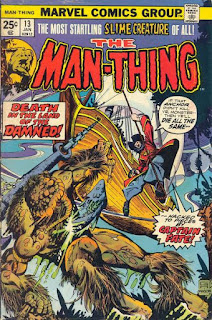


In comics-circles, Steve Gerber's initial tenure on the Marvel Comics feature MAN-THING-- a tenure extending across various titles from roughly 1972 to 1975-- remains one of the premiere works of the so-called "Bronze Age of Comics." The feature-- not originated by Gerber-- concerned the events in the life of a scientist who becomes transformed into the Man-Thing, a near-mindless monster made of mud and swamp-plants. The Man-Thing wandered the Florida swamps getting into various forms of trouble, and was particularly celebrated by fans when Gerber used him to reflect on the evils of human society. I enjoyed these stories as much as any Gerber fan, but most of them don't speak to the mythopoeic potentiality. One of the few Gerber MAN-THING stories that does possess a significant mythopoeic density is a two-part story in issues #13 and 14, which I'll denote using the title of its second part, "Tower of the Satyr"-- but for reasons of perhaps misplaced moralism, this story occasioned a hostile reaction from many fans.

Issue #18's letter column printed some of the responses to the second part of "Satyr." One letter expressed disapporval of "the breakdown in Steve's even-handed approach to male-female situations," and the author boiled down the story to a dicey theme statement: "Give a old goat a young woman and see a miraculous change of life and restored magical power." The Marvel employee answering the letters asserted that "several readers wrote to chastise us about the male-chauvinist elements" of the story and assured the readership that Gerber would not in future "let his baser instincts get the best of him." Like the uncredited respondent, I don't deny the presence of "male-chauvinist elements." But I do think that they are mitigated by their context.

In summarizing the story as simply as is possible, I'll state that the monstrous star of the feature takes something of a back seat to the "guest stars" of the tale. Principally, he serves two functions: that of catalyst or catspaw (occasionally both). The Man-Thing is accidentally taken aboard a cargo ship, and when the ship departs on a scientific expedition, the monster goes along for the ride. The ship has been hired by a lady scientist, Doctor Maura Spinner, a somewhat prickly lady who professes a strange attraction for the area she's going to investigate' the legendary Bermuda Triangle.


After this initial set-up-- which includes the crew's discovery of the muck-monster's presence aboard ship-- the narrative of the story's first half shifts into overdrive. A magical biigantine appears in the skies above the cargo vessel, and from it descend 18th-century pirates, who proceed to abduct both Doctor Spinner and the Man-Thing. (The ship's captain and crew continue to appear in the story's second half as well, but play such minor roles that I'm leaving them out of this summary.)


The minor conflict of male and female in the first half is also amplified in Part Two. Doctor Spinner meets the leader of the pirates, who styles himself "Captain Fate." Fate tells her that she is the modern reincarnation of Maura, the Pirate Queen, who was formerly the captain of a pirate ship, and commanded both Fate and the rest of the crew. Back in the 18th century, the original Maura commanded her minions to help her investigate a small island in the Bermuda Triangle, to search for treasure in its only man-made structure, a single tower with neither doors nor windows. Given the structure's phallic shape, it's significant that Maura is the only one who can break into the tower, making it possible for her rowdy crewmates to follow her in.

They find a treasure, all right, but they also find the tower's sole occupant: Khordes, a master sorcerer who is also one of the last satyrs of the ancient world. Satyrs, as the story acknowledges, are almost always symbols of unrestrained lust, but Khordes has become a withered old goat-man over the centuries. He proposes a bargain: he'll allow the pirates to take his treasure, if they will leave him Maura: "a woman with whom to mate-- one whose charms will replenish my youth and virility."

The pirates accept the bargain and leave Maura behind. Gerber's captions are a little ambivalent about how much of a victim she is, suggesting that she anticipates killing the satyr-- which she does-- and rejoining her men, However, by the time she manages to get out of the tower, the ship has departed the island, leaving her behind for real. Maura curses the pirates to never enjoy their booty, and the dying satyr reinforces her curse with his own power. The pirates and their ship are thrown into a limbo, where they remain for the next 180 years. The tower does what its organic model does when in danger: it retreats-- specifically, sinking beneath the ocean-waves. Presumably the treacherous Maura drowns when the tower and its magical island sink, though Gerber does not say so. Before Khordes dies he specifies that Maura's spirit will live through three generations "e're you return to the sea-- three lives to learn the meaning of love-- e're we meet again."

After Fate has detailed this story to Doctor Spinner, she pretty much seems to lose all connection with her modern-day self, and her scientist persona fades into the persona of a piratical hellion for the rest of the story. Fate, having awakened her old self, commands his magical ship to descend once more to the waters of the Triangle. Obligingly, the tower-island of Khordes rises from the sea to meet the pirates, who want Maura to persuade the satyr to remove the limbo-curse. Khordes too has returned to life, still frail and wrinkled, and he still wants Maura to accept "the love you callously destroyed three lifetimes ago." Maura sics her piratical catspaws on the satyr, but Khordes sics his own catspaw, the Man-Thing, on them. The outcome doesn't go well for the buccaneers, thus clearing the decks, so to speak, for a talk-fest between the satyr and the pirate queen.


In SACRED AND PROFANE VIOLENCE, PART 3 I described some of the ways in which the dominant gender-roles of men and women might undergo a *bouleversement,* resulting in male characters who were predominatly lovers and female characters who were predominantly fighters. Khordes and Maura are both examples of these reverse-archetypes. Khordes now claims that he didn't just want Maura for her body, but because he loved her "spirit." Being a wizard, he foresaw that the other pirates, who were entirely dominated by standard male aggression, planned to kill her at some future time anyway. Maura, though still less than admiring of male attributes, is somewhat impressed by the satyr's chivalry and decides to stay with him in his tower. The cargo ship leaves, the magical tower sinks beneath the waves, and eventually the Man-Thing makes his way back to his swampy home.

Some of the reaction against "Tower" is understandable: certainly there's a power discrepancy between Khordes and Maura that inevitably reminds one of real-world parallels between "old goats" and "sweet young things." That said, Maura isn't really all that sweet, her central persona is a murderous, plundering pirate, and Gerber suggests that she even co-operates with Khordes' bargain with the idea of betraying him later. One may be fairly skeptical about Gerber's other formula: the "female who's so competitive with men that she's closed herself off to love." Certainly he doesn't manage to make either of Maura's personas come alive; she remains symbol first and person second. Nevertheless, what Gerber does with the symbols is still interesting. Richard Wagner formulated the mythic idea of the "love-death," in which a man and woman were united either in death or after death. "Satyr" has it both ways: Khordes and Maura die together when the tower first descends into the waves, but on the second descent, it's suggested that they will enjoy some immortal life together-- which might have some appeal for Maura, if the magical satyr literally recovers a youthful body thanks to the pirate-lady's "charms." It's not likely a coincidence that the first name of the doctor-turned-pirate resembles the Latin "mare," meaning "sea," so the tower's descent into the ocean is patently a sexual action. There's no strong connection between the surname "Spinner" and any action the character takes in either persona, though Gerber may have been thinking of "spinster," since this is the fate often assigned to man-haters in fiction. Even so, the "spinster" persona is the one that essentially disappears, in favor of a persona that becomes "married" after a fashion, though without losing all agency, as some irate Marvel readers claimed that she did.

As I've noted here, the confounding of boundaries between the relatively young and the relatively old can lead to a sense of transgression that forms parallels with, but is not identical to, the transgression of incest. It's understandable that the confounding of boundaries makes some readers squeamish, but that in itself is not any sort of barrier to the realm of the mythopoeic.


Saturday, July 26, 2014

ELLISON AND ELITISM PT. 1

A recent forum-post reminded me of the momentous 1980 Harlan Ellison interview in COMICS JOURNAL #53. I hadn't read it for a while, and my memory was that the first time Ellison slagged the work of artist Don Heck, he was doing so in the mistaken impression that Heck had done the art to the 1970s comic NOVA.

Instead, as I reread the interview, it turned out that the NOVA reference came second. In the course of the interview Ellison was ranging all over the place, holding forth on his personal gospel of artistic excellence vs. journeyman mediocrity. On page 76, Ellison has just finished exulting in his own escape from the hell of network TV: "...they get you to write this shit and they corrupt you and writers are turned into mere hacks. I won't do it any more but there are plenty who will..."

Slightly later he makes the caveat that in some cases the willing hacks don't even have talent to start with, which brings him to an excoriation of the total worthlessness of all mainstream comics then current. Ellison asks interviewer Gary Groth to name the "worst artist in the field," and Groth names Don Heck.  When Groth also mentions that a particular publisher once praised Heck, Groth assumes that the praise was for Heck's ability to turn the work in on time. For Ellison this is tantamount to compromising the integrity of the work for a paycheck. Somehow it never occurs to Ellison that this contradicts his earlier point: if Heck had no talent to begin with, then, one may reason, how can he compromise the work?  But then Ellison is off again, touting Neal Adams as a conscientious professional who respects the work over the demands of the industry. After opining that "five thousand Don Hecks are not worth one Neal Adams," THEN he remembers how much he disliked the art of NOVA. He wonders if Heck was the artist on that work; Groth agrees that it was terrible art (as do I, incidentally) but neither remembers that Sal Buscema committed the crime against great art.

Four JOURNAL issues later, the magazine's lettercol carried several responses to Ellison's tirade, one of which came from Steve Gerber. Gerber praised some of Heck's work, not coincidentally work on which Heck and Gerber had collaborated. Then Gerber asserted parenthetically that Heck had suffered some personal tragedy in his life. In his response Ellison did not retract his opinion on Heck's work, but he did admit that in some situations "one should watch one's mouth."

Strangely, I recall reading an interview with Heck-- who passed away in 1995-- in which he denied that he had experienced any personal tragedy that had interfered with the quality of his work. In fact, I recall that Heck claimed in said interview that the story had taken on "urban legend" status in his field, where dozens of fellow workers believed it but no one knew precisely what had supposedly happened to the artist. But since I cannot at present remember where I read this, readers are advised to take my recollections with a grain of salt.

Next up: examining the roots of an elitism from over thirty years ago.

Monday, August 1, 2011

MYTHCOMICS #22: VOID INDIGO (Books 1-2, 1984-85)


PLOT-SUMMARY (scripter Steve Gerber; art Val Mayerick) : The story starts in a long-vanished civilization in Earth’s past, one ruled by the sorcerous Dark Lords. The four mortal wizards maintain a stranglehold over lesser mortals by summon the powers of the “demon-king Kaok” through an eye-shaped “Living Orb.” Barbarian chieftain Ath’agaar challenges their power, so the wizards abduct him and his mate Ren to their sorcerous lair. After Ren is tortured and sacrificed, Ath’agaar receives the same treatment. The means of his death is especially grisly; a jewel-encrusted spike is pounded through his forehead, just above his eyes. Yet the barbarian rallies and pulls free the spike, which he uses to smash the Living Orb. The resultant magical explosion destroys the entire civilization, though the spike, touched by the Orb’s energy, survives the holocaust. The souls of Ath’agaar, Ren and the four sorcerers are reincarnated throughout many lives until the present time. Through convoluted circumstances, Ath’agaar, whose soul has entered the body of a crimson-colored alien named “Jhagur,” makes contact with the spiritual realm known as “Void Indigo.” Jhagur’s contact with the memories of Ath’agaar causes him to crashland his spaceship on 20th-century Earth. He’s given shelter in Los Angeles by honkytonk floozy Linette Cumpston after he saves her from a beating. They form a bond “like that between a sister and brother” while Jhagur tries to figure out how to pursue his reincarnated foes, who now seek power over modern Earth under the name of “the Death Guild.”


Jhagur’s first move is to send the villains a message by slaying one of their servants, a female transexual named Brita, whom Jhagur eviscerates moments after Brita kills a cross-dressing male prostitute. The cop assigned to Brita’s case interviews the victim’s lesbian lover Amanda Tower, a member of the Guild. When Amanda appeals for the Guild’s help, they send an assassin who shoots her. Jhagur also endeavors to recover the jeweled spike from a man named Mulgrew, but Mulgrew’s high-school daughter Colleen gets hold of the spike and begins falling under the power of Kaok. Linette, conflicted about Jhagur’s dangerous mission, seeks the help of a psychic named Raka. During an intense session, during which nearly-naked Raka embraces seemingly-naked Linette, the psychic predicts that Linette is destined to be “poised between the slayer and his victim.” Jhagur seeks out Mulgrew again, but his daughter takes on the form of a flaming angel and tries to kill Jhagur.


While Jhagur battles the possessed girl, the magical spike flies away and rips an eye from the head of a derelict in order to take the form of the Living Orb. The Orb then sucks Colleen into itself (probably taking her to some extradimensional realm) while Jhagur falls unconscious. The police find Jhagur and take him to a local hospital, which happens to be the same L.A. where Amanda Tower is recovering from her gunshot wound. Despite the fact that Jhagur’s body generates a defensive coating over his flesh, a coating that burns anyone who touches it, Amanda climbs into bed with Jhagur. The two of them share an intense “psychic sex” experience even though their bodies never fully touch. Both of them awake from the shared ecstacy, and Amanda suddenly possesses the ability to morph into a crimson-skinned version of herself, as well possessing powers like Jhagur’s. While the Death Guild lays plans to dominate Earth with the power of Kaok, Jhagur and Amanda leave the hospital and take refuge at Linette’s apartment. The story ends on a cliffhanger, as Amanda promises to aid Jhagur against the Guild but only if Jhagur sexes her up first -- all while a bemused Linette looks on from concealment.


MYTH-ANALYSIS: The curious dual nature of the protagonist, who is both the human Ath’agaar and the alien Jhagur, will be easily understood if one knows that VOID INDIGO (apparently named for the famous jazz song “Mood Indigo”) stems from Steve Gerber’s rejected proposal to reinterpret DC Comics’ Hawkman. Gerber’s proposal would have merged the first two versions of the character, for the first Hawkman was an Earthman whose ancient spirit was reincarnated in modern times, while the second Hawkman was a humanoid alien. But of the two it’s the Golden Age Hawkman’s backstory—in which the hero is killed in ancient times by an enemy and is later reborn to fight the villain again-- that dominates Gerber’s narrative. Gerber also intensifies minor elements of the Golden Age scenario: whereas the knife that kills the first Hawkman doesn’t take on narrative importance, the jeweled spike becomes more central to the VOID INDIGO story, presumably because it would have become the means by which the hero would have met the demon lord Kaok (who has no parallel in the Golden Age story).


I’ve written extensively elsewhere about the transformation of market expectations that led many authors to transform comic-book icons of juvenile pulp (like earlier versions of Hawkman) into concepts more properly deemed “Adult Pulp.” As I noted in this essay, this does not mean simply that the features became more sexy or violent. I demonstrated how certain features took on more of those qualities without necessarily “graduating” to this different set of cultural expectations.


Unfortunately, when Marvel Comics’ Epic line published VOID INDIGO, sex and violence were all that mattered to distributors and retailers, who felt that the publisher had failed to provide sufficient warning of the feature’s adult content. No adult advisories appear on the covers of either the graphic novel publication of “Book One” nor the two comic-book format issues that comprise the unfinished “Book Two;” however, the GN does carry an ad-insert noting that the forthcoming comic book is “recommended for mature audiences.” In any case, in 1985 distributors and retailers were aghast at the first three pages of VOID INDIGO #1, which reaction insured that Gerber and Mayerick did not continue the opus beyond #2. Many years later a letter from Gerber appeared in COMIC BUYERS’ GUIDE soliciting artists for a new version of INDIGO, but no further Jhagur adventures appeared.


Even Gerber’s less extreme work is generally marked by gruesome scenes worthy of the most horrific EC Comics, but INDIGO is one of the first features in which the author attempted to justify their use thematically. On the inside front cover of INDIGO #2 appears a passage from a book “written” by author Delilah Stone. Stone, who appears in just one panel of the story proper, begins her screed by stating, “The fundamental principle of escapist culture is the systematic denial of humanity’s dark side.” Stone/Gerber disputes “escapist culture’s” notion that humans “are creatures whose basic nature is to do good.” Three written paragraphs don’t prove sufficient to make Gerber’s case, but the events of INDIGO would have also validated this Marcuse-like theme on the therapeutic benefits of sensationalism. Though the Dark Lords and their later incarnations are clearly the villains of the narrative, Jhagur’s murderous mission certainly connotes a “dark side” as well. When Linette asks Jhagur what gives him the right to kill the emissaries of the Guild, the alien hero makes the chilling reply, “I do not decide. I listen to the void-- and I am told.”


Not all the violent incidents in INDIGO are tinged with sex, but Gerber embraced the chance to entwine sex and violence, the basic elements of sensationalism, as much as he could. In the bloody encounter of Brita and the prostitute she solicits, the visual confusion of their respective sexualities connotes the confusion of their moral natures, which in turn leads to violence. Fourteen-year-old Colleen, changed into a naked angel by Kaok’s power, embraces Jhagur with flaming arms and loins as she declares, “I am to consume you—first with ecstacy, then with flame!” Linette goes to Raka for guidance, but as she crosses into Raka’s magical circle her clothes disappear. Raka’s embrace with Linette isn’t explicitly sexual, but Mayerick’s visuals depict the bodies of the two embracing women morphing into the image of the jeweled spike, as Raka rambles about how “[Jhagur’s] pain creates your pain—and I must accept them both--” Amanda’s psycho-sex encounter with Jhagur gives her some of his power to inflict violence. But despite her mental toughness—a toughness Jhagur admires-- Amanda wants a bodily climax at the story’s climax.


Further, if the ambience of Gerber’s HOWARD THE DUCK is any indicator, probably the platonic relationship between Jhagur and Linette would have developed a sexual vibe. Raka’s vision reveals that Linette was once abused, though not actually violated, by her father. This would account, at least in pop-psych terms, for the character’s sexual looseness. Jhagur, who saves Linette from being robbed and beaten by one of her bedpartners, stands in reasonably well for a father-figure, but his desire to court death would remind Linette of how her abusive father died drunk while her mourning mother also deserted Linette through suicide. The addition of a sexual female into the platonic household shared by Jhagur and Linette would probably have pushed Linette to think of Jhagur as more than either substitute daddy or sexless brother—which thought would of course be a symbolic culmination of the very incest Linette resisted from her father.


Because INDIGO is an unfinished narrative, it’s difficult to judge how important some motifs would have been in finished form. Is it significant when the spike, with its masculine imagery, morphs into the shape of an eye, which should connote a more feminine value? Linette is recommended to Raka by a friend named “Delphine:” this may have been Gerber’s cryptic reference to that other famous prognosticator, the Delphic Oracle of classic times. None of the male characters have mythically-resonant names, unless one counts the joke that Jhagur’s name reminds Linette of “Mick Jagger.” Yet in addition to the Greek-influenced name of Delphine, Gerber uses the Biblical names of “Delilah” for his spokesperson, while Delilah’s niece is visited by a vision of Raka, calling herself “Aunt Rachel.” Whether Gerber meant to invoke specific aspects of the Delilah and Rachel myths will remain unknown. However, even the suggestions of symbolic complexity are sufficient to deem VOID INDIGO one of comics’ most intriguing missed opportunities.

Tuesday, February 12, 2008

STEVE GERBER, 1947-2008

Steve Gerber was seventies comics.

As that's a subjective opinion I'm not going to qualify it as being only mainstream comics, or only American comics, or what have you. In my view his significance cuts across those artificial borders, making him the best representative of the era in which he began his comics-career, the so-called "Bronze Age."

The designation of "Bronze Age," which largely connotes the mainstream comics of the 1970s (I've yet to see it applied to a later period), may have come about so that comics-merchants could sell their back issues more easily. However it came about, the designation proves appropriate, for even though one can see rumblings of change in the mainstream comics of the 1960s, 1970 is the year that the paradigm of commercial comics irrevocably shifted. Sixties comics, for all of their inventiveness, remained pretty well under the thumb of the Comics Code Authority (even if it was a thumb attached to the fingers of the comics-companies that underwrote the Authority). But as sales slumped toward decade's end, it's evident that mainstream publishers sought to reach wider audiences by goosing their traditional adventure-tales with more adult content-- and thus the Bronze Age paradigm was born, which still has a substantial influence on Comics In Whatever Age We're In Now.

The words "adult content," however, don't necessarily signify the same thing to all people, though both main meanings are legitimate. The first type of "adult content" is the type that is purely kinetic in effect: scenes of violence or intimations of sex that are considered too intense for Junior. For this type of content, Marvel's launching of CONAN THE BARBARIAN in 1970 is emblematic. The second type is thematic rather than kinetic, in that this type of content deals with that range of thoughts and emotions that are deemed beyond the reach of children. Here too 1970 provides a clear example of a mainstream making such a transition into deeper thematic territory with the Adams/O'Neil revision of GREEN LANTERN, beginning in issue #76 (April 1970). It can be fairly argued that these "adult-themed" books were still solidly aimed at a readership of not-yet-adult juveniles, but that doesn't alter how the paradigm altered to allow such content, irrespective as to how maturely it was rendered. As with the underground comics that in some sense paved the way for both types of adult content in the comic-book format, the majority of the "adult-themed" books were either bad or merely unimpressive, with only a few standouts in either camp.

Steve Gerber was one of the few makers of good adult-themed comics, and it could be said that he was somewhat in both camps, though he's best known for giving us comics with the second "thematic" type of adult content, such as his most-celebrated series, HOWARD THE DUCK and MAN-THING. At the same time, he was an advocate of showing scenes of intense violence in comics, as against the more pervasive trend toward "clean violence." Therefore, he had a foot in both camps, which by itself is one reason to say that Steve Gerber was seventies comics.

But in addition, just as seventies comics represent an uneasy alliance between adult themes and juvenile audiences, Gerber pulled off the best balancing-act between giving audiences adult content without sacrificing the child's delight in polymorphosity, in beholding the confusion and interpenetration of separate realities.

The delights of polymorphosity have long been the best-known aspect of comics, manifesting in the rogues' galleries of Batman and Dick Tracy, Alex Raymond's impossible animal-people, Superman's nutty red-kryptonite transformations and Jack Kirby's panoplies of gods and super-weapons. But Gerber manages to give us our polymorphous delights-- what Freud called "the pleasure principle"-- even as he questioned the nature of those delights with a covalent "reality principle." In the midst of an exciting heroes-vs-villains battle in an issue of DEFENDERS, a Gerber narrator-panel intrudes to tell us, "Sadly, it all comes down to a punch in the face." Other writers often said similar things, but Gerber made one feel both the pleasure of a wild genre like superheroes and its limitations in other idioms.

"All is not. Nothing is," says the nihilist villain Father Darklyte in MARVEL PREMIERE #23, showing Gerber's Heraclitean flair for playing with the many contrarities of existence. Not everything he created was gold, of course, but most of his creations (and re-creations) contain some trace of this contrarian take on life, the universe and everything: Daimon Hellstrom, Winda, the Headmen, Omega, Pop Syke, Charley Kweskill, Foolkiller, Doctor Bong. In Gerber's world everything was a mind-game in which arguably parts of his own consciousness vied with other parts, all to the benefit of the comics-reader.

Naturally, Gerber's legacy goes beyond his seventies work, but I'd be lying if I didn't say that I think the 1970s will always be deemed his most creative period, as well as the one during which his works had their greatest influence, just as THE SPIRIT will always be seen as the pivotal work of Will Eisner.

Indeed, the image of the pivot isn't too bad to describe Gerber's influence. Certainly he didn't cause the paradigm to shift all by himself, just as the fabled lever of Archimedes wasn't supposed to move the world without some help.

Nevertheless, to paraphrase Galileo, it did move, and we as comics-readers are immeasurably better off for it.