Featured Post

SIX KEYS TO A LITERARY GENETIC CODE

In essays on the subject of centricity, I've most often used the image of a geometrical circle, which, as I explained here,  owes someth...

Showing posts with label george perez. Show all posts

Sunday, August 10, 2025

VARIANT REVISIONS PT. 2

 Some of my current terminology re: "originary and variant propositions" was preceded by the two essay-series CRYPTO-CONTINUITY AND DOPPELGANGBANGERS, starting here. In those essays I more or less used "template" to stand in for the current "originary proposition," "template deviation" to stand in for "variant propositions," and "total deviation" to stand in for "null-variant propositions." All of these terms, though, are predicated on analyzing the propositions "from outside," seen from the POV of the "real" reader.

However, it's not impossible to see many if not all such variations "from inside," as if all of the propositions weren't just created by isolated raconteurs but were instead variations on archetypal tropes that precede even the first "originary proposition." 

It's true thar often the originary proposition is the strongest one in terms of evoking one or more of the four potentialities, which is why I previously compared such propositions to the sort of template used, say, in early printing technology. I mentioned in the CRYPTO series major icons like KING KONG and DRACULA, and it would be hard to argue that any of the variations on these figures, however entertaining, exceeded the originals in any way. 


  However, there are times that the originary proposition is not the most compelling, even on simpler levels. The durable Terrytoons stars "Heckle and Jeckle" are known by most viewers as a pair of wisecracking male magpies. However, the first cartoon in the series, 1946's "The Talking Magpies," posited them as a married male-and-female couple that caused no end of trouble for Farmer Al Falfa. Paul Terry then chose to issue a "rebooted" Heckle and Jeckle that same year with "The Uninvited Pests," and as two identical males with differing accents, the characters enjoyed another 51 theatrical cartoons. So in terms of popular success, the variant proposition was the more successful, not least because two obnoxious males could be used in many more slapstick situations than a married magpie pair.


Now, if one wanted to take the archetypal perspective I suggested above, one could imagine two parallel worlds, one in which Heckle and Jeckle were both male, and one in which they were a married couple. Most fictional propositions regarding parallel worlds are not much less chimerical. The parallel-world explanation for duplicate versions of DC characters such as Flash and Green Lantern sometimes verged on expressions of archetypal realities, though usually in fairly clumsy terms. The first Green Lantern begins very poorly-- I read the first volume of Golden Age reprints and could barely see any reasons for the success of the character beyond the base idea of a hero with a wonder-working "magic ring." Later in the series writers conceived a few subordinate characters-- Solomon Grundy, Vandal Savage-- evocative enough that DC Comics made them major figures in the company's later cosmology. But I'm not sure that, taken just on their Golden Age appearances, Grundy or Savage were as good IN THEIR TIME as the better villains of that era, from serials like Batman, Wonder Woman, or even Airboy and The Hangman. In contrast, the Silver Age Green Lantern, which crossbred the rudimentary Alan Scott concept with the "space ranger" ideas of the prose "Lensmen" series, displayed excellence in the kinetic and mythopoeic potentialities within a few years.


Even "soft reboots" within the same cosmos-- which make no use of "parallel worlds" as such-- are often treated as constituting variant propositions in, say, fandom-wikis like the DC Database. The 1988 ANIMAL MAN, reviewed here, dispenses with any idea that two separate Animal-Men co-exist in two distinct worlds. Rather, the first one knows that he was created by one author and rejected in favor of an updated hero with the same name by another author. Yet at the same time, Grant Morrison suggests that there's some loosely archetypal limbo where even the lamest characters ever created (hello, Ultra the Multi-Alien) continue to exist. And some soft reboots are performed not through intention but through error. In the first VARIANT REVISIONS, I took pains to analyze how Bob Haney first created a reasonably evocative mystery villain in one TEEN TITANS story. Yet when Haney later needed a make-work villain to plug into a hastily conceived scenario, the writer simply rewrote the established character's motivations to suit his current needs. As if to compound the error, George Perez constructed yet another ramshackle artifice on top of Haney's blunder and, to the extent that DC fans think of The Gargoyle at all, they probably defer to the Perez interpretation.

Some soft reboots even occur simply in response to changing tastes or priorities. Jerry Siegel's original Superman, while always devoted to justice, sometimes played fast and loose with legalities. DC editors didn't like that, possibly fearing a profitable character would get targeted by moral watchdogs-- which eventually happened anyway-- and so Silver Age Superman became an absolute stickler for obeying the law, even the law of made-up planets. Here too I would probably argue that Silver Age Superman surpassed the originary proposition in many though not all respects-- though the more creative Golden Age concepts of Siegel and his collaborators became the essential foundation for the Silver Age proposition.  

More to come.


Wednesday, July 9, 2025

VARIANT REVISIONS

 In ICONIC PROPOSITIONS PT. 2, I gave two examples of established literary works, ROB ROY and IVANHOE, which respectively represented PURE and IMPURE forms of variant propositions, said purity being based on how much the narrative is based on previously established figures. However, particular icons within variant narratives may be deemed originary.

In the previous essay I analyzed "Requiem for a Titan," a TEEN TITANS story which related the first appearance of the Gargoyle. The character didn't appear very often, but because he did not, he offers a fair illustration of the way an originary icon-- albeit one situated within a variant proposition about a team of sidekicks--gets changed over time, even by the icon's creator.


 Bob Haney returned to the Gargoyle twice, but the first story, "A Titan is Born" (TEEN TITANS #35, 1971), wasn't an auspicious return. In this tale Haney tried to find something interesting to do with non-powered Titan Mal Duncan, a character introduced by Robert Kanigher during the "Relevant Titans" phase. In these seven pages, Mal pulls solitary computer-watching duty at the Titans HQ. A scientist named Heller-- the Gargoyle in disguise-- intrudes on Mal's solitude, claiming to be a colleague of the group's patron. Haney's vague on a vital point-- that somehow the Titans computer, set to perform some unspecified experiment, opened a dimensional doorway, allowing the Gargoyle to return to Earth. By story's end Mal manages to reverse the experiment and send the villain packing. The odd variance in the tale is the Gargoyle's own creator seems to have forgotten his original idea. In "Requiem," there's no indication that the tale Gargoyle told about his being an ex-convict was anything but a dodge to seed doubt into the heroes' minds. Since in "Requiem" Haney gave Gargoyle no real identity, and since in "Titan" he needed a quick-and-dirty motivation for the villain's actions, he faked one. Haney could never have anticipated how many odd turns his minor deviation from his originary story would later generate.               


Haney wrote one last story with Gargoyle, which I reviewed in detail here, and I don't need to say anything more about it except that Haney just treats the villain like a demon escaping its domain. Then in TEEN TITANS #53 (1978), writer Bob Rozakis contributed another link in the confusion. Rozakis imagines a story that supposedly took place between the canonical first and second adventures. Robin, Kid Flash, Aqualad, Speedy and Wonder Girl team up for this "actual second Titans tale." All the sidekicks' mentors-- Batman, Flash, Aquaman, Green Arrow and Wonder Woman-- have suddenly turned into remorseless criminals. The young heroes prove their stuff by capturing the evil-ized good guys, and then, by dumb luck, the Titans stumble across the solution to the mystery by attempting to hold the Justice Leaguers at the JLA headquarters. There, the Titans meet one of the dumbest looking aliens ever conceived in comics (by artists Delbo and Fuller) -- The Antithesis. 

Rozakis gives no reason as to why the Antithesis is hanging out at the JLA HQ, and the heroes don't even smoke him out. The villain pops up to keep the Titans from contacting other Leaguers, but at the same time he shows absolutely no ability to attack anyone. He followed the Leaguers "from a far corner of the galaxy" because he could gain great energy by dominating heroes and making them do bad things. (This story has nothing to do with Haney's Gargoyle, but the Antithesis and Gargoyle are not dissimilar in that raison d'etre.) As the Titans attack Antithesis, he proves immaterial, but that's because they've cut off his supply of corrupted-hero energy. The evil ET seems to be hoping his last pawn will win in the field, though that pawn is defeated and Antithesis vanishes, wailing something about "power generators." From what Rozakis writes, the only "power generators" Antithesis has access to would be his heroic pawns.     


It was left to George Perez, long after he and Marv Wolfman had reworked the TEEN TITANS concept into a sales success, to link Haney's Gargoyle with Rozakis' Antithesis, and with a separate character as well. "Pieces of the Puzzle" (SECRET ORIGINS ANNUAL #3, 1989) is mostly a mashup of selected stories from the Haney, Rozakis and Wolfman-Perez eras, conveyed to the reader by dream-scenes experienced by Nightwing as he's tormented by a cowled enemy. As a story "Puzzle" may be worse than that the Rozakis "Antithesis" tale, though the art is much better. But to make his story work, Perez interpolates an odd new detail; that the Antithesis was hiding in the JLA's own computers. This detail seems to serve no purpose, and I hypothesize that Perez confused the origin of the Antithesis with Haney's "Titan is Born" tale, where Gargoyle gets out of limbo thanks to the Titans HQ computer. Perez recounts the Haney tale at the end of "Puzzle" as he's retconning it into the narrative of Mal Duncan, but that retcon doesn't actually require the revision of the Rozakis story.      

The big Three Reveals, if one can call them such, is that (a) the cowled figure giving Nightwing bad dreams is The Gargoyle, (b) The Gargoyle is really the Titans' first foe Mister Twister (which factoid could be used to justify Haney's erroneous 1971 story), and (c) Gargoyle got all his powers, in both identities, from the Antithesis. Whenever I read this, I remember thinking it was a good idea to combine the best enemy of the original Titans with their first one. But now I recognize that Perez was a little too desperate to shoehorn together unrelated stories for a superficial effect. In fact, there's are so many retcons in "Puzzle" that there was no room for the author to expatiate on the Gargoyle-Antithesis relationship in the story proper, so it all had to be explained in a prose sidebar. 

Of course, heavy-continuity stories can be done well. But since my next essay will discuss the mythic tropes surrounding the Titans' first antagonist, I felt it necessary to explain why I thought all of these variant propositions were badly framed.         

Wednesday, May 18, 2022

NULL-MYTHS: WONDER WOMAN WAR OF THE GODS (1991)


George Perez stated that one reason for his doing the WAR OF THE GODS four-issue mini-series-- the core of a multi-crossover, naturally including WONDER WOMAN-- was because the Amazon's fiftieth anniversary came to pass in 1991, and he was also planning on concluding his sixty-plus run on the title at that time. But I can't help but wonder if part of his motivation was to see whether or not he could top his most famous crossover-work, 1986's CRISIS ON INFINITE EARTHS, which he created alongside writer Marv Wolfman. In my review I noted that CRISIS, while it was governed by commercial considerations, Wolfman and Perez managed to come up with certain characters that endowed the "jumbled mosaic" of the story with mythic significance:

These three characters all play roles that bear a striking resemblance to characters associated with the Christian Passion. This observation does not speak to what either of COIE's creators thought about religion. COIE is a secular comics-story and all the Judeo-Christian allusions are secular as well, just as were (Jewish) Marv Wolfman's uses of Christian mythology in the TOMB OF DRACULA series. But the fact that Wolfman and Perez invoked such complex associations at all speaks to the likelihood that they were attempting to endow their commercial endeavor with the significance of a great mythic tale, rather than just tossing together a crock-pot full of super-dudes and letting the chips fall where they might. 

WAR OF THE GODS, though, has no "master thread" to unite all the chaos. The TPB referenced collects only the four issues of WAR and Perez's last five issues of WONDER WOMAN, and therefore it leaves out various other tie-ins to the main narrative. This means that the WAR TPB suffers from several storytelling lacunae, though at the same time a lot of the complementary stories, such as those of SUICIDE SQUAD, probably didn't really have much impact on the overall structure.


The main menace in CRISIS was the Anti-Monitor, who was gobbling up all the "alternate worlds" in the universe, and when he was stopped, the DC Universe ended up (however temporarily) with just one unitary universe. But since Perez wants to build up Wonder Woman's concluding storyline, the Amazon's old foe, Circe the Sorceress, unleashes an assortment of spells designed to destroy Gaea, the Goddess of Earth, for some vague reason. Circe not only framed the Amazons of Themiscyra for various crimes, she also foments a big purposeless martial conflict between the gods of various Earth-pantheons. Regardless of whether these deities are from ancient Africa or from the planet Thanagar, they're all pretty much thick-headed brawlers straight out of Jack Kirby, and not "godlike" in any way I recognize.


 That said, there might still have been some potential in this setup, if the fight-scenes had been as vivid as what Perez gave fans in CRISIS. However, Perez only contributes various layouts to the project, and none of the people brought in to finish the pencils provided any really kick-ass scenes. Further, the most extended god-battle is the most problematic: a duel between the gods of Greece and those of Rome, which had all the charm of seeing superheroes fight their doubles. This idea that the Roman gods have some existence independent in the Universe allows Perez to revive "the Son of Vulcan," an obscure Charlton character whom DC purchased in the eighties-- a revival I feel confident no one was asking for. On a somewhat more satisfying level, the articulation of a Roman mythology allows Perez to provide a new origin for the diverse powers of Captain Marvel. This is also something no one was demanding (maybe Roy Thomas?), but if you have to have a retcon to explain a sloppy yet fun Golden Age formulation, you could do worse.


I seem to remember having a vague liking for the WAR story back in 1991, even though I wasn't reading most of the tie-in books, least of all Perez's WONDER WOMAN. I didn't remember that Perez is nowhere near as good at organizing fifty-something guest-star characters into one narrative as Wolfman and Perez were in CRISIS. One accepts that in multi-crossovers there will be numerous "walk-ons" who only appear to acknowledge their existence. Yet even the few characters who get more sizable dialogue-exchanges don't have actual character-arcs. Most if not all of the characters sound exactly the same and barely make reference to their individual lives. But even the five issues of WONDER WOMAN, in which Perez is dealing with a regular cast of characters, are marked by tedium and poor dramatic construction.


The closest Perez comes to valid myth is a sequence from the WONDER WOMAN title, in which the demigod Hercules visits Themiscyra. I can't remember if Perez's version of the hero had the same checkered history with the Amazons that appeared in the Marston canon, but if so, no one remarks on it. The island is assailed by earthquakes, and when Hercules ventures into caves beneath the island to learn what's going on, he learns that the island's being supported by that little old earth-supporter Atlas. After the two of them go back and forth on their contentious history, Atlas disappears and Hercules has to take over the role of supporting the giant's burden. However, Hercules' problem is apparently solved in one of the comics not collected here, which provides the most annoying lacuna in the narrative. 

Oddly, The George Perez Website preserved a comment from an interview with the late artist , commenting on two of the projects Perez was working on at the same time, the other being INFINITY GAUNTLET, which Perez had to depart in order to finish WAR.

George also mentioned that he was itching to leave DC Comics (contract expires in 1990 but extended for WW's 50th): "I do not plan to ever sign another exclusive contract."

The story behind this is that he ended up working on War of the Gods (in celebration of Wonder Woman's then-50th Anniversary), but also working for Marvel Comics' Infinity Gauntlet AT THE SAME TIME. The result is that George had to drop IG to finish WotG.

It's strange how everybody loved Infinity Gauntlet (hot back issues and a popular movie)... while War of the Gods are typically quarter-bin comics.

I wouldn't necessarily validate the tastes of comics-fans across the board, but in this case, I think the fans were right. Whatever the flaws of GAUNTLET, it's a unified story with a beginning, middle and end. WAR OF THE GODS, with or without its crossovers, is just the aforementioned crock-pot of super-dudes-- and dudettes, of course.


Tuesday, May 17, 2022

MYTHCOMICS: "LEGACY" (WONDER WOMAN #45, 1990)

Less than two weeks ago, celebrated comics-creator George Perez passed away due to a long struggle with cancer. I had liked Perez's work since I had encountered it in the 1970s, where he put as much work into delineating a toss-off character like Marvel's "Man-Wolf" as he would later devote to Fantastic Four, Avengers, Teen Titans, Crisis on Infinite Earths and the 1987 re-launch of Wonder Woman. FWIW, I even reviewed the first three issues of the Amazon's rebirth for THE COMICS JOURNAL. Without looking back at the old review, I remember stating that I admired the writer-artist's updating of the Marston origin for comics of the eighties and nineties, though I found that the next two issues slumped back into standard superhero fodder-- and I tend to think most of his Wonder Woman scripts, whether he drew them or not, fell into the same rut. Thus, though he worked with superheroes for over forty years, it's my reluctant evaluation that his immense creativity was focused largely on design of spiffy looking new characters, but that he didn't bring to those characters the sort of mythopoeic personality I can find in the creations of Jack Kirby and Gardner Fox.


Nevertheless, the WONDER WOMAN title pushed Perez to incorporate archaic myths into the type of stories he told, and "Legacy" from issue #45 seems to be one of his best ventures into the mythopoeic realm-- even though, oddly, the starring character is barely in it.


One relatively obscure archaic myth-figure whom Perez brought into the WONDER WOMAN mythos in the first issue was Harmonia, daughter of Ares. The Greek war-god, usually given the Roman name of "Mars" in the Marston continuity, was a frequent opponent of the peace-loving heroine, but Marston didn't devote much space to the offspring of either the war-god or any other Greek deity. I won't explore the full history of Harmonia in the Perez Wonder Woman stories. However, issue #45 makes clear that one reason Perez chose to build up this character was because in archaic Greece Harmonia was one of many incarnations of "the Fatal Woman," one who brings bad luck to men without even intending to do so-- not unlike another Greek myth-figure of greater modern renown, Pandora.


"Legacy" opens with Harmonia seeking the counsel of the famed dispensers of mortal fates, the Moirai. Harmonia has overheard various intimations from both her father Ares and from the forge-god Hephaestus about some mysterious identity between the archaic Pandora and the modern heroine Princess Diana. The goddess's desire to resolve the mystery gives Perez the excuse to expatiate upon the heritage of the archaic Pandora, with an eye, naturally, to explaining her significance to modern readers.


Perez then weaves two stories of Pandora. The first follows many familiar tropes of the story from the Greek poet Hesiod, the main source for the tale of the lady and her box, though Perez mixes in his fair share of tropes designed to heighten a feminist interpretation. His first break with tradition is that he depicts how, following the Greek gods' triumph over the Titans, a man named Prometheus-- mortal, and therefore not a Titan himself-- infiltrates Olympus and steals fire for the benefit of his fellow mortals. As in most renditions of the traditional tale, Zeus then has Hephaestus craft a woman of clay, calling her Pandora, which name was said by some to mean, "the gift of all" because a variety of gods bestowed assorted charms upon her. (It's of some interest that when Robert Kanigher rewrote the Wonder Woman in the 1950s, he had her getting her powers from various Greek deities as well.) As in the Hesiod story, Zeus sends Pandora as a peace offering to Prometheus. Prometheus smells a rat and won't receive the gift, but his not-so-bright brother Epimetheus marries Pandora. A second divergence appears, however, in that Pandora brings with her the Box of Evil Fate to which her name was ascribed. In the original tale Prometheus has custody of the container from the first, which is why Pandora's opening of the box rates as a great betrayal.


Perez's version also spreads the blame by borrowing from the Adam and Eve story, in that Pandora doesn't open the fatal box on her own, but incites Epimetheus to do so. However, after the world becomes overwhelmed by multitudinous evils, Epimetheus is not penalized the way Adam is, by getting blamed for his sins. Only Pandora gets cast forth, and presumably dies alone, though the end of the story seems to indicate that her clay may get "recycled" into the prima materia from which Princess Diana is conceived.


Then Harmonia's conversation with the Moirai provides a segue to the second Pandora story, which is far more in line with the way modern feminists would rewrite the story to contradict Hesiod's misogyny. The Moirai speak of a time before either Titans or gods ruled Earth, implicitly "caveman times." The only deity was Gaea, a goddess coterminous with the Earth, who looked upon struggling humans as her children. By some process of "virgin birth"-- yet another shout-out to Marston-- Gaea conceived Pandora, who was not the recipient of gifts but the bestower of only good things from the jar she carries. (Scholars have asserted that the "box" attributed to Pandora, "pyxis" in Greek, was in the original text a "pithos," a storage jar.) 


Yet, for reasons not made clear by Perez, the "Age of Titans" comes into being, followed by the Titan-god conflict which razes the Earth even though Later-Pandora has yet to unleash the evils of her box. Humankind at this point seems to lack any agency to be wicked, so Perez elides the traditional reason for the Greek deluge: that Zeus chose to wipe out most of humankind because of their sinful ways. Instead, most of humankind dies because kind-hearted Gaea weeps "ten thousand tears" at the carnage. Perez keeps the idea that two mortals survive the flood, a son of Prometheus and a daughter of Pandora--thus, like Hesiod, making modern humanity the descendants of a "marriage" that didn't happen between the sires of each progenitor. Perez then observes that the later Pandora story was  a repudiation of the true, earlier one, so that Woman became not "the Inspirer" but "the Tempter." Following the conclusion of the second story, the last few pages set up later WW storylines, and so aren't relevant to the mythopeic "meat" of the two conflicting narratives. 

"Legacy" has a fair number of weaknesses. The artwork-- contributed by three female artists and one male-- is only fair overall, though the artists can't be faulted for a sequence in which Perez shows fierce gryphons guarding Zeus's sanctuary, but never explains how mortal Prometheus gets past the monsters. Perez also notes that the two survivors of the flood fling stones behind them when they survey the wasted world, but he fails to explain that this is the magical method by which the two humans repopulate the world-- an omission so major than one suspects editorial meddling. But overall "Legacy" is still a creditable entry into the ranks of modern mythcomics, and a tribute to George Perez's own legacy.


Monday, December 27, 2021

NEAR-MYTHS: THE JUDAS CONTRACT (1984)


I referenced this TEEN TITANS story-arc in my essay NO FOOL LIKE AN OLD PRO, where I talked about the futility of imposing moralistic restrictions on transgressive content in art. More recently, I decided to reread JUDAS CONTRACT and review it. I was certain that it was not a mythcomic, but was it just a near-myth, like many other stories in the Wolfman-Perez corpus, or a null-myth, like the narrative I reviewed here?


My verdict is that although writer Wolfman’s focus here is the same as in “Trigon Lives”—the almost Manichean presence of sheer evil—here his focus is a little better because he embodies his evil not in some road-company Satan, but in a teenaged superheroine, the junior to the older teens (and non-teens) of the Titans group. This is “Terra,” who is admitted into the ranks of the Titans despite her generally snarky attitude and occasional outbursts of uncontrolled rage.


According to Wolfman’s public statements, he meant to fake out readers by making them believe that Terra would fulfill a role not unlike that of Kitty Pryde in Marvel’s X-MEN. I don’t how many readers were fooled back in the day—Wolfman is not exactly known for the subtlety of his writing—but the fact that one established Titan, Beast Boy, was deeply in love with the minx probably helped put the hoax across. After a handful of issues in which Terra serves as an apprentice member of the super-group, the first issue of “Judas Contract” reveals that she’s a mole, using a miniature eye-camera to take pictures of the Titans’ routines and local haunts. She then funnels this intel to one of the heroes’ worst enemies, Deathstroke the Terminator. The same issue also reveals that fifteen-year-old Terra is not only Deathstroke’s partner in crime, but also his partner in bed.


Once Wolfman tips his hand in the first part, a great deal of time is devoted to depicting the ways in which Deathstroke systematically captures capture of most of the heroes, all of whom look rather stupid for not harbored any serious suspicions of the teen traitor—not Raven, despite her empathic powers, and not the former Robin, with his detective training. I say “former Robin” because it’s also in this story-arc that Dick Grayson assumes his new (and still current) superhero identity of Nightwing. He’s the only Titan to escape capture, though he’s only able to secure the release of his friends with the help of yet another “new member.”


As if to compensate for the loss of Terra, he and Wolfman debut the character of Jericho, who can possess the body of most if not all living beings and usurp their wills. Just to ramp up the soap operatics, Jericho also happens to be the son of Deathstroke. The arc also reveals the origin of the Terminator and his own tangled familial history, but neither Deathstroke nor his superhero son rise to the level of mythic presences.


Prior to the inevitable scene in which the captive heroes are released by Nightwing and Jericho, Wolfman twists the knife for his protagonists by having Terra strut around, gloating about how easily she tricked them. When the rescue comes off, followed by the usual pyrotechnics, Terra goes berserk, lashing out at Deathstroke as well for supposedly betraying her. In her big death-scene, Wolfman leaves no doubt that she’s a “Bad Seed” with no real motive for her obsessive hatred of all things good: “Due to the fault of no one but herself, she is insane. No one taught her to hate, yet she hates… without cause, without reason.” At least one later writer chose to claim that Deathstroke had driven her mad with a drug meant to enhance her powers. But even though Wolfman’s portrait of destructive behavior lacks any psychological depth, I prefer the idea that this “nasty Kitty Pryde” is just evil for the sake of being evil.


On a side-note, Wolfman and Perez seem to have had eye-symbolism on their minds during this arc. The first section of the arc repeatedly emphasizes “The Eyes of Tara Markov,” meaning the camera-implant with which the traitress records everything she sees while spying on the Titans. Jericho also uses “the windows of the soul” to make his power work, since he must catch the gaze of anyone he wishes to control. During the big end-fight, Jericho possesses his evil father and makes him slug Terra, after which she tries to kill him as well as the escaping Titans. Then, if all this eye-stuff wasn’t enough, Beast Boy commits a classic “injury to the eye.” Even though the shapechanging hero doesn’t believe that Terra’s truly corrupt, he turns himself into a small insect and assails the camera-lens in one of Terra’s eyes. Instead of making her more vulnerable, the minor injury enrages her so that she loses control of her powers and kills herself. Though Wolfman and Perez could have chosen a lot of ways to inflict this injury, and even though Beast Boy isn’t being vindictive when he assaults her, the attack on the traitorous “eyes of Tara Markov” provides an ironic way for the simon-pure heroes to vent their wrath on the rogue heroine—and to pave the way for a new member who knows how to use “the power of the gaze” for the forces of good.

Saturday, February 20, 2021

CRISIS OF INFINITE ENSEMBLES


Earlier I broke down the superordinate ensemble of DC THE NEW FRONTIER, separating off some characters from the others in the narrative on the basis of which ones had what I’m currently calling “stature,” which I may or may not further define as stemming from a sort of “motive force.” I said that I’d contemplated doing the same for CRISIS ON INFINITE EARTHS.


The problems of CRISIS are more formidable than those of NEW FRONTIER. In executing the 12-issue series, Marv Wolfman and George Perez were in effect providing a “send-off” for the often inconsistent “continuity” of DC Comics that had grown, Topsy-like, since roughly 1938. Thus, partly as an appeal to hardcore fans, they included countless DC characters who had enjoyed at least a brief series, though in the case of long cancelled heroes Wolfman and Perez limited themselves to those with whom their fans were somewhat familiar through revivals and retcons. (In other words, obscurities like Nadir the Magician and the Gay Ghost got no exposure here.) The creators also introduced a few new heroes who then went on to appear in post-Crisis features, though none of these proved especially popular.


Basically, Wolfman and Perez chose two methods for assembling their hundred-plus protagonists into action against the evil Anti-Monitor. Either a small group of heroes went on a mission of some sort, or a larger group participated in some big fight-scene. These tended to use characters purely for quick shots, making them functionally indistinguishable from the roles of “spear carriers” in theater. Of all those in CRISIS, only two fight-scenes focused on events that would carry over into extrinsic stories: the killing of the Dove, which would affect all future depictions of his brother/partner the Hawk, and Doctor Fate’s interaction with Amethyst Princess of Gemworld, which would give rise to a rewriting of Amethyst’s backstory, as I chronicled here.


Most if not all of the heroes who went on missions together, though, had sufficient stature in the narrative to be deemed part of a superordinate ensemble. Thus, in addition to the four characters mentioned above, this would include:


The Earth-One Superman, the Earth-Two Superman, Batman, the Earth-One Wonder Woman, the Ted Kord Blue Beetle, Firestorm, Geo-Force, the Jay Garrick Flash, the Barry Allen Flash, Kid Flash, Supergirl, the second Doctor Light, the Red Tornado, the second Wildcat, Captain Marvel, Power Girl, Uncle Sam, The Spectre, Captain Atom, Dawnstar, the second Firebrand, Mon-El, Jade, The Ray, J’onn J’onzz, the John Stewart Green Lantern, the Guy Gardner Green Lantern, the Blue Devil, Zatara, Madame Xanadu, the Thunderbolt, the Phantom Stranger, Doctor Occult, Deadman, Fury, and possibly the three characters created especially for CRISIS: Harbinger, Lady Quark, and Alexei Luthor.


A few villains took part in missions as well, such as Doctor Polaris. But since there was no substantive “team-up” between any of the DC heroes and villains for any length of time, I would not deem any of the villains to possess ensemble-status. As in the features where the criminals usually appeared, they exist to oppose the ensemble, not to enhance it.


Saturday, July 7, 2018

ENSEMBLES DISASSEMBLED

In TRANSITIVE AND INTRANSITIVE ENSEMBLES, I explored some of the ways in which various characters did or did not belong to ensembles occupying a work's narrative center. For instance, I regarded Captain America to be the only centric star of CAPTAIN AMERICA CIVIL WAR. while the Avengers and other superheroes were all "guest stars." Yet in AVENGERS: INFINITY WARS, it's not just the Avengers, but most of the heroes, including Doctor Strange and the Guardians of the Galaxy, who provide the ensemble. Only a smattering of goodguy protagonists, like Wong and Nick Fury, don't qualify as members of the centric ensemble,  because they function largely as support-cast

This line of thought was designed to cope with the extended casts of multi-character smorgashbords, such as the Jim Starlin mashups that influenced INFINITY WAR. Generally speaking, I think most of these mashups follow the same pattern as INFINITY WAR, with one big exception: CRISIS ON INFINITE EARTHS. 

I scanned through the twelve-issue series recently, and found that it was not structured quite the same as the usual superhero smorgasbord. Marvel's competing project of the time, SECRET WARS, included a huge ensemble-cast, most of whom were Marvel's most popular heroes. That said. as I commented in TRANSITIVE, one of the participants in the "Wars," Lockheed the Dragon, still rated no more than support-cast status.

CRISIS, however, was much more ambitious than SECRET WARS, given that it was a sendoff to DC Comics' complicated continuity. Whether for reasons of sentiment or marketing, Wolfman, Perez and whoever else worked behind the scenes attempted to work in not only all the DC heroes being published at the time, but dozens of characters without a current berth, ranging from Rip Hunter Time Master to Detective Chimp. I didn't even attempt to count all of the heroes who participated in the battle against the Anti-Monitor, but it seems obvious that, in order to function as part of the ensemble, a given character would have to "stand out" from the madding crowd.

Some characters are clearly front-and-center. like Superman and his dead cousin.


And the Flash, who also bites the big one here.


But when Wolfman and Perez kill off an almost forgotten western hero, the Nighthawk, within one page, I would have to say that the late, not-great Nighthawk is no more than a guest-star.


Ditto more celebrated heroes who just participate for a panel or two, like the Metal Men.


Even getting a few pages to themselves, as happens with this motley crew (one of whom is the Atomic Knight, an unsuccessful reboot of a John Broome concept), doesn't serve to make the likes of Dolphin and Captain Comet part of the centric ensemble. I seem to remember that Animal-Man (seen there behind Atomic Knight) plays a little more central role in another section, but this raises the question: what criterion here does separate the assembled from the disassembled?


In features with regular characters-- like, say, the MCU's Captain America series-- guest-stars are narratively subordinate to the starring characters. I've made similar arguments in regard to horror-stories, arguing that Doctor Moreau, not his animal-people, is the star of Wells' ISLAND OF DOCTOR MOREAU , while Stevenson's Edward Hyde assumes more narrative importance than his alter ego Henry Jekyll. So clearly, if I were ever moved to list exactly which characters in the compendious CRISIS belonged to the ensemble, I would probably include only those that had a very strong influence upon the outcome of the overall plot.

Not that I anticipate doing so at any near point in the future, though.


Thursday, November 12, 2015

NULL-MYTHS: ""TRIGON LIVES" (NEW TEEN TITANS #5-6, 1981)


I can appreciate the fondness with which many fans regard the original Marv Wolfman-George Perez NEW TEEN TITANS. The book was one of the first DC comics-features that rivaled the sales-figures of the then-dominant Marvel titles. In addition, unlike many other books that sought to emulate the success of Marvel's X-MEN title, TITANS did have its own identity. As far as mastering the soap-opera dramatic potentiality exploited so well in X-MEN, Wolfman and Perez reached roughly the same heights as Claremont, Cockrum and Byrne. The TITANS title never quite came up to the same level as X-MEN in the mythopoeic department, though, and the issues featured here, TITANS #5-6, provide a good example of the feature's failings.

The four issues previous established the members of the 1980s incarnation of the Teen Titans-- old characters Robin, Wonder Girl, Kid Flash, and Beast Boy (renamed Changeling), and new characters Cyborg, Starfire, and Raven. The mystical heroine Raven was responsible for drawing together this ad hoc assemblage of heroes, though only with issues 5 and 6 were her reasons for "team-building" revealed.

The explanation is accompanied by an origin for the Raven character: one worthy of all the "Satanic panic" stories of the 1970s. Raven's mother was an Earthwoman, going by the name "Arella" by the time the Titans meet her. Arella in her youth was a discontented rolling stone who rolled her way into a Satanic cult. The cult performed a ritual meant to summon up Satan himself: what they got was a near-omnipotent demon-god from another dimension, Trigon. Trigon assumed a comely human guise in order to seduce Arella and lie with her. Apparently he went through all this trouble just to see the look on her face when he lets her see what he really looks like: a four-eyed monster with red skin and antlers. He deserts her, leaving her pregnant with the half-demon offspring of a demon. Arella can get help from no one on Earth, but for obscure reasons an otherworldly cult of pacifistic magicians goes out of its way to locate Arella and transport her to their own magical domain, Azarath. The mystics of Azarath teach Arella to "expunge all my feelings of hate and greed, and all of the more basic violent emotions."  It's not clear from the dialogue whether or not the priests had hoped to do the same for her daughter Raven, though that would be the most likely reason for them to have taken in Arella. In any case, Raven had too much of the Old Devil in her to live in peace and harmony, so she left Azarath, anticipating that some day Trigon would return to Earth. Unable to enlist help from Earth's more established heroes, she assembles a new Teen Titans, and issues #5-6 comprise the story of how the teen heroes manage to forestall Trigon's invasion.

In many respects this story could have been a routine "demonic invasion" plotline, in addition to providing a melodramatically tortured background for Raven. The story does connect all the necessary dots to build up said heroine's backstory. But it's in Wolfman and Perez's portrait of Trigon that the mythopoeic dots fail to connect, thus rendering the storyline inconsummate.


Wolfman and Perez spare no cliches in their attempt to make Trigon the baddest of the bad. He incinerates a little girl with a gesture; he blows up a planet in a moment of pique (rather than for a military advantage, like Tarkin of STAR WARS), and he's apparently bedded dozens upon dozens of wenches over the years. But all of his offspring, it seems, have either failed to survive the rigors of birth, or they have been assassinated by revolutionary zealots. He wants Raven, his only surviving spawn, to reign beside him over the many worlds he controls-- but Wolfman and Perez don't give this avatar of evil a reason for wanting an heir. In his battles with the Titans, Trigon seems to have insuperable powers, and he doesn't seem prey to age or sickness, so he can't want an heir for the reasons that mortal beings want them.

Here we encounter a situation not unlike the one analyzed here: because the TITANS book was meant to circulate on the newsstand-- where juvenile readers might pick it up-- it would have unlikely, though not impossible, to state certain things outright. Certainly when I first read the story, I assumed that the demon-lord's motivation is to have his daughter reign at his side not out of sentiment-- to which Trigon is clearly immune-- but because he intends to make her his queen in all respects.

I note that nowhere in the story does Trigon allude to a formal marriage between himself and his offspring, but of course, why would a demon care about such formalities? It's possible that this idea wasn't consciously on the minds of Wolfman and Perez. But even so, the problem of characterization-- a mythic characterization, rather than one dependent on mundane dramatics-- is still lacking. And this is without even observing that Wolfman and Perez's idea of Satanic evil-- that of being a big, mean dictator who kills a lot of innocent people-- is banal in the extreme.

In keeping with the Greek-derived name adopted by this motley band of superheroes, there may well be some TITANS stories that deserve to be considered mythic. But the Tedium of Trigon is not one of them.

Wednesday, April 8, 2015

MYTHCOMICS: CRISIS ON INFINITE EARTHS

In a recent post I gave some thought to reviving the "1001 Myths" feature I instituted back in 2011. For anyone who's interested, here's the original rationale. I don't plan to follow the same schedule I followed at the time, nor will I necessarily use the format I used before. Whether I do or not will depend on how well I think the format elucidates the meaning. The topic here, the 1985-6 limited series CRISIS ON INFINITE EARTHS, requires a little more flexible handling.  This being one example--

_________________


I don't have as much of a problem with commercial art as do the more ideologically minded critics. In tune with my loosely Jungian beliefs, I consider that the commercial artist's sheer need to come up with something that might sell can *sometimes* play the midwife to a breakthrough in creativity. There's no guarantee that the creative lightning will strike more than once, of course. The same commercial artists who gave birth to Superman also gave birth to a lot of unexceptional features, like "Slam Bradley" and "Doctor Occult."

That said, I generally prefer that commercial artists maintain the illusion of storytelling for its own sake while they entertain me: that is, not injecting anything that strongly reminds me of the commercial status of the work, such as advertisements for the publisher's other publications. In the early Silver Age Marvel Comics managed to perfect the device of "the crossover," so that the company could advertise other works without seeming too blatant about their commercial motivations in, say, having Spider-Man meet Daredevil. That brings me to one of my biggest problems in reading CRISIS ON INFINITE EARTHS (henceforth COIE for short)-- for often the appearances of the hundred-plus heroes who answer the "call to crisis" are often so perfunctory, so nugatory, that I can't think of them as anything but advertisements for the history of DC Comics.

I don't know how COIE would read to someone completely unacquainted with that history. The limited series was clearly meant to be an insider's thing: one could not appreciate it unless one were "universe-versed." And the most important message COIE had to convey was that DC Comics was undergoing a massive universal sea-change.

Whereas Marvel Comics had in essence 'started fresh" with the publication of 1961's FANTASTIC FOUR, DC Comics's history involved a tremendous number of franchises, some of which were originally intended to stand as part of a loose "continuity," while others were not. When DC began reviving the basic ideas behind some of its once popular Golden Age heroes-- particularly the Flash in 1956 and Green Lantern in 1959-- they initially intended to "start fresh," without making references to other aspects of continuity. However, both the FLASH and GREEN LANTERN features were more heavily invested in science-fiction concepts than their forbears had been-- and this led to both features' greater use of the concept of "parallel worlds."

GREEN LANTERN was first to evoke a parallel universe in its second,October 1960 issue, as the hero encountered denizens from the anti-matter universe of Qward. The original story did not make any special references to past history, but over time, Qward's central world would be re-fashioned as the anti-matter counterpart to Oa, the planet of the Guardians, who mentored the law-keeping forces of the Green Lanterns.


Roughly one year later, FLASH #123 (which shared the same writer and editor as GREEN LANTERN #2) featured a different parallel-world concept. Though the first FLASH story was written as if the Golden-Age version was just a comic-book character, #123 established that the Golden Age Flash occupied his own world, "Earth-2," which existed in a dimension parallel to that of the Silver Age Flash, who termed his own world "Earth-1."


In time DC found the "alternate Earth" paradigm to be a convenient way to account for other franchises that the company acquired, notably those of Fawcett Comics and Quality Comics. There was never a clear distinction between the "alternate Earth" concept and the "matter/anti-matter" concept, but COIE depends greatly on this distinction, more or less taking the position that all of the "alternate Earths" belong to a universe of "positive matter," while only Qward belongs in the universe of "negative matter."

Unfortunately for DC, twenty years after the birth of the Fantastic Four, Marvel Comics had become the leader of the comic-book market. And since Marvel's universe was more or less unitary, COIE was conceived to boil down all of DC's unruly universes into one conceptual cosmos. They did so by orchestrating a massive conflict between two immortal being: the Monitor, the representative of the "positive matter" universe, who could call on all the heroes of all the Earths for aid, and the Anti-Monitor, the representative of the "negative matter" universe, who wishes to destroy everything but ends up doing the will of the extra-diegetic series-creators, killing off only what they want killed.

The job of becoming "hit men" to the old DC multiverse went to writer Marv Wolfman and artist George Perez. As commerical artists, part of their job involved persuading comics-buyers to invest in the new cosmos without feeling that the new one had displaced all the beloved aspects of the old one. Thus COIE follows a loose plot that allows for maximum appearances of almost every then-current DC character, as well as guest-shots from characters who were no longer published, such as the cave-boy Anthro, who only enjoyed seven appearances in his 1970s series. Very few characters were strictly necessary to the plot, which somewhat resembles those of old movie serials. Villain launches Plan X, heroes prevent Plan X, villain appears defeated but then launches Plan Y, and so on. With such a structure, no single character was vital to the story. Even the series' much-ballyhooed "celebrity deaths" of the Barry Allen Flash and the Kara Zor-El Supergirl could have been written out had that proved necessary, with no damage to the overall structure of the plot.
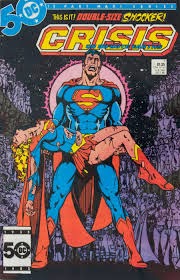


So in my re-reading of the series, its commercial motives are even more clear than they were in 1985: loose plot, innumerable guest-stars, and an extra-diegetic reason behind the cosmos-shifting changes. But even if all of these audience-stroking devices make COIE less than pleasurable to read, do they exclude the series from the realm of the creative "breakthrough?"

They do not, though the symbolic complexity of COIE is certainly compromised by all the commercial stuff. In this essay I pronounced a particular CHALLENGERS OF THE UNKNOWN story as "inconsummate" because, although it had some interesting mythic content, the story was rather half-assed, so that "the gears of the symbol-making machine" appear to be "a little out of whack." But I must admit that COIE, unlike a lot of the apocalypse-tales that emulated it, has a sense of the pathos involved in trading old worlds for new.

By "pathos" I'm not referring to Wolfman's tortured prose or Perez's frequent head-shots of characters' faces distorted in horror. I'm referring to the creators' references to figures of Judeo-Christian mythology, as seen through a lens superheroic, as evinced by the following:

(1) PARIAH. This is the first character who speaks diegetically within the COIE storyline. He is the only survivor of the first positive-matter earth to be destroyed by the series' villain, the Anti-Monitor of the negative-matter universe. He believes himself to be responsible, due to certain scientific investigations, for having unleashed the Anti-Monitor upon the positive matter dimensions. Late in the series, Pariah is exonerated of this crime. Nevertheless, as a consequence of his special destiny he keeps flitting from parallel world to parallel world, presaging the destruction of each world he visits, so that he becomes something of a conflation of the Biblical Jonah with the extra-Biblical legend of the Wandering Jew.
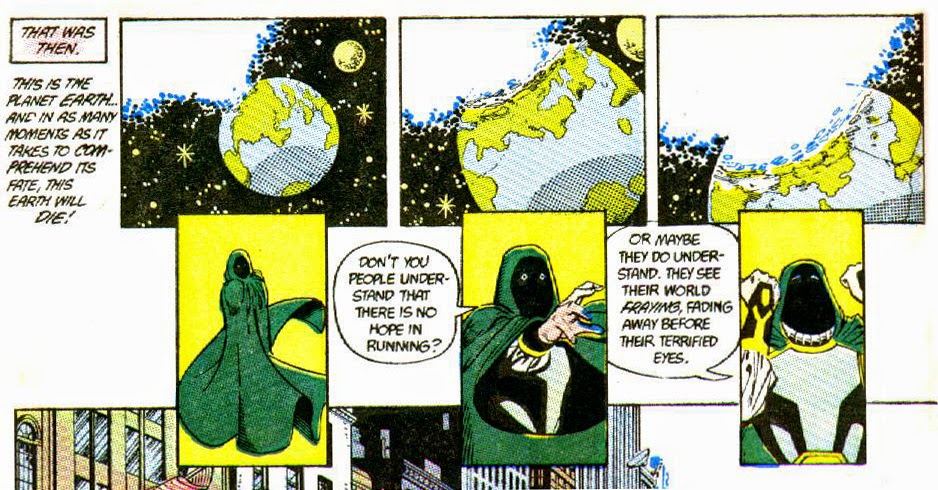


(2) THE HARBINGER.  This character is an orphaned Earth-woman raised as an adoptive daughter by the Monitor. Long before the COIE series officially began, the two of them were seen endlessly researching the affairs of DC Comics heroes, and COIE was the pay-off to that continuing mystery. However, only in COIE was it revealed that Harbinger's destiny was to become enthralled by the Anti-Monitor so that she would kill the Monitor. This destiny, however, turns out to be more or less stage-managed by the Monitor, much as Judas' betrayal of Christ is destined to accomplish the Crucifixion. Obviously, the Monitor's goals are far more secular in nature-- he wants his death to liberate certain energies to use against his enemy, sounding more like Obi-Wan Kenobi than Jesus. But this consideration doesn't nullify the potential symbolism of the Judas-archetype.


(3) ALEXANDER LUTHOR JR. Like Pariah, this character is a survivor of one of the worlds destroyed by the Anti-Monitor. He is the child of Lois Lane and a good version of Lex Luthor, but he survives via a method copied from DC's favorite Messiah, Superman. The child-- who grows to maturity in short order, like many folkloric "wonder-children"-- combines "positive matter" and "negative matter" in his body without their imploding. This "alpha and omega" constitution is, like the Monitor's sacrifice, principally a chess-move that can be used at a certain point to counter the villain's efficacy. Nevertheless, though he is the son of one Earth's Lois Lane and Lex Luthor, he vanishes from continuity by going into another (spiritual?) world, along with the original Superman and Lois Lane from the Golden Age. It might have been a good commentary on the "father, son, and holy ghost" trope if the creators hadn't decided to have a stray alternate-world version of Superboy go along for the ride.
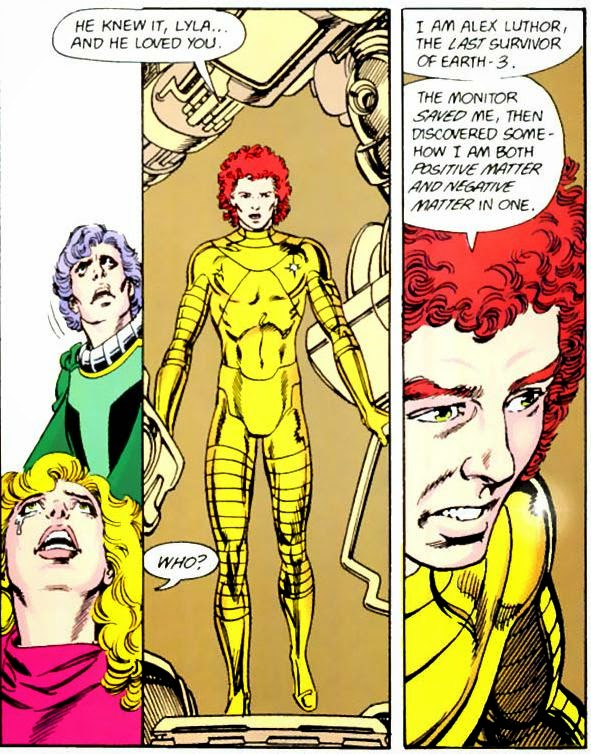


These three characters all play roles that bear a striking resemblance to characters associated with the Christian Passion. This observation does not speak to what either of COIE's creators thought about religion. COIE is a secular comics-story and all the Judeo-Christian allusions are secular as well, just as were (Jewish) Marv Wolfman's uses of Christian mythology in the TOMB OF DRACULA series. But the fact that Wolfman and Perez invoked such complex associations at all speaks to the likelihood that they were attempting to endow their commercial endeavor with the significance of a great mythic tale, rather than just tossing together a crock-pot full of super-dudes and letting the chips fall where they might. COIE is at best a jumbled mosaic, and I frequently don't feel that the whole was more than a sum of its parts, any more than DC's "new unified world" turned out to be.

But at least some of the parts proved interesting, which is more than most DC epics can say.