Featured Post

SIX KEYS TO A LITERARY GENETIC CODE

In essays on the subject of centricity, I've most often used the image of a geometrical circle, which, as I explained here,  owes someth...

Showing posts with label inu-yasha. Show all posts

Monday, January 19, 2026

MYTHCOMICS: ["KIKYO'S LIGHTS"] INU-YASHA (200?)

 This analysis of this long arc (18 chapters) is thematically tied to the one I arbitrarily titled KAGOME'S HEART, so reading that essay before this one is recommended. Chapter 17 of this arc is entitled "The Lights," and since none of the individual titles summed up what I wanted for an umbrella-designation, I'm using the overall title, KIKYO'S LIGHTS. Although the manga ran for roughly another two years, it's in this arc that Rumiko Takahashi brought to a close the romantic triangle between the undead priestess Kikyo, the living mortal girl Kagome, and the half-demon who loves them both.

In HEART, Naraku the demon-human hybrid launches a complicated plan to both eliminate his own human side's reluctance to kill Kikyo-- whom he once loved, and who has the power to exorcise him-- and to utilize Kagome's hostility to the priestess as a psychic (and psychological) weapon. Naraku's failure to do so in HEART merely moves him to a new elaboration of the same gambit. Takahashi also introduces, previous to LIGHTS, a subplot in which the heroic monk Miroku is poisoned in such a way that, though his life is saved (by Kikyo), he's in danger of imminent death whenever he utilizes his wind-tunnel power-- so naturally, throughout the arc he keeps being put in a corner, usually in defense of his beloved fighting-mate Sango. Also, the wolf-demon Koga, Inu-Yasha's rival for Kagome's affections, joins the demon-fighting team.


\


As the arc begins, Naraku possesses most of the shard of the Shikon Jewel. However, Kikyo has the power to banish the evil influence of the jewel, which would exorcise Naraku's evil as well. To compromise the undead priestess' power, he entraps her in near-invisible webs of mystic silk, webs that will also reach out to enfold Kagome and Inu-Yasha.
Kikyo attempts to get Kagome to purify her of Naraku's corruption by shooting the priestess with her own magic bow. Unfortunately, Kagome still holds a deep resentment of Kikyo's involvement with Inu-Yasha, and the mortal girl's divided heart causes the bow to break, so that it's useless. Kagome, Koga, Shippo, Sango and Miroku travel to a shrine atop Mount Azusa, where they can seek a new bow for the purification ritual. Inu-Yasha guards Kikyo, and in a separate subplot, Kohaku, brother of Sango, flees the agents of Naraku, seeking to capture him for the Shikon shards in his body.


  However, Kagome is separated from her freinds and taken into the shrine, which tests her to see if she's truly capable of the ritual. An illusion of Kikyo appears to Kagome while she hangs off a cliff, bearing the magic bow, though it seems incredibly heavy in her hand. The spirit taunts Kagome for her human failings. However, Kagome defeats the spirit's logic with her own: asserting her absolute conviction in the reality of the love between her and Inu-Yasha, which even his old love for Kikyo cannot sunder. As a result of Kagome's defiance, she gains control of the bow and is expelled from the shrine. Significantly, Inu-Yasha arrives on the scene in time to succor her.


 However, Kikyo is present at Azusa as well, and Naraku appears to sweep her up, taunting her with the nearness of her extirpation. Koga, who like Kohaku possesses Shikon shards in his body, assails Naraku, and Kikyo hopes she can use Koga's shards to purify the evildoer. Inu-Yasha and Kagome arrive, and while the half-demon battles Naraku, Kagome starts to purify Kikyo's wounds. But Kikyo tells her to hold off, and Kagome sees a vision of the Jewel inside Naraku's body. however, the Jewel then disappears, so that when Koga assaults Naraku again, he has no hope of exorcising the demon. 

   Kagome then realizes that Naraku transported the Jewel into Kikyo's body. The intrepid girl is able to shoot Kikyo and give her enough power to exorcise the Jewel, but Naraku withdraws the gem before the ritual can be completed, and he flies off, the Jewel still partly corrupted.


But Kikyo, who already died once before, has reached the end of her second life. She and Inu-Yasha say their farewells to one another, while the other heroes think about what she's meant to them. Her artificial body dissolves into a congeries of lights. allowing her the ability to say farewell to all of her noble allies.


In the final chapter of the arc, Koga has been stripped of the shards that gave him special powers, so he resolves to leave the group and return to his people. He shows his respect for his rival by irritating the hell out of the mourning Inu-Yasha, the better to snap him out of his funk, and he even loosely approves of Kagome's romantic choice. The chapter then winds up with the beginning of a new arc concerning Inu-Yasha's half-brother Sesshomaru. He, like Kohaku, has been kept out of the main action, and he accidentally-on-purpose becomes Kohaku's new protector in the wake of Kikyo's passing. I have not yet finished the entirety of the opus. Still, I'm guessing from this narrative's tone that for Takahashi this was the definitive end of Kikyo's story, which should make for a more complete arc for both Kagome and Inu-Yasha at the epic's final conclusion.   


Saturday, November 8, 2025

MYTHCOMICS: ["KAGOME'S HEART"] INU-YASHA (200?)

 I won't devote any time in this essay to detailing the basic setup of Rumiko Takahashi's INU-YASHA serial. I outlined those basics in both of the other essays on this property: THE BLACK PEARL and SECRET OF THE TRANSFORMATION. Further, the long arc I've chosen to label as "KAGOME'S HEART" commences only a handful of installments after TRANSFORMATION, so the INU-YASHA status quo remains largely the same, at least in terms of who's chasing who and the stakes of the seesaw battles of good and evil. 

In my analysis of TRANSFORMATION, I noted that it was made up of two long arcs-- each labeled according to one of the story-titles (according to the Viz translated editions), "The Third Demon" and "Secret of the Transformation." These two had in common Inu-Yasha's progress toward mastery of the magical sword Tetsusaiga, though they were interrupted by three other story-arcs only tangentially related to that theme. I simply chose to use the title of the concluding arc as an umbrella-title for both.

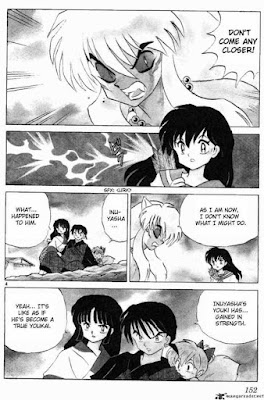
An additional complication is that the story translated "Kagome's Heart" is one of the installments present in the intervening arc "Kikyo's Crisis," in which, to repeat myself, concerns how "Kagome is tormented by seeing Inu-Yasha's feelings for his former lover," i.e., the dead priestess Kikyo, restored to a semblance of life by magic. Takahashi does not devote a lot of space to this "Crisis" arc, for she chose to let the emotions invoked in "Heart" simmer for quite some time, coming to a boil a little while after Inu-Yasha passed one trial by fire, only to face another with regard to the human girl he loves. Below are three illustrative pages from the "Heart" story:


The culmination of the "Crisis" arc is that Kagome tries to resign herself to Inu-Yasha's divided heart, obliging him to love both a living woman and a dead one. HEART-the-long-arc then comes back to this psychological conflict and combines it with the five heroes' efforts to destroy their nemesis Naraku and to gather together all of the shards of the Shikon Jewel. The group's sometimes allies-- Sesshomaru, the wolf-demon Koga, and Kikyo-- also have reasons for pursuing Naraku, though predictably enough Kikyo's entrance will unleash emotions that Kagome has tried to tamp down. As the arc begins, however, the five heroes only know that Naraku has somehow secreted himself so that they cannot find him, either to kill him or to take possession of his stolen Shikon shards. Their only clue seems to lead them to the legendary Mount Hakurei, alleged to have been the dwelling-place by a great monk, Hakushin. But Hakurei is so pervaded with spiritual energy that both Inu-Yasha and Shippo are adversely affected when they come close. So how can the evil Naraku be concealed therein?    


In addition, it's quite evident that Naraku has been busy, for seven dead mortal mercenaries have been restored (via Shikon shards) to undead status, implicitly to run interference for Naraku. Though Takahashi devotes a lot of space to Inu-Yasha's group battling the seven revenants-- each of whom has a deadly specialty-- I'll pass over them quickly, since the warriors are just there to keep up the needed level of spectacle for a shonen series. The revenant who has the most personality is the perverted Jyakotsu, who forms a homoerotic desire for Inu-Yasha, a desire that will only be satisfied when he cuts off the dog-demon's head. However, arguably the dog-demon really gets curbed by Kagome.


For some readers, it might be easy to mistake this scene for just another of Takahashi's many "irate-female-clobbers-insensitive-male" schticks. But there's a deeper dynamic here. In the short tale "Heart," Kagome confesses that she'll try to put aside her negative feelings toward her competition just to remain in Inu-Yasha's presence. But the rash hero wants to be held blameless for any pain he causes her, and that's what unleashes Kagome's ire. She's a woman in love who wants her loved one to be true only to her, and when he reacts to her sublimated resentments as if she had found fault with him, she uses her "sit command" power to punish him.     


 Takahashi eventually parallels Kagome's attempts at self-sacrifice with those of the Buddhist monk Hakushin. Once Kikyo manages to access Mount Hakurei, she meets Hakushin, who sought to become a "living Buddha" in order to help others after death. However, self-doubt infected the monk's resolve, and later Naraku suborned him, persuading him to let Naraku stay within the holy mountain. But Kikyo is able to assuage the monk's weakness, so that he's able to find peace.   


However, though the spiritual shield around Hakurai dissolved, Naraku accomplishes his purpose there: splitting off a part of himself, a sort of demon-baby. The baby, later named Hakudoshi, then seeks to take control of Kagome in order to utilize her ability to sense Shikon shards. The evil infant at first can't find darkness within the young girl's heart, until Kagome's negative feelings toward Kikyo come forth. However, even though Kagome feels resentment that Inu-Yasha left her side to search for a missing Kikyo, she successfully resists the demon-baby's spell with her love for Inu-Yasha, moments before he arrives on the scene. 


The spawn of Naraku escapes the hero's retribution, and once he's alone with Kagome, Inu-Yasha swears to never again leave Kagome for Kikyo. However, she realistically judges him to be incapable of deserting his former love-- who of course has further appearances to make in the ongoing series-- but the heroine manages to negate her natural irritation with her complete conviction in her own love. 

The INU-YASHA series takes place in a fantasy-version of Sengoku Japan, where Shinto gods and demons (or fictional versions thereof) intermingle with Buddhist monks seeking to transcend the physical world. I suspect that Takahashi's primary interest was the conflicts of the human heart. This is why, though she's respectful to Buddhist precepts, the artist is more concerned with Hakushin's failure than with his ascension to nirvana. But this is the core of her art, for in the words of G.K. Chesterton, Takahashi is, first and foremost, a poet who's in love with the finite, rather than a philosopher, whose abiding love is the infinite.   


Sunday, October 17, 2021

MYTHCOMICS: “SECRET OF THE TRANSFORMATION” (WEEKLY SHONEN SUNDAY, 1997)

Long after I wrote my first analysis ofan INU-YASHA narrative, I formulated my CATEGORIES OF STRUCTURALLENGTH in 2018. With those formulations in mind, I’ll now label Rumiko Takahashi’s “feudal fantasy” as a “basic serial,” in that the finished narrative consists of interpolated “stand-alone” stories, short arcs, and long arcs. The arc considered here, identified as SECRET OF THE TRANSFORMATION after one of the chapter-titles, is an extra-long arc that encompasses five other long arcs.


In my earlier summary of the series, I related only the factors that bore directly upon the arc under consideration, THE BLACK PEARL. Some of the things I omitted become more important in the TRANSFORMATION sequence, such as the fact that the two-person ensemble of half-demon Inu-Yasha and modern mortal girl Kagome expands to five principals. Thus for the balance of the narrative, the ensemble also includes demon-hunters Miroku and Sango, both roughly the same ages as the first two heroes, and a juvenile fox-demon, Shippo, who provides substantial comedy relief.


The quintet’s members are united by the desire to gather all the scattered shards of the Shikon Jewel and to keep the powerful shards out of the hands of both meddlesome mortals and rapacious demons. Many of the demons who menace the heroes are just one-off marauders, but there are also continuing opponents, In addition to the two ambivalent figures I mentioned in BLACK PEARL—Kikyo, a revenant version of a mortal woman Inu-Yasha once loved, and Sesshomaru, the half-demon’s hostile half-brother—there is also the series’ “big bad,” Naraku. Long before Kagome travels back to Sengoku Japan to meet Inu-Yasha and the others, the medieval bandit Naraku suffered injuries which brought him under the ministrations of the shrine-maiden Kikyo, then pledged to Inu-Yasha. Naraku lusted after Kikyo, and when he could not have her, he gave his injured body up to being consumed by demons, who molded him into a mortal-demon hybrid. In this form Naraku caused the death of Kikyo and the imprisonment of Inu-Yasha, until Kagome travels in time and releases the demon-youth from his magical confinement. From then on, Naraku continually hectors the jewel-hunters with dozens of plots, so that for its entire run INU-YASHA strongly resembles the scenarios of a RPG fantasy, with the heroes sussing out each new threat to their lives and managing to counter it.


TRANSFORMATION actually concerns two major changes at this point in the series. I mentioned in the BLACK PEARL summary that Inu-Yasha inherited from his late demon-father a magical sword, Tetsusaiga, and that throughout the series the demon-hero must learn all the ways in which the sword can transform itself through its occult powers. I left out the fact that when he first appears, Inu-Yasha is alienated from his mortal side and that he yearns to become a full demon—but that when he undergoes this “transformation,” it finds it’s not all its cracked up to be.


Some lesser transformations have already taken place: as mentioned before, Kikyo has returned as a revenant, pursuing her own obscure purposes. Sesshomaru, though as passionless as ever, allows a little human girl, Rin, to accompany him in his travels, possibly showing the demon’s potential for human growth, though he may be on some level imitating his half-brother’s penchant for acquiring human beings as allies. As for Naraku, he has just begun to unveil his most formidable talent. The villain, created from a congeries of demons, displays the ability to “split off” new entities from himself. Prior to TRANSFORMATION, he’s already used this process to create two other demon-allies, Kagura and Kanna, and the story that launches the long arc under consideration is entitled “The Third Demon.”


The ogre Goshinki, the newest of Naraku’s self-spawned servants, attacks Inu-Yasha and his allies. But when the hero wields Tetsusaiga, the ogre catches the huge blade in his teeth and snaps the metal to pieces. This not only deprives Inu-Yasha of his weapon, it breaks a preventive spell laid upon him by his late father; a spell to reign in Inu-Yasha’s demon-half. Inu-Yasha goes berserk with demon-rage and slaughters Goshinki, but now he presents a danger to his friends, even after he temporarily reverts to normal.


The swordsmith Toto-sai intervenes with some much-needed advice. He can fix Tetsusaiga—a blade carved from a fang taken from Inu-Yasha’s dead father—but only by pulling out one of Inu-Yasha’s own fangs to use in the sword’s re-construction. The smith fixes the sword, but he relates that Tetsusaiga is no longer powered by the magic of the hero’s dead sire, but by Inu-Yasha’s own resources—and thus the hero finds it much harder to wield the huge weapon. Meanwhile, Sesshomaru comes up with his own deviltry. He finds the dismembered head of Goshinki and forces a rogue smith to make a new sword from one of the ogre’s fangs—thus producing a new weapon, Tokijin. Sesshomaru uses the weapon to duel Inu-Yasha, only to be shocked when he senses his half-brother’s new demonic potential.


The fraternal conflict is put on hold when Inu-Yasha’s company is forced to deal with a new threat from Naraku. This plot comprises another long arc of stories, starting with the winsomely titled “The Fourth One,” and none of these developments directly relate to TRANSFORMATION’s master-thread. Somewhat more germane is an arc beginning with “Kikyo’s Crisis,” in which Kagome is tormented by seeing Inu-Yasha’s feelings for his former lover, though this arc largely exists to set up more developments down the road. An arc starting with “The Castle’s Ghost” then follows up on a plotline involving Sango’s brother having been suborned by Naraku.


Then we at last get to the story entitled “Secret of the Transformation,” wherein Inu-Yasha crosses paths with a minor marauding demon. After getting separated from his sword, Inu-Yasha again transforms into his full-demon form and mangles the marauder—but once more, he poses a threat to his own people. Sesshomaru chooses this moment to intrude on his brother’s life once more—and this time, there’s no question that Sesshomaru is capable of slaying the bestial version of Inu-Yasha. Yet the full demon spares his sibling, with the excuse that “there’s no virtue in killing a beast that doesn’t know who or even what it is.” Once Sesshomaru has departed, Kagome puzzles over his motives: “It’s as if he came to stop Inu-Yasha’s rampage.”


The puzzle of Inu-Yasha’s brother must wait for a future story, but Toto-sai finally reves what the hero needs to gain mastery of Tetsusaiga’s powers and thus of his own demon-nature. Inu-Yasha’s new quest is to journey to the place where his late father imprisoned a huge dragon-demon, Ryukotsusei, and slay said dragon. While in combat with this demon, Inu-Yasha is belatedly informed that his sire perished of wounds he took in the process of jailing the dragon. Thus, even though Inu-Yasha professes no goal beyond mastering his own abilities—a thing possible only if he can “surpass my old man”—the narrative of TRANSFORMATION inverts the conclusion of BLACK PEARL. In PEARL, Inu-Yasha accepted the last bequest of Tetsusaiga from the father he never knew. Here, despite claiming that “I wouldn’t waste even a drop of sweat avenging [my sire],” the hero performs the ultimate act of filial piety by slaying his father’s killer. And he does so after facing a “last temptation,” for he briefly casts his sword aside and becomes a pure-demon again to fight the dragon-thing. But he regains his purpose, reclaims the sword, and instinctively taps a new power from the sword, with which he obliterates Ryukotsusei. From then on, the accounts between the hero and his late father are squared, and Takahashi makes few if any references to either of Inu-Yasha’s parents in the rest of the continuity. Future stories continue to show Inu-Yasha finding new methods to employ his father’s bequest against his many enemies. But only once he’s discharged his last duty to his demon-father can Inu-Yasha pursue his own human destiny.


Monday, June 27, 2016

MYTHCOMICS: INU-YASHA [THE BLACK PEARL. 1997-98]


I've always thought Rumiko Takahashi's works get short shrift from American critics of manga. For American readers, Takahashi can be challenging simply because so much of her work is intensely wrapped up in Japanese themes-- theoretically, one of the reasons that URUSEI YATSURA failed to interest American audiences, because its humor was so imbricated with the author's cultural references. In contrast, RANMA 1/2 enjoyed a full publication in the U.S., possibly because its specific Japanese content was subsumed by the subcategory of fantasy-themed martial arts, with which American comics-readers were well acquainted.

Admittedly, Takahashi probably did herself no favors-- as far as ideological critics were concerned-- in that her two landmark serials followed the pattern of sitcom humor. Some of these episodic stories were as brilliant in their way as the better episodes of American sitcoms, but because of the episodic structure, it's easy for the diamonds to get lost in the-- well, not trash, but the less impressive pebbles.

While URUSEI and RANMA both included considerable magical fantasy-content, most of the concepts were "one-offs" designed to set up this or that joke. INU-YASHA, launched in 1996 and concluding in 2008, was Takahashi's first attempt to organize her fantasy-content into an epic structure, roughly akin to the prose fantasies of American and British authors.

INU-YASHA (sometimes translated as "dog demon") is named for one of its central heroes, a young male who exists in Japan's medieval "Sengoku" period, and who is a hybrid of a mating between a human female and a male "dog demon," both of whom have expired at the time that the series begins. The other primary character at the series' outset is 20th-century female teenager Kagome Higurashi, who finds herself transported by magical forces back to Inu-Yasha's time. Partly because Kagome is the reincarnation of a Sengoku sorceress named Kikyo-- who, before her demise, was the lover of Inu-Yasha-- Kagome becomes involved in Inu-Yasha's quest to locate all the pieces of a magical icon, "the Shikon Jewel." Even when Kagome gains the power to cross back into her own time, she continues to periodically return to the medieval fantasy-scape, not only out of a sense of heroic responsibility but also because the two young people have started to form the almost obligatory romantic attachment.


The set of stories I term "The Black Pearl" was the first time Takahashi gave her exploration of Japanese mythology a strong sense of psychological structure. By the time this storyline begins, Inu-Yasha and Kagome have just barely put aside their differences enough to start working together. As mentioned before, both of Inu-Yasha's parents and his former lover are all deceased, but the demon-youth's half-brother Sesshomaru-- seen above-- is still around, and he seeks out Inu-Yasha because Sesshomaru covets a special treasure left behind by the dead demon-father they have in common. To learn the location of the treasure, which Inu-Yasha does not consciously remember, Sesshomaru
presents his half-brother with what seems to be the spectre of Inu-Yasha's late mortal mother.


However, the spectre is actually a "nothing woman," a faceless demon composed of the spirits of mourning women who have lost children. The demon gains the secret Sesshomaru wants. But because she's begun to think of Inu-Yasha as her actual child, the nothing woman sacrifices herself for Inu-Yasha.


This doesn't deter Sesshomaru from plucking the secret he wants from Inu-Yasha's head-- or more specifically, from his eye.


The black pearl that the full-demon brother steals transports him into another world, the otherworldly tomb of the demon-dog father of both Inu-Yasha and Sesshomaru.


While the medium of comics is replete with all sorts of weird fantasy-dimensions, the idea of the two Japanese heroes being forced to root around within the skeleton of a dead demon is one of Takahashi's most psychologically astute fantasy-concepts. (Sort of the inversion of Freud's notion of how all individuals carried the "family romance" around in their heads.)

Within the skeleton-structure, Sesshomaru finds the treasure he seeks: a magical sword named Tetsusaiga, stuck in the earth. In a clever reversal of the Excalibur trope, neither of the brother-rivals can draw the sword, but Kagome can.


I won't go into detail regarding the conclusion of the first battle between Inu-Yasha and Sesshomaru over the sword, for Takahashi doesn't truly resolve it. Both Sesshomaru and the sword continue to play major roles in the long-running series, so the termination of "Black Pearl" is more in the nature of a stand-off.

Throughout the series proper, Inu-Yasha continually seeks to master all the magical powers of Tetsusaiga. This part of the demon-youth's spiritual journey no doubt bears some comparison with other Japanese narratives about heroes mastering sword-craft, real or fantastic. But perhaps because Takahashi herself is female, she's careful to arrange the sword's purpose as one that indirectly reinforces Inu-Yasha's protection of, and bond to, Kagome.

Interestingly, though Inu-Yasha's mother and father do not make literal appearances in the series, it might be argued that negative symbolic versions of such figures appear. Sesshomaru may be viewed as a displacement for a hostile father-figure, in that he is a pure demon and older than Inu-Yasha. In addition, the deceased mortal sorceress Kikyo-- once Inu-Yasha's paramour-- is reanimated with all of her charms-- which are largely the same as Kagome's, since the two females are "related" through the vehicle of reincarnation. I view the "nothing woman" as an anticipation of the role Kikyo plays throughout the series, though instead of being a maternal figure to Inu-Yasha, Kikyo is more in the nature of an "older sister," who overshadows teenaged Kagome with her superior wisdom and maturity. Thus Takahashi's very freewheeling exploration of traditional Japanese mythology is also the medium through which she explores her most frequent theme: that of the enduring sturm-and-drang of male and female.