Featured Post

SIX KEYS TO A LITERARY GENETIC CODE

In essays on the subject of centricity, I've most often used the image of a geometrical circle, which, as I explained here,  owes someth...

Showing posts with label popeye. Show all posts

Wednesday, November 15, 2023

MYTHCOMICS: "LONG LIVE THE KING" (POPEYE, 1932-33)


Though the popularity of Popeye had already hit new heights three years after his introduction in E.C. Segar's THIMBLE THEATER, 1932 also provided the one-eyed salt with a new venue, as he made the transition to animated theatrical shorts. As many before me have mentioned, the mere fact that Popeye had just had a week-long battle with a pirate named Bluto resulted in this one-shot comics villain becoming ensconced as the go-to evildoer for the cartoons.

The Bluto arc and the one after it were just business as usual for Segar, wherein he would generate some loose concept and use it as an excuse for an assortment of gags. However, the arc after the arc that followed Bluto's managed to form the gags into a spoofy satire of politics. 


The post-Bluto arc involved Popeye and various other characters rendering aid to King Blozo as he sought to harvest gold from a sunken city in order to solve the economic problems of his postage-stamp kingdom Nazilia. (Whatever the origin of the name, I think it's unlikely that Segar derived the country from a notorious German political party.) However, in Blozo's absence his foremost general Bunzo tries to take over the throne. After being ejected, Bunzo forms a new scheme, hiring a hot young foreign woman to vamp Blozo. Her name is "Dinah Mow," eventually explained by her ability to "spark." 


Bunzo only wants Dinah to trick Blozo with the idea that she'll become his queen later (despite the fact that Bunzo is married). But Dinah pitches some woo in Popeye's direction as well. Despite his intention to remain true to his sweetie-pie Olive Oyl, Popeye does yield to the "vampirate's" blandishments. "I thought I could resisk ya by bein' a man of steel, and here ya happing to be a woman fulla magnetism. Arf! Arf!" Olive rails against Popeye, who makes no excuses for his waywardness, though to be sure the sailor's idea of "sparking" is to sit holding the vamp's hand. Dinah conveniently decides she's really in love with Popeye but leaves Nazilia of her own accord.


Blozo's own citizens are still not very impressed with his kingship, so Popeye suggests that Blozo hand out a big nugget of gold to each of his subjects. However, in the tradition of welfare states everywhere, Blozo then finds that no one in Nazilia wants to work for a living. At first Blozo thinks he'll simply tax everyone heavily, but Popeye has a quicker solution: using his skill with dice to turn everyone back into paupers.


But Bunzo challenges Blozo in an election. This is one of the funniest sections, in that Popeye, despite his notorious intregrity (intekrity?), cheerfully tampers with the ballot-box as much as Bunzo's agents do. 


Despite all this perfidy, Bunzo appears to win the election, and he demotes Blozo to office-boy. Bunzo's wife then decides to exert her queenly powers, bringing "dance boys" into the palace. However, Popeye finds a bunch of uncounted votes and Blozo returns to the throne. Bunzo threatens revolution, but Popeye buys off the rebels by tossing gold nuggets at them, so that they fight one another over the gold. In other news, Olive copies Dinah Mow by dolling herself so that both Popeye and Blozo don't recognize her but still pitch woo to her. When she removes her false face, Popeye is duly ashamed of his faithlessness-- for a while, at least.

The master-thread of this arc comes down to "everyone's a dick," but Segar puts across the moral failings of all the characters with such joie de vivre that KING remains a sprightly comedy rather than a depressing irony. In contrast to some of Segar's other arcs, Popeye doesn't perform any marvelous feats, though he's seen to be strong enough, even without gimmicks, to hit a guy hard enough to send him flying out a window.


Friday, November 10, 2023

NEAR MYTHS: MARS ATTACKS POPEYE (2013)


I wasn't paying much attention to current comics in 2013, so I was unaware that IDW had released five or six one-shots that crossed over the franchise MARS ATTACKS with other properties. I came across MARS ATTACKS POPEYE, and though there's not a lot to say about it, it's a pleasant callback to both franchises. The Martians attack the Earth of Popeye's universe, and the sailor-man's old enemy The Sea Hag abets their wave of conquest. Mad genius Professor Wottaschnozzle comes up with a way to nullify their disintegrator  rays, so that the rays only annihilate clothing (but only to a decent level!) Thanks to this leveling of the playing field, Popeye and his irascible daddy Poopdeck Pappy eat their spinach and drive the skull-headed raiders back into space.

ATTACKS is moderately amusing though not laugh-out-loud funny, and is primarily admirable in that writer Martin Powell shows great facility in emulating the voices of Popeye and several of his cast-members, some of whom may be appearing for the first time in a 21st-century comic. Terry Beatty's style is more openly "bigfoot" than Segar's but he's faithful to the designs without being slavish. It might've been amusing to contrast the Old World feel of the Segar strip-- created when a huge portion of American comics-readers were immigrants-- with the "space-age" vibe of the Martians, but one can't have everything.

Saturday, August 27, 2022

PERSONA-TO-PERSONA CALLINGS

 In ONCE AND FUTURE STATURE (AND CHARISMA), published on 7-27-22 I made the following inexact statement: 

Lee had Foswell return to crime as an ally to the newly minted Kingpin-- only to be killed by the Kingpin's thugs for trying to protect Jameson. This might be deemed a demi-crossover of the charismatic kind, since Foswell had some escalation-charisma even as a support-figure, and the Kingpin had none until he appeared often enough to become a familiar figure.

I added a note to the blogpost to the effect that I would trash this opinion in another essay, and this is it.

The problem with my previous formulation is related to my ongoing theory of personas, given its final form in 2012's DIAL D FOR DEMIHERO PART 1. I feel as if I've implied, though never stated outright, this necessary rule:

"When dealing with icons who originate within the cosmos of a given series, there can be no charisma-crossovers except between icons belonging to the same persona."

An example: within the Batman series, Commissioner Gordon and the Joker have existed almost the same number of years, and have frequently appeared in the same stories. Both characters are Subordinate Icons to Batman, but there's no charisma-crossover between the two Subs as there is when the Joker appears in a story alongside another villain, such as the Penguin or Two-Face.


To return to the Spider-Man cosmos once more, Fred Foswell may have started out as a super-villain, but he spends the majority of his career as a demihero in the Lee-Ditko stories, wherein he's reformed and become a crusading reporter, generally being of aid to Spider-Man or the police but only with the limited actions of a demihero. Lee and Romita change him back to a villain who conspires with the Kingpin, probably because neither creator cared anything about Foswell and simply wanted to be rid of him. Nevertheless, Foswell's gratitude toward J. Jonah Jameson causes him to betray the Kingpin to save Jameson, which means that his brief conversion back to villainy was less than consequential in summing up his character arc. So Foswell dies, according to my system, a demihero.

So by my newly stated rule, Foswell might in theory interact with another demihero in the SPIDER-MAN cosmos, and that might be a charisma-crossover. Nevertheless, such a crossover would have to have something unusual about it, rather than just Fred Foswell bumping into Betty Brant or Jonah Jameson in the news room. For that matter, Foswell bumping into any of Peter Parker's college-chums-- which I don't believe ever happened-- would also prove inadequate to sustain any charisma. Now, if Stan Lee had written a bizarre story in which Fred Foswell was revealed to be the real father of Flash Thompson, then THAT might be a charisma-crossover, but even then it would be largely because the two characters had spent a long time in the Spider-cosmos acting independently of one another. 

In some of my earliest writings on crossovers, I distinguished between "static crossovers" and "dynamic crossovers." I won't repeat those particular observations, but the salient aspect of that theory was that the static crossovers were those that were fairly regularized, like Donald Duck appearing in Uncle Scrooge's feature, while dynamic crossovers were those that spotlighted a more unusual meeting, say, of Spider-Man and Daredevil. I would now tend to state that, in contrast to the crossovers of the other three persona-types-- of heroes, villains, or monsters-- demiheroes only sustain crossovers of a dynamic kind, because most of them function as support-characters. Returning to the Batman cosmos, a story in which Alfred simply met police detective Harvey Bullock would not be a dynamic crossover. But if the two of them joined forces to accomplish some mission, as the characters did in an episode of "Gotham," I would consider that a charisma-crossover. This principle builds on what I said here about viewing the meeting of two URUSEI YATSURA support-types as a charisma-crossover, because they immediately challenge one another.


Now crossovers of demiheroes from different universes are a different matter, since those are dynamic by definition. On my blog OUROBOROS DREAMS I devoted a post to a multi-demihero crossover, a TV-cartoon entitled POPEYE MEETS THE MAN WHO HATED LAUGHTER. Although the humorous hero Popeye is the star of the show, he's conned into bringing together a few dozen characters from funny comic strips, all under the aegis of King Features Syndicate, and including both famous types like Blondie and Dagwood and near-forgotten types like Snuffy Smith. Some "serious" heroes are mixed in as well, but almost all of the crossover-characters are of the demiheroic persona.

Similarly, there's no problem crossing over demiheroes with other persona who originate in separate conceptual universes. When DC Comics finally brought back their late sixties character Brother Power, who belongs to the "monster" persona, they did so in 1989's SWAMP THING ANNUAL #5. But the Brother didn't cross paths with the monster-protagonist of the feature, but with two of Swamp Thing's support-characters, Abby Arcane and Chester Williams. A crossover with Swamp Thing would have been a stature-crossover, but Brother Power meeting Swamp Thing's friends only works on the level of cosmic charisma.


Wednesday, August 29, 2018

THE READING RHEUM: THE ENCHANTED SCREEN (2011)


I'd read one or two works by Jack Zipes before sampling THE ENCHANTED SCREEN, and to say the least his heavily Marxist interpretations of fairy tales were not to my taste. Still, SCREEN was touted as the first extensive survey of cinematic fairy-tale adaptations, so I couldn't resist giving it a try.

Although the book's subtitle is "the unknown history of fairy-tale films," my word "survey" applies better than "history," which implies a tracing, whether synchonic or diachronic, of developments over a timespan. Zipes' first chapter sets forth his theoretical preferences. Then, in the next four chapters, he (1) excoriates all of the fairy-tale works of the Walt Disney company, (2) champions the greatness of George Melies, and (3) provides quasi-histories of short fairy-tale cartoons and of feature-length animated fairy tale films. Live-action fairy-tale films are discussed in later chapters, but they don't get this summary treatment. The rest of the book is somewhat in the diachronic mode, as Zipes devotes whole chapters to cinematic treatments of particular fairy tales, such as "Cinderella" and "Snow White," or to general topics of academic interest, such as the lugubriously titled "Between Slave Language and Utopian Optimism." In a prologue Zipes admits that he simply didn't have room for some subjects, such as adaptations of the Arabian Nights.

What Zipes finds plenty of room for-- over and over and over again-- are his aesthetically hollow validations of only those works that conform to his Marxist dialectic. On the first page of the book proper, Zipes describes his priorities.

Fairy tales hint of happiness. This hint, what the German philosopher of hope, Ernst Bloch, has called the anticipatory illumination, has constituted their utopian appeal that has a strong moral component to it.

Much in the same vein as a similar Marxist work, Rosemary Jackson's FANTASY: THE LITERATURE OF SUBVERSION, Zipes' survey celebrates fantasy for purely utilitarian purposes, in line with the Marxist project of restructuring corrupt society. Thus, a fairy-tale story that has "a strong moral component" gets the Zipes stamp of approval, but if it in any way supports the bad old bourgeoisie, it gets condemned to commodification hell.

Here's Zipes clarifying that what he doesn't like about the bad fairy-tale films, i.e. almost everything done by Disney, because they're not "carnivalesque" in the sense of the word coined by Mikhail Bakhtin:

Fun is cotton-candy, fluffy, sweet, and without nutrients. It is the staple of all banal products of the culture industry up through the present. Fun has nothing to do with carnivalesque laughter... for the carnivalesque fairy tale ridicules fun and provokes reflection and self-reflection-- p. 56.
The idea that one should divorce "fun" from any concept related to carnivals-- which are, by the bye, a great source of cotton candy-- is not redeemed by such Marxist moralizing as "a questioning of the hierarchical arrangements of society" and so forth.

The real-world history of applied Marxism does not exactly suggest that it can deliver on its "utopian" anticipations. At best, Marxism has provided critiques of particular manifestations of social corruption, but so far its perfect society, like More's original utopia, exists in "no place." Thus, for someone who advocates fairy-tale works that are "reflective," Zipes is pretty unreflective about his discriminations. For instance, he validates most of the Fleischer Brothers' fairy-tale works, particularly those starring Betty Boop, since Betty is the picture of a harried working-girl. But for paltry reasons he dismisses three long Popeye cartoons of the late 1930s-- wherein the sailor-man encounters such entities as Sinbad, Aladdin's genie and the Forty Thieves-- largely because Zipes thinks the Fleischers were trying to emulate the works of Disney, that evil emissary of the culture industry. I would say that there's nothing in the Fleisher history more "carnivalesque" than one scene in POPEYE MEETS ALI BABA'S FORTY THIEVES. Popeye, facing off against the nasty Abu Hassan (Bluto in Arabesque gear), somehow steals the villain's longjohns off his fully clothed body, and then remarks:


"Abu Hassan got 'em any more."


Clearly, Zipes only likes moral arguments he agrees with. Of other non-Disney works that he faults is Jacques Demy's 1970 DONKEY SKIN, because "it is unclear at the end of the film whether Demy winks at the serious nature of incest." Demy's film might have some problems, but I find it ironic that Zipes dismisses it, simply for not being overtly serious about the subject of incest, given that many of the actual oral stories in the "Donkey Skin" tradition don't supply a pellucid moral. Thus, in Zipes's world, the foremost requirement of the carnivalesque is-- seriousness.


The most that I can say for THE ENCHANTED SCREEN is that it should introduce readers to many, many fairy-tale adaptations that aren't well known to Americans. But the tired recitation of nearly every Marxist cliche-- from "culture industry" to "commodification" to "appropriation"-- renders most of Zipes' observations less than illuminating.

Monday, August 7, 2017

MYTHCOMICS: "THE MYSTERY OF BROWNSTONE HALL" (THIMBLE THEATER, 1930)


If this sequence of THIMBLE THEATER hadn't been given a title in this collection of Popeye's first adventures, I might have called it "the Beginning of the End for Castor Oyl."

As many comics-devotees know, Popeye was a late-comer to E,C. Segar's 1919 strip. The earliest incarnation of THIMBLE THEATER starred Olive Oyl and her boyfriend Ham Gravy, whose comical adventures included burlesques of stage "mellerdramas," including a villain who was something of a mustache-twiddling "Snidely Whiplash" type. Castor Oyl, Olive's enterprising but none too swift brother, was introduced in 1920 and seems to have become the strip's principal star until that fateful day in 1929 when Castor needed a sailor for one of his enterprises, and met a 40-year old gob with one eye and swollen-looking forearms.
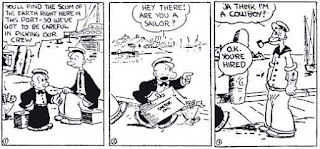


The 1929 introduction of Popeye works both as a straight adventure and a burlesque thereof, and Segar gets a lot of mileage from the relationship of wheeler-dealer Castor to the plain-spoken sailor. Though Segar originally had no plans to keep Popeye around, allegedly readers protested Popeye's leavetaking at the end of the first story, so Segar brought him back and the sailor-man never left again. Eventually it was Castor Oyl who was edged out of the strip, though it may be that his "con artist" persona was channeled into J.Wellington Wimpy, who joined the strip in 1934.

THIMBLE THEATER's first few Popeye sequences make for good "near myths," especially a storyline featuring the first appearance of the sailor's recurring foe, the Sea Hag. This one starts with an excellent sense of creepiness when Popeye and Castor are obliged to seek sanctuary on the forbidding Black Barnacle, the ship of the Sea Hag. However, the story turns into a simple piracy yarn, with the villainess attempting to get hold of a cache of diamonds. However, the tale is the first time Popeye goes toe-to-toe with a bruiser twice his size. the Sea Hag's henchman Jabbo. For the next eight years of his life, Segar never tired of pitting the sailor-man against big overconfident brutes, whom Popeye would usually demolish with small effort-- all without any overt reliance on the consumption of spinach.
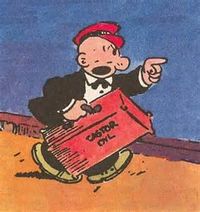

Segar probably realized that he had a hit in Popeye, but he wasn't quick to dump Castor after some nine years. He may have even realized that his team-up between a tall fellow and a runt had a nodding resemblance to Bud Fisher's MUTT AND JEFF, an insanely popular comic strip in the 1920s, though the order of appearance in that strip had been the opposite to Segar's: Mutt came first, and Jeff came following after. But Segar showed a greater psychological acuity than Fisher for playing his disparate characters off one another. Popeye was a hardened brawler, quick to fight at a moment's notice, but not too smart. Castor was usually a born coward, but he had enough wit to play on Popeye's insecurities and lack of sophistication. Popeye often complains about the "insulks" he receives from Castor, but he hardly ever responds with violence against the shorter man. Though I've not yet read the ensuing Fantagraphics collections of THIMBLE THEATER, it looks to me as if Segar was painting the duo as a partnership between "Brawn" and "Brain."
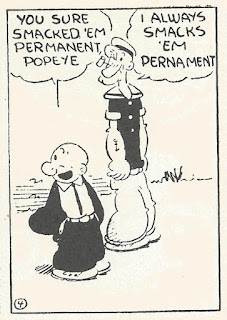


This is most evident in the most mythic tale in the first collection, "Mystery of Brownstone Hall." For the first time Segar places the duo in the position of mystery-solvers, when the owner of Brownstone Hall wants them to find out what's going on at his house. The owner rented the house out to a scientist, Doc Wattley, but a mysterious "dead circle" manifested around the house, making it impossible for anyone to come near it. All of this took place fifteen years ago, and Wattley has never emerged from the house. One spectator-- in the employ of the story's villain-- has kept tabs on the house with a telescope all that time, and reveals to Castor and Popeye that Wattley is still in the house, but that he mysteriously has not moved from a fixed position for all those years.

Popeye is very much at a loss to deal with these abstruse matters. His only response to the "dead circle," which kills plants and ennervates humans who approach the house, is to blame "evil spiriks." Castor is the real hero, who deduces a way to enter the forbidding domicile, while Popeye provides comedy relief with his superstitious fears. Not surprisingly, since a scientist is involved, there's a scientific rather than a supernatural resolution to the mystery, involving not only suspended animation but spirits switching bodies, as well. I'd be curious to know what if any pre-1930 SF-stories might have influenced Segar in these inventive uses of science-fiction tropes-- though to be sure, Segar doesn't really ground his story in the known technology of the time.


"Mystery" would never be a high-resonance mythcomic based on its cosmological content. However, the psychological interplay of Popeye and Castor is a different story. Even before this sequence begins, Segar has forged a strong friendship between the mismatched pair. The artist makes it clear that they need one another. Castor's original need for Popeye's skills and fighting-abilities evolves into a loyalty toward the language-mangling gob, while Popeye, despite his tendency to beat up people who offend him, likes Castor enough to tolerate Castor's insults and bossiness. That said, the sailor isn't too moral to tell the occasional fib, for he tries to take credit for solving the mystery of the Hall, though he's little more than a stooge to Castor throughout the sequence. Future readings of the collections may bear out my suspicion that the duo's detective career didn't last much longer. This sort of Castor-centric story wouldn't have satisfied the readers who wanted to see Popeye haul off and slug bullies, and in time Olive Oyl and the aforementioned Wimpy became the sailor's partners in his comical misadventures.

Still, "Mystery" is one of the few stories that makes Segar's original protagonist more than just a catchpenny fall guy-- proving that there were times that Castor Oyl wasn't at all hard to take.