Featured Post

SIX KEYS TO A LITERARY GENETIC CODE

In essays on the subject of centricity, I've most often used the image of a geometrical circle, which, as I explained here,  owes someth...

Showing posts with label politics. Show all posts

Sunday, September 21, 2025

KEEPING VS. SHARING PT 3

 In my previous recent essays, I've been examining the way two ethical systems, the Ethos of Keeping and the Ethos of Sharing, have interpenetrated human history in the past and continue to do so. principally through their modern manifestations as "conservatism" and "liberalism." However, I added a couple of subdivisions to the mix. Keeping and Sharing can both manifest into extreme forms, both of which can be subsumed under "radicalism." The less extreme forms of both are best described as "meliorism"

Routine political discourse often distinguishes between radical and meliorist forms of liberalism. In the meliorist form, the ethic recommended to those that hold power can be summed up as "You Should Share" such things as rights and privileges with those that do not have (or do not think they have) said capacities. In the world of American civil rights, it's almost de rigeur to name Martin Luther King Jr as an exponent of persuading powerholders to cede power to the marginalized. In the radicalist form, the prevailing argument says, "You Must Share" and the best-known advocate from the same Civil Rights era, Malcolm X, favored the stick rather than the carrot.

Conservatism, though, displays the same two subdivisions. Liberals are usually only able to recognize the extreme form, so that everyone from the KKK to the guy running the Christian cake-shop are viewed as equals in tyranny. Naturally there are specific agents who want to Keep Power under all circumstances and cede nothing.  However, meliorist conservatives display the ethic that "You Should Share," albeit only under the right conditions. Franklin D. Roosevelt earned the reputation of a Liberal for measures like empowering the Fair Employment Practice Committee. Yet, the act of interning Japanese-Americans was fundamentally a conservative act, even if one takes the most charitable view of FDR's action.

And so I come to my first fictional example, that of the opposition between meliorism and radicalism seen in SPIDER-MAN #68-70 (dated January, February and March 1969). Yet to examine this scenario, a little grounding is necessary, since the conflict revolves around one of Spider-Man's support-cast, Joe Robertson. Though introduced in ASM #51, not until issue #55 does Stan Lee set up the newsman's role as a regular character, where he's a voice of reason as against the mule-headedness of publisher J. Jonah Jameson. He's also the epitome of a Liberal meliorist view: Joe Robertson ascends to his position of authority purely on the basis of merit. 

Jumping forward a year and some months, Joe's son Randy Robertson is briefly seen in ASM #67, but only in #68 do we see Randy's purpose: to show Stan Lee's negative view of radicalism. Thus, almost as soon as Peter Parker encounters Randy on the campus they both attend, up comes the shadow of Randy's friend Josh-- who, since he never has a last name, might as well be called Josh X.


Though Lee was often criticized for the piddly nature of the "campus protest" involved here, he shows considerable acumen in showing how militant Josh X is. There's no "hey, how they hangin,'" just, "are you joining the cause?" Lee obviously means readers to find Josh abrasive here and later, even though Peter Parker nominally approves of his cause. The campus protest will tie into Spider-Man's adventure with his frequent foe The Kingpin, but the cause is less important here than showing how Randy, the offspring of a meliorist parent, is being influenced by a radical who demands that the campus authorities "Must Share," while said authorities are taking the radical conservative posture, presumably currying favor with alumni to garner donations (though Lee does not say this).

Josh X is even less appealing in his second scene in the story. Though Randy is the first to invite Parker to help the students fight the good fight, Josh not only acts like Parker owes him allegiance, he addresses a near-stranger as "Whitey" as if he doesn't owe Parker the slightest courtesy. Stan Lee doesn't have Parker react to the racial slur, but rather to Josh's statement that the young militant doesn't think he has to listen to, or account for, the response of the authorities to the protesters' demands. On the next page, an unnamed Black protester casts aspersions on Randy for being "the son of an Uncle Tom," and Josh, for whatever reason, defends Randy as a "soul brother." But it's not hard to imagine Josh flinging the same insult if Randy failed to follow Josh's lead.

The battle between the spider and the gang-lord continues into ASM #69 and #70, but Stan Lee devotes just a handful of scenes to winding up his mini-debate about meliorism and radicalism. In the first of the two scenes above, Joe is aghast that a son of his was involved not just in protest, but in causing damage to personal property, which is something neither Randy nor Josh apologizes for. (In the next issue, Lee changes his mind and says no damage was caused by the protesters.) Randy, probably channeling whatever Sidney Poitier movies Stan had seen, complains that he has to be more "militant" because his meliorist father is part of "the White Man's establishment." Joe makes the more reasonable argument about proving oneself, though oddly, Josh gets the last word, claiming that "we" (meaning Black people) won't get anywhere unless they "kinda shake Whitey up a little." Given that Stan Lee was almost certainly a meliorist, it's fairly generous that he at least acknowledges the rationale of the radicalist in this issue. In #70 the voice of the "Must Keep" authority is at last heard, as the dean admits having failed to listen to the voices of his students, and that he was on their side but was busy fighting the real entrenched interests. the college's trustees. Josh admits the need to think about things a bit more, but no one's ever privy to his thoughts since I don't think he ever appears again.  

So in this late 1960s tale, some respect is accorded the "You Must Share" ethos even if the "You Should Share" is clearly the superior ethic. Yet what about one of the principal franchises of the era of identity politics?


The 2018 MCU film BLACK PANTHER presented audiences with a world where "You Must Share" is the only game in town. However, it's not a power structure based on the racial politics of America. Rather, Wakanda, an idealized African fantasyland, is called upon to pledge fealty to the radicalist ethos. In a loose way Wakanda is also governed by an Ethos of Keeping, though it's implied to be a world without the racial divisions found in the outside world, only a heritage of tribal quarrels that can be solved with rituals of combat. Wakanda keeps its miracle element vibranium out of the hands of the powerful and the powerless alike. However, their isolationism takes a major blow thanks to a poor relation of the realm's hereditary ruler, The Black Panther.   


Considering that T'Challa's uncle N'Jobu is critical to the end of Wakanda's isolationism, the character is barely more than a bare function of the plot. We are never told what radical influencer managed to persuade N'Jobu, brother of the reigning Wakandan king T'Chaka, to betray his country's policies and try to sell weapons to radicals in that hotbed of political activity, Oakland. Nor does the film tell us why T'Challa is so traumatized by the death of his traitorous uncle. N'Jobu's main purpose in the movie is to spawn Erik Killmonger, whom many critics described as the film's "real hero." Even though Killmonger takes over Wakanda with zero concern for its people and with the agenda of using their weapons for his network of blacktivist conspirators (also never defined), all that counts is forcing Wakanda to Share with the downtrodden, "By Any Means Necessary." Of course, Whitey is still the main villain even when no White person is directly involved in Killmonger's plans. Thus CIA agent Everett Ross is automatically a "colonizer" according to one of T'Challa's guardians. Yet none of the Wakandans uses that term for Killmonger, even though he's applying CIA tactics to ruin their country for his own agenda. Even though Killmonger dies, he succeeds in ending Wakanda's isolation. And the audience knows this must be a good thing because the nation starts donating money to American Blacks-- who I guess are supposed to be way worse off than all the impoverished tribes of real-world Africa.            

It's clear from BLACK PANTHER that without any sort of compensatory ethos, the radicalist ethos loses all control of whatever moral compass it might potentially possess. I would like to think that PANTHER's success at the box office was a short-lived anomaly, since most of the radicalist MCU movies since then have tanked. But as another famous Liberal-with-Conservative-tendencies observed, "the price of freedom is eternal vigilance."                 


Saturday, September 20, 2025

KEEPING VS. SHARING PT 2

 In Part 1 of this essay-series, I offered a broad characterization of the two political philosophies, conservatism and liberalism, as overt manifestations of two deeper ethical systems, the Ethos of Keeping for the first and the Ethos of Sharing for the second. I also showed just a few historical examples of how the two systems interwove, but here I'll focus on how they played out in two historical periods, the 1960s "Civil Rights" era and the 21st-century "identity politics" era, and I'll use illustrations taken more from fiction than from history.

I commented in Part 1 that the pietistic religions strongly emphasized the Ethos of Sharing, but there were different degrees of emphasis. Early Christianity did not suggest that all slaveholders should free their slaves-- even though the Jewish custom of Jubilee at least indicated that this was a beneficial act-- but rather enjoined slaveholders to treat their slaves with charity and humanity. Thus the message to conservatives here was "You Should Share." At the same time, Christianity was founded upon the template of the Old Testament, which sometimes put forth the countervailing message, "You Must Share." One can see this illustrated by the Exodus story of Moses and the Pharaoh, in which Pharaoh's desire to "Keep" the Jews as slaves was finally overthrown by God's will that the Jews must be liberated. Pharaoh himself represents the extreme of conservatism, that of "You Must Keep" one's perceived property no matter what. Yet, going back to the slavery-rhetoric from early Christianity, some masters followed a milder version of Keeping, which I'll call the commandment "You Should Keep," unless one sees a good reason not to do so. Within this form of ethical compass, even if one decides to liberate this or that meritorious slave-- as Philemon releases Onesimus in the Epistle of Paul-- that does not mean that the slaveholder releases all his slaves, or renounces the belief that slavery is a perfectly normal societal practice.

Vaulting over centuries to the American Civil Rights era, it's possible to see these commandments on both sides of the liberal/conservatism spectrum manifesting in the political persuasions often called "meliorism" and "radicalism." The radical conservative swears by the commandment "You Must Keep," which resulted (for one example) in banning free Blacks from being educated in any way, for fear that they might have a better chance at escaping a second-class citizen status. The meliorist conservative, swearing by "You Should Keep," by contrast would be okay with allowing Black Americans to be educated in Black schools, but would still want Blacks to stay within certain boundaries. The meliorist and the radical attitudes with respect to liberals have received much more commentary. The meliorist liberal wants to work within the system, to prove that he deserves a seat at the table on the basis of merit-- again, telling conservatives "You Should Share." The radical liberal insists that, on the basis of past treatment, the whole table should be overturned so that only his people (and maybe some fellow travelers) can be seated, telling conservatives that "You Must Share," even to the extent of beggaring oneself.

I'd originally planned to address my fictional examples in this post but now it seems to me that the length of the post will become ungainly, so I'll hold the rest for a Part Three.           


Thursday, September 18, 2025

KEEPING VS. SHARING


 It's now a week and a day since the assassination of Charlie Kirk. I'd heard his name off and on but only had become aware of him in the last month, thanks in large part to SOUTH PARK. I don't regularly watch the show but some podcast on YT featured Kirk reacting to a 2025 SP episode. From the clips shown, the show spoofed Kirk by having Cartman give extremely racist speeches, supposedly modeled on those of Kirk. The real Kirk was highly amused by SP's hyperbolic satire, and he stated something to the effect that he felt he'd "arrived" by getting lambasted by the famous teleseries.  

The SP episode may have been clever or stupid, but it falls within the realm of art, and so it can't be judged as pure political discourse. Not so, the dozens of contemptible reactions on the Left to the murder, in which people felt it more important to virtue signal about Kirk's alleged racism than to show common respect for a man shot down for his words. Even worse were the bottom-feeders who tried to make a hero of the left-leaning assassin, or to romanticize him, or to make him part of some convoluted conspiracy on the Right.


But this is a philosophy-blog, not a political rant blog, so I do have some thoughts about what I consider the "two ethical systems" that underlie all forms of political endeavor-- the Ethos of Keeping and the Ethos of Sharing. They are the two sides of human nature, which have taken many forms in history. In this century we know the Keeping-Ethos as "conservatism," which connotation is baked into the very word "to conserve." Now, the word from which "liberalism" descends means "to free," not "to share." But no actual liberal in modern times advocates simply "freeing" marginalized people without also letting those people "share" in whatever rights or privileges have supposedly been denied them-- ergo, liberalism is predicated on an Ethos of Sharing. The two words are even traced back to the same century, the 14th, while in another century, the 19th, they became rhetorically linked to the two dominant U.S. political parties.

Within the liberal view, conservatism is evil, the domain of money-hoarding tyrants, but this is false logic, and not only because there are a lot of rich liberals too. From the tribal level up, every organized society depends upon an Ethos of Keeping, particularly with respect to resources. If Tribe A has control of the headwaters of a river, then Tribe B will not be allowed to Share in this bounty, for that would mean less for every member of Tribe A. Tribe B can only access the river only through (1) reciprocal trade, which exchanges goods from B to A, which is still the opposite of Sharing since each party Keeps the fruits of the exchange, or (2) killing off Tribe A or somehow managing to merge with the other tribe consensually. Obviously small societies often merged to make larger ones, but often this strategy, like trade, was executed for mutual advantage, such as defense against a common enemy, Tribe C. The primary mode of non-reciprocal Sharing appears within families, where parents share with children and may get nothing out of the bargain except a sense of familial immortality. One may assume that some tribes extended familial charity to tribe-members who were injured or indigent, and that this eventually led to a sense of philanthropy toward the poor as tribes coalesced into city-states. But this still constitutes Sharing within a particular ingroup.         

The Ethos of Keeping also applies equally to the ethos behind slavery, which is in modern times supplies both sides of the political spectrum with a source of conflict. In archaic times no citizen would have thought that any society was obligated to free slaves. Slaves were often taken during wars with other nations, along with other plunder. The idea of simply letting enemy slaves go free would not have made any more sense than a request for the return of any other sort of plunder. Ancient citizens might have understood a slave wanting to be free, but that would not mean that the slaveholder had any moral duty to free him. The closest thing ancient societies had to the modern idea of liberation would be related to Nietzsche's concept of the largesse of the nobility. Nobles might choose to free slaves-- say, during the Hebrew festival of the Jubilee-- as a gesture of generosity. Something similar may inform the story of Cyrus the Great releasing Jewish slaves in Babylon from captivity once the Persian ruler took over the country. One does not need to believe the Old Testament's account of the event, and one may fairly speculate that Cyrus may have liberated the Jews with the notion of being able to garner a return favor from Israel down the line. But since the Jews did not to our knowledge render Cyrus any goods in exchange for freedom, his gesture is still defined as a gesture of magnanimity.    

Though one can find evidence of the Ethos of Sharing in early societies, its manifestation in the form of charity became arguably more cental to what some have called the "pietistic religions"-- Judaism, Christianity, Islam, Buddhism. With the rise of these beliefs, the Ethos of Sharing became a general commandment. It's also during this period that two of the greatest empires of the Old World, Imperial Rome and Imperial China, had their Keeping-systems of empire-building interfused with the Sharing-oriented systems of Christianity and Buddhism. Granted, Imperial Rome had to take a "fall" before it rose again in a more religiously oriented form, while Buddhism had to share China with Taoism and the secular "faith" of Confucianism. In both domains, strong limitations remained upon the Ethos of Sharing, for the institution of slavery continued in both empires. More egregiously, the later Empire of Islam turned the practice of slavery, which had most often been the consequence of warring tribes and nations, into a transnational moneymaking business.    
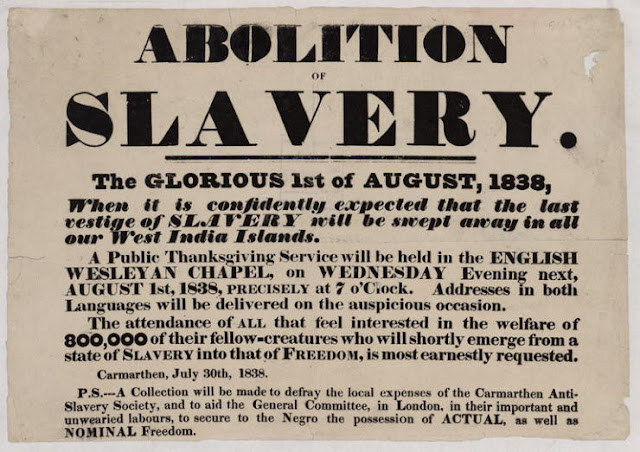


So when I write something about the American Confederacy and don't react with a knee-jerk excoriation of the evils of slavery, it's because I recognize that slaveholders in all of the twelve original slaveholding states were governed by the same Ethos of Keeping that applies to any other form of property. American slaveholders in the North and the South didn't bring Africans to the States for any other reason but to be slaves, the same way the captive Africans would have remained slaves had they been sold anywhere else, in Persia or Turkey or China. But in the United States, there had arisen a secular "ethic of emancipation" due to the American Revolution. This combined with the Sharing-ethos of mainstream Christianity-- as well as offshoots like Quakerism-- and so produced abolitionism. The abolitionists were far too few to have influenced the nation's course, but their aims happened to coincide with (1) Great Britain's early-19th century ban on slave-trading, and with (2) the desire of Northern politicians to nullify the congressional power of the Southern states. The "liberals" of this period were no less devoted to their Ethos of Keeping than were the "conservatives." Aside from real abolitionists, who often sacrificed life and property campaigning for slaves' rights, most Northerners had only one real goal: to bend the Southern states to their will. These early "liberals" sometimes wrapped their quest for power in an alleged Ethos of Sharing. But they often expected the South to do all the sharing of resources, by enforcing codes that kept even free Blacks from emigrating into certain states, such as Illinois.  

And now, about a hundred and fifty years after the close of the Civil War, modern liberals are still telling conservatives that they Must Share whatever liberals think ought to be shared. To that imperious command, conservatives reply that they Must Keep what they hold rather than becoming de facto slaves to the Left. While there are real racist movements within the Far Right, and while there are reactionary elements within the "Center-Right" that I don't always countenance, the anti-racist screed of modern Liberals has become removed from all practical considerations. Thus, they only command others to Share on their own terms-- yet they cannot share condemnation of the political murder of a man who only contended against them with words. Thus the Left's alleged narrative of Sharing becomes that of Keeping one's political stance in place, no matter what. I'll add that I imagine a lot of Righties want to keep the controversy boiling too. But the Left missed a real chance to participate in a Sharing that would have made them look a lot better than they do now.     


Sunday, July 27, 2025

INDEPENDENCE DAZE

 Independence Day 2025 is long gone, but I found it still on the mind of one of my forum-opponents. Without bothering to lay out the general argument in which the Fourth came up, my opponent's attitude was definitely that of the "slavery is America's original sin" mindset, in that he expressed the view that modern Americans are being hypocritical to celebrate Independence Day, but things weren't so independent for slaves. 

I've already set forth some of my views on the phenomenon of slavery in a few posts here, such as the two-part SLAVE WAGES essay. But for amusement's sake, I decided to randomly flip through Frank Fukuyama's THE END OF HISTORY AND THE LAST MAN, which remains an important work in analyzing the role of the United States in creating what the author called "an ethic of emancipation." I came across the following paragraph in the chapter "The Universal and Homogenous State," and though I'm sure it won't have any impact on the stance of my opponent, I'll reprint the Fukuyama paragraph here as it may prove useful down the road.  

The second way in which economic development encourages 
liberal democracy is because it has a tremendous leveling effect 
through its need for universal education. Old class barriers are 
broken down in favor of a general condition of equality of op¬ 
portunity.
 While new classes arise based on economic status or education,  
there is an inherently greater mobility in society that 
promotes the spread of egalitarian ideas. The economy thus cre¬ 
ates a kind of de facto equality before such equality arises de jure.

Monday, February 10, 2025

TOTALITARIAN TOKENISM PT. 3

I suppose that this essay-series is a very roundabout way of approaching the subject I first raised in my review of Season One of the Netflix SANDMAN teleseries. In that review, I specified that I wanted to discuss the formal properties of the show, and deal with the "politically oriented alterations" elsewhere. But before doing so, I wanted to explore the background of said changes. In Part 1, I described the way that a given phenomenon could be viewed as either a "negative token" or a "positive token" according to one's presuppositions. In an intermediary essay, I analyzed the conditions of the early 20th's century's "Status Quo," in which positive tokenism had very limited potential, and in Part 2, I proceeded to specify the early inroads of this form of tokenism in the 1960s decade. I did not deny the possibility of negative tokenism. However, whereas many people have used the term to connote a superficial pretense to follow certain political principles, I've defined negative fictional tokens as those that shows no individuality, but are defined ONLY as sociopolitical indicators, whether for "Liberal" or "Conservative" purposes. While the showrunners showed a great deal of sensitivity in adapting the Neil Gaiman stories from the SANDMAN comic book, their efforts were compromised by the constant emphasis on virtue signaling through Netflix-approved DEI casting. Instead of making all the race-bending, gender-bending and kink-bending seem natural, the message of forced inclusivity serves as a constant reminder of a new-- and totalitarian-- Status Quo.                                                                                                                        So what were the various "bendings" of SANDMAN SEASON ONE?                                                                                                                  

"The Sleep of the Just"-- Alex Burgess, who has custody of Morpheus at the time that the dream-lord breaks free, is given a gay lover, played by an apparently-Black British actor. Lucienne, the librarian of The Dream-World, is depicted as a White male in the comic book, becomes a Black female in the TV show.                                     
"Imperfect Hosts"/"Dream a Little Dream of Me"-- the original Gaiman stories concern male John Constantine, who gives aid to Morpheus in exchange for help with his opposite-sex lover. In the Netflix narrative, John becomes Johanna, but her lover remains female. In the comics John Constantine was sometimes defined as bisexual, but I suspect Johanna swings only one approved way.                  
"A Hope in Hell"-- In the original Gaiman story, a male demon in Lucifer's domain acquires Morpheus' helmet, and the dream-lord enters Hell to challenge the demon, name of Choronzon, for custody of the prize. In the TV show the challenge proceeds largely as it does in the comic, except that Lucifer, now played by Gwendoline Christie, takes Choronzon's place in the contest, for no discernible reason but to give the actress playing Lucifer more lines than the actor playing Choronzon. In a subplot, the madman John Dee escapes an asylum and catches a lift from a female driver. In the comic the driver is a White woman, whom Dee kills when he's done with her. In the TV episode, the driver is a Black female, but Dee not only spares her. he gives her a protective charm for no plot-related reason.                                   

     "24/7"-- As in the original story, John Dee enters an all-night diner and uses his powers to manipulate the personnel and customers. The comic included a White "power couple." but here they become an Asian wife and a Black husband. The original story includes a young lesbian woman, who gets to stay the same. But that's not enough for the TV show: the Black husband is secretly gay, and so is the diner's cook, with whom waitress Bette thinks she has a romance of sorts. The cook not only reveals that he's gay, but that he's slept with Bette's younger brother. Somehow the writer manages to omit the question of anyone gay committing child sexual abuse.               
"The Sound of Her Wings"-- In the comic, Dream's sister Death is depicted as a Caucasian-looking Goth girl with skin as chalk-white as Dream's, so of course she must be played by a Black actress here. Hmm, since she's a conceptual being, couldn't she have also satisfied DEI had she been played by a dark-complected Hispanic or one of several different Asian types? But no, we have a hero who's White, so a Black "sister" is the necessary counterbalance. One or two minor characters go from White to Black as well.                                         

    "The Doll's House" and the next three episodes-- The characters Rose Walker, her brother Jed, and her great-grandmother Unity go from White to Black. Yet Jed, separated from his family when his Black father dies, lives with his Aunt Clarice, played by a White performer, as is her abusive husband Barnaby. Was Clarice's sister, mother to Rose and Jed, supposed to be White too? Maybe someone in the writers' room didn't think things through? Or they just thought it was OK for villains to remain White? Another conceptual entity, a nightmare named Gault, is played by a Black actress, but this time the two entities she substitutes for were generic monsters, not belonging to any racial type as such. Rose's friend Lyta Hall, a White character in the comics, is played by a Lebanese-British actress, but her late husband Hector? Starts with "B," ends with "k--" again.         

   "Dream of a Thousand Cats" and "Calliope"-- though there a few minor characters who are race-bent, there are no major changes here. But that may be because the main human characters-- a couple who drown some kittens for expedience, and Ric Madoc, a man who keeps a Greek muse in captivity-- are White People Doing Bad Things.                                                                                                                                                                                                                Yet "Calliope" displays the most interesting script-change in any episode. In the original story, Madoc is an immense hypocrite. Though he exploits his imprisoned, suffering Muse so that he becomes a celebrated author, Madoc describes himself to his adoring fans as a "feminist writer." This line is also in the episode's script. However, someone on staff added a rather revealing line. Madoc is on the phone, talking to what one assumes to be an agent about a TV-adaptation of one of his books, and he says, "I need [the producers] to guarantee at the outset that the cast and crew will be made up of at least 50%  women and people of color, and that we need to publicize it so they won't get out of it when it comes to hiring people."                                                                                                                                                                                             Now, what does it mean that someone-- be it the credited writer or one of the showrunners-- inserted that line? Was it meant to carry the same irony as the Gaiman line in which Madoc describes himself as a feminist writer? It's possible, but the line is weird, coming from a writer working for a company that insisted on the very pattern of virtue signaling that Madoc uses to make himself look virtuous. Did the writer of the line want to imply, however covertly, that virtue-signaling Netflix wasn't any more virtuous than Ric Madoc?                                                                                                                             That's one possibility. Another is that the writer of the line really did believe that it was both moral and necessary to make companies commit to DEI hires, because otherwise they would revert to the bad old days of "if you're White you're all right." I should point that, although SANDMAN Season One came out in 2022, as of this writing Netflix remains firmly committed to DEI, unlike a number of companies that have at least modified their more extreme positions.                                                                                                                                                                                                   To pursue my tokenism metaphor to the bitter end, usually the word is used for one character of a divergent race, gender or proclivity whose presence "proves" that an author, or the characters the author creates, is/are free of bigotry against the divergent type. But tokenism inheres just as much in mass quantities of virtue signaling. In the minds of the politically correct, they believe they're fighting the good fight. But how "inclusive" can their multi-ethnic, polysexual characters be if they exclude themselves from accepting any of the "badness" that belongs to the entire human race? Their demands to be in all ways sympathetic and/or heroic hold the ring of totalitarian propaganda-- particularly that of the totalitarian seeking to drum up a war against an enemy's alleged wrongdoings.                                                                                                                                                                                             

Tuesday, October 22, 2024

QUICK POST ON ROOT CAUSES

 My response to a political post regarding the "root causes" solution of illegal immigrant incursions.

___________

Now, we've heard for a long time about "root causes," which in this case consist of the U.S. taking steps (which will almost certainly cost the country money in some manner) to "build up" the chaotic countries so that in theory their citizens won't want to travel to the U.S. I have no faith in this solution. I understand why Liberals of all stripes would like this latest manifestation of dollar diplomacy, since it allows them to think of themselves as generous sponsors of our "little brown brothers." (The Taft quote applies here since the Left has repeatedly characterized border security as racist.) One major problem with this solution is that a lot of immigrants-- even the ones who intend to work an honest day's work if they get in by hook or crook-- are coming here not just for free stuff (though that doesn't hurt) but because the U.S. already has the advantages of a fully articulated system of social benefits. Underdeveloped countries may or may not develop such systems if we give them lots of patronage, but they won't develop them any time soon. And the cartels that have battened onto the Liberal permissiveness toward illegal immigration-- what do they care about preying on penny ante operations in Honduras, when they've already got a foothold in the richest country in the world?


Even if this "root cause" approach could have *some* limited good effects, the plan also fails overall in that its main motivation is to allow Liberals to virtue signal in order to gain political advantage. Building up other countries is not, in the final analysis, America's responsibility.


Monday, May 27, 2024

THE APPROPRIATION HUSTLE PT. 3

I have not used the above essay-title since I completed a couple of posts on the subject of appropriation in 2017, but since my views on the subject have not changed, the title seems fully applicable here, to extend my remarks on the topic as they appear in Brian Attebery's 2013 book STORIES ABOUT STORIES.

In the last section of my Attebery review, I quoted the author's opinion of a particular White Australian author's "appropriation" of Aboriginal stories for her fantasy-novel.

As with similar endeavors in Canada, the United States, and other colonial locales, a goal of the [colonial] project... was to get rid of indigenous peoples through a combination of assimilation and genocide while APPROPRIATING [my emphasis] their songs, stories and rituals.

I won't repeat my refutation of this dubious logic, though I'll add the point that Attebery managed to conflate all those colonial persons urging for "assimilation" of marginal peoples with those who were supposed "appropriating" the sacred narratives of those people. In point of fact, the powers urging assimilation would have been totally focused on erasing all cultural differences. But when a researcher with an interest in Native American culture like Henry Schoolcraft devotes six volumes to preserving Native American culture-- research that, in turn, provided much of the content of Longfellow's HIAWATHA-- one could hardly call that erasure. It's also possible to fairly critique the characterizations Schoolcraft or Longfellow made of Native American culture without assuming some dire plot to heap opprobrium on Indians, and without assuming that the respective authors made tons of money by adapting their stories. (Longfellow did; Schoolcrafr probably did not.)

On a separate matter: Attebery was very vocal against the idea that only authors aligned with "living traditions" like that of Aboriginal worship could be deemed worthy to weave fantastic fiction out of those sacred narratives. He said nothing about other Aboriginals would approve of what the hypothetical Aboriginal author did with their sacred narratives, though Attebery dismissed the complaints of Christians who didn't always like what authors like C.S. Lewis wrought in his fictions about the "living tradition" of Christianity. Somehow I doubt Attebery would be quite so sanguine if traditional Aboriginals were upset with their religion's depiction, even by one of their own-- or even one who was ethnically related to that subgroup, but not "living the life." 


A specific example of some real-world condemnation can be found in the public criticism of fantasy-author Rebecca Roanhorse. Of her six published books, I've read both entries in the "Sixth World" series, which take place in a future where an apocalypse has more or less returned certain parts of the U.S. to their pre-Columbian status. So, given that it's a author with partial Native American ethnicity writing about Native American culture, it all must be good, right?

Not quite. According to Roanhorse, she's half-Black and half-Pueblo Indian, but her "Sixth World" fantasy is based upon Navajo religion. After Roanhorse became well-known, certain Navajo pundits claimed that a non-Navajo, even one who had lived for some years on the Arizona reservation known as "Navajo Nation," had no right to utilize Navajo narratives for fiction irrespective of formal literary quality. From Wikipedia:

Dr. Matthew Martinez, former Lieutenant Governor of Ohkay Owingeh,[8][9] welcomed Roanhorse on her first and only visit to the community, in 2018, and spent time with her. He said, "I recognize that adoption is an emotional experience for families and communities and especially those who have been adopted out with no real connection to home....At Ohkay Owingeh, our current enrollment process privileges family lineage and not blood quantum." Agoyo explained that "anyone who descends from an Ohkay family - as Roanhorse has publicly claimed - can become a citizen. But Martinez said the author has chosen a different path."[1] Martinez continued, "by not engaging in any form of cultural and community acknowledgement, Roanhorse has failed to establish any legitimate claim to call herself Ohkay Owingeh." He eventually concluded, "It is unethical for Roanhorse to be claiming Ohkay Owingeh and using this identity to publish Native stories."[1]


Serendipitously, a similar example of small-minded exclusionary attitudes was brought to my attention by this CRIVENS post. It seems that a 2024 facsimile of the renowned GIANT-SIZE X-MEN #1 came out with an advisory warning reading, in part, that the story contained "negative depictions and/or mistreatment of people or cultures." But GSXM is not some 1940s cartoon making jokes about African cannibals or the like. The advisory also claims that its purpose is "spark conversation to create a more inclusive future." But how can there be a conversation, when the authors of the advisory don't even say what was wrong with "Second Genesis?" Did the story fail to depict non-White characters like Sunfire and Thunderbird as even-tempered? Or did some Marvel drone get the whim-whams from the scene in which a group of tribal Africans are shown worshiping mutant heroine Storm as a goddess, because neither they nor she know better?

Those are both possibilities. However, I'm of the opinion that the real issue was probably that all of the creative people involved were dominantly Caucasian in ethnicity. Yet the idea of having a concept like X-MEN being written so as to satisfy all ethnicities is absurd. Navajo pundits may be content to have no fiction-author base a story upon their sacred tales unless it's someone who truly came, ethnically and culturally, from the Navajo community. But how could any single writer or artist satisfy the demands of writing for all the ethnicities in this or any X-MEN story? Storm is ethnically though not culturally Black American, so I guess Rebecca Roanhorse could write her. But she couldn't write Thunderbird (even had he survived), because he's Apache. Nor could she write any hero from any other culture. And the same would apply to any other author. (And yes, I know that there are no "sacred narratives" in X-MEN, but obviously the whole "appropriation argument" extends far beyond the specific "religious fantasy" context it assumed in Attebery's screed.)

While I will admit that some pro-appropriation individuals may be motivated to preserve the integrity of their cultures, I stand by my imputation that an awful lot of talk about "appropriation" is what I called it in the title, a hustle designed to make sure some people get jobs and others don't. What did Ryan Coogler, a Black American from Oakland, know about real African cultures before he helmed a motion picture based on a made-up African nation? Wasn't he as dependent as a White writer-director would be, upon what expert researchers advised him? Even though he's credited with scripting, I feel sure that he depended on outside research as much as Longfellow depended on Schoolcraft. 

I have seen some online essays claiming that some of the worst political correctness is losing its hold on American culture. That doesn't mean an absolute return to the days when almost all comics-creators shared the ethnicity of European Jews and/or Gentiles. But it could mean a return to the idea that the quality of the work is more important than the identity of the work's creator.


Friday, May 3, 2024

THE LATEST KATHLEEN KENNEDY WARS

While arguing the matter of STAR WARS politicization online, I had the notion, "wouldn't it be more interesting to cite recorded statements by a prominent Disney exec, say Kathleen Kennedy, and let her damn herself by her own statements?"  I preface this line of thought by noting that I have no personal opinions on the line of Disney streaming TV projects, since I've barely watched any of them. I don't have streaming Disney now and when I briefly had access, I only watched a handful of Mandalorian episodes and barely remember what I watched. My negative opinion toward Disney SW is taken largely from the movies I've seen.


That's not the case with the podcaster I'm citing, one Mike Zeroh, who appears to be conversant with the streaming projects whether or not one accepts his opinions. This podcast appeared a month ago, made in response to a press release by Kennedy about the impending (June of this year) ACOLYTE project, and Zeroh reads verbatim selections from the Kennedy press release. This I find valuable because it indicates whether or not the virtue signaling I've argued has been sustained over some years, rather than being just a momentary whim. (The "whim defense" is how Kennedy somewhat defended wearing the infamous NIKE "Force is Female" T-shirt, BTW.)


https://www.youtube.com/watch?v=cN5vRGEgZwM


Here are my takeaways from Zeroh's quotes.


(1) Kennedy claimed that only a "minority" of fans are opposed to the ACOLYTE project. In contrast, Zeroh claims that it has been the most heavily ratio'd SW project yet. One may argue that some fans may be producing more than one ratio-rating, though I don't think there's any way to prove that assertion.


(2) Kennedy denies at one point that she's promoting an "agenda," but celebrates that she's promoting not only DEI but the celebration of an all-female main cast with female show-runner Leslye Headland behind the camera. This would indicate, to me at least, that she was entirely serious about "the force is female" despite her denials.


(3) She says "George Lucas's treatments with his films" don't matter. She wants to "change the story" to reflect whatever Headland wants to champion. Wikipedia provides evidence of this, indicating that Headland wanted to attack the idea of the Jedi as fundamental good guys, which Headland claims (in separate statements, not in the video above) is right in line with Rian Johnson's positions in LAST JEDI.


The series questions the Jedi practice of training children,[ and also explores differing views on the Force and the amount of power and control that the Jedi have-- Wikipedia, THE ACOLYTE.


(4) She claimed that the sequel films had made money for the company. This avoids the question as to whether the streaming services have justified their expense, and it also does not show her taking responsibility for the box office bomb of SOLO, which barely made a million dollars past its estimated $300 million budget. Interestingly, Ron Howard blamed the failure on toxic fans, just as Headland claims such fans are responsibility for bad reactions to the ACOLYTE trailer.


In a larger sense, there have been times when Hollywood producers embraced this or that cause, and then backed off because the public did not prove receptive. But there's something weird about the Disney producers' utter, unshakable commitment to their ideological agenda. I assume that some of this attitude was brought into being by the political influence of asset manager Blackrock, but it may not be the only factor.


Wednesday, December 20, 2023

THE ROAD NOT TAKEN

 Another politics post...

__________


While I won't criticize the South for doing what the North had been doing for the previous hundred years, I will criticize them on another line: they allowed themselves to be gulled by the Northern politicians into taking an absolutist, hard-line view on the slavery question.


Imagine what might have transpired if, a brilliant Southern statesman, of the capacity of John C Calhoun, had looked at the Tallmadge Amendment of 1819 (talk about an extra-legal, un-Constitutional stipulation) and realized, "Hey-- this is the wave of the future. These Northern dinks don't care anything about Black slaves, but they want to give the illusion that they do in order to gain Congressional superiority. And with all the new territories opening up-- there's no chance that we'll able to convert enough Western states to the slavery position to keep Congressional power."


The far-sighted solution to the Northern anti-slavery posture would have been to institute something similar to what the North was doing, in order to steal their thunder. Possibly there could have been an incentive plan for slaves to amass enough credit to buy their freedom, which also might have diverted a fair number of them from simply running away to the North and undercutting the bottom line of the planters. Instead, the planters dug in their heels, like many people who simply don't like being told what to do by those who aren't any more moral than they are. A far sighted person would have seen that the Missouri Compromise was just a bandaid, albeit one that lasted over thirty years, yet one that clearly did not prevent the North from continuing to inflict partisan tariffs on the South. For instance, the Nullification Crisis took place in the early 1830s, long before new states became a clear and present danger to Southern Congressional representation. Andrew Jackson backed down from his partisan tariff. Lincoln would not.


But we didn't get a far sighted politician. Calhoun, despite his brilliance, failed to see that his strategy, that of abiding by the letter of the Constitution regarding its protections of property, was going to be swept aside by the emotional appeal of liberation for an underclass. Legally, slaves were property, but emotionally, they were human beings capable of citizenship, and more often than not, emotion trumps legality. Northern soldiers didn't fight the South to free slaves, and most of them probably weren't even aware of the tariff issues. But they felt they'd been attacked, and they responded accordingly, even as the South did. But had the South liberalized its stance on slaves by 1860, those states would have been in a position to forge links with Western states on concerns other than slavery.


Saturday, September 16, 2023

SHARKS AND REMORAS

 In response to Joe Rogan's podcast interview with Bill Maher, I wrote the following, which I'm reproducing here mostly because I like my "shark-remora" metaphor.

_____________

I listened to the "BLM" segment of the Rogan/Maher interview twice, and at no time did Maher make any statement that Black people are more violent than other racial groups. At most he said that a lot of the killings, specifically in Chicago though the principle applies elsewhere, took place because of "stupid shit" like people quarreling over being dissed in one way or another. It is quite possible to criticize elements of particular ethnic subcultures without being racist, though you wouldn't know it from Progressives (and Maher makes an astute case about why these people should not be called Liberals, BTW).


The idea that all of this shitty behavior would stop if you address "social causes" with money is a dumb idea beloved by Progressives. The truth is, give an immoral person money and he won't become moral. If anything he'll feel like you paid him because of his immoral actions. Thus the Black gangbanger who kills or terrorizes ordinary Black citizens, upon being given money, may well become the BLM organizer, who in theory terrorizes both ordinary Whites and Whites in the power structure. But wait, did any of those organizers actually change the power structure? Or did they just become remora-like attachments to the Great White Sharks, sponging off the sharks while their poor Black brother-fish are still being targeted by the gangbangers?


I don't have much faith that Maher's idea of getting Black civic leaders or sports figures to decry illegal activities would have any effect. There's too much short-term gain. But I agree that there are ways they could make a stand just for its own sake. "Silence is violence," after all.


Sunday, June 4, 2023

NEENER, NEENER, CBR

 Just a quick notation of this podcast by Clownfish TV to the effect that Comic Book Resources is in the process of major restructuring, laying off several employees, one of whom reportedly had been there for ten years.

Now, while I'm not precisely glad about anyone losing a job, it strikes me as the logical outcome of a business that chose to pursue only Radical Leftist fans as their base. I've mentioned here that I had several experiences with rabid Lefties while I was a member there, and that eventually I was banned for no stated reason, presumably for saying something that offended some snowflake. In the cited article from four years ago, I even quoted Clownfish as calling CBR a "dumpster fire," though Kneon and Geeky presumably had their own reasons for that observation, possibly very different from my own.

Clownfish TV doesn't draw the comparison I did, to the restructuring of CNN months ago for analogous reasons. That's not to say that it's any more profitable to court only conservatives either, though at present some FOX shows are doing better in terms of viewer-numbers than those on CNN. 

However, the big difference is that CNN does have an alternative; to return to a model of non-advocacy news. My earliest experience with CBR was from the days when individual artists had their own subgroups, and I gravitated to the Gail Simone subgroup only because a few people there showed a little knowledge of comic book history. But later, the Janelle Asselin suit and the Comicsgate controversy moved CBR firmly to the Far Left. I found that the Lefties were just as verbally abusive as the Comicsgate fans about whom they constantly complained. But in the minds of the ultraliberals, their abuse was OK, because they were supposedly defending the oppressed. I tend to doubt that most comic-book journalists know what non-advocacy journalism for comics would even look like, because of the sites are either Left-leaning or Far Left.

I don't know why any viewers with conservative or even middle-of-the-road sentiments would bother with CBR ever again. But I suppose I might be surprised, WAY down the road.


Saturday, May 6, 2023

TOMORROW ALWAYS DIES (AS HUMOR)

 Here's a post from one of the forums I visit, which I argued that when corporations and public schools endorse ultra-liberal causes, they're seeking to immunize themselves from frivolous lawsuits. To place things in context, my opponent argued that Florida's Parental Rights Act could encourage frivolous lawsuits. A separate opponent reprinted the following editorial cartoon from the odious ultraliberal Tom Tomorrow, to which I also made reference. All of Tomorrow's allegations are full of crap, but the SONG OF THE SOUTH lie is in the fifth panel.

_________


I may surprise you with a minimal agreement. Will the Parental Rights Act open up the possibility that some parents file frivolous lawsuits over minor kerfuffles? Yes, that is a distinct possibility.


But what you fail to mention is that American corporations, including the schools, are already constantly under the threat of frivolous lawsuits from grifters who want to use inclusivity to make money in court. Remember the winner who called himself Jessica Yaniv? No, that didn't have anything to do with public school, but you think schools don't worry, as much as any corporations, about getting so targeted?


In fact, Disney's apparent championing of LGBTQ representation may have a lot more to do with immunizing their corporation from such activist targeting than any high ideals. A few days back a poster printed a broadside from that stellar comics genius (sarcasm emoji) Tom Tomorrow. Tomorrow should remind everyone here that Libs frequently used to attack Disney for being too conservative (though in the forties through the nineties, they were generally more centrist). To that end Tomorrow brought up SONG OF THE SOUTH, claiming that the movie was constructed to portray Southern plantation life as happy for Black people. This was a lie that's doubly insulting because it can be so easily refuted, but Tomorrow, if he was ever a Classic Lib, has gone full Progressive. And yeah, I'm sure schools would like to get parents off their backs so that they can immunize themselves from frivolous suits by tossing out a few drag queen performances to please the activists.


P.S. Tomorrow also lies like a dog about Scott Adams, who has categorically stated that he made his "race remarks" as a hyperbolic method of provoking conversation. But guys like Tomorrow are not interested in conversation, only in dogma.


Friday, July 22, 2022

THREE STRIKES FOR BAD BOOKS

This may be the shortest book review I'll ever post, because it's actually a review of the reasons I will NOT read the book.

I knew nothing about Cassandra Khaw's ALL-CONSUMING WORLD except that an acquaintance said that it was a modern-day space opera. So I checked out a library copy.

The blurb on the cover provided the first potential strike against Khaw, as the blurb-ist said: "Profane and gorgeous... the angry queer space opera you've been waiting for." But I didn't stop there, since after all the author was not responsible for what a blurb-writer said.

The second strike was all the author, though. The back cover ballyhoo for the author certainly had the author's approval, inasmuch as it stated of Cassandra that "THEIR short stories can be found" in such-and-such places. The use of the term "their" for some individual who didn't want to be typed as male or female strikes me as the height of idiocy. If transgenders want to come up with a new pronoun for themselves, don't borrow one that's familiar and distort it. It's as if they're trying to see what ridiculous crime against grammar "they" can get away with.

I read five pages, none of which established characters or settings, until I came to this winning phrase:

It's fortunate that this day and age has surrendered homophobia to the firing squad of basic human decency, because Maya would have had to gun down the bigots otherwise. Not that she wouldn't have shot them up anyway for being terminally wrong.

And with that third strike, I was made aware that, regardless of my opinions for or against queer identity, the author intended to subject me to a lecture, not an adventure. 

In one way, Cassandra's name is apt. No matter how good her arguments might be, once she strikes out with me three times, I won't believe anything else she says. 


Monday, June 27, 2022

ROE, ROE,-- WAIT, DON'T ROE THAT BOAT

So "Roe vs. Wade" was overturned last week. I've said little about the topic of abortion on this blog, aside from this conclusion from THE ILLEGITIMACY OF 'LEGITIMATE RAPE':

I am opposed categorically to the politicized sentiments of Akin's kind.  Their only solution to the multifarious problems relating to unwanted conception-- which include, but certainly are not limited to, conceptions through rape-- is an absolute refusal of the state's power to kill the unborn. 

And, unpleasant though it may seem, the unborn cannot be given special rights, despite any and all societal instincts to protect future generations.  It goes without saying that the state probably has made many mistakes in executing particular abortions, just as it has in executing particular prisoners.  But it does not follow that all of the executions were mistakes.  There are times when the unborn, innocent though they may be, simply have to suffer from living in an imperfect world.

I sympathize somewhat more with those individuals-- none of whom are affiliated with the anti-abortion crowd-- who recommend, not an absolute ban on abortion, but merely restrictions as to how *often* citizens might "choose" to have abortions.  But it's seems almost certain that our society, having become polarized between two extremes, will never explore this area of legal theory. 

Over the years I've heard many of those on the Far Right voice the opinion that the 1973 SCOTUS decision was rooted in "activism," and that its extrapolations of the Fourteenth Amendment and the Bill of Rights were out of line. I would agree only in one respect: of the various rights that the Constitution spells out, none of them relate to medical matters. One may speculate that lawmakers of the 18th and 19th centuries did not foresee the politicization of medical concerns, particularly abortion. So they never spelled out whether or not changing ethics regarding such subjects would truly fall under the so called penumbra of the "life, liberty, and property" guaranteed by the Fourteenth Amendment (that is, one could not be deprived of these without "due process of law.") This essay from CNN alleges that abortion was available under common law in the U.S. until 1880, though CNN may not be the best arbiter of our national history.

Though I may have become somewhat more conservative on this or that topic over the years, I've never had a problem, as shown above, with the notion that the state may expedite the termination of new life, simply because that state always has that power in essence. I favor neither of the hardcore absolutisms regarding the physical act, be it religion's arbitrary dictates about when the soul enters the fetus, or materialism's screeds about how the fetus just ain't alive until science says so. Neither are worthwhile guides as to whether a contemporary society should consider the option of abortion to be part of the "life, liberty and property" troika. 

I also noted in the segment above that I'm less than impressed with the extremism of some pro-choicers, who would not accept any restrictions whatsoever in their favored form of liberty. Yet it's possible that even if we lived in a time dominated by Classic Liberals rather than Progressives, the SCOTUS Judges would have made the same decision: that abortion could not be viewed as a federally mandated "right" that trumped the local politics of states. 

I do not know all the reasons that the Judges chose to nullify Roe v. Wade. I don't disbelieve their stated reasons, nor do I dismiss all of the animadversions expressed by those who hate the verdict. Nevertheless, I think it possible that, just as the 1973 decision had the effect of breaking down the power of the Religious Right, the 2022 decision may be a challenge to the power of the ultraliberal Left, which enjoyed a boost in cultural hegemony in response to the presidency of Trump and the devastation of Covid, which Lefties blamed on Trump.

In many ways, the Right's crocodile tears for the slain unborn are a way of stoking emotional response from the faithful, in much the same way that the Left sheds similar tears for the sufferings of marginalized women and POC. I think that in recent times the fanaticism of the Left has been more harmful to the culture as a whole, but I won't claim that a return to the values of the Right might not be worse. 

In other words, I cast a plague on both their houses-- albeit with the caveat that I don't really have a dog in the fight.


Friday, March 11, 2022

MYTHCOMICS: "DAYS OF FUTURE PAST" (X-MEN #141-142, 1981)


It's a mark of my long-retired investment in the seventies X-MEN franchise that I can still recall the experience of reading the first pages of DAYS OF FUTURE PAST. 

A few months earlier, Chris Claremont and John Byrne had concluded the ambitious "Phoenix Saga," which, despite its tragic climax, also sported a couple tons of "sense of wonder" elements. Then came X-MEN #141, depicting how, thirty-six years later (than the comic book's cover date), all of America would be reduced to a doomed world bereft of wonders. In the future, the robotic mutant-hunters known as The Sentinels, whose potential had never really been tapped in their first stories. took control of the United States (at the very least) and killed all the Marvel superheroes and most of the X-Men. Only a tiny handful of the mutants survived, kept in power-dampening collars and dressed in jumpsuits designed to evoke the sufferings of real-life WWII Jews. DAYS OF FUTURE PAST addresses the desperate attempt of the survivors to cancel out their dreadful future. Not until re-reading DAYS, however, did I perceive one reason why this dystopian fantasy seemed so much better grounded in reality than dozens of others. 


The two issues are cover-dated January and February 1981, though the whole adventure as such is internally dated as occurring on "Friday, October 31, 1980... the final Friday of one of the closest, hardest-fought Presidential elections in recent memory." To be sure, since one might argue that Marvel-reality may not always line up with our reality, one can't be entirely sure that Claremont is talking about the 1980 victory of Ronald Reagan over Jimmy Carter. But even had Claremont wanted to address a real political situation, it's unlikely that any Marvel Comics editor, least of all Jim Shooter, would have allowed a Marvel writer to editorialize about a living political figure. That said, given the lag time between comic-book production and the comics' availability to customers, it's not impossible that Claremont plotted DAYS before he actually knew of Reagan's victory-- which may be a reason why, when the new President does appear in the story, he's only a shadowy figure with no name or distinguishing characteristics. In fact, DAYS might be Claremont's projection of what might happen if America went down "the wrong road" that most liberals of the time associated with the Republican Party.

From the conception of the Sentinels, they incarnated the idea of isolating a subgroup of human beings from the rest of humanity. This science-fiction motif was pointedly compared to the human history of racism and chauvinism by many comic-book readers and creators, not least Claremont himself. To my knowledge no one from 1976 to 1980 accused Ronald Reagan of wanting to impose some version of the Nuremberg Rules upon the United States, though at least one of his campaign speeches back in 1980 was accused of recrudescent racism. But it's still interesting that on the very day that the new President of Marvel-Earth was announced, a set of circumstances arise that will bring about the destruction of civil rights-- not only for mutants, but for all human beings.


In 2013, there are six surviving mutants. Five are older versions of Storm, Wolverine, Magneto (now crippled and out of the action), Colossus and Kitty-- now "Kate"-- Pryde. The sixth is a new character, a psychic named Rachel, whom Claremont will explore in great detail over the next decade. The X-survivors intend to erase their doleful era by using Rachel's mind-skills, projecting the consciousness of 2013 Kate to inhabit the body of 1980 Kitty. Then, rather than simply watching over Kate's comatose body to see what happens, Storm, Colossus, Wolverine and Rachel-- joined by the last surviving scion of the Fantastic Four, Franklin Richards-- plan a frontal attack upon the Sentinels.


The mind-transfer succeeds. Kate Pryde takes over Kitty's body and informs the X-Men that a new incarnation of the Brotherhood of Evil Mutants is out to assassinate Senator Robert Kelley, a politician obsessed with legally restricting the activities of mutants. Kate informs the heroes that in her world, this murder doesn't cow humanity, as the Brotherhood intended. Instead, in 1984, a new President-- carefully unnamed-- approves the creation of a new set of Sentinels, who carry out their draconian plan to corral all mutants, which extends to keeping all humanity under control as well. Kate also asserts that the Sentinels in her era plan to extend their control to other countries, which will certainly bring about nuclear Armageddon. After overcoming a natural reluctance, the X-Men-- then consisting of Storm, Nightcrawler, Wolverine, Colossus, Kitty and guest-star Angel-- zoom off to prevent the Brotherhood's dirty deed.


The battle of the X-heroes and the Evil Mutants isn't particularly mythic in itself, though it's in this narrative that Claremont and Byrne decided to give the ranks of the villains a makeover. The new roster includes only one old-time X-foe, The Blob, and debuts three new malcontents, Pyro, Avalanche, and the oracular Destiny. Lastly, Claremont re-purposes a character he created for the MS. MARVEL series, Mystique, as the new leader of the Brotherhood. Mystique's reasons for believing she can intimidate all of humanity with one assassination are not explored at all, possibly because Claremont, following up on a plot-thread introduced in a 1980 story, was preoccupied with suggesting a connection between Mystique and Nightcrawler. (Eventually she's revealed to be his long-lost mother, FWIW.) The heroes triumph, Kate departs the body of Kitty (who has no memory of the events). and Robert Kelley's life is spared. However, the concluding clincher is that the heroism of the X-Men means nothing to the obsessed politician. In a coda, Kelley is seen conferring with the President-elect-- as said before, given no name and depicted in shadow-- as the new President does what his 1984 successor originally did: authorizing a new series of Sentinels. 


The fact that 1980 present-day events are only partly rewritten may have been Claremont's rationale for not erasing the Sentinel-future from Marvel continuity. I don't remember what happens when Kate's mind returns to 2013, by which time the future-versions of Storm, Wolverine and Franklin Richards have all been slain-- though I have a feeling that the threat of nuclear doomsday somehow gets taken off the table. Unlucky 2013 has to continue, though, because Claremont has introduced the telepath Rachel for the purpose of having her time-travel back to Marvel-present. In due time it will be revealed that she comes by her psychic talent honestly, for she's the child of Cyclops and the recently-deceased Jean Grey a.k.a. Phoenix. For many years to come, Claremont will get a lot of mileage out of Rachel Summers, though DAYS is probably more notable for all the stories Claremont and other Marvel writers generate from Kelley's "Mutant Control Act," which will morph into the Superhuman Registration Act underlying the CIVIL WAR continuity of the 2000s. 


One last myth-point: though a lot of superheroes are mentioned as having been slain by Sentinels by 2013, only the Fantastic Four and their mythos has any direct impact on DAYS OF FUTURE PAST. I've noted that the survivor-mutants are briefly aided by Franklin Richards, but not that he's also the boyfriend of Rachel, and that he's killed early in the story, His presence seems to be nothing more than a foreshadowing of the revelation that Rachel too will prove to be the offspring of superhero parents. The Sentinels, when attacked by the 2013 mutants, have made the Baxter Building their HQ, which would carry a sense of irony were the occupants not unfeeling robots. Finally, a scene in which Kate walks by the tombstones of dead superheroes displays only the names of either X-Men or FF-members. Much later, Kurt Busiek's MARVELS would comment on how the transformed foursome of heroes were lauded by the public while the mutant crusaders were despised for being fundamentally different from the rest of humanity. But Claremont anticipated the same contrast. The Fantastic Four is the "first family" of Marvel-Earth, and the fall of those heroes could be interpreted as the demise of Silver Age Marvel. In contrast, though most of the 2013 mutants also perish, the future of Marvel turns out to be more aligned with the children of Xavier than the buddies of Reed Richards. Claremont was at the top of his game when he plotted out this challenging opus. The downside, though. was that he kept churning out less resonant visions of nightmare realities, most of which were as bad as DAYS OF FUTURE PAST was good. But such is the conundrum of talent: praise a writer for doing one thing well, and nine times out of ten he'll run the same idea into the ground.