Featured Post

SIX KEYS TO A LITERARY GENETIC CODE

In essays on the subject of centricity, I've most often used the image of a geometrical circle, which, as I explained here,  owes someth...

Showing posts with label nominative and innominate. Show all posts

Monday, June 30, 2025

CROSSING GODS PT. 4

 As a quick coda to CROSSING GODS PT. 3, it occurs to me that. although I may find uses for the terms I introduced there, there's a simpler line I might draw in the sands of shifting alignment, at least with respect to modern usages of all types of traditional narratives, be they myths, folktales, or legends. 

If a given modern narrative attempts to substantially represent a traditional story's plot action-- that is, making some attempt to be "canonical"-- but alters the scenario by bringing in extraneous elements, or rearranging elements within the actual canon, then that is a crossover. Thus, of the earlier examples cited, the 1952 QUEEN OF SHEBA would be a "re-arrangement" type, in which the (probably political) marital alliance of King Solomon and the Queen of Sheba is reworked so that Sheba never marries Solomon but rather hooks up with the king's son Rehoboam, who's in the Solomon narrative but not with that role. The examples with extraneous elements would include the movie NOAH, which imports Tubal Cain from a different Biblical story to serve as the story's villain, and the 1980s CLASH OF THE TITANS, which the story of Perseus is merged with elements from the narratives of Achilles and Bellerophon.

However, if there is no substantial attempt to be canonical, then what one has is an "open canon" created of whatever elements appear in an aligned set of traditional stories. Thus Marvel-Thor can meet any character from Norse mythology or folktales, and there is no crossover-tension. Even though the Thor of Myth may never have encountered the Surtur of Myth (so far as we know from surviving texts), Marvel-Thor can meet any Nordic traditional figure, from any time period, and it won't be a crossover. However, when he meets Hercules or Shiva, traditional figures from other myth-cosmoses, that's a crossover.

The "open canon" principle would also hold for my example of THE IRON DRUID CHRONICLES from the first CROSSING GODS. The entirely fictional hero of this series, Atticus, is a master of Celtic magic, so any purely Celtic myth-figure he encounters is a null-crossover. But when he meets the pale horseman of Christian Revelation, that's a crossover of the innominate kind. Ditto Marvel's Daimon Hellstrom meeting any entity purely native to the Judeo-Christian tradition. Null-crossovers would include Satan and all traditional figures from that cosmos, probably including even icons from other pantheons who were demonized by early Jews and Christians (Baal, Astarte), but would NOT include icons from completely different traditions, such as the Egyptian Anubis and the Celtic Morgaine LeFay.         


Monday, March 17, 2025

CROSSING GODS PT. 4

 I devoted one essay in this series to "external alignment," defined thusly: 'This form of crossover I will term an "external alignment" crossover, in that one icon with archaic myth-associations appears in a cosmos with which that icon is not aligned.' I then followed it up with another essay, which defined "internal alignment" as "substantive alterations of icon-arrangements in a single cosmos." However, in re-reading my other essays on the topic of "alignment," I see that the essay I wrote just before these two, COSMIC ALIGNMENT PT. 5, also dealt with two forms of alignment, both of which might subsume the external and internal formulations.                                       


  One example I gave of internal alignment was that of the 2014 film NOAH. I remarked that this film took place in the "Noah cosmos," but that it reached into some loosely allied Biblical narratives to flesh out the cinematic storyline: narratives such as the story of Tubal-Cain, which is not directly involved in the tale of Noah. I did not mention that the film also played off of alternate Noah-stories like the apocryphal Book of Enoch, which is probably the movie's source of its "rock-giants." These two borrowings bring me to explore my description of "static alignment" in Part Five of COSMIC ALIGNMENT. In that essay, I used the Joker as an element of the "Batman cosmos" that is always aligned with Batman, no matter how many other "other-universe" characters the Joker may encounter.                                                                                           
Now, there are various narratives, whether stand-alone or serial in nature, that relate fictional stories of archaic myth-characters meeting, even though they never met in archaic stories. The archaic Hercules never met a lot of the Greek figures encountered by, say, the televised Hercules of the LEGENDARY JOURNEYS teleseries, such as the above-seen monster Echidna. But in my view, even the modern-day version of Hercules remains in a static alignment with nearly all Greek mythology, just as the modern-day Noah is in a static alignment with all Biblical mythology. The only way in which the alignment is bent, though not broken, is when an element strongly aligned with another icon-cosmos is imported into a given narrative. The rock-giants of NOAH aren't in the Old Testament text, but they are in the Book of Enoch, so the two iterations of the Deluge Story can blend with no crossover-vibe. But Tubal-Cain, though he's a distant Hebrew ancestor like Noah, properly belongs to the narrative of Cain, and so a static type of crossover ensues.                                       


     The opposite of the "static alignment" was the "dynamic alignment." My main aim in forming this concept was to describe cases in which a particular "Sub" was not firmly bonded to the cosmos in which it first appeared, so that it could successfully migrate into other cosmoses. My examples there were super-villains like Thanos and the Cobra-Hyde team, which did not remain firmly associated with the hero-cosmos in which each originally appeared, to wit, Iron Man for Thanos, Thor for Cobra-Hyde. This also applies to the examples given in the "external alignment" argument: certain elements in a given culture's stories can be seen as dynamic in that they can and do move from one sub-cosmos to another. For example, one may posit that the Greek monsters called "Cyclopes" start out as smith-servants to Zeus, King of the Gods, crafting the heaven-lord's fatal thunderbolts. Arguably later, the poet Homer reworks these traditional figures into a race of cannibalistic giants who live apart from humankind and become menaces within the cosmos of the hero Odysseus.                                                                                                                         

                                                                             This transitive property of certain myth-figures transfers to their entirely fictional (and thus nominative) iterations. Thus Marvel Comics' Thor can meet pretty much any figure within Norse mythology-- say, the fire-god Surtur-- and it doesn't matter that Archaic Thor never crossed paths with Archaic Surtur.  This is the same intertextuality that keeps the NOAH movie's intermingling of elements from both Old Testament and apocryphal sources from meriting the crossover-vibe. The "static crossover" might still be possible if Marvel-Thor is constellated with another major figure of Nordic myth, like Roy Thomas' attempt to meld the legend of Marvel-Thor with that of Seigfried. But there's no intertextuality between Norse myth and Hindu myth, as per my example of Marvel-Thor meeting Marvel-Shiva. Thus, an encounter between any version of Thor and any version of Shiva is a dynamic one and parallels the sort of dynamic crossover one finds whenever a villan with a static default to a particular cosmos interacts with some other cosmos (The Joker hassles Superman, for example).                                                                                   


                                                                                      I felt I should be more specific on this subject also with reference to purely nominative fictional characters who are aligned with archaic mythologies, such as Wonder Woman. If Wonder Woman simply encounters a beast from Greek mythology without its "own story," such as the Chimera or the Hydra, then that's not a crossover. But if she meets a character from Greek myth that has been the "star" of his own narrative, such as Heracles, then that's a static crossover-- while if she meets myths or legends from outside the sphere of Greek myth, then that's a dynamic crossover.

Tuesday, August 20, 2024

CROSSING GODS PT. 3

 Following directly upon my comment at the end of Part 2--

In formulating my definition of an "internal alignment" crossover, I'm again only concerned with the interrelationship between nominative and innominate icons in modern fiction, but I'm not discussing the interaction of different icon-cosmoses, but with substantive alterations of icon-arrangements in a single cosmos.

I've already touched on two examples of such alterations in the essay PHASED AND INTERFUSED PT. 4. In the 1952 movie THE QUEEN OF SHEBA, King Solomon is "deposed" from his Prime position in the Old Testament in favor of a romance between the titular queen and Solomon's handsome young son. In the 2004 NOAH, because the patriarch didn't have a "villain" to drive a film-narrative, the writers imported an icon from another section of the Old Testament, Tubal Cain, to serve in that capacity.


Two other interesting examples are both cinematic versions of CLASH OF THE TITANS. Both movies attempt to emulate a number of familiar tropes from the Perseus legend, but they import figures from other Greek narratives having nothing to do with Perseus. As I discussed in my review of the 1981 movie, that script edged out the character of Hera and built up the character of Thetis, Mother of Achiles. More memorably, since this was a Harryhausen production, Perseus does not fly with the aid of Hermes' magic shoes, but on the back of Pegasus, freely borrowed from the narrative of Bellerophon. 


The 2010 CLASH, reviewed here, arguably delves into even more "cosmic" waters, situating Perseus within a war of gods between Perseus' negligent father Zeus and the malefic Hades, God of the Dead. So both of these films mingle the alignments of differing innominate myth-tales within the widespread cosmos of Greek myth.

Parenthetically, both films used the name "Kraken" for the giant monster Cetus from the original Perseus narrative. But there's no attempt to make the creature homologous with the Norse beastie, so the use of that name does not constitute any sort of "cross-alignment."

CROSSING GODS PT. 2

 Like the earlier CROSSING GODS, this essay will focus mostly upon how different forms of literary works, whether nominative or innominate (as explained here), utilize deific icons.

As noted in the cited essay, innominate texts are those whose "history is hard to determine." So even the earliest texts available to us testifying as to the history of Zeus or Enki or Thor are not necessarily the first appearances of those deities, in the way that we can be totally certain that the first appearance of Marvel Comics' Thor was JOURNEY INTO MYSTERY #83. So the Thor of the Prose Edda is an innominate figure, even if the author tries to claim that he was just a human being descended from Priam of Troy, while Marvel's Thor is nominative, "able to accurately named."

Now, a nominative icon may emulate many of the tropes associated with an innominate original. In archaic texts, Thor isn't always the star of every story in which he appears, but he is for all of the Thor stories appearing in the MIGHTY THOR feature. And just as Thor is a nominative character based upon an innominate one, the same holds true for all the support-cast icons who derive from archaic stories. Further, these Subs are aligned with Prime icon Thor as much as his rogues' gallery of villains.


However, icons who do not derive from the Norse mythos of the archaic Thor cannot be fully subsumed by his cosmos. I've already referenced some of the differing ways the character of Hercules was brought into the Marvel Universe-- first as a one-off character in an AVENGERS issue, and then as a more long-lived iteration that was probably planned to be launched as a Prime at some future time. 

But Thor crossing over with another deific "cosmos" stands as a crossover even if the new icon never appears again. For instance, in THOR #301 Marvel premiered its version of the Hindu god Shiva, who naturally was given some reason to go toe-to-toe with the Thunder God. I think it's safe to speculate that none of the people associated with that story planned to use Shiva again. Had there been any such intention, that plan would have been squelched by reader-protests to the effect that it was inappropriate to feature a fictional version of a still-worshipped deity alongside a fictionalized Norse god. FWIW, Marvel editors did a retcon claiming that the entity who had fought Thor in that issue was actually "Indra," a Vedic divinity whose worship seems well and truly dead.

I touched on this type of crossover at the end of CROSSING GODS PART 1, discussing a paperback fantasy-series, "The Iron Druid Chronicles." The Prime icon of this series was a modern-day druid who was still in contact with all the ancient religious entities of Celtic myth and legend, and so I judged that all of those Celtic entities were Subs to that hero's Prime, just as Odin and Heimdall and Loki are all Subs to Thor. But just as Shiva was a "crossover god" the first time he appeared in Thor, because of his innominate history, the same would be the case for every time the druid-guy encountered a myth-figure from outside the Celtic cosmos.

This form of crossover I will term an "external alignment" crossover, in that one icon with archaic myth-associations appears in a cosmos with which that icon is not aligned.

And where there's an "external alignment," can there fail to be an "internal" one? Stay tuned.


COSMIC ALIGNMENT PT. 5

 For this term-centered post, I'll revise some of the terms I introduced in the COSMIC ALIGNMENT series, starting here, for greater specificity. I'll also limit this post to examples of the cosmoses of nominative serials.

In Part 1, I said:

The first appearance of an antagonist often determines his alignment for the foreseeable future.

This tendency I will now call "default alignment," since serials that maintain a variety of protagonist/antagonist oppositions tend to favor this default. It's a default that exists as soon as a given icon comes into being, though it's only relevant to "crossover-dynamics" when said icon has appeared more than once. 

When, as a result of quantitative or qualitative escalation, the default becomes an entrenched expectation on the part of audiences, I'll term this a "static alignment." The Joker was my example in the cited essay. He may cross swords with Superman or with Batgirl or with Kamandi the Last Boy on Earth, but he will always be thought of as a Batman villain first.

In the same essay, I mentioned two characters who appeared independently as enemies of The Mighty Thor, and then teamed up against the thunder-god: Mister Hyde and The Cobra. I suspect that since that first team-up, editor Stan Lee conceived the notion that even both villains together weren't really a match for the increasingly powerful Thor, so Lee shuttled the felonious duo over to the Daredevil feature. As I discussed in the essay, eventually both characters tended to wander around the Marvel Universe, so that it's debatable if they ended up being aligned with any single icon, or group of icons. In one essay my term for this state of affairs was "floating alignment," but I've abandoned that phrase for "dynamic alignment."

Part 1 also discussed a slightly different situation: that of Jim Starlin's character Thanos. This villain-icon first appeared in an IRON MAN story, and if he had never appeared anywhere else, then the default alignment would have made Thanos an Iron Man antagonist. But from a historical POV, it's evident that Starlin had some plans-- how definite, I do not know-- to use Thanos in some feature he would be able to write and draw continuously. Thus, Thanos became one of the major villains of both Starlin's CAPTAIN MARVEL and WARLOCK serials. This is a somewhat more constricted form of a dynamic alignment, according to my statement that I myself deem Thanos dominantly a Warlock foe these days. Thanos can still float from feature to feature, the same way as does the Hyde-Cobra team, but there's a stronger association with Warlock than with any other feature-- though not strong enough that readers automatically think of Thanos as a "Warlock villain."

Having completed this exercise, I move on to a more complicated rumination on both nominative and innominate icons.


Saturday, April 6, 2024

TIMELY MEDITATIONS

 So far my most extensive ruminations about how icon-crossover is affected by temporal considerations appeared in last June's TIME OUT OF ALIGNMENT. And now, as if so often the case, I find myself repenting at leisure some of the proposals I put forth-- though in my case I've never explicitly been "married" to any of them.

So in ALIGNMENT, I said:

 A major aspect of my crossover-theory is that of alignment; the principle that every literary cosmos, particularly with regard to serial concepts, is dominated by one or more superordinate icons whose are the "center" of the narrative, while all subordinate icons orbit around the central icon or icons. In CROSSING GODS I gave several examples of innominate figures from mythology being "crossed over" with one another, and sometimes with newly created serial characters, the example of the latter being Atticus of "the Iron Druid Chronicles." In COSMIC ALIGNMENT PART 3 I spoke of a different form of innominate character, that of a fictionalized version of a historical personage. I asserted that no crossover took place when a narrative associated legendary characters already associated in history-- Jesse James and Cole Younger-- but that it was one if the author depicted an association between characters not known to have encountered one another, like Jesse James and Belle Starr.

Characters involved in time-travel, though, break down normative categories of alignment, and for that reason even figures I've rated as properly "legendary" don't rate as crossovers when they interact with characters who (more or less like authors) are no longer bound by restrictions of the time-space continuum. Thus, a goodie-good Billy the Kid meeting a version of Dracula? Crossover. A vampire-version of Billy the Kid, who has no real connection with the historical figure, meeting Bloodrayne? Crossover. But Billy the Kid, as portrayed by Robert Walker Jr. in the scene above, meeting one of the Time Tunnel guys? Not a crossover. And the same principle applies to works in which the time-travelers bring together assorted characters from different eras, as Billy the Kid, Napoleon and Socrates are brought together by those excellent time-dudes Bill and Ted.

So, in re-assessing this theory, I ask myself: why was it important to me that all subordinate icons in a serial narrative should be aligned in terms of time? Arguably, there are many serial narratives wherein the superordinate icons are not aligned with the subordinates in terms of space. All of the adventures in the 1960s STAR TREK take place within a certain time-frame, roughly aligned with the life-spans of the main characters. But the TREK superordinates never visit the same precise location once, aside from appearing on Earth, but in different time-frames. A couple of times, Enterprise heroes meet figures that appear to be such innominate legends of history as Genghis Khan and the Clanton Gang, but these are merely lookalike constructs.
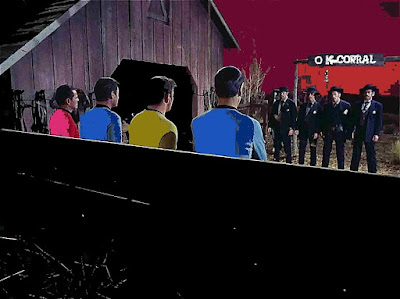


I suppose my basic feeling was that protagonists who traduce the boundaries of time aren't "playing fair." Such TREK antagonists as the Metrons and the Excalibans are so separated by the gulfs of space that they're unlikely to meet-- but as long as they're in the same time-frame, they COULD. But there would normally be no way that a 20th-century "Time Tunnel guy" could meet the legends of other eras, like Ulysses, Merlin, or Billy the Kid, without crossing the gulfs of time. Conquering space with the use of a star-drive may be sheer fantasy in reality. Yet it seems a believable extrapolation from the way Planet Earth has grown "smaller" thanks to technological advances that allow, say, James Bond to jet over to Italy or Japan. 

Nevertheless, I have to admit that in my ALIGNMENT statement I accidentally alloted crossover-status to a different form of "time-travel." I said that Bloodrayne's meeting with Billy the Kid counted as a crossover. But the heroine is only able to meet her universe's version of the  Kid in the late 1800s because she's an immortal dhampire. Bloodrayne becomes a mature female in the early 1800s, but she looks the same age in the late 1800s, and the same is true in her final cinematic adventure, where she's still unaltered age-wise, in WWII, kicking Nazi ass. So, if I'm going to allow for Bloodrayne meeting The Kid thanks to a fantasy-factor, I suppose I ought to make the same allowance with regard to time tunnels, TARDIS-machines, and the like. 

However, not all fantasy-factors are equal. I would maintain that non-legendary historical figures still carry no innominate crossover-mojo when they appear in modern times, whether it's Ben Franklin whammied up by Samantha Stevens or Bill and Ted using their time-traveling phonebooth to summon Napoleon and Socrates. But Billy the Kid remains a legendary historical figure, so I guess his meeting with the excellent dudes-- who, to be sure, are both superordinate icons-- does count as a crossover. And the same would be the case for their interactions with innominate figures of myth and legend, like Satan and the Easter Bunny-- particularly when Bill and Ted meet both in the same narrative, giving rise to a "Super-Legend Crossover."
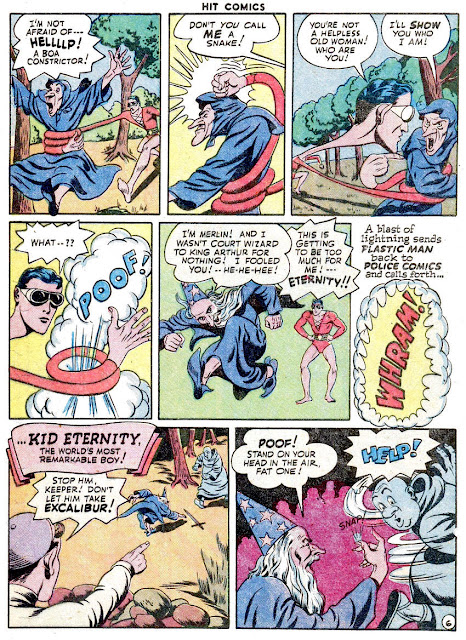


I also raised issues with the Quality Comics character Kid Eternity, whose super-power allowed him to call upon various figures of myth and fiction to fight on his behalf. I even cited a page from one adventure in which the hero calls up Sherlock Holmes. A side-character rightly remarks that Holmes was created in fictional stories, and Holmes answers that "Doyle's stories made me seem real to so many readers that I became a real person." Because of this sort of jiggery-pokery, I'd speculate that the hero's power didn't summon actual humans or deities from the past, but merely images of them, who were able to flawlessly emulate the skills or powers of their models. 
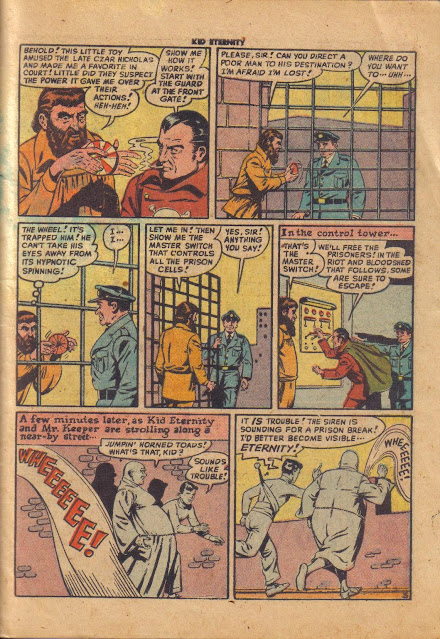


If these figures were all just spectres of the original models, then Kid Eternity isn't actually summoning anyone from any time-frame, not even contemporary heroes like Blackhawk and Plastic Man, and thus that they aren't any more diegetically "real" than the illusions of Genghis Khan and the Clanton Gang in STAR TREK. So it might be the case that none of the characters the hero summons are crossover-figures-- and the same would be true of legendary evildoers called forth by the Kid's polar opposite, Master Man from KID ETERNITY #15 (1946).


However, if the time-travel summoning is veracious, then innominate  manifestations can be crossovers. This would include such interesting if quirky examples as AVENGERS #10, in which newly-minted super-villain Immortus invokes innominate figures of fiction and history such as Attila the Hun, Paul Bunyan, Merlin, Goliath, and a version of Hercules presumably unrelated to the Marvel-Earth incarnation that would debut a year or so later.
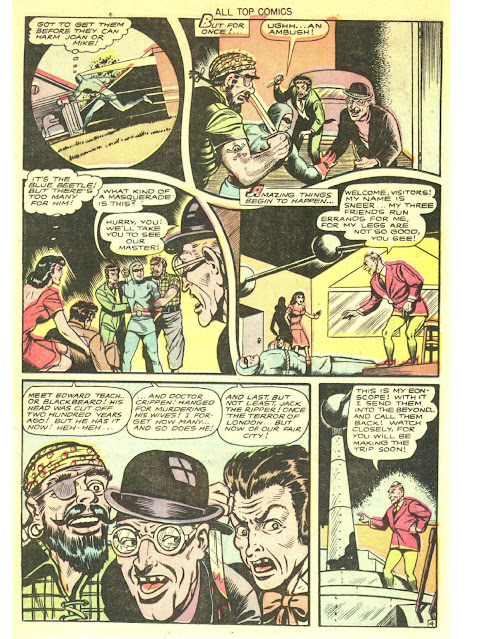


And just to give an example of a "team" of innominate legends drawn purely from recorded history, here's a 1947 BLUE BEETLE story from ALL TOP COMICS #8. The titular hero encounters, thanks to a time-travel device, a "super-menace team-up" whose members are culled from different eras: the pirate Blackbeard, the serial killer Jack the Ripper, and the wife-murderer Doctor Crippen. In fact, the writer of this tale made an overt attempt to "mythify" the historical Crippen-- who only killed one woman according to the law-- into some sort of odd "Bluebeard" type who killed multiple wives.

Wednesday, June 14, 2023

TIME OUT OF ALIGNMENT

 A major aspect of my crossover-theory is that of alignment; the principle that every literary cosmos, particularly with regard to serial concepts, is dominated by one or more superordinate icons whose are the "center" of the narrative, while all subordinate icons orbit around the central icon or icons. In CROSSING GODS I gave several examples of innominate figures from mythology being "crossed over" with one another, and sometimes with newly created serial characters, the example of the latter being Atticus of "the Iron Druid Chronicles." In COSMIC ALIGNMENT PART 3 I spoke of a different form of innominate character, that of a fictionalized version of a historical personage. I asserted that no crossover took place when a narrative associated legendary characters already associated in history-- Jesse James and Cole Younger-- but that it was one if the author depicted an association between characters not known to have encountered one another, like Jesse James and Belle Starr.


Characters involved in time-travel, though, break down normative categories of alignment, and for that reason even figures I've rated as properly "legendary" don't rate as crossovers when they interact with characters who (more or less like authors) are no longer bound by restrictions of the time-space continuum. Thus, a goodie-good Billy the Kid meeting a version of Dracula? Crossover. A vampire-version of Billy the Kid, who has no real connection with the historical figure, meeting Bloodrayne? Crossover. But Billy the Kid, as portrayed by Robert Walker Jr. in the scene above, meeting one of the Time Tunnel guys? Not a crossover. And the same principle applies to works in which the time-travelers bring together assorted characters from different eras, as Billy the Kid, Napoleon and Socrates are brought together by those excellent time-dudes Bill and Ted.


The same applies to figures of myth and folklore, as when Bill and Ted take a bogus journey that brings them into contact with both the Easter Bunny and Satan, or when the Time Tunnelers meet the equally innominate figure of Merlin.


There's also a cognate figure of characters who summon up innominate characters without those icons leaving their own time-frame. In comics the hero who did this most often was Quality's Kid Eternity, who was forever enlisting characters from both myth (Nepture, Midas, Achilles) and from history (Annie Oakley, Abraham Lincoln). None of these would even be charisma-crossovers, either with one another or with Kid Eternity.


However, unlike the time travelers Kid Eternity did possess the power to plumb the vasty deeps of fiction as well-- and so, when he conjured up Sherlock Holmes or (more amusingly) Blackhawk, THOSE would count as crossovers with nominative icons.

Thursday, April 20, 2023

LEGENDS OF YESTERYEAR

In COSMIC ALIGNMENT I addressed the way certain real-life historical figures generated innominative characters based on them, but I didn't try to address what if any limits I might place on the simple appearance of historical figures of any kind within a fictional context. In the essay I spoke of four Old West figures in terms of the enduring "folk-legends" they had engendered in addition to their appearances in nominative fictional works.

... these [four characters] would all be high-charisma crossovers, since all of the folk-legends attached to these westerns would be *innominate* by nature.

I won't pause at this time for a rigorous definition of what I mean by "legends," but I think it important to stress that though there are hundreds of famous historical figures who have been committed to fiction, very few of them have taken on the quasi-unreal status of legends. Billy the Kid is such a legend. A later author can imagine him doing all sorts of unhistorical things-- becoming a vampire who fights Bloodrayne, or being taught gunmanship by the Two-Gun Kid, but each fictionalized Billy has that legendary quality. Thus even a story in which the Kid is a superordinate character, Billy sustains only a "crossover-charisma" when he appears alongside a stature-bearing character like Bloodrayne or Two-Gun.The vast majority of historical figures, even when they're shown doing unhistorical things, are still no greater than what the reader/audience knows of the originals. Winston Churchill is just Winston Churchill even if he's seen consulting with The Invaders. Adolf Hitler is just Hitler, even if he's depicted as the secret creator of The Red Skull.

This idea of "legendary stature/charisma" came to mind as I considered a pair of early seventies films by junk-auteur Jesus Franco. The first of the two, DRACULA PRISONER OF FRANKENSTEIN, was indubitably a crossover of two nominative icons from particular fictional works.


However, the quasi-sequel THE EROTIC RITES OF FRANKENSTEIN depends on mixing the nominative figures of Frankenstein and his Monster with a brand-new character given the name Cagliostro. The movie uses the same pair of actors who played Frankenstein and Dracula in the earlier film, and a version of a character from the Stoker novel DRACULA also appears in both films. Franco's Frankenstein has a qualitative level of stature, but Cagliostro-- who isn't even explicitly compared to the 18th-century occultist-- lacks either stature or charisma capable of sustaining a crossover. Even if there had been some explicit connection to the historical figure, though, I would say, "Cagliostro is no Billy the Kid." 

The occultist only gets a few popular-fiction incarnations. He appears in a 1970s DOCTOR STRANGE continuity, for example. Wikipedia mentions several usages of Cagliostro's historical personage in various works, but  the only book I'd heard of was Alexander Dumas's 1846 BALSAMO-- and this was used as a partial basis for the oddball Orson Welles swashbuckler BLACK MAGIC. The latter two works may be the closest the historical character came to having "stature" in particular nominative texts, but they aren't sufficient for me to think of him as a figure of "legendary" status. Ergo, in Franco's RITES the intersection of Doctor Frankenstein with a man who might be the 18th-century occultist is at best a mashup, not a crossover.


The same would apply to any number of interactions between stature-icons and whatever historical figures they cross paths with-- Doctor Strange and Ben Franklin, Superboy and George Washington, or any time-traveling icon meeting any number of famous historical people-- on which I may expound further later on.

ADDENDUM: Of course when Adolf Hitler becomes a super-villain, as when a version of Der Fuhrer got turned into Marvel's "Hate-Monger," then the real historical figure has become totally subsumed by a fictional character. This type of fictionalized character becomes nominative, not innominate, and said character can be a "charisma-crossover" with another repeat-villain, as he is in SUPER VILLAIN TEAM UP. Also, if Hate-Fuhrer had been the star of his own villain-centric series, or part of an ensemble, for an impressive amount of time, he would obtain stature and would qualify as a stature-crossover with any other character with stature, much as Deadshot acquired stature and keeps it after his respectable run in the SUICIDE SQUAD ensemble.


Wednesday, August 31, 2022

QUICK DEMIHERO POST

 In PERSONA-TO-PERSONA CALLINGS, I wrote:

In some of my earliest writings on crossovers, I distinguished between "static crossovers" and "dynamic crossovers." I won't repeat those particular observations, but the salient aspect of that theory was that the static crossovers were those that were fairly regularized, like Donald Duck appearing in Uncle Scrooge's feature, while dynamic crossovers were those that spotlighted a more unusual meeting, say, of Spider-Man and Daredevil. I would now tend to state that, in contrast to the crossovers of the other three persona-types-- of heroes, villains, or monsters-- demiheroes only sustain crossovers of a dynamic kind, because most of them function as support-characters. Returning to the Batman cosmos, a story in which Alfred simply met police detective Harvey Bullock would not be a dynamic crossover. 


I'll make this observation short and sweet: though it's possible for the continuing demihero star of a series to sustain a crossover-vibe with an innominate character-- that is, a character drawn from myth, legend or imagined history-- one-shot demiheroes cannot sustain such a vibe.

Some examples of non-crossovers include:

A couple of nugatory Abbott and Costello characters meeting Mister Hyde is not a crossover. 


However, a movie in which a nugatory viewpoint character meets SEVERAL monster-icons-- who are all supposed to be strong template deviations of the original icons-- IS a crossover. 


The 1959 ALIAS JESSE JAMES causes a nugatory Bob Hope character to cross paths with the innominate icon Jesse James. The film is not a crossover for that reason.


But the same movie is a Low-Charisma Crossover thanks to one scene in which several western-heroes, played by actors associated with those characters, make cameos. These cameos included both innominate characters based on historical figures, such as Fess Parker's Davy Crockett, and nominative characters totally original to fiction, such as Ward Bond's Major Adams from WAGON TRAIN.


A bunch of nugatory characters essayed by The Three Stooges do not carry the vibe of a crossover when they meet Hercules.


HOWEVER--

If you have demiheroes who exist in a loose serial continuity, then you do get such crossovers, as when we have the cartoon demiheroes Tom Cat and Jerry Mouse encounter such innominate characters as Robin Hood--


Or a nominative character like Sherlock Holmes.


I hope that clears that up.😝


Wednesday, July 6, 2022

COSMIC ALIGNMENT PT. 3

 Another note on the topic of cosmic alignment...

I discussed more than a few western-related examples of alignment in the first essay in this series, and here I'll discuss a largely forgotten western with crossover aspects. 

In the first essay, I noted that a character like Doc Holliday became a "Sub" in at least one of his fictional re-creations, where he regularly assisted buddy Wyatt Earp in the 1950s TV show of the same name. Holliday seems to have only rarely garnered solo status as a Prime, an exception being the 1971 DOC, in which the dissolute former dentist was portrayed by Stacy Keach. I also mentioned that Holliday accrued Prime stature in a 1999 TV-movie, PURGATORY, though only by teaming up with three other deceased gunfighters.


Like Holliday and Billy the Kid, Jesse James has generated numerous innominate texts about his supposed career. One such is the 1960 B-western YOUNG JESSE JAMES, in which Jesse is re-imagined as a young hothead in the "juvenile delinquent" mode still popular during the period. The film resembles little about the real lives of the James Brothers or their allies the Youngers, except in stating that they all rode at one time or another with Quantrill's Raiders. The film shows Jesse gaining vengeance on a man who killed his father, after which he tries, not very successfully, to live a just life, only to be pulled back into outlawry. 

The subject of alignment applies particularly well to the way that all other members of the James-Younger gang became "Subs" to the "Prime" presence of Jesse (Ray Strickland), including older brother Frank, Major Quantrill, and all of the Younger Brothers. For whatever reason, most depictions of the two gangs tend to make Jesse James the center of attention, whatever the realities of history.


The most curious insertion, though, is that of Belle Starr (Merry Anders). The real "shady lady" had nothing to do with Jesse James, though a disproven story did circulate about her having married the uncle of Cole Younger. I'd conjecture that the story of that tenuous relationship was the reason the writer shoehorned Belle Starr into the story, though she only has a few scenes in which she gives the outlaws a haven and has a romantic interlude with Cole Younger himself. I can imagine that the movie-makers wanted a little extra sex appeal in the mix, if only for promotional ads, since there's one moment in which Jesse makes a pass at Belle and she slaps him down, calling him a "young colt." (Amusingly, Strickland was six years older than Anders.) So in my system, while Frank James and the Youngers are normally aligned to the story-cosmos that was Jesse James, Belle Starr was "out of alignment" with Jesse's cosmos, much like the interaction with the four gunfighters in the aforementioned PURGATORY are out of alignment with one another, not having been associated either in real history or in legend. Thus YOUNG JESSE JAMES would not be a crossover film if it had confined itself to subordinating the real associates of Real Jesse James to the narrative authority of Fictional Jesse. But Belle Starr's presence makes the film a crossover, however minor.

Thursday, March 24, 2022

CROSSING GODS

 As in "crossing guards," get it? Ah, well.

Thus far the only thing I've written on the interaction of deities from different mythoi is this section from COSMIC ALIGNMENT:

In conclusion, I will admit that full-fledged myths are harder than folk-tales to judge in terms of alignment. Suzanne Langer and others have noted that in mythology proper figures like gods and their monstrous antagonists often become set in their own "continuity," however often this or that detail may change. Yet some gods and heroes, theoretically in the same universe, never really cross paths, despite "continuities" like those of the Iliad or the Argonautica. Does it count as a crossover if Perseus and Jason, who never meet in the old myths, appear in the same story? I would not tend to consider it a crossover if some ordinary schmuck conjures up the goddess Venus. But Venus crossing over with the mythology of Satan would certainly be a different matter. More on these matters later, perhaps.

Before going into further discourse on the crossovers of gods, demigods, and other characters from myth proper, I want to re-emphasize my earlier statement that a given character does not accrue either stature or charisma just because he either assumes, or is bestowed with, the name of a mythic character. A quick example is the Two-Gun Kid villain Goliath, who was simply a big, strong man who'd acquired the nickname at some point.


Now, when dealing with a character who is supposed to be even a strong template deviation of a myth-character, that character possesses at least some minor charisma. In ACTION COMICS #320 (1965), Superman uses a time-travel device to draw three famous strongmen of myth into present-day Metropolis for some damned reason.


Writer Otto Binder doesn't make any effort to emulate more than superficial aspects of Atlas, Hercules and Samson, and he even gives all of them special powers that they didn't have in their original stories. (Two years later, Binder would show somewhat greater myth-fidelity in the three-part Zha-Vam story.) Yet the extra powers are Binder's clue to the reader that the three strongmen, who immediately start trying to take over Metropolis, are not from Earth's past, but from a parallel world where the trio were evildoers. Nevertheless, because even evil parallel-Earth versions participate in the charisma of the original innominate myths, these dumbbells have more charisma in their first appearance than, say, Brainiac does in his first appearance, or the aforementioned Goliath.


The same principle holds for the first adventure in which Marvel's version of Hercules appears in Thor's first annual, also in 1965. Had this version of Hercules only appeared once, he would still have a degree of innominate charisma because he's linked to the classical Greek hero, in contrast to some other first-time villain, such as the above-shown Radioactive Man. However, when Hercules begins to appear as a guest-star in various THOR tales, he doesn't accrue any more charismatic value than any other character making one or more return appearances. But once he begins to be used repeatedly, Marvel-Hercules makes a transition from an innominate figure to a nominative one. Successive writers may continue to draw on the myth of the archaic Hercules to gloss the exploits of Marvel-Hercules, but he's become nominative because readers can trace exactly where he began as a comics-character, and the allusion to the legendary past of the original myth-figure is not as significant.


During this period, Hercules is aligned with the mythos of Thor, so when he "crosses over" into a  mythos like that of the Hulk, he becomes even more firmly imbricated within the greater Marvel Universe. The icing is fully on the cake when the demigod becomes an Avenger, which is the first time Marvel-Hercules accrues the stature of a starring character. (I should note that Thor also becomes a nominative character as the creators elaborate his history apart from that of the archaic Thor, but the process is easier to illustrate with Marvel-Hercules.)


Given that Thor and Hercules become nominative characters rather quickly, they don't have as much of a "myth-crossover" aspect as my earlier post suggested one might find in the conflicting mythoi of Venus and the Son of Satan, if only because the latter character never makes another appearance. Innominate charisma tends to remain stationary in non-serial formats, such as the Neil Gaiman novel AMERICAN GODS. I can't speak for the streaming series-adaptation, which I've not seen. But the stand-alone novel would be high-charisma-- unlike any of the works I've discussed here-- because even though they may be gods in decline, they are supposed to be the real things, and Gaiman ups the charisma by showing intersections between mythoi as different as Odin and Anansi.


Kevin Hearne's novel HOUNDED also takes place in a world where all of the archaic gods still exist in modern times. The first book in this series, entitled "The Iron Druid Chronicles," focuses not on the gods but on Atticus, a druid who's become immortal enough to live into contemporary times. In the first novel, Atticus' mythos is almost entirely made up of Celtic deities, and since Atticus is Celtic himself, they are all aligned to him in a "Sub" relationship. One of the more entertaining allusions to gods from other mythoi is a reference to how a bunch of death-goddesses-- the Celtic Morrigan, the Nordic Valkyries, and the Hindu Kali-- allegedly hang out together. But since the meeting is merely talked about, there's no crossover-charisma. Hearne only works one myth-crossover into HOUNDED, and it's a minor one. Atticus's Celtic enemy Aengus Og makes common cause with a bunch of demons from the Judeo-Christian Hell, though the demons only appear for a few pages. In addition, when Aengus is slain he's claimed by a Christian myth-figure, the pale horseman of Revelation. That's not much myth-charisma to be had, but I imagine later books in the series will expand on Atticus's encounters with figures out of other myths-- though I expect them to be as lightweight as HOUNDED is.

Wednesday, December 22, 2021

COSMIC ALIGNMENT

The sort of "cosmos" I'm talking about in this essay is essentially the same as the word "mythos" as I've been using it to apply the totality of elements within any narrative, where a variety of Subs-- mostly antagonists and supporting characters-- interact with one or more Primes. This cosmos may be generated within the space of one narrative, as per my earlier example of the novel IVANHOE, or throughout the progress of a series, be it short-lived or long-lived. All subordinate presences within a narrative-- characters, settings, and certain types of artifacts-- are defined by their *alignment* with the stories generated by the superordinate character(s).

I indirectly alluded to this concept, not then named, in A CONVOCATION OF CROSSOVERS PT. 1,  regarding the character of Fu Manchu. Since Fu is the sole superordinate character of the series of books named for him, all other characters in those books are aligned with him, even those opposing him. However, when Fu becomes a subordinate character in the MASTER OF KUNG FU series, he then becomes an aligned figure within the Shang-Chi cosmos.

The first appearance of an antagonist often determines his alignment for the foreseeable future. No matter how often the Joker appears in features other than those of Batman, he remains known as a Batman foe. However, it's possible, particularly when the individual features of a given publisher share continuity, for subordinate presences to cross over into other features. In CROSSOVERS PT. 3,  I reviewed the way in which two villains, Mister Hyde and the Cobra, had debuted in the THOR feature but were recycled into that of DAREDEVIL. The two super-crooks never became firmly attached to the latter feature either, and they subsequently drifted into such venues as SPIDER-MAN and CAPTAIN AMERICA. Since the two evildoers never became strongly associated with any single feature, I would still tend to view them as Thor-villains who bring about a charisma-crossover every time they venture into a new character-cosmos.


 OTOH, in comic books Thanos first appeared in an IRON MAN story, but he was never established, via escalated appearances, as an Iron Man villain. Instead, his creator Starlin aligned Thanos first with the third Captain Marvel and then with Warlock, and given the demise of the former, I would tend to think that he aligns most strongly with Warlock. However, in the Marvel Cinematic Universe, the nasty titan becomes an Avengers foe-- and will probably never be re-interpreted further in the movie-medium.


As it happens, a number of famous historical figures also cross paths, though of course these events are not being contrived for anyone's entertainment. In this essay, I addressed the subject of notorious western marauder Billy the Kid, focusing on how little all fictional treatments of the outlaw related to the real historical personage. But even though the real Billy the Kid never met a lot of the famous people of his time, much less Dracula, some "real crossovers" did take place. The Kid's sometimes criminal associate Dave Rudabaugh, for instance, is credited in this Wiki-article with also encountering Bat Masterson, Wyatt Earp, and Doc Holliday. Earp and Holliday may have met for the first time due to Earp's hunt for Rudabaugh.


The real-life association of Earp and Holliday became the stuff of many fictional westerns, most of which tended to make Earp a Prime protagonist while Holliday was relegated to Sub status. Nevertheless, Holliday had enough charisma that he occasionally migrated into other fictional cosmoses, dueling with the Rawhide Kid in one comic and making an appearance in an episode of the TV show THE HIGH CHAPPARAL.


Strangely, Holliday gets a post-mortem encounter with three western folk-heroes in the 1999 movie PURGATORY, none of whom he knew in life: Billy the Kid, Jesse James, and Wild Bill Hickock (though the last character seems more like a faux Wyatt Earp in his characterization, since he's not that "wild.") Again, these would all be high-charisma crossovers, since all of the folk-legends attached to these westerns would be *innominate* by nature.


Moving from folk-legends to folklore, there are a wide number of crossovers which focus on associating figures from folktales and fairy tales. Usually these type of tales are too amorphous to establish a "cosmos" for, say, Little Red Riding Hood. But on occasion the Wolf, aligned as a subordinate character in that story, becomes the star of a given story, or he may become one of many stock folk-figures to cross over with some superordinate character, often a new, non-traditional character like Shrek.

In conclusion, I will admit that full-fledged myths are harder than folk-tales to judge in terms of alignment. Suzanne Langer and others have noted that in mythology proper figures like gods and their monstrous antagonists often become set in their own "continuity," however often this or that detail may change. Yet some gods and heroes, theoretically in the same universe, never really cross paths, despite "continuties" like those of the Iliad or the Argonautica. Does it count as a crossover if Perseus and Jason, who never meet in the old myths, appear in the same story? I would not tend to consider it a crossover if some ordinary schmuck conjures up the goddess Venus. But Venus crossing over with the mythology of Satan would certainly be a different matter. More on these matters later, perhaps.


WHAT'S IN A NOMINATIVE TEXT?

 In A CONVOCATION OF CROSSOVERS PT. 4 I wrote:

Moving away from this type of High Charisma crossover, I want to return to the matter of "crypto-continuity" introduced in Part II, I asserted that "King Kong II," though not technically in continuity with "King Kong I," borrows enough motifs from the original that the later character may be seen as what I term a "weak template deviation." 

However, there are also "strong template deviations," which often involve authors totally overwriting not totally fictional characters, but characters from myth, legend, and history-rendered-into-fiction.

Though I may have reason later to utilize these "template deviation" terms, I'll put them aside for this essay to discuss the two types of texts from which a later narrative may deviate: the *nominative* text and the *innominate* text. Innominate texts are all texts that arise from anonymous sources, whose history is hard to determine. Nominative texts are all texts whose origins and authorship are easy to verify. 


Some texts from very archaic times may combine aspects of both, in that we know the historical placement of the BEOWULF poem and of the EPIC OF GILGAMESH, but not who wrote them. We know the name of Homer, who composed the two epics once believed to be the earliest literary works in existence, and we know the probable times in which the epics were circulated, but we know next to nothing about the author himself. Homer's epics, Beowulf and the GIlgamesh Epic were most probably built up from assorted shorter stories of myth and folklore, and indeed the ILIAD and the ODYSSEY might be considered the world's first major crossovers, given that they are forging connections between legendary characters who may not have been associated with one another in anterior eras.

 To further complicate the matter, even some legendary characters may have verifiable historical associations. The figure of Gilgamesh is attested to have been a mortal king in an early period of Sumerian history. However, in keeping with the theory of the Greek scholar Euhermus, later Sumerians used the name Gilgamesh for one of their gods, and it is as a demigod that the character appears in the aforementioned epic. For this reason I tend to regard all of the archaic works, even the epics of Homer, to be innominate because their full history is sometimes murky in its specifics.


In contrast, the majority of texts produced since the rise of European culture in the post-Renaissance era are usually known quantities for  the most part. From that time on, a much stricter distinction between fiction and non-fiction pertains in Western culture. In Shakepeare's historical plays, he feels free to change details of real history-- sometimes of historical eras very close to his own-- and this may be because he knew that his audience would dominantly regard his plays as fiction based on fact, in contrast to any archaic Greeks that may have regarded the ILIAD as the history of Troy's fall. 

In CROSSOVERS PART 4 I contrasted two characters whom I regarded as a "high-charisma crossover," the titular figures of the 1966 weird western BILLY THE KID VS DRACULA. It should go without saying that the Dracula of this film, despite having little if anything in common with the Dracula of Bram Stoker, nevertheless descends from a *nominative* text: a book published in 1897.


Billy the Kid, however, was a real historical personage, who became over time a folk-hero in a process roughly analogous to what may have happened with the historical Gilgamesh. A scholar knowledgeable in the subject of dime-novel westerns could probably cite a particular work that contributed to the growth of the Kid's repute. However, it's unlikely that any single literary or even cinematic work was responsible for the articulation of the legend. Most of the real-life exploits of the outlaw born "Henry McCarty" are not in the least admirable, and maybe not even all that daring. Yet simply because the real-life person became a figure that people could talk about, the people began building him into a legendary personage, even to the extent of making him a righteous hero. 


Thus in my system every fictional story including Billy the Kid is an *innominate* text-- even one that purports to represent the "real" Billy, like the 1972 film DIRTY LITTLE BILLY. 

An *innominate* text, because its main characters are not grounded in a text with a particular history, cannot boast characters that have any stature relevant to a crossover. Every Billy the Kid in every serial or stand-alone work is different from every other one, and so there exists not even the tenuous "crypto-continuity" that exists between the Dracula of Stoker and the Dracula of William Beaudine. 


To be sure, it's not impossible for an author to use the name of a character from a nominative text for a new character who has nothing in common with the original save the name. In a series of B-westerns starring Ken Maynard, the hero rode a horse named 'Tarzan." I assume the filmmakers legally got away with using the name of the Burroughs ape-man because no one in any audience would have believed that the horse was an attempt to imitate the copyrighted Tarzan character.