Featured Post

SIX KEYS TO A LITERARY GENETIC CODE

In essays on the subject of centricity, I've most often used the image of a geometrical circle, which, as I explained here,  owes someth...

Showing posts with label kurt schaffenberger. Show all posts

Sunday, November 20, 2022

MYTHCOMICS: "THE WITCH OF METROPOLIS" (LOIS LANE #1. 1958)


This post by A. Sherman Barros reminded me the cover story for LOIS LANE #1, whose winsome witch-incarnation appears six years before a similar and better known image in the BEWITCHED TV series. However, even on an image-to-image basis the LOIS LANE cover is more interesting. Not only does the cover-copy suggest that witchy Lois is going to one-up her super-powered swain at last, artist Kurt Schaffenberger puts her in ragged clothes, as if to suggest that by so doing the sorceress-reporter has put herself outside the bounds of standard attractiveness-- though she does have enough feminine modesty to ride side-saddle only.

In my comments-response to Sherman I said I saw this story as a near-myth, but on reflection, Otto Binder's "Witch of Metropolis" plays into a rich tradition of "the war between men and women" that began with Superman's debut in ACTION COMICS #1. The fact that Lois doesn't really become a witch-- and I doubt any adult reading this blog will find this much of a spoiler-- doesn't take away from the story's ability to play to the main character's resentment of her often elusive boyfriend.


Within the decade of the fifties, this first issue of Lois Lane's own comic had been preceded by two tryout issues in the SHOWCASE title. Those issues and the other two stories in LOIS LANE #1 quickly established that Fifties Lois was going to be a lot like Fifties Jimmy Olsen, a somewhat admirable protagonist who nevertheless got involved in a lot of wacky escapades, often prompted by egotism. Yet one thing interesting about "Witch" is that the story doesn't begin with Lois doing anything wrong or unseemly, unless one counts laughing at old superstitions. And some of Lois's scorn is justified, since I strongly doubt that any "Jekyll and Hyde" witches existed outside Otto Binder's imagination. One might argue that Lois's imagination is also working overtime, since page 2 shows her imprudently sniffing the fumes of an experiment involving a "youth serum"-- and yet she, unlike even the more clever kid-readers of the comic, ought to have known that her getting old might have a little something to do with said serum.


Even her next-page encounter with Superman doesn't show Lois in a foolish light; at most, one might say that she lets her feminine ego keep her from confessing her embarrassment to the Man of Steel. Having totally bought into the idea of a curse passed on to her from the long dead witch Molly Todd, she also buys into the idea that she has magical powers.


I'll jump ahead a bit and reveal that Witch-Lois doesn't have supernatural powers. Superman has seen through her charade, and he uses his powers to keep her delusion going, for the usual hard-to-believe reasons. Later in the story, the hero's rationale will be that he played along with her fantasy so that she wouldn't have a hypothetical breakdown. However, even though the girl reporter isn't the victim of a curse, the idea of having magical powers does bring out her inner Hyde. After exulting in her ability to ape one of Superman's powers, she uses her "magic" to spy on a film project to get a great scoop. It's only at the end of this page that Lois expresses some invidious emotions toward colleague Clark Kent, who "gets the juiciest jobs."


While Lois didn't spy on the film-set with any idea of one-upping Clark, it's her express reason for doing so when she swipes the documents Clark was assigned to pick up. From there, it's just one step to making an assault upon Superman's most prized secret, by conjuring up kryptonite to discover his double identity. 

Obviously, the whole dumb-show of Superman managing to anticipate every one of Lois's whims is absurd, particularly giving her fake kryptonite. (And what was going to be his plan, if "Miss Hyde" won the internal struggle and tried to zap Clark Kent with her fake chunk of Kryptonian real estate?) The moral of the story is that even though Lois's "Miss Hyde" personality is totally the result of her own fantasia, she does manage to resist the urge to cause harm to her beloved, even if it means he continues to exclude her from his confidence. However, on a mythopoeic level "Witch" serves to put on display some of Lois's feminine resentment of her often manipulative love-interest, which even extends to the desire to expose and at least wound him. Superman's not nearly as much of a dick here as he is in many other Lois-stories, and Lois isn't as much of a blockhead-- and for those reasons this feels like a variation, albeit a minor one, on the "men and women at war" theme.

On a side-note, though other artists depicted the lady reporter in the SHOWCASE stories, all three stories in LOIS LANE #1 were illustrated by Kurt Schaffenberger, the artist who would be most associated with Silver Age Lois-- though he was much better known for making her a glamour-puss than a glamour-wielding sorceress.

Friday, January 8, 2021

MYTHCOMICS: “EYES OF THE SERPENT” (SUPERMAN FAMILY #174, 1975-76)


In one reminiscence Roy Thomas recalled that his one-time DC editor Mort Weisinger was the first person he Thomas heard use the term “mythology” for a corpus of comic-book stories, in particular the “Superman Family” titles over which Weisinger held sway for the entirety of the Silver Age. I would guess that this was just a convenient tag for the editor, that he probably cared little or not at all about what comprised a genuine archaic mythology, or what status if any modern-day stories might have as “myths.” Still, in the late 1950s Weisinger made some concerted effort to have his writers utilize far more fantasy/SF tropes in the Super-books than had previously been the norm. Not all such metaphenomenal tropes are automatically mythic in nature. Yet as it happened, many writers in Weisinger’s stable—Otto Binder, Leo Dorfman and of course Jerry Siegel—did manage to use these tropes to tell a handful of stories with a high level of mythic concrescence.


However, Weisinger was edged out of DC just in time for the debut of the Bronze Age in 1970, and the Super-books were parceled out to assorted editors. Julie Schwartz took custody of the two titles starring the Big Blue Cheese, SUPERMAN and ACTION COMICS. But though Schwartz’s Silver Age writers had also produced a respectable number of myth-stories, in the Bronze Age the editor favored in large part two writers given to penning very gimmicky, superficial tales: Cary Bates and Elliot Maggin. When three of the ancillary Super-features—SUPERGIRL, JIMMY OLSEN and LOIS LANE—failed to sell well, DC cancelled the individual titles and transferred their features to a portmanteau book, THE SUPERMAN FAMILY. As it happens, it was in this title that editor Schwartz and writer Maggin produced one of the few stories that can stand alongside the best myth-outings of Siegel, Binder and Dorfman.
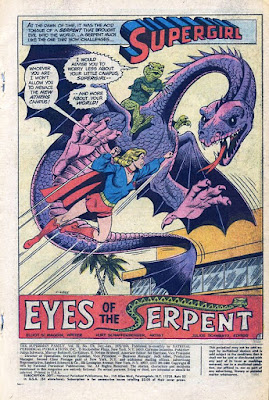


The first page of Kurt Schaffenberger’s art for “Eyes of the Serpent” is a splash-page portraying a scene that does not literally occur in the story: Supergirl flying into combat against a giant winged dragon, while on the dragon’s back rides a green-scaled humanoid. The humanoid looks a bit like a frog-man, but Maggin’s caption makes clear that this fellow so viridian is also ophidian: “At the dawn of time, it was the acid tongue of a serpent that brought evil into the world—a serpent much like the one that now challenges Supergirl!” In this introductory sentence, Maggin establishes that in this world, he validates as real the story of the Garden of Eden, including Eve’s temptation by a serpent later identified with Satan. However, the story Maggin tells is about a serpent who is only “much like” the Biblical tempter, the better to avoid any accusations of mixing serious religious figures with the “let’s pretend” of a comic book.

As the story proper begins, the same serpent-man from the splash, Lord Beriak, stands in an indeterminate location (full of rocks and smoky vapors) along with other serpent-men, who give Beriak his assignment. He must journey from wherever the serpent-people make their home to a college in Florida, where the Kryptonian heroine works as a guidance counselor in her Linda Danvers identity. Beriak's purpose is that of “reasserting our dominance over the human race.” (Some influence from Robert E. Howard’s “serpent-men” stories seems likely, given that the snake-people are never identified as either aliens or supernatural demons.)
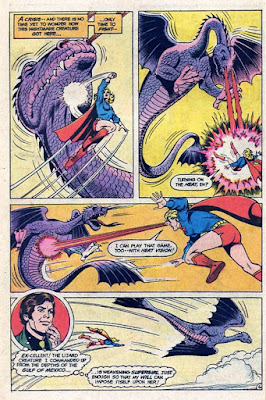


Once Beriak arrives in the fictitious Florida town of New Athens—where, for once, the locale plays a role in a Super-story—he takes on the appearance of a good-looking human male and contrives to meet Linda Danvers. Linda/Supergirl is somewhat attracted to the false flesh of Beriak, but she doesn’t immediately agree to date him. Since Beriak’s as-yet-unrevealed master plan requires him to gain mental dominance over Supergirl, he decides that she may become more pliable if he wears her down a little. To that end he summons a dragon from the vasty deep of the neighboring ocean and makes it run amuck in New Athens, so that the heroine will appear and bring the beast to heel. (Though dragons have some status in Bible lore, this critter is just another of DC’s countless convenient prehistoric survivals.)
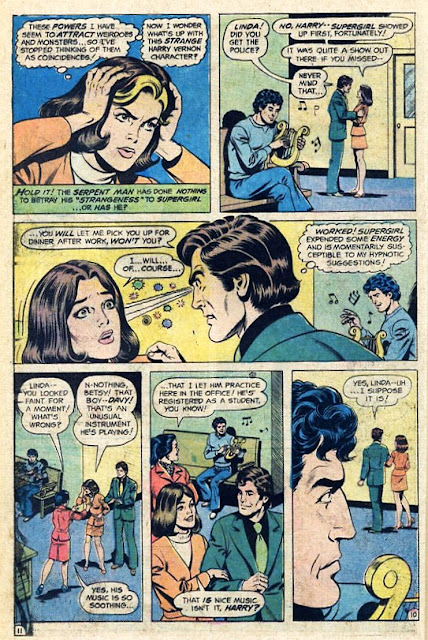


While all this is going on, a mysterious young fellow named “Davy” appears at the college, and he like the serpent-man shows some ability with exerting persuasive mojo. The Davy character, created by Maggin for a three-part Green Arrow story in ACTION COMICS, is given no precise origin, but he’s clearly meant to be identified with the youthful David of the Bible, since Davy carries a lyre on which he can play enchanting music, and a sling with which he can cast stones, like the one David used to defeat Goliath. Maggin does not ever say that Davy is identical with Bible-David, who after all aged, sinned and died in the course of his narrative. But since the House of David was associated (in a roundabout way) with the lineage of Jesus of Nazareth, Davy is as associated with the powers of Heaven as the serpent-men are with the Devil.


In addition, in what may be the shortest foreshadowing in a comic book, an orange-picker falls unconscious after eating an orange in a local grove. The man is never seen again, though by customary expectations the reader would assume he’s okay once the threat of the serpent-men has been vanquished.


The disguised Beriak once more encounters Linda Danvers after her heroic other-self has driven off the winged dragon. This time, he places her under his mental thrall, at least enough that she accepts a date with him. As Beriak leads his victim to the slaughter, Davy follows along, sometimes playing the music on his lyre, though for reasons undisclosed the serpent-man can’t hear it. (Perhaps Maggin believed the legend that snakes can’t hear or thought that his audience would believe as much.)
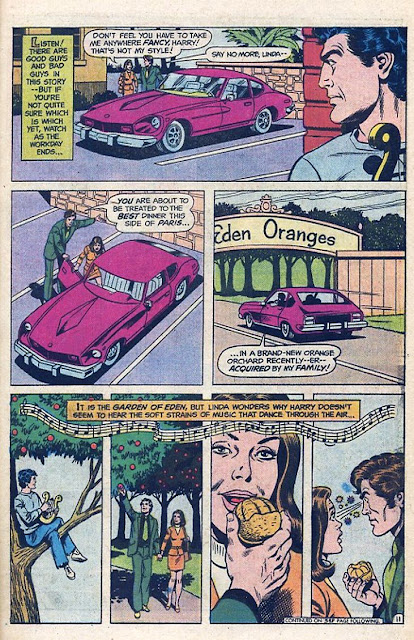


Beriak takes his date to an orange orchard—possibly the same one where the unnamed man collapsed—and ramps up the Eden-references by getting Linda to eat one of the tree’s “forbidden fruits.” Whjen Linda eats the orange, it apparently puts her under Beriak’s total control. Beriak then reveals his scaly other self and makes the Girl of Steel perform a few super-feats for his amusement. Then he finally reveals his master plan. Beneath one of the orange-trees in the orchard—presumably the one from which Linda ate, just to keep up the parallel with the Biblical Tree of Knowledge—lies a “golden stone” called the Eden Rock. Once Beriak compels Supergirl to surrender her life-energy to the stone, this maneuver will give the serpent-race total dominion over humanity and all of its superheroic defenders.
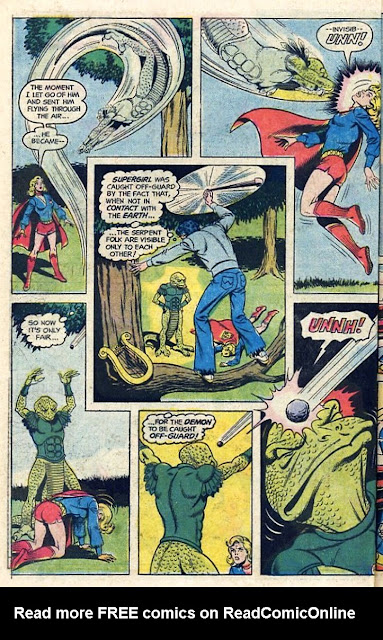


However, Supergirl has been shamming: she caught on to his imposture early on. The two super-beings fight, and though Beriak gets the upper hand once, Davy is on hand to distract him with a handily-hurled sling-stone. Beriak finally recognizes Davy as an old foe of his Satanic species, and Davy uses his magic to keep Beriak restrained while Supergirl tunnels beneath the earth and destroys the Eden Rock, so that no one can use it again. Then, as the enemies square off again, Beriak’s fellow serpents, who are watching from afar, decide to call back their agent, commenting that he was stymied by “our old nemesis, the immortal singer David.” Supergirl and Davy converse briefly and the story ends with a minor coda at Linda’s workplace.
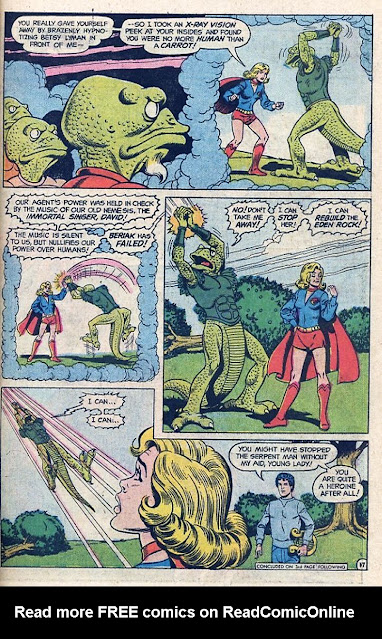


It would appear that the serial’s Florida setting was the only reason for Maggin to substitute an orange for the forbidden food, though to be sure some scholars don’t believe the Biblical fruit was an apple, either. Maggin doesn’t say why this particular delicacy is forbidden, or who forbade it, or why eating it doesn’t really affect Supergirl at all. Presumably the only parallel is an inverted one: unlike Eve, Supergirl resists the blandishments of the serpent, and so preserves her world in contrast to Eve losing Eden for herself and Adam.


As noted, since the Biblical David was not “immortal” like Davy, there can only be a symbolic connection between the two. Davy is what Carl Jung might have called a “puer eternus,” an eternal child—which is, to an extent, an archetype to which Youthful David subscribes as well. Bible-David has no connection with the mythology of Eden except in the sense that David provides a link between Adam and Jesus of Nazareth. In a larger sense, of course, the expulsion of the first Man and Woman from Eden leads to Christ’s sacrifice to redeem humanity, so the Fall foreshadows the Redemption, and the general defeat of Satanic evil. In addition, in Maggin’s scenario Davy is meant to be something of a destined warrior like David: able to overcome evildoers who seem far more powerful than he.


There is nothing paralleling the Eden Rock in Genesis. However, there are a few foundation-stones in the Bible and in later Judeo-Christian commentary. In the Zohar, God is said to have unleashed the flood—the instrument by which the Divinity eradicates almost all the sinning spawn of Adam and Eve—by moving a foundation-stone called the Eben Shetiyah. There is no firm evidence in the story that Maggin knew of this trope. But given that he was already juggling the myths of Eden, it’s not improbable to think he might work in one from the Flood-Myth, even if he does turn it into a standard comic-book gimmick, “the thing that makes all humanity bow down.”


Lastly and leastly, Beriak’s name doesn’t seem to have any strong forbears, Biblical or otherwise. There is a Canaanite deity named Berith or Baal-Berith, who later becomes a Christian demon, but in this case it’s just as possible that “Beriak” took no influence from this figure, that the serpent-man just has a nonsense-name. It’s of passing interest that “Berith” means “covenant,” which reference could take us back to Flood-mythology—but that’s not a holy hill on which I’d choose to make my stand.

Thursday, March 2, 2017

MYTHCOMICS: "LOIS LANE'S SUPER-DAUGHTER" (LOIS LANE #20, 1960)


This story was actually the second in a series of two imaginary "what if Lois married Superman" stories, which ran back to back in issues 19 and 20 of the LOIS LANE magazine. I presume from this that editor Mort Weisinger accepted an initial pitch for both stories, instead of choosing-- as he sometimes did-- to wait awhile to gauge audience interest. There may have been a sequel or two that followed, but these two were produced so as to be read back-to-back.

The first story from #19, "Mr. and Mrs. Clark (Superman) Kent," however, is not as symbolically resonant as the second one from #20, though both stories were written by Jerry Siegel and drawn by Kurt Schaffenberger. "Mr. and Mrs" is not much more than a "beware what you wish for" homily. Superman marries Lois Lane, thus supposedly fulfilling the dream she's cherished since she first met him (at least in Weisinger's universe), finds out her dream isn't all it's cracked up to be, for in public she's simply the wife of the hero's alter ego Clark Kent. The fact that he's Superman is of course kept secret from the populace, so that no one-- especially Lois' longtime rival Lana Lang-- knows that the superhero is off the romantic market. It's a pleasant enough story, but "Lois Lane's Super-Daughter" strikes a deeper chord.

About three years after this story appeared on newstands, Betty Friedan's THE FEMININE MYSTIQUE was published. Building on material the author had gathered during the late 1950s, Friedan sought to make clear that modern American women had become desperately, symtomatically unahppy due to the imposition of a "mystique" upon their lives; one that kept them from fulfilling themselves as rounded human beings. MYSTIQUE was a major influence upon Second-Wave feninism from that time on. But Jerry Siegel's "Super-Daughter" presciently taps into some of the same discontents, though obviously it does so within a juvenile context, and within the context of a continuing superhero melodrama.

A few fans of Silver Age Superman have wondered why, after Superman's cousin Supergirl appeared on Earth in 1958, he didn't "man up" and adopt her in his identity of Clark Kent. I don't think the question was formally addressed in the actual continuity, and I'm sure that the proximate reason the character did not do so was that his editor and writers didn't want him playing Adoptive Daddy in every story. But there was still a kernel of logic in Clark's reticence, for during this time-period social services personnel generally took a dim view of single men or women adopting children of any age. Given this state of affairs, having the teenaged Kryptonian placed in an orphanage to seek adoption by a bonafide married couple-- which eventually does transpire-- doesn't strain my credulity.

What's interesting from the story's beginning is that the moment Clark and Lois are married, Clark springs it upon her that he'd like them to adopt this teenaged cousin that he's never mentioned before.


Lois looks a little bit poleaxed by this revelation, but she's married "for better or worse," and when the adoption agency complains that she might not be able to handle a new child and a job, Lois does what anyone in the period would deem The Right Thing.


Keep in mind that this Lois is not the fire-eater from the Golden Age. Though it would be absurd to assert that the Lois character was thoroughly consistent, since her moods could fluctuate according to the needs of a given story, it is at least part of Weisinger's conception of Lois that she has an irreducible domestic side to her personality. Mort Weisinger may well have been the sort of man whom Betty Friedan criticized for wanting women to become wholly domestic once they became wives. Nevertheless, for the time, the demands of the adoption agency seems not unusual, and the strength of Siegel's story is that one does see certain disadvantages to the world of domestic bliss.

True, there's almost no trace of mother-daughter bonding in the story, except for minor scenes like this one:


But it probably would have been a little beyond Siegel's skill-set to be THAT attuned to the ways of modern women, and besides, the main thrust of the story is all about Lois's discomfort with this perky intruder who's been thrust into her domestic world before the former lady reporter has even had a chance to get used to her new husband. The problem is only aggravated by the fact that both Lois' husband and her de facto daughter belong to a world of super-powered endeavors to which Lois cannot aspire. Here's one of the tandem "super-feats" to which Supergirl alludes on the cover of #20:


Worse by far, though, is that Supergirl's powers make Lois's function in the household irrelevant.


There's an exquisite irony in this setup that I wonder if Betty Friedan could have appreciated, even without the fantasy-content. Lois sacrifices the "exciting life" she enjoyed as a girl reporter, but her reward is to be marginalized within the household that is supposedly her domain. Yet through it all, Lois masks her pain, a veritable Stella Dallas of the comic books, an icon of maternal martrydom. Yet, where Olive Prouty's character accepts her marginalization, Siegel's Lois manages to manifest her hidden hostility in one of the most roundabout ways ever conceived, even in a Mort Weisinger comic book.


Yes, that's right: not only does Lois "just happen" to whale on the backside of a robot who looks just like Supergirl in her secret ID, a snoopy women from the adoption agency literally invades Lois's private home just in time to catch Lois in the act of unleashing her fury at the (first) unwanted intruder. I particularly enjoy how tearful Lois is in the story's final panel, perhaps revealing just a touch of the schadenfreude she may be experiencing from Supergirl's "unhappy ending." Will Lois ever make things up to Superman? Well, maybe or maybe not, but either way, she won't have a fifth wheel getting in the way.

I should note that though a fair number of stories from this time-period contain hints at some sexual stirrings between the two super-cousins-- particularly "Superman's Super-Courtship"-- "Super-Daughter" actually works just as well without any such elements of sexual transgression as it would with it. I could see the story entering new terrain if it were ALSO about a nubile young adoptive daughter nudging out an older wife from the affections of the adoptive father. But mythically speaking, the story works quite as well as a melodramatic-- as well as comical-- look at the marital disadvantages of a former working woman in the era of the Comic-Book Silver Age.