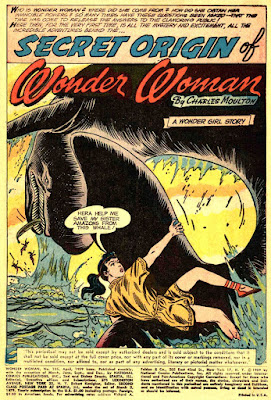
The “events” to which my title
refers are all the 1959-1966 appearances of DC Comics’ original
“Wonder Girl” character, whose name I will henceforth abbreviate
to “WG1.” Prior to 1959, the WONDER WOMAN continuity had made
loose references to the idea that the heroine had passed from
childhood to adulthood on Paradise Island before taking on her
costumed mantle. However, in no previous period was a younger version
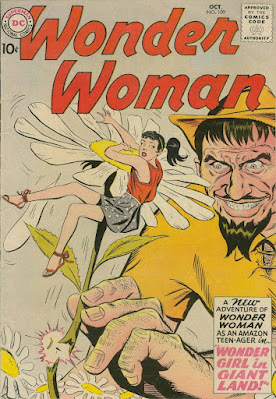
of Wonder Woman a frequent element of the series. But in WONDER WOMAN
#105, dated April 1959, writer/editor Robert Kanigher and artist Ross
Andru began making repeated use of a teenaged version of the heroine,
much as the feature SUPERBOY told stories of Superman when he was a
youth. WG1’s adventures were sometimes featured on WONDER WOMAN
covers, while at other times the teen Amazon was just a backup to her
better-established older self. Not a lot of fans, even back in The
Day, were especially fond of the character, though ironically WG1
indirectly spawned DC’s second Wonder Girl iteration, and that character enjoyed
considerable cachet in the TEEN TITANS series-- more on which later.
Many fans, then, would have deemed WG1
an unfortunate result of editor Kanigher’s tendency to write down
to the readers of WONDER WOMAN. But it only recently dawned on me
that WG1 was also “un-udderable,” in a way I can only express in
song:
No boobs at all,
No boobs at all,
Double-U Gee-One
Had no boobs at all!
(Approximate melody based on a song
about Fawcett’s Captain Marvel, who was said to have no “balls”
at all.)
While looking through one of the WG1
stories, a question occurred to me. If one presumes that Kanigher
began writing stories of a teenaged Amazon, logic would dictate that
he was doing so to improve sales. Movies about the new breed of
American called the “teenager” had proliferated in the middle
1950s. Such films varied between stories about “clean teens” or about adolescents with somewhat raunchier proclivities. But all teen movies dealt
with youths over fifteen, meaning that the female teenagers no longer
looked like kids. However, WG1, despite being called a teen, always looked significantly undeveloped.
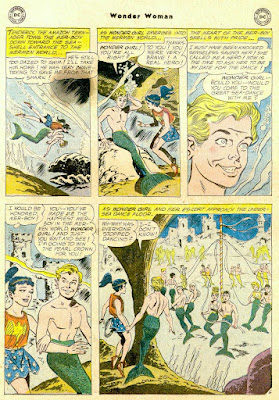
The WG1 stories do not explicitly state
how old the young Amazon is. Yet in all the character’s
appearances, she goes around clothed in a very loose tunic, whether
it’s some Graeco-Roman garment or a version of the famous Wonder
Woman costume. Since the mature Wonder Woman was reasonably well
endowed, the logical conclusion is that the creators of WG1 meant to
imply that the character was too young to have significant
breastitude. If Kanigher was at all consistent about deeming WG1 a
teenager, the youngest she could be would be thirteen, and for some
individuals this can be too young for full development.
Of course, though WG1 was not
technically a kid sidekick, I believe most if not all “young
allies” of older superheroes were supposed to be in this same
age-range. Michael Fleischer’s ENCYCLOPEDIA OF BATMAN offers
evidence that Robin the Boy Wonder was supposed to be a perpetual
thirteen or fourteen before he finally started aging in the late
1960s, and most boy sidekicks looked no older than Robin. Prior to
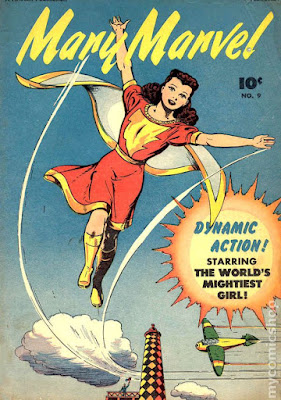
WG1, there were few teenaged superheroines in comics, and the only
long-lived one was Fawcett Comics’ Mary Marvel, sister of the
aforementioned Captain Marvel. Mary’s age probably wasn’t stated
either, but on the whole, her figure also suggested the appearance of
a girl who had just recently passed into adolescence. All this
circumstantial evidence suggests that the raconteurs who worked on
Golden Age superheroes were convinced, probably not without merit,
that most of their readers were pre-teens, and that the only ages
they wanted to see represented were either (1) kids of middle school
age or (2) adults, the latter embodying the fantasy of attaining
temporal power. That’s also probably one reason that Kanigher
decided to devote space to stories of a thirteen-year-old Amazon. The
baggy clothing may have been calculated to dodge any question of the
not-yet-budding youth being exploited, since a reader couldn’t even
tell if she had breasts.
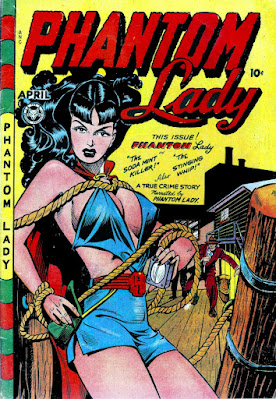
Of course, if you lived back in the
1950s and listened to the Abominable Doctor Wertham, all comics in
all genres were replete with what the psycho psychiatrist called
“headlights.” There can be little doubt that a few superheroines
were especially well endowed, particularly some versions of the
Phantom Lady. But most of the genres that accentuated the positive
power of cleavage were those of crime, jungle-adventure, and
teen-humor—the last being the only genre in which developed female
teens regularly put their goods on display.
I doubt that during the middle 1950s
the very conservative DC company had to clean up very much in the
boobage department. Before the Code, the potential lubricity of
Wonder Woman’s costume was restrained by the quasi-Classical art of
H.G. Peter. After the Code, Andru and others tended to draw her as
being a bit on the slender side. Most regular female characters—Lois
Lane and Lana Lang (in the SUPERBOY feature) -- sported modest
cleavage, while Catwoman, one of the few well-endowed DC femmes,
found herself placed in exile for having drawn the wrath of Wertham.
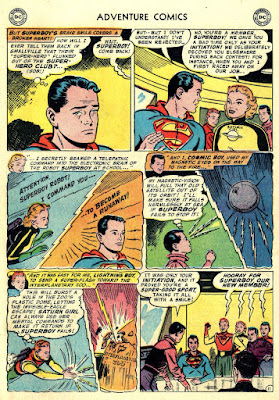
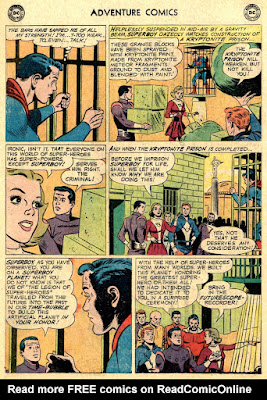
One character, Saturn Girl of the Legion of Super-Heroes, made her
first appearance as a supporting character in a 1958 SUPERBOY story,
and in that story she barely appears to have any tits at all.
However, once the idea of the Legion earned some plaudits from the
readers, Saturn Girl’s second appearance gave her a better costume
and cleavage about the same as that of Lois and Lana. But then, she,
unlike WG1, was supposed to be at least fifteen. On a side-note,
though the lady Legionnaire’s first appearance predates that of
Kanigher’s WG1, neither Saturn Girl nor any of her compatriots
appeared in a regular feature until 1962.
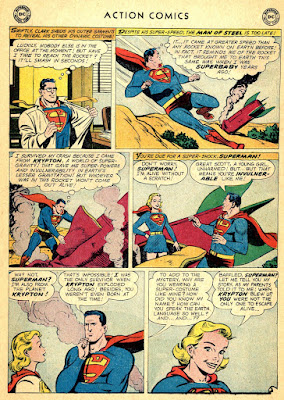
In any case, there’s some irony in
the fact that WG1 was the first teen heroine of the 1950s to appear
on a semi-regular basis, for she only appeared on newsstands about a
month ahead of ACTION COMICS #252, dated May 1959. The first version
of Supergirl is explicitly said to be fifteen, a topic which comes up
when she auditions to join the Legion of Super-Heroes. (In a twist
typical of the period, the heroine washes out when she temporarily
becomes an adult and violates the group’s “no one over 18”
rule.) More relevantly, from the first Supergirl, unlike WG1, did
have fully developed knockers, and though they probably weren’t any
bigger than Lois Lane’s, the girl’s girls got a little more
emphasis because of the “S” emblem she wore on her chest.
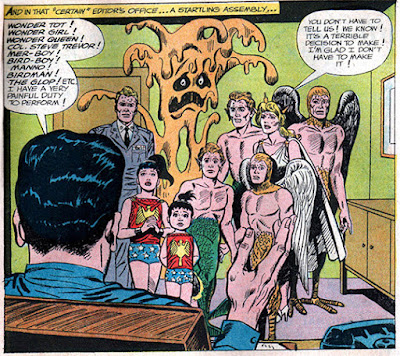
As for WG1, Kanigher had her making
references to teenaged pursuits like dancing, dating, and listening
to “platters.” But she was always a pale shadow of her older
self, in contrast to Superboy, whose small-town background gave him a
little distinction from his mature persona. So, in 1966, fading sales
on WONDER WOMAN impelled Kanigher to make a show of dumping WG1 and
many other wacky creations out of the comic. The gesture didn’t
prevent the writer-editor from losing his access to the venerable
Amazon property. Yet just as WG1 was being knocked off, her sort-of
doppelganger, Wonder Girl II, debuted in TEEN TITANS.
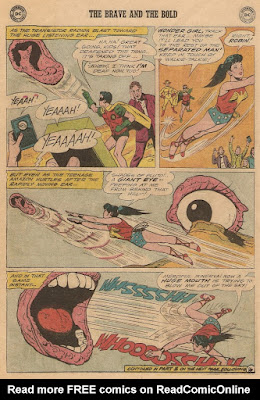
In the first appearance of the TITANS,
three kid sidekicks—Robin, Kid Flash, and Aqualad—assembled to
fight a menace. Writer Bob Haney and artist Bruno Premiani made them
all look like they were in the thirteen-year range, but this didn’t
last long. In the group’s second appearance, WG2—who was never
decisively stated to share the complicated origins of WG1—joined
the group, and remained a member for the series’ initial run, and
later revivals as well. Yet from WG2’s debut in the TITANS title,
the artist did not follow Kanigher’s lead in terms of putting WG2
in a baggy toga. Instead she wore a version of Wonder Woman’s
costume that conformed to the contours of her body. Naturally, the
new character began with the same modest breasts of other DC
heroines. But unlike her predecessor, her costume was tight enough to
demonstrate that at least she HAD boobs.
By the end of the sixties, WG2, like
both Wonder Woman and Supergirl, became better endowed. Further,
Catwoman returned to the comics, and some new characters were
breast-monsters from the first, like the Barbara Gordon Batgirl and
the vampy Legionnaire Dream Girl. All of which just proves the
non-existent adage, “You can’t keep a good--” …no, I just
can’t say it. I invite my few readers to write their own bad pun.