Featured Post

SIX KEYS TO A LITERARY GENETIC CODE

In essays on the subject of centricity, I've most often used the image of a geometrical circle, which, as I explained here,  owes someth...

Showing posts with label doctor who. Show all posts

Thursday, April 4, 2013

A STRATEGIC ASIDE

In this essay I said:

Dirty Harry inspires ADMIRATION in terms of his physical and strategic abilities...
 
Some may observe that a more usual pairing would be "physical and mental."  I didn't want to parse that particular issue at that point, but I had reasons for choosing the word "strategic" instead.

In defining my "mode of the combative," it's entirely necessary that no less than two exceptional forces should clash in order to yield the sublime-affect Kant termed "dominance."  However, though there is a long-standing tradition wherein a momentous battle ends with a final triumphant blow-- be it Aeneas ending THE AENEID with the killing of Turnus, or Captain America clobbering the Red Skull-- a conclusion using a battle-related strategy is just as valid a conclusion as a punch in the jaw or a sword in the belly.

In TWICE THE MIGHT 2 I made this narratological assertion regarding 1956's FORBIDDEN PLANET:


To be sure, when the Id Monster is defeated, it isn't because of the clash between the weapons of Earth-science and the power of the Krell machines. The Monster is defeated by undermining the source of its power in Morbius, who is in essence the Monster's Achilles heel.

Nevertheless, without the clash of energies that establishes how potent the Id Monster is, there would be no narrative perception of the need to seek such a vulnerable point.
 
Thus the conflict in FORBIDDEN PLANET concludes not by one force conquering another in a direct sense, but rather in an indirect one, as the Earthmen use strategy to divine the Id Monster's weakness.

I consider this sort of "Achilles Heel" maneuver to be just as related to battle as an actual physical triumph would be, and therefore its presence does not negate the combative mode.

In contrast, there are other ways to work against one's foes that I do not consider to have common kinship with the principles of *forza.*  In KNOWING THE DYNAMIS FROM THE DYNAMIC I wrote the following estimation of Doctor Who.


The Doctor is typically portrayed by a male actor who is, for one reason or another, not meant to resemble the typical he-man of adventure-fiction, which is one element that signals the serial's intent to avoid the pattern of dynamization set by those more typical stories. The Doctor, though, does not triumph over his many foes solely by luck-- though on many occasions he is considerably outgunned, and luck is at times invoked as a force that keeps him from being vaporized. But typically, the Doctor fights his foes with the centuries-spanning knowledge of a Time Lord, not with martial abilities. His doctrine is *froda,* not *forza.*
 
Some might view the Doctor's assorted schemes to undo evil aliens to be allomorphic with the "Achilles Heel" strategy of the Earthmen in FORBIDDEN PLANET.  But even though DOCTOR WHO can't be combative anyway, due to the lack of seeing any exceptional energy manifested by the hero, I want to underline that "strategy" should only apply to the combative mode when such exceptional energies are present in two or more opposed parties.  By making this determination, it is possible for me to include characters who may function largely behind the scenes-- as with the Fu Manchu of the original Sax Rohmer novels-- as being in control of the literal forces they unleash upon their antagonists.

"Strategy," then, when allied to the unleashing of *forza,* becomes a form of *forza.*  When not so allied, it can only be viewed as an aspect of *froda.*


Tuesday, January 15, 2013

MYTHOS AND MODE PART 3

In MYTHOS AND MODE 2 I said:

In a similar manner, narrative values can trump significant values in terms of determining whether or not a work is “combative” or not.  Based on that assertion, I would say that MACBETH remains a “combative drama” even though it lacks the significant value of sublime dominance between two contending forces.  In contrast, I would not consider CORIOLANUS combative in that I feel the subcombative narrative values predominate.  As I continue to consider other cases I will probably come across examples where the reverse verdict proves true for each example.

I'm revising this nugget of theory to say that the "combative mode" should always denote those works that contain both a narrative combative value and a significant combative value.  This means that MACBETH and possibly one or two other works I previously labeled as "combative" are necessarily subcombative instead.

I recently came to this conclusion as I considered the statement I'd made re: the character of "Doctor Who" in WHAT'S ON FIRST, WHO'S ON SECOND:

...in essence the Doctor... belongs in the adventure-mythos, but only in the subcombative compartment of that mythos.

I realized that the reason I'd made that assignment was precisely because the Doctor's tendency to use "froda" rather than "froda" to triumph over his multifarous enemies. This approach deprives the viewer of beholding "the significant value of sublime dominance between two contending forces."

To be sure, certain Who episodes may contain brief contentions of this sort, as when the Doctor employs a powerful ally like K-9.


But because the narrative is not centered around the battle, such clashes have at best a transitory effect, such as one sees in the sole battle of Coriolanus and Aufidius examined in MYTHOS AND MODE 2, or with the clash of the two werewolves in WEREWOLF OF LONDON.

The same applies to the example of MIGHTY MAX, which I analyzed in terms of its central persona but not in terms of its conflictive mode in this essay.  I remarked that Max sometimes had his ally Norman handle much of the heavy lifting.


But Norman is neither a member of a "ensemble" as I define the term, nor a "genie" who becomes the real center of the story because he dependably comes to the hero's aid, a la GIGANTOR.  Thus his exhibition of "might," like that of K-9, are no more central to the narrative than the examples from the Shakespeare play or the Universal werewolf film.

It's possible that I may come across exceptions to this rule as currently stated.  But at present, I will consider that a work should generally be combative only if it combines the narrative and significant values associated with the mode.

Monday, July 30, 2012

WHAT'S ON FIRST, WHO'S ON SECOND

Before delving into the complications of *dynamis* once more, I want to clarify some of my earlier pronouncements on the categorization of works in terms of both their mythoi-affiliations and their extent to which they utilize the combative mode, the latter discussed here.

Since I decided to reconstitute the idea of my combative/subcombative distinctions, I found myself returning to a question I tabled years ago: is there a subcombative form of adventure, given that its essence is symbolized by the *agon,* the very representation of combat and therefore of the quality of sublimity that Kant calls *dominance?*

I've been moving toward an affirmative answer in recent months.  In MIGHT VS. DOMINANCE, I referenced a scene in the 1940 film THIEF OF BAGDAD-- which is as a whole a combative film-- and observed of the scene in which Abu tricks the genie that 'in this sequence, we are dealing with something very like "dominance," although perhaps a qualified form.'  In the same essay I also noted that the original Arabian Nights story of Aladdin:


The original story of ALADDIN AND HIS WONDERFUL LAMP would seem to be a subcombative form of adventure, in that there is no actual combat between Aladdin and his opponent the "Chinese Magician," nor does Aladdin fight any proxy servant of the Magician. The conflict consists of either hero or villain swiping the lamp away from the other at this or that time, but never in a direct confrontation.
In a similar project, I decided to apply my idea of a "combative mode" to all of the films I'd reviewed thus far on NATURALISTIC! UNCANNY! MARVELOUS!, while also simultaneously aligning them with their dominant mythoi: adventure, drama, comedy or irony.  Since I label all the films I review in terms of their dominant mythoi, I made it implicit that if it was a comedy without the "combative" label, then it would be necessarily be subcombative.  The one exception I made was for the adventure-mythos, since I had, as noted above, a special interest in ferreting out subcombative versions thereof.  And of all those films thus far reviewed, I only found one that functioned more like an adventure than any of the other three mythoi: 1989's BRENDA STARR.  The movie deals with the standard tropes of adventure-- a heroine and her assistants attempt to foil a Nazi plot-- but neither Brenda nor her allies are especially combative.  They function more like comic heroes than adventure- heroes, often succeeding by luck more than by skill.  On a side-note, I have a loose impression that the comic strip which birthed the movie followed the same basic pattern, but I've not read the strip in sufficient doses to make that determination.

With all that in mind, I'm reversing one of my seminal mythoi-determinations, seen here.  The basic logic remains unchanged; for instance, the other example set forth in that essay, STARGATE, I still regard as being a drama/adventure; that is, essentially a drama with strong adventure-elements.  But I've changed my mind on DOCTOR WHO, of which I said:


...the Doctor fights his foes with the centuries-spanning knowledge of a Time Lord, not with martial abilities. His doctrine is *froda,* not *forza.* This puts him very close to the territory of the typical dramatic protagonist of mainstream science fiction, but in the end DOCTOR WHO is still about external peril rather than internal instabilities, and so it still falls within the category of the adventure mythos, for all that its protagonist lacks the *dynamis* of an adventure protagonist.
I didn't go quite so far as to call DOCTOR WHO a "comedy-adventure" as I did with INFERIOR FIVE, but that was my basic implication: to say that the *dynamis* of the Doctor's trippy character dominated the narrative and overwhelmed the *dynamis* of the adventure-oriented plotlines.  But I'll reverse that implication now: in essence the Doctor, like Aladdin and Brenda Starr, belongs in the adventure-mythos, but only in the subcombative compartment of that mythos.

More in the forthcoming DYNAMIS VS. DYNAMICITY.


Friday, March 5, 2010

KNOWING THE DYNAMIS FROM THE DYNAMIC

DYNAMIC (noun): An interactive system or process, especially one involving competing or conflicting forces.

"The plot, then, is the first principle, and, as it were, the soul of a tragedy; Character holds the second place."-- Aristotle, POETICS.

The "interactive system" of conflicting forces I'll discuss here are "plot" and "character," which Aristotle deems the two most important elements of "tragedy." Certain sections of the POETICS imply that the dynamic between the two applies to other forms of art as well, so I see no barrier to the idea of applying the dynamic to all narrative art, with the caveat that plot may not *always* be more significant than character: just that it is dominantly so because the plot is so often the structure within which the characters' acts are determined, rather than the characters imposing "their" will upon the structure.

In keeping with Aristotle's privileging of plot, Frye's formulation of literary categories is dominantly based upon plot-elements shared by works in the same category. At the same time, it should be noted that one of Aristotle's earliest points in the Poetics-- one which Frye reiterates and reformulates-- is that characters act within the plot according to expectations set up by their power of action, which connotes whether they are average, better than average, or worse than average. So even within Aristotelian theory it's easy to see plot and character joined in an interdependent pas de deux. Thus, despite the natural inclination toward plot-evaluation, the evaluation of character has unquestionable relevance if one desires to separate the dancers and see what each contributes to the dance.

In BUFFY THE MYTHOS SLAYER, my argument was largely plot-based. I focused on the plot dynamics of the BUFFY THE VAMPIRE SLAYER TV series as a means of demonstrating why I believed that it was best placed in the category of the "adventure" mythos, even though the series also demonstrated that it contained substantial elements of the other three *mythoi*: of drama, irony, and comedy. I also made brief mentions of three other serial works which each represented one of the other three *mythoi*, and compared some of their plot-functions to those of BUFFY. These, too, I discussed in terms of how the protagonists functioned within plots typical of those *mythoi.*

However, after I examined the concept I term "myth-radicals" in SUBCATEGORIAL IMPERATIVES, and discerned that there were certain subcategories within these four divisions, it further occured to me that many of the irregularities could be explained as irregularites of either plot or character with respect to the dominant dynamic of a given mythos. As mentioned earlier I chose to focus upon the adventure mythos because (as I can't stress too much) so little of worth has been written about it, but I think my mediations on categories and subcategories apply across the board to all four mythoi.

Explanatory preamble done, I move on to two specific examples of works that seem to belong to the adventure genre but which I label "subagonistic" because they have what I called a "less agonistic value." Here for the first time I'm explicating why the difference may be one either of plot or of character.

My example for character is DOCTOR WHO, as portrayed in his initial 1963-89 series and in the current BBC version. (I disinclude the American-made TV-movie because I just don't remember much about it.) Clearly, in terms of the general range of plots used on both serials, one would tend to believe that it falls within the category of adventure. Like BUFFY, DOCTOR WHO borrows liberally from other *mythoi," most obviously from that of the comedy. But since the generic WHO plot would probably boil down to something like "Those Damn Dirty Colonial Alien Overlords," it's obvious that elements of physical peril take precedence over the dynamizations of the other three *mythoi.*

Yet against the galaxy-spanning might of Sontarans, Cybermen and Daleks we get...

THIS GUY.

In DOMINANCE, SUBMISSION I concluded with another comparison of Haggard's SHE and KING SOLOMON'S MINES, with the verdict that KSM was a true agonistic work due to its focus on the heroes' winning their battle through armed combat and perservance, while the heroes of SHE, despite a certain formidable nature, basically "get lucky" because their opponent destroys herself. The Doctor is typically portrayed by a male actor who is, for one reason or another, not meant to resemble the typical he-man of adventure-fiction, which is one element that signals the serial's intent to avoid the pattern of dynamization set by those more typical stories. The Doctor, though, does not triumph over his many foes solely by luck-- though on many occasions he is considerably outgunned, and luck is at times invoked as a force that keeps him from being vaporized. But typically, the Doctor fights his foes with the centuries-spanning knowledge of a Time Lord, not with martial abilities. His doctrine is *froda,* not *forza.* This puts him very close to the territory of the typical dramatic protagonist of mainstream science fiction, but in the end DOCTOR WHO is still about external peril rather than internal instabilities, and so it still falls within the category of the adventure mythos, for all that its protagonist lacks the *dynamis* of an adventure protagonist.

Moving on to STARGATE, the comparison of the two strikes me as felicitious, since when I first saw the 1994 feature films I thought of its "colonist alien overlords" plot as being "Doctor Who without the humor." And its plot, too, seems to belong to the category of adventure by virtue of the emphasis on physical peril, while its characters, unlike Doctor Who, are definitely typical agents of *forza:* gun-toting American soldiers and their alien allies who are out to clean up the territories dominated by various overlords-in-gods'-clothing. Indeed, one of the articles in the essay-collection SUPER/HEROES:FROM HERCULES TO SUPERMAN even refers to the star of the first TV series, the Richard Dean Anderson character, as a "superhero."

Yet I find it hard to see these rather unremarkable soldier-boys (and girls) as belonging to the idiom of the superhero.
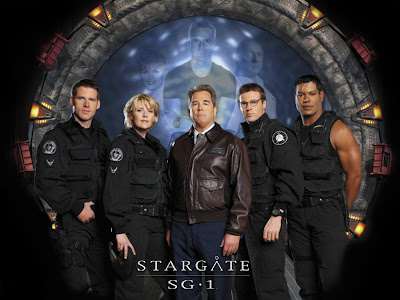
I considered that this might simply be a matter of taste-- the fact that I didn't care that much for the movie and less for the TV show(s)-- but I dismissed that idea. I'm aware of many, many unremarkable protagonists whom I do see as belonging to that idiom, who possess roughly the same *dynamis* as the STARGATE soldier-boys. To use two othe SYFY-channel serials as counterexamples, I'm not hugely fond of the characters on either SANCTUARY or WAREHOUSE 13. But I can see both of them as having stronger ties to the superhero idiom, even if the heroes are not superheroes per se.

My final verdict, then, is that there's something about the execution of the generic STARGATE plot that edges a little too far out of the bounds of the adventure-story and into those of the dramatic story with adventure-elements. Over time the first serial and its epigoni took on an increasing resemblance to the "starship melodramas" of the STAR TREK franchise. I don't think STARGATE was ever as much about what Faulkner called "the human heart in conflict with itself," as all of the TREKshows have arguably been. But in the STARGATE franchise the adventure-mythos became somewhat dennatured. I view this as a lack of heroic *dynamis* within the overall plot-structure, rather than within the concept of the characters, as it is for DOCTOR WHO.

As I've said before, this basic rule of character-irregularities and plot-irregularities would apply across the board to the other three categories and their subcategories. At present I don't think it's possible for *both* plot and character(s) to be irregular and still deserve to be labeled a part of the regular mythos. For instance, a DOCTOR WHO without the adventurous plot-elements would probably look something more like HITCHIKER'S GUIDE TO THE GALAXY, and so would be more properly termed a comedy.