Featured Post

SIX KEYS TO A LITERARY GENETIC CODE

In essays on the subject of centricity, I've most often used the image of a geometrical circle, which, as I explained here,  owes someth...

Showing posts with label catwoman. Show all posts

Friday, November 8, 2024

NEAR-MYTHS: BATMAN ETERNAL (2014-15)


I'd read some decent reviews of this 2014-15 series, though I've the impression that most of the "big changes" instituted by ETERNAL proved nugatory.

The involved plot, orchestrated mostly by Scott Snyder and James Tynion IV, doesn't bear a lot of close examination. It's a big, noisy Bat-soap opera, with the city of Gotham once more under siege by both ordinary criminals and super-crooks. Yet ETERNAL qualifies as a "near-myth" by virtue of its attempt to rework two previous celebrated multi-issue storylines, respectively 1996's LONG HALLOWEEN and 2003's HUSH. From HALLOWEEN, Snyder and Tynion took the idea of a foundational conflict between the mobsters and the costumed freaks, while from HUSH the writers emulated the mystery of a Master Manipulator who somehow marshals most of Batman's major foes against him. I don't think Snyder and Tynion managed to weave a tight master-trope as HALLOWEEN did, and the "hidden mastermind" schtick in ETERNALis put off for so long with red herrings that I for one lost interest in the Big Reveal.

Some myth-kernels of interest:


Contrary to some theories that Catwoman's estranged father might be venerable mob-boss Carmine Falcone, ETERNAL reveals that her true "bad dad" is a different mobster, introduced here for the first time, name of Rex Calabrese. Despite an acrimonious relationship, Calabrese eventually talks Selina into becoming a new Gotham crime-boss-- which I imagine did not last long.


The Barbara Gordon Batgirl is more or less in mourning for Dick Grayson, since I believe this is the period when he was supposed to be in a temporary state of death. Yet she apparently has some sort of tentative interaction with "second Robin" Jason Todd, reborn in the form of Red Hood, which is sort of like dating the first Robin's symbolic sibling. It's a nice touch when, thanks to the Mad Hatter's connivance, Batgirl fights Hood under the impression he's the Joker, who's a bugaboo for both characters.


Spoilers works out her daddy issues the same way Catwoman does.


And the eighties version of Alfred's daughter, Julia Pennyworth, is reborn in a new form. apparently a POC of some sort, though her racial makeup was not expounded in ETERNAL. She becomes part of the Bat-team but I don't know if she eventually got a costume or what.

And Batman pretty much remains Batman. So it's a good lively read, but nothing transformative.


Saturday, January 20, 2024

A DEMIHERO DISTINCTION

This post follows up on one made about a year and a half ago, wherein I made a point with which I no longer agree.

 Shortly after I re-defined "focal presences" as "icons" in the 2022 essay I THINK ICON, I THINK ICON, I stated that in PERSONA-TO-PERSONA CALLINGS that I didn't think "charisma-crossovers" occurred at all when, in a given open-ended series, subordinate icons belonging to one persona-type encountered subordinate icons belonging to another persona-type. Here was one of my examples:

...within the Batman series, Commissioner Gordon and the Joker have existed almost the same number of years, and have frequently appeared in the same stories. Both characters are Subordinate Icons to Batman, but there's no charisma-crossover between the two Subs as there is when the Joker appears in a story alongside another villain, such as the Penguin or Two-Face.

One flaw in this statement, though, is that as an often-seen support character, Commissioner Gordon is as familiar a sight in the BATMAN comics as an object like the Batmobile. He belongs to what I've called "the subordinate ensemble," so naturally he does not "cross over" with subordinate icons who are only seen in a more irregular fashion. Gordon, like Alfred the Butler, might be seen as moons circling a planet called Batman-- or sometimes "Batman-and-Robin." Non-regular subordinates are more like celestial bodies that might not be big enough to be planets, but they too respond to the gravitic influence of the Bat-planet. But even if the Joker and the Penguin are seen as separate celestial bodies, when they come near one another they also issue a gravitic influence on one another-- and that intermingling of energies does qualify as a charisma-crossover.


Side-note: arguably some of these celestial bodies may increase their mass, enough to become "planets" in their own right, then they may start generating their own gravity-power on the Bat-planet as well as upon lesser celestial bodies. Catwoman, for instance, remained a "Charisma Dominant Sub" for the first fifty years of her existence, and her very rare forays into stature-territory did not change her, any more than the JOKER series made the Clown Prince into a "Stature Dominant Prime." But in 1993 Princess of Plunder acquired strong stature from a series that lasted roughly eight years, and continued to headline various projects over the past twenty-plus years. All that stature bulked her up into a "planet" with "Stature Dominant" mass, and she would be stature-dominant even when appearing as a guest-star in some other feature. End side-note.

Another inaccurate statement I made in CALLINGS was the following:

When dealing with icons who originate within the cosmos of a given series, there can be no charisma-crossovers except between icons belonging to the same persona.

In saying this, I was trying to suss out why demiheroes in a given series did not have "crossovers" with one another, just because, say, Flash Thompson crossed paths with J. Jonah Jameson (which I believe was a minor event that only happened one time in the Lee-Ditko years). But there was no necessity for this statement, since characters like Thompson and Jameson were already part of Spider-Man's subordinate ensemble.


Further, if it ever made sense to me to say that "monsters" and "villains" could not cross over their charisma-filled gravity-wells, that now seems entirely unnecessary. Monsters and villains are indeed very different personas, but as long as they are subordinate icons who are NOT part of the subordinate ensemble, then there's no reason that, say, if Batman crosses paths with both The Mad Hatter and Solomon Grundy, that's not a charisma-crossover. The reader recognizes both icons as "adversaries of Batman" and so their gravity-waves play off one another. Equally, in one Superman tale he encountered a "villain" of his own rogues' gallery, the Atomic Skull, and teamed up with a "monster" from the Dark Knight's domain, The Man-Bat. I would deem both Skull and Man-Bat Charisma Dominant Subs, since Man-Bat never enjoyed more than fleeting stature-roles. So the two charisma-icons definitely cross over, just as if they'd both been Superman-foes-- or even two foes belonging to some third hero's cosmos.

Now, is it possible for a "non-regular" demihero "foe" of a hero to cross over with a monster or villain? Possibly. A character from the Frank Miller series BATMAN YEAR ONE, Commissioner Loeb, only made rare appearances in the comics. But he did make recurring appearances in the first two seasons of GOTHAM. There Loeb was a menace to James Gordon but not one regular enough to belong to that show's subordinate ensemble. He would have to have had some "dynamic" relationship to a monster or villain for that to sustain any crossover-vibe, not to simply be in the same room with Riddler or that sort of thing. A brief scene from THE LONG HALLOWEEN, in which Harvey "Not Yet Two Face" Dent crosses paths with Solomon Grundy for a chapter or so could have been reworked as a stand-alone arc with such a crossover-vibe with a demihero-type. I already alluded to a "monster-demihero" crossover in CALLINGS, where Brother Power crossed paths with two of Swamp Thing's support-characters.

And that's probably enough noodling on that for now.


Monday, August 21, 2023

MYTHCOMICS: BATMAN: THE LONG HALLOWEEN (1996-97)


In contrast to the many admirers of the Loeb-Sale LONG HALLOWEEN, I didn't get much out of the collected issues after two separate readings, aside from appreciating Sale's art. I'm not sure that I realized that it was supposed to be a direct sequel to Frank Miller's celebrated BATMAN: YEAR ONE, though obviously HALLOWEEN had to occur early in Batman's career due to the absence of any members of his Bat-family. 
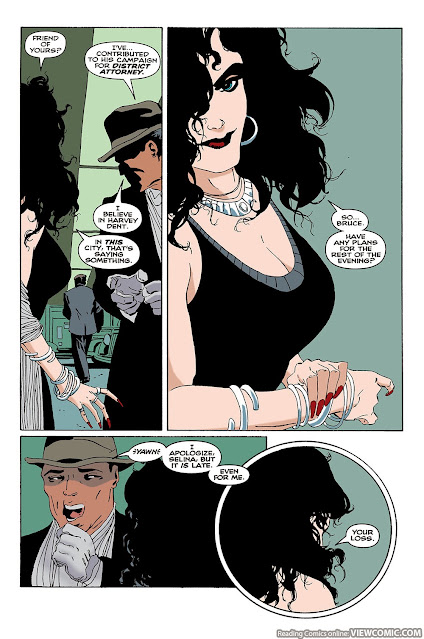


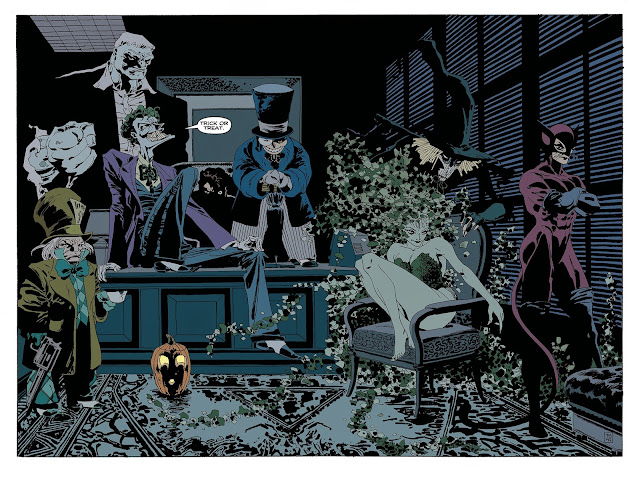
In this iteration Batman has just barely started to make inroads against the entrenched "Roman Empire," the reigning crime family in Gotham, represented by local godfather Carmine Falcone, aka "the Roman." The Caped Crusader has already won the confidence of police captain James Gordon, and much of the action in HALLOWEEN centers around the way Batman and Gordon also bond with D.A. Harvey Dent in their attempt to bring down criminals. Organized crime is the true foe of these do-gooders, while the notorious super-villains of Batman's mythos are regarded as "freaks," particularly by the career criminals. Batman has met most of his big-name foes at this time-- Joker, Riddler, Penguin, Scarecrow, Mad Hatter, Catwoman, and Poison Ivy-- though Loeb and Sale also make use of two lesser lights in the Bat-mythos, Calendar Man and Solomon Grundy. At this point in time, Harvey Dent has not yet undergone his transformation into Two-Face, and indeed that transformation is the culmination of HALLOWEEN's main plotline.
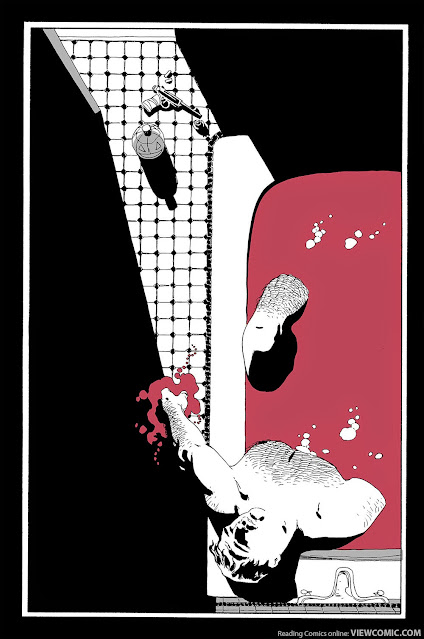


Still, I wasn't deeply impressed with the Loeb-Sale treatment of either the ordinary crooks or the super-crooks, nor with the retelling of Dent's transformation, or with the "serial killer" mystery that extended across all 13 issues of HALLOWEEN. Each issue represented a month in the Bat-universe, during which Batman proved unable to keep the mysterious assassin Holiday from executing at least one victim a month, always on a popular holiday. Most of Holiday's victims are also members of the Falcone crime family, and so a major part of the mystery is the attempt to determine whether the killer belongs to a competing family-- or someone who hates crime but has decided to go outside the law-- someone like Harvey Dent.
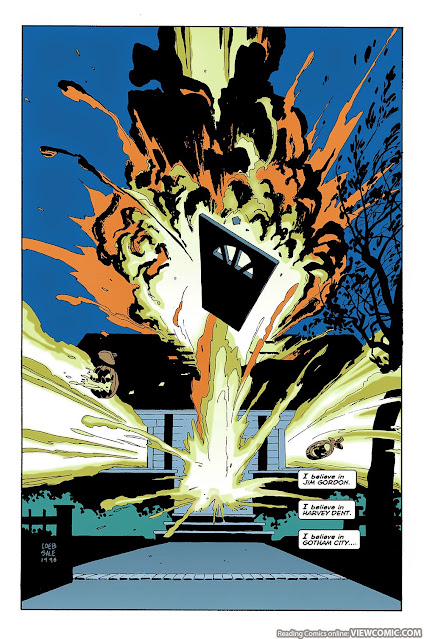


I confess that even though I'm not a great admirer of Christopher Nolan or his collaborator David Goyer, their prologue to a 2011 collection of HALLOWEEN gave me a new insight. Both filmmakers stated that the Loeb-Sale work had been a seminal influence on their first two Bat-films. Remembering how much THE DARK KNIGHT plays off of HALLOWEEN's leitmotif about "belief"-- particularly with the phrase "I believe in Harvey Dent"-- I realized that whatever I thought about the films, HALLOWEEN was about how even among good men, belief is always vulnerable to corruption.
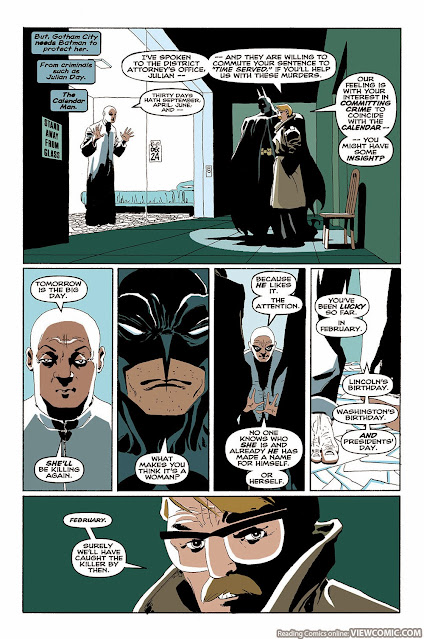


In most Batman stories, the hero can track down any serial killer, because the murderer always conveniently leaves clues that enable the crime-fighter to track down the miscreant. HALLOWEEN goes to the other extreme. Even though Holiday leaves behind some holiday-themed token every time he (or she) kills, Batman learns nothing from the tokens, and he almost nver manages to anticipate where Holiday might strike next, despite knowing what day the assassination will take place. Holiday remains "off-camera" for most of the story, since Loeb and Sale were creating a genuine mystery, even if their denouement is somewhat ambivalent. Oddly, one of the few super-villains who has some mythic presence here is the lower-tier felon The Calendar Man. Though Julian Day is not directed involved in the Holiday killings, his obsession with seasonal occurrences gives him in HALLOWEEN a function like unto that of Hannibal Lecter in RED DRAGON. Batman consults with Calendar Man as Clarice consulted with Lecter to learn the nature of the Red Dragon-- with the main difference being that Calendar Man only provides one useful yet highly ambivalent clue, as if he were a Greek oracle dispensing problematic advice.
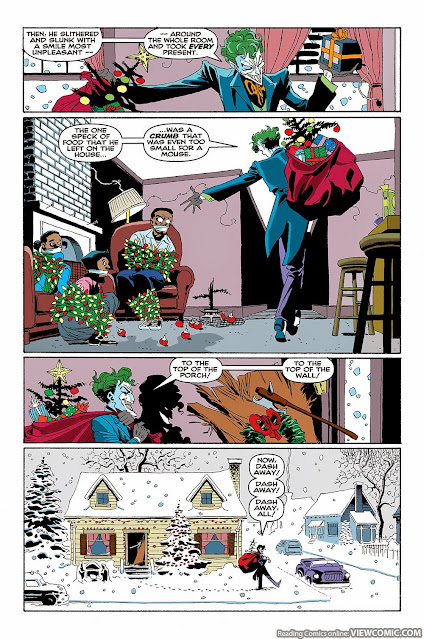


The other super-villains almost function as date-markers during Holiday's year-long campaign of targeted killings, and all of them are pretty routine. The Joker is crazy. Catwoman is unpredictable. Poison Ivy uses her hypnotic plants to suborn Bruce Wayne's will. Arguably none of them shine, because the focus is on Harvey Dent, whom the reader knows is destined to become Two-Face. 


None of the "ordinary crooks" in HALLOWEEN get any better treatment, despite Sale's borrowing from visual elements in THE GODFATHER. All of the hoods knocked off by Holiday are ciphers, while Loeb doesn't bring any interesting dynamics to Carmine Falcone and the various literal members of his family: wife, sons, daughter. There's a minor subplot revealing how, many years ago, Thomas Wayne saved Falcone's life, but not much comes of it.
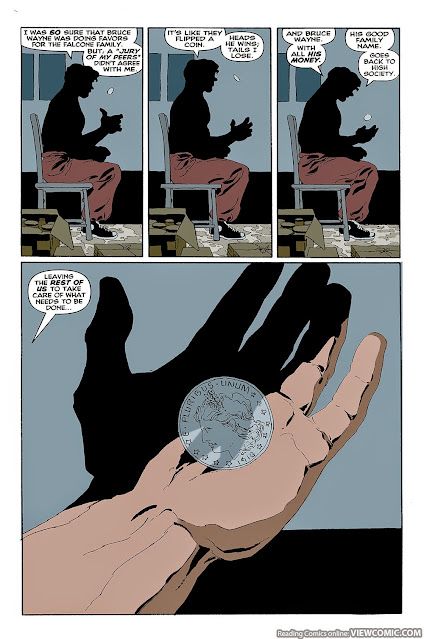
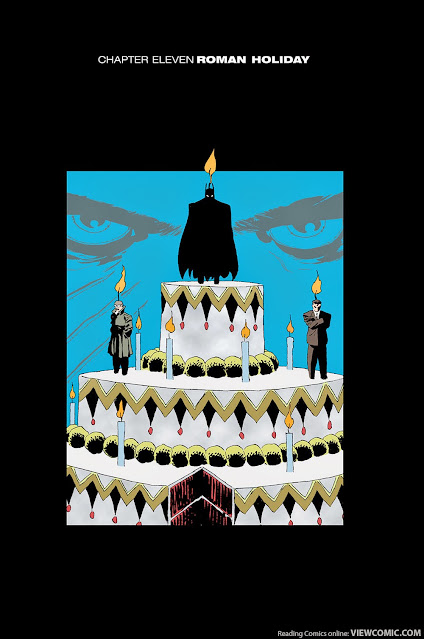


Though no one cares about the bickering of the criminals, freakish or normal, Loeb and Sale spotlight the trials of the just at every opportunity. Dent's busy schedule as prosecutor causes him to neglect his wife Gilda, and on one occasion she's injured by a bomb intended to kill both of them. Because of Thomas Wayne's past action, Dent tries unsuccessfully to prove that Bruce Wayne has some collusion with Falcone, though of course the fighting D.A. does not know that Wayne's other identity. The troika of Batman-Gordon-Dent is strained as the first two suspect Dent of having adopted the identity of Holiday in order to murder the ganglords of Gotham. 
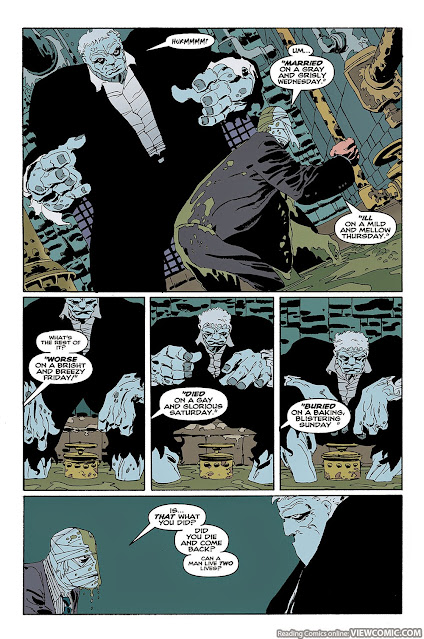


But before Batman and Gordon have the chance to accuse Dent, one of the crime-lords strikes a decisive blow: assailing Dent's face with acid. Crazed by pain, Dent flees to the underworld of Gotham's sewer system, where he forms an odd bond with the undead monster Solomon Grundy, simply because Dent knows the "Solomon Grundy" rhyme. And although Harvey Dent is not guilty of the Holiday murders, his ambivalence about the law's effectiveness transforms him into Two-Face. Only with the passage of a full year do Batman and Gordon finally figure out how to trap the real Holiday, and that's only with Calendar Man's help. But the damage is done. Two-Face uses Grundy to liberate the other fiends from Arkham Asylum, and though Batman manages to corral them all, he can't prevent the formerly righteous D.A. from going over the line and killing Carmine Falcone.  
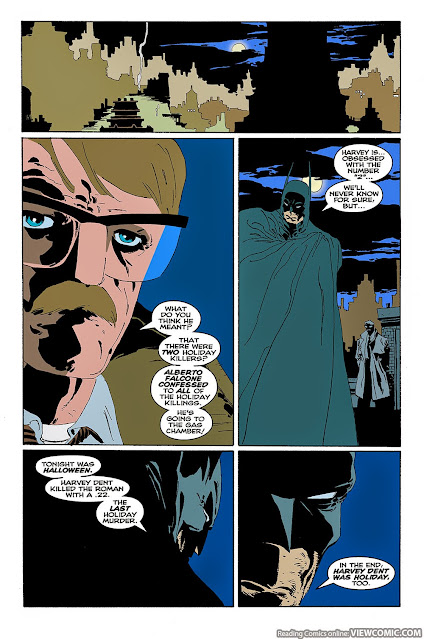


Two-Face is arrested as well, but he's beyond the pale to his former friends, and they can only ask themselves if their actions were just. Loeb and Sale then throw in a last "teaser" to suggest that there's an angle to the Holiday killings that the two crime-fighters will never learn.

One podcast professed the opinion that HALLOWEEN was all about how the ordinary crooks were displaced in the Bat-mythos by the super-crooks. On the contrary, I think the diminished importance of the super-crooks' deeds in the story indicates their transitory effects on the crime scene. Yes, by the end of the story "the Roman Empire" has fallen, but every Bat-reader knows that other crime families simply filled the void in present-day Gotham. Sale's deliberately cartoon-like art frequently exaggerates the super-fiends to the point of absurdity. When Batman punches the Joker in one scene, the villain's neck stretches like the body of a jack-in-the-box. In the Penguin's brief appearance, he sports a monocle so big that no human eye-muscles could hold it, and Poison Ivy has "leaf-hair" that's longer than her entire body. Compared to the scourge of ordinary criminals and the poisonous effect they have even on righteous people, the super-fiends themselves are like the calendar's holidays: attempts to punctuate the dull round of human existence with the celebration of non-rational customs. And that is the "master thread" by which BATMAN THE LONG HALLOWEEN can be accurately read as a mythcomic.


Wednesday, December 7, 2022

NEAR-MYTHS: THE NOCTURNA LEITMOTIF (1983-85)

 The early 1980s was an odd transitional time for Batman. Though the character had gained some cachet in the 1970s, the crusader was not even close to being the financial juggernaut he became later, partly though not solely thanks to the 1986 DARK KNIGHT RETURNS and the 1989 Tim Burton opus. At some point in the 1980s, either before or during the hiring of Doug Moench as sole scripter of Batman in both his titular book and in DETECTIVE COMICS, DC Comics attempted to goose the sales of both titles by having the stories interconnected. That is, if one story with a villain (say, the subject of my essay, Nocturna) began in BATMAN #363, that story's conclusion would appear in the subsequent issue of DETECTIVE COMICS, and the next story in BATMAN might begin a new narrative. This editorial ploy was spectacularly unsuccessful, for most regular consumers resented being forced to buy two titles a month to make sense of the stories. Sales went down and the idea was dropped, though not before Moench left the series in 1985.

At the time he accepted the DC assignment, Moench's last major opus had been on Marvel Comics' MASTER OF KUNG FU. That series had garnered high praise from fans, particularly for Moench's ability to weave a diverse group of characters, male and female, into a bracing melodrama, and one far more intricate than most Marvel comics of the early eighties. Given that Moench had been given the chance to be the main arbiter of the mainstream Batman continuity, he may have approached the assignment with the idea of repeating some of his fan-pleasing tropes from MASTER OF KUNG FU. That series had focused upon a group of heroic individuals bound by a common code rather than by family bonds, while the only familial relation of the series was the inimical one between Shang-Chi and his father Fu Manchu.


In contrast, prior to Moench's assignment, DC had just taken the first steps to introduce Second Robin Jason Todd to take the place of Dick Grayson, who was in the process of transitioning away from the Robin identity. Thus Batman had just gained a new surrogate son to share his adventures. In addition, during the pre-Moench period an old Bruce Wayne girlfriend, Vicky Vale, had been re-introduced, and another potential romantic interest for Wayne, Julia Pennyworth, had debuted. However, Moench injected two new characters, first seen to share a loose sibling-like history: Nocturna and the Night-Thief (a.k.a. "Night Slayer.") Whereas there were no mothers of significance in the MASTER OF KUNG FU series, Nocturna was soon defined by her taking the place of Jason Todd's recently deceased mother, just as Batman had taken the place of the orphan's late father.


Nocturna comes very close to rivaling Catwoman in the BATMAN mythos as the essence of a "dangerous yet desirable femme fatale," but in my estimation she never rises above the level of a near-myth. Possibly the character's many poetic ramblings about the beauties of darkness (she's an albino who avoids the sun) are meant to sell her as the embodiment of feminine mystery, of the principle of "Yin" perhaps. However, Moench rides the metaphor like a hobby horse, thus diluting its effect. However, where Catwoman had little or nothing to do with Dick Gayson, Nocturna inserts herself into Jason Todd's life in the second part of her first story, in DETECTIVE #530. Moench is a little vague about the sequence of events, but in the first part, Batman catches the Night-Thief but fails to capture Nocturna. She then apparently just happens to use a high-powered telescope to check out stately Wayne Manor, which eventually leads to her discovery of Bruce Wayne's double identity. At this point Jason has not yet donned a Robin costume, and he's decided to desert Wayne's charity because Batman won't let him become a junior birdman yet. For no rational reason, Nocturna sees Jason leave the manor, seeks him out, and talks him into returning to Wayne's tutelage, despite the fact that she should know nothing about him at this time. 


Moench then allows Nocturna and Night-Thief to recede from the picture for several issues, until DETECTIVE #543. She then appears to Jason again, acting very mysterioso, and laying some vague maternal claim upon him. By issue's end, she files a suit to legally adopt Jason, which Wayne has neglected to do. Presumably she knows that Wayne is Batman by this time, though she does not say so until a later issue. But the reader may well assume that knowledge, for when she first meets Wayne, she proposes solving their rival claims on the boy by getting married. 


Jason's reaction to the lawsuit makes Wayne's case harder, for he claims he wants Nocturna to be his new mother. His motive, though, is loyalty to Batman, for by this time he does know that the mysterioso woman is a thief, and he abets her adoption with the idea of getting the goods on her crimes. This leads to the strangest scene in the entire Moench run, in BATMAN #379. I should note here that Jason is drawn to look about fifteen, even though some sources claim he was supposed to be twelve. Yet, on one of his first nights under Nocturna's roof, she comes to his room to tell him a "bedtime story," an activity one associates with much smaller children. I'm sure Moench's main motive was to provide yet another poetic reflection on darkness, but the "bedtime story" ends with some puzzling dialogue about whether or not Jason would be susceptible to Nocturna's charms if he were just a little older. Moench doesn't pursue the concept of hebephilic sexuality in later issues, so I assume he was just playing around with Oedipal imagery as a side-issue to his main theme, the blossoming romance between Batman and yet another "forbidden femme fatale."


Most of the ensuing issues are more concerned with the triangular romantic conflict between Batman, Nocturna and Night-Thief, but the alluring albino makes a conquest in Jason Todd, who toward the end of Moench's run goes so far as to forget legal impropriety and to refer to the enchantress as "Mom." By this time Moench may have planned to leave the series, for he arranges a send-off for Nocturna in the form of an ambivalent death. But unlike so many other comics-characters, Nocturna did not get revived in continuity with her original form-- for in the last Nocturna-arc, the Earth is suffering the first signs of the Crisis on Infinite Earths. Thus once DC-reality was rewritten by the Crisis, any version of Nocturna that returned would exist out of continuity with the original-- and indeed, another Nocturna did pop up somewhere later, though I've not endeavored to check out this later character. I should also note that in the last arc Catwoman returns to challenge Nocturna for Batman's affections, and Catwoman more or less "wins" the bout. I imagine Moench had Catwoman somewhat in mind when he created his seductive lady crook, and maybe he was gratified that no other author would ever "lay hands" on his character, thanks to the exigencies of DC Comics' total reboot of their cosmos.


Tuesday, December 7, 2021

A CONVOCATION OF CROSSOVERS PT. 4

The third and fourth categories deal with narrative presences who are dominantly known for being Subs, which means that they may possess charisma but have rarely or never possessed stature in any iteration. 

Since charisma is judged with regard to the ways in which audiences have received various presences, HIGH CHARISMA crossovers are usually seen in situations where two or more Subs, both of whom have earned considerable approbation from audiences, interact. In the last section I mentioned that the Joker has almost always been a Sub, and since his existence as a Sub largely places him within the cosmos of Batman's adventures, this status gives him no stature.


However, his charismatic qualities may be boosted when he comes into contact with other Bat-villains with similar pedigrees-- though this may depend upon when the interaction takes place. When the Joker first crosses paths with the Catwoman-- one of the first villain-crossovers in comics-- neither has made more than one appearance apiece. It could be argued that at the time this story appeared, neither one had accrued all that much charisma-- and so a better example of high charisma might be the first-time meeting of Joker and Penguin, from 1944:


By the same principle, teams of villains, often meant to parallel those of the featured heroes, also display the same charismatic crossover, as long as some of the members have appeared more than once, as we see with the Injustice Society.


In theory, one might also have a charismatic crossover just from crossing over other types of Subs-- a League of Sidekicks, perhaps, including Snapper Carr, Pieface Kalmaku, and Rick Jones.

Moving away from this type of High Charisma crossover, I want to return to the matter of "crypto-continuity" introduced in Part II, I asserted that "King Kong II," though not technically in continuity with "King Kong I," borrows enough motifs from the original that the later character may be seen as  what I term a "weak template deviation." 

However, there are also "strong template deviations," which often involve authors totally overwriting not totally fictional characters, but characters from myth, legend, and history-rendered-into-fiction.


For instance, the 19th-century outlaw Billy the Kid has a certain documented history, even if there's much about the real-life William Bonney (or whatever his real name was) that moderns will never know. But the cowboy-hero of BILLY THE KID VS. DRACULA borrows nothing from the historical personage but the name, I would tend to view this totally fictionalized Billy is the main character of the 1966 film, while Dracula, despite having originated as a Prime character in the 1897 Stoker novel, has been demoted to a Sub, Yet the film's Billy has no more stature than would any cowboy-character who'd had never appeared before. The effect of the title is to suggest that the titular characters intermingle their respective charismas, though only one of the two possesses any stature, albeit minor.


Even more problematic are characters who lack anything more than a circumstantial history. While Dracula is a fictional character whose depiction may change as any author pleases to change him, Jack the Ripper was at least one real person in real history-- but because he was never identified, he becomes in a narrative sense even more insubstantial than the vampire count. In this 1985 mini-series, reviewed here, Dracula and Jack the Ripper do indeed enjoy a crossover. But because the Ripper is different in every iteration, whereas the Count is comparatively stable, I don't think they possess comparable stature-- though they both do possess high charisma, which stems from the investment audiences have in their respective forms of monstrousness.


Saturday, November 7, 2020

NEAR-MYTHS: HUSH (2003), HEART OF HUSH (2008)


HUSH, the 2003 work by Jeph Loeb and Jim Lee, is a work I would have liked to rate as a mythcomic. It’s definitely one of the best Batman stories to have appeared within the rather limited period of the twenty-first century. Even if the story had been crap, I imagine I still would have got a buzz at seeing how Jim Lee—by no means a favorite of mine—rendered the Bat-characters with his lush, photo-realistic art. Yet Lee’s contribution is matched by that of Jeph Loeb, who spins a cool mystery involving many of Batman’s famous foes, as well as introducing a new one, the titular Hush, who may go on to classic status eventually. HUSH is certainly a much better story than Loeb’s LONG HALLOWEEN, another Bat-villain rally from about five years previous. But try though I did, I didn’t find enough of a symbolic discourse to make this a mythcomic—though there’s at least an interesting bachelor-thread relating to Batman’s alienation from all the other characters who comprise his Bat-family.


Hush makes his first appearance in the collected work’s second chapter, entitled “The Friend.” The first words of the master villain—largely responsible for the assemblage of eight Bat-villains as part of a grand anti-Batman plot—are also on the subject of friendship, quoting Aristotle: “Without friends no one would choose to live, though he had all other goods.” Hush’s true identity is a big deal in the narrative, but it’s old news now, so—


USUAL SPOILERS


Hush is actually Bruce Wayne’s childhood friend, one Thomas Elliott, a character whom Loeb created from whole cloth. I’ve seen one review that scorned the new character’s introduction as a transparent setup, but I’m more interested in whether or not Loeb succeeded in painting a good psychological picture of Elliott as more than just “a dark version of Bruce Wayne.” For the most part, Loeb succeeds in giving Elliott some psychological heft. Given that content, the mystery angle didn’t matter as much to me, not even when the character’s appearance—that of a man in a trench coat with bandages over his face-- is meant to suggest that of a more established evildoer.


Loeb and Lee model Hush’s general appearance not upon the iconic visuals of Two-Face, but upon that character’s appearance in Frank Miller’s THE DARK KNIGHT RETURNS. In that work, Two-Face’s disfigurement has been cured and he appears for the most part only a man in a coat, wearing surgical bandages over his face. Since HUSH also features an appearance of Two-Face's alter ego, attorney Harvey Dent, it seems clear that Loeb sought to trick the reader into thinking that Hush was simply a new incarnation of an old foe. Of course, had that been the case, then the writer would’ve had no reason to devote so much space to Thomas Elliott—who is apparently killed late in a late chapter, some time prior to the Big Reveal. As for Dent, he ends up being almost the only former Bat-foe who’s on Batman’s side, aside from the always mercurial Catwoman. Hush’s reasons for warring on Batman and Bruce Wayne are reasonably consistent, though they never become more interesting than the high-octane fights between the heroes—Batman, Nightwing, Tim Drake-Robin, and Huntress—and such opponents as Joker, Harley Quinn, Riddler, Poison Ivy, Killer Croc, Scarecrow, Lady Shiva, and Ra’s Al Ghul. On top of all this, Superman is also unwillingly dragooned to fight on the side of the devils, and Catwoman, despite being on the side of the angels this time, gets an intense battle with another goodguy, Huntress. To be sure, without a penciller as skilled as Lee, most of these punch-ups would have been no better than those of the average comic book.


Hush’s plan to destroy Batman fails of course, and he appears to “die” at the hands of his doppelganger Harvey Dent. Another five years later, Hush, who had made one or two intervening appearances, commanded the spotlight once more in HEART OF HUSH by writer Paul Dini and penciler Dustin Nguyen. There’s far more detail about Elliot’s background and his relationship with childhood friend Bruce Wayne, and while Catwoman once again plays a romantic role in the hero’s life, there aren’t nearly enough other villains here to qualify as a rally. Nguyen’s art is more attenuated and stylized than that of Lee, emphasizing mood rather than action, but this matches Dini’s attempt to flesh out the central villain, even expanding on the character’s repeated citations of Aristotle. Still, though HEART OF HUSH provides a literal “loss of heart” for one character, Dini doesn’t extend Hush’s potential into the realm of the mythic any more than Loeb did. Still, I certainly think the character has more potential than many other latter-day additions to the mythos.

Tuesday, November 20, 2018

MYTHCOMICS: CATWOMAN DEFIANT (1992)

CATWOMAN DEFIANT followed 1989's 4-issue mini-series as a further attempt to promote the character to starring status, probably because her popularity had been received something of a boost from Frank Miller's two BATMAN mini-series, DARK KNIGHT RETURNS and BATMAN YEAR ONE. I haven't read the 1989 series, but the only thing CATWOMAN DEFIANT took from Miller's version of the semi-heroic villainess was the ugly grey costume.  However. CATWOMAN finally vaulted into a monetarily successful series the next year, which then lasted for ninety-odd issues until 2001.


SPOILERS SPOILERS SPOILERS

DEFIANT isn't a great story by any means, but scripter Peter Milligan and artist Tom Grindberg pave the way for the ongoing series by painting Catwoman as a playfully immoral master burglar, sans Miller's prostitute angle. Further, Millgan's script emphasizes her as the embodiment of feline-- and feminine-- unpredictability.

In fact, Milligan attempts to inject this unpredictability into the story's big revelation. The narrative begins with Catwoman having a heist interrupted by a bunch of fashion-plate hirelings. They want to abduct her in the name of their crime-boss, Mister Handsome, who has a reputation of stealing valuable art-objects and destroying them.


Batman rescues Catwoman from the thugs, and then makes her an offer. Instead of busting her for her attempted burglary, he'll let her go if she'll help him catch the elusive Mister Handsome. Catwoman, who doesn't want to go to jail and would like to get the crime-boss out of her hair, agrees. It's not clear whether or not this adventure takes place around the same time as  Miller's YEAR ONE, but some of Batman's dialogue suggests that he has yet to get used to Catwoman's amoral attitude, or to the effect she has on him.


However, the plan fails. Batman gets decoyed, and Catwoman is knocked out and taken to the lair of Mister Handsome. He places her in an abandoned mine-shaft, chaining her to a stone statue of Venus, Roman goddess of love, and then speaks to her through a closed-circuit TV. He reiterates his desire to see all forms of beauty destroyed, ostensibly because of the death of his beautiful wife, and rants about the pleasure he'll take in seeing Catwoman's good looks destroyed by the "beast" he's also set loose in the mine-shaft. However, there's one other inhabitant down there with Catwoman: a time-ravaged old woman named Mary. Mary identifies herself as the supposedly dead wife of Mister Handsome, and says that when she began aging, her husband cast her down into the shaft, intending to let her die at the hands of "the Beast," a mindless freak of nature.


Mary promises to aid Catwoman's escape if the master thief will kill her husband for her. Catwoman demurs at the prospect of assassination but accepts the help. The two women manage to reach one of the upper levels, but Mary then falls back down into the shaft. Angry at the older woman's apparent death, Catwoman broaches Mister Handsome in his lair. There she finds him admiring his face in a hand-mirror, despite the fact that he's wearing a face-mask that merely makes him look handsome. Milligan has thus set up the reader to expect that the crime-boss is ugly beneath the mask, but when Catwoman whips off the mask, it's actually Mary, who faked her death in the shaft so that she could force Catwoman to kill her. She also reveals that she killed her betraying husband and took over his identity, seeking to use his crime-organization to castigate the beauty that Mary had lost. Catwoman refuses to kill Mary and even keeps her from being killed by the Beast, though she does so only by sending an unwitting Batman into danger-- thus punishing him for using her in his crimefighting schemes.

Milligan loads the script with numerous references to the "Beauty and the Beast" story, and the tale even ends with Catwoman looking into Handsome's hand-mirror, as if to invoke another fairy-tale mirror, one that could pronounce its holder "the fairest of them all." But what makes DEFIANT mythic is that, even though the script deals with such feminist issues as men tiring of women victimized by the ravages of age, the author plays off the issues of beauty and ugliness as symbolic entities, rather than as elements for some predetermined allegory.

NEAR MYTHS: "THE JUNGLE CAT-QUEEN" (1954)

The back cover copy for this week's mythcomic, CATWOMAN DEFIANT, correctly states, "Since Catwoman made her debut in BATMAN #1 in 1940, she has become one of comics' most popular villains." However, like other Bat-villains of the Golden Age, Catwoman's potential for symbolic discourse always remained somewhat restricted. I've mentioned some of this potential in other essays, as I did in LEAD US NOW INTO TRANSGRESSION:


... because the established mythology at the time of this 1954 comic continually emphasized a romantic tension between Batman and Catwoman-- that's the narrative value-- the scene (which isn't in the story) takes on a significant value of "battle of the sexes," which is certainly one motif within the story proper (a reformed Catwoman returns to crime because she wants to challenge Batman again). We cannot know if the adult raconteurs who crafted the story (Edmond Hamilton and a "Bob Kane" ghost) were aware of the S&M associations of the whip, particularly when it's wielded by one gender against the other, but if they did they may've assumed that the scene would "tease" readers into buying the comic even though, being 1954 juveniles, they might not know consciously why the scene seemed appealing.

The one Golden Age story that comes close to realizing Catwoman's potential-- 1954's "Jungle Cat-Queen" from DETECTIVE COMICS #211-- was also her last appearance during that Age, after which she vanished from DC Comics for undisclosed reasons, only re-appearing in 1966.

The feline villainess, who had briefly reformed a few years earlier, came back to the criminal life with a vengeance, and makes one of her most potent appearances robbing a mail-plane with the help of a big black panther, and then escaping in her "Cat-Plane."


Batman and Robin are quick to pursue in their Batplane, and just as they're nearing her island hideout, Catwoman performs a "wing-ecdotomy" on the Dynamic Duo's vehicle.


The site of a giant cat-plane shredding the Batplane's wings is alone worth the price of the story, but there's more to come. The heroes bail out and land on the island. They come across a small coterie of white hunters, but the hunters trap the heroes, revealing that they're crooks working with Catwoman. When the villainess shows up, she's attended by a lion and a tiger, suggesting that she's somehow become a "mistress of animals," when before the biggest creature she ever controlled was a housecat. It'll later be revealed that all the big cats have been circus-trained-- implicitly brought into Catwoman's hands by the crooked hunters-- but for the time being, Catwoman plays her image as a "mistress of animals."


For no good reason, she forced the captive crusaders to don animal-skins a la Tarzan, and chases them through the island-jungle with the cats. She claims that she plans to unmask them when she catches them, but this may be a cover for preserving their lives against the other crooks, since she's seen luring her own beasts off the heroes' trail. Inevitably, Batman and Robin get the upper hand over the beasts and their trainers, but Catwoman gets a reward her for refusing to kill the good guys, in that the script allows her to get away at the end.


Given that one of the big attractions of Edgar Rice Burroughs' TARZAN mythology is sexual in nature, scripter Edmond Hamilton seems to be upping the sexual elements by having Batman (and, to a much lesser extent, Robin) turned into jungle-men. There's naturally no actual sex between Bat and Cat here, but their contention through the agency of controlling lower animals may be deemed a displacement of such sexual energies.


Wednesday, March 1, 2017

LOIS, MANSPLAINED

Since I remarked in the previous essay that I thought Lois Lane was a more intrinsically "mythic" figure than Jimmy Olsen, I'll provide a little justification of that statement here.

In the first official "mythcomics" post here, I only touched upon the significance of Lois Lane in passing, but I've noted elsewhere that she's highly significant as the "chosen bride" of Jerry Siegel's "Christ with Muscles," no matter how far in the future their unison might take place. This 2014 essay provides a refutation to Noah Berlatsky's rhetoric of victimization-- i.e., that Lois was always being maltreated by the main hero-- and shows that, even though she had her share of faults, she was on the whole an admirable character, and something of a "tough cookie" for her time.


In the next day or so, I'll devote a mythcomic essay to one particular Lois tale, and it comes from DC's long-running LOIS LANE comic book, which presented a somewhat different version of the character. Whereas the comic-book Jimmy Olsen was strongly modeled on the radio/television character-- even if comics-Olsen showed some significant departures-- Lois seems to have been remodeled less with reference to the "Adventures of Superman" TV show and more in line with what editor Mort Weisinger thought would sell to his readers. There's a fair amount of anecdotal evidence to the effect that SUPERMAN'S GIRL FRIEND LOIS LANE was more oriented toward female juvenile readers, and even though all of the raconteurs on the title were male, it seems a safe bet to say that they re-modeled Lois in line with their perceptions regarding feminine soap-opera, albeit adjusted for a juvenile audience. If Lois had held on to any of her streetwise toughness and courage during the period when Jerry Siegel was drummed out of the DC ranks, that last remnant of that previous characterization was well and truly gone by 1958, when the magazine was launched (following a tryout in the SHOWCASE magazine, by the bye). Lois wasn't seen to slug anyone, as in the panel above, until about 1966.

Perhaps because Lois, unlike Jimmy, was viewed as a full adult, there are more adult concerns in the stories, albeit filtered through a juvenile lens. Many of the stories are just as silly as the ones in the JIMMY OLSEN title, but there is a greater propensity to allude to Lois as a mythic concatenation of womanly traits. This often reflected negative characterizations typical of men's humor, like accusations of overweening feminine curiosity-- but even these retain a certain larger-than-life quality. In the remainder of this essay, I'll briefly touch on some of these myth-kernels, though with the caveat that nearly none of them qualify as mythcomics.

Though the character of the Weisinger Lois was a little too hard-nosed to go in for occult matters, I find it symbolically significant that the first issue of her series attributes to her a "witchy" power. Note Superman's apparent fear of having his powers surpassed.


Here's the first of many issues in which Lois is "body-shamed" in some way. Some find these sort of tropes to be representative of the whole series, which is certainly throwing out the baby with the bathwater.


Though Lois isn't really any sort of tough jungle-babe in this story, it's amusing to see her take a leaf from the book of Sheena. Some will recall that Sheena preceded Superman in being the first major comic-book character published, even though the jungle-queen's sales didn't take off until after the Man of Steel became a superstar.


One of the first stories really condemning Lois for the sin of curiosity. The big giveaway? Lois has the head of a cat, or rather, she thinks she does, having been given a post-hypnotic suggestion to punish her for an act of intrusive curiosity. It's interesting that the hypnotist in this case is female, though.


Weisinger recycles a trope used by Siegel in an earlier story, in which Lois was supposed to get powers from a super-blood transfusion.


Jimmy Olsen's relationship with Superman never lent itself to stories like this one.


Second of a two-part story in which Lois marries Luthor and spawns an evil son. However, he later marries into the family of Superman and Lana. Ah, if only Weisinger had edited Greek plays!


"The Snoopiest Girl in History" reveals that Lois traveled in time and gave rise to the legend of Pandora.


Lois again travels in time, gets stuck on Krypton, and decides it's a good idea to steal Superman's father from Superman's mother. Only at the end of the story does she realize that she might have ended up becoming the mother of the man she always wanted to marry. Writer Otto Binder must have been digging into his Freud the day he scripted this one.


Lois has the distinction of re-introducing Catwoman to the DC universe after the villainess had been exiled for eight years, probably because of her being mentioned in SEDUCTION OF THE INNOCENT. Sadly, no actual catfight takes place between the two Golden Age icons, though Lois does get to take a walk on the wildcat side by assuming Catwoman's identity.


"Shock story of the year," indeed. It's hard to believe no one at DC knew that Joe Shuster had done not entirely dissimilar work for a 1954 skin magazine.


Aside from a reprint issue, here's the last issue edited by Weisinger. Appropriate, since she starts off as a witch and ends up as the bride of Satan.