Featured Post

SIX KEYS TO A LITERARY GENETIC CODE

In essays on the subject of centricity, I've most often used the image of a geometrical circle, which, as I explained here,  owes someth...

Showing posts with label civil war history. Show all posts

Wednesday, January 15, 2025

THE CONFEDERACY AND THE DUNCES PT. 4

 For once I'm writing an essay here that I plan to use part of in some online forum discussion. Because of such a discussion on one such forum, I began reviewing the history of the American Civil War in Jeffrey Rogers Hummel's masterful 1996 overview EMANCIPATING SLAVES, ENSLAVING FREE MEN. I won't go into the many complexities of Hummel's work, but even in the first chapter I found an interesting statement that corrects one of my claims in this not-really-a-series agglomeration of essays. In Part 3, I said:                                                                                                                 Though anti-slavery abolitionists campaigned for the end of the institution even before the signing of the Constitution, Northern politicians did not become highly invested in anti-slavery rhetoric until the 1830s-- which just happens to coincide with the establishment of the "Tariff of Abominations," whose purpose was to make Northern goods more appealing than the lower-priced European goods, all of which led to the Nullification Crisis.


  Hummel, however, pegged the genesis of the anti-slavery issue as about ten years earlier.  "Not until the decade following the War of 1812 did slavery fully divide the South from the North... Opponents beat back last efforts to legalize the institution in Indiana and Illinois. Simultaneously, the free states were beginning to overwhelm the slave states in total population. Already in 1819, the North outvoted the South in the lower house of Congress, 105 to 81. Only the Senate maintained a balance between the country's two sections: eleven free states to eleven slave states."                                                                                                                                            Hummel cites the 1819 efforts of New York Representative James Tallmadge to set arbitrary limits on slave-state Missouri's admissibility to the Union. I've been aware of Tallmadge's influence on the slave-free conflict for many years, not least because the conflict that legislator introduced led to Henry Clay's "Missouri Compromise" of 1820. But I didn't realize that the Northern states had swelled in population so early, though Hummel specifies in the same section that a number of Northern politicians, termed "doughfaces," sometimes made common cause with Southerners, being "northern men with southern principles." Hummel concludes this line of thought thusly:                                                                                                                                                                                                                                  "Southerners furthermore became advocates of inviolate states' rights. What particularly disturbed them was that Tallmadge's amendment would have imposed antislavery upon a full-fledged state, and not just a territory. Previously states' rights had been an ideological issue with support and opposition in all parts of the country. But once the Missouri controversy exposed the South's vulnerability as a minority, states' rights increasingly turned into a sectional issue. Southerners came to realize that only strict limits upon national authority could protect their existing slave system from hostile interference."                                                                                                                                                           

Wednesday, December 20, 2023

THE ROAD NOT TAKEN

 Another politics post...

__________


While I won't criticize the South for doing what the North had been doing for the previous hundred years, I will criticize them on another line: they allowed themselves to be gulled by the Northern politicians into taking an absolutist, hard-line view on the slavery question.


Imagine what might have transpired if, a brilliant Southern statesman, of the capacity of John C Calhoun, had looked at the Tallmadge Amendment of 1819 (talk about an extra-legal, un-Constitutional stipulation) and realized, "Hey-- this is the wave of the future. These Northern dinks don't care anything about Black slaves, but they want to give the illusion that they do in order to gain Congressional superiority. And with all the new territories opening up-- there's no chance that we'll able to convert enough Western states to the slavery position to keep Congressional power."


The far-sighted solution to the Northern anti-slavery posture would have been to institute something similar to what the North was doing, in order to steal their thunder. Possibly there could have been an incentive plan for slaves to amass enough credit to buy their freedom, which also might have diverted a fair number of them from simply running away to the North and undercutting the bottom line of the planters. Instead, the planters dug in their heels, like many people who simply don't like being told what to do by those who aren't any more moral than they are. A far sighted person would have seen that the Missouri Compromise was just a bandaid, albeit one that lasted over thirty years, yet one that clearly did not prevent the North from continuing to inflict partisan tariffs on the South. For instance, the Nullification Crisis took place in the early 1830s, long before new states became a clear and present danger to Southern Congressional representation. Andrew Jackson backed down from his partisan tariff. Lincoln would not.


But we didn't get a far sighted politician. Calhoun, despite his brilliance, failed to see that his strategy, that of abiding by the letter of the Constitution regarding its protections of property, was going to be swept aside by the emotional appeal of liberation for an underclass. Legally, slaves were property, but emotionally, they were human beings capable of citizenship, and more often than not, emotion trumps legality. Northern soldiers didn't fight the South to free slaves, and most of them probably weren't even aware of the tariff issues. But they felt they'd been attacked, and they responded accordingly, even as the South did. But had the South liberalized its stance on slaves by 1860, those states would have been in a position to forge links with Western states on concerns other than slavery.


Tuesday, October 4, 2022

QUICK GENERAL LEE POST

 Getting into one of my usual online debates, this time the subject has to do with whether it's proper or not to build memorials to General Robert E. Lee despite his history of serving a slave-advocating system.

NOTE: "Mad Libs" is what I'm currently terming Progressives and ultraliberals.

________

Given that it is a fact that Robert E. Lee was idolized by later generations, what did his veneration mean to the venerators?


The standard Leftie response was that every time Southerners put up any sort of memorial to the  Confderacy, it was either (a) an attempt to rewrite history to make the South look heroic, (b) an attempt to keep Black people in their place, particularly during Civil Rights battles, or (c) both.


There's no way to persuade Mad Libs not to favor these conspiracy theories. One can only state that the attribution of such invidious motives is tainted by the fact that it makes the Lib feel all warm and fuzzy about his superiority to such deplorables.


What other motives might there be? Well, the other motive stated here has been just as an admiration for raw military talent, much as some WWII experts admire Erwin Rommel. But that seems a pretty cold reason to put up a memorial.


It's possible Lee gets honored not for what he did but what he represents to Southerners, and even occasionally persons outside the geographic South. Not necessarily the championing of slavery in itself, but the willingness to stand up to a superior force that has dealt badly with you and yours. 


Monday, February 21, 2022

THE CONFEDERACY AND THE DUNCES PT. 2

This post has nothing to do with the earlier essay of the same title: I just decided to recycle the title for this "short history of events leading to the Civil War" that I wrote on a political forum.

_____________


The topic (of the Civil War) is not finished because of the inaccurate narrative of the event. From your previous posts I'm sure you don't have any more to say about the topic that any of the one-sentence wonders here, but since you wrote more than one sentence here, your post makes a convenient launchpad to review what the non-ideologues out there could discover on this thread. 


(1) The Constitution, ratified in 1788, does not mention the topic of secession. Given that the whole purpose of establishing this new rule of law was to empower the federal government that had been ineffective during the Articles of Confederation period, why not say that this is one of the powers that should be expressly delegated to the Fed? Why not clear that up from the first? Because, in all likelihood, many of the States would not have signed the Constitution if they knew they were signing away their potential for independence for all time. The politicians who favored a strong Fed were playing a shell game: once the stronger government was in place, then they could bring any dissenters back into the fold by force. One online essay wrote of Madison: " despite his reservations about the new system, he wanted to see it in operation before thinking about how it might be reformed."


(2) The Tenth Amendment was passed in 1791, just three years later. By stating that all powers not delegated to the Fed devolve to the states, the amendment is clearly intended to limit the power of the Fed. However, it too worked as a shell game, given that throughout the ensuing years proponents of Federalism simply talked around the Tenth, claiming that its statement of limitations did not matter when faced with anything that actually threatened the Republic.


(3) Though anti-slavery abolitionists campaigned for the end of the institution even before the signing of the Constitution, Northern politicians did not become highly invested in anti-slavery rhetoric until the 1830s-- which just happens to coincide with the establishment of the "Tariff of Abominations," whose purpose was to make Northern goods more appealing than the lower-priced European goods, all of which led to the Nullification Crisis.


(4) The Nullification Crisis, of course, had nothing to do with slavery, though any number of people have tried to link slavery and tariff resistance. South Caroline threatened to secede from the Union over the tariff, and this prompted Andrew Jackson to mount the first legislation that ignored the Tenth Amendment and proposed to answer secession with force through the appropriately named "Force Bill" of 1833. At the same time, Jackson modified the tariff so that South Carolina dropped the idea of secession.


(5) The growing controversy over slavery in the 1850s coalesced around the struggle for power between North and South. The 1820 Missouri Compromise, which offered the fig-leaf of parity on the theory that both slave and free states would be admitted from then on, was repealed in 1854. While politicians did begin utilizing more abolitionist-style rhetoric, at base their concern was to have more free than slave states in the Union in order to nullify the Congressional power of the South. Modern liberals assume that had the Union become dominated by free states, they would have soon banished slavery out of hand. There is no conclusive evidence that the Northern politicians would have taken that step, given that the South's use of slaves made a lot of money for the Fed.


(6) When the CSA seceded in April 1861, in response to the 1860 election of Lincoln, outgoing President Buchanan clearly diverged from the position of Andrew Jackson, stating that the Fed did not have the power to compel states to return to the fold. Lincoln said little about slavery when he entered the Presidential office, but he did talk about money:


Lincoln takes office March 4th, 1861 and on his way offered in several speeches, his solution to the Number One Issue - Lost Revenue. Lincoln Offered on Day One that he was going to Collect Revenue in Southern Ports, or more commonly known as Impost Duties on Foreign Goods arriving in this Country. We know them as tariffs. From March 4th to April 12th - LINCOLN day by day focused on Collecting Tariffs in the Seceded Ports. He was most concerned that any day, England and France would 'Recognize' the new Confederacy, and that meant War, if he tried to Coerce the Seceded States back into the Union.

After roughly a year and a half of fighting, Lincoln signed the preliminary Emancipation Proclamation, which in theory settled for all time the question of Federal power over State power. By so doing, Lincoln contravened the Tenth Amendment of the Constitution


(7) Finally, after roughly a year and a half of fighting, Lincoln signed the preliminary Emancipation Proclamation, which would eventually put the controversy about "slave states" to rest, but also extending the authority of the Fed government as never before. But the liberation of slaves was never more important than the hegemony of the North's power to control the flow of money.

Monday, August 2, 2021

DEPARTMENT OF COMICS CURIOSITIES #6

Up until the 1970s it was still possible to imagine former Civil War soldiers as heroes of western fiction, the most memorable being Jonah Hex. I feel reasonably certain that whenever comic books portrayed Confederate (or former Confederate) soldiers as heroic, they weren't necessarily endorsing any political stance of the Confederate States. It was simply a response to the well traveled literary trope of "brother against brother" with which Americans-- or at least Caucasian Americans-- chose to portray the Civil War.


One of the most unusual uses of the "courageous Rebel" in my experience appears in MILITARY COMICS #33, in the lead BLACKHAWK story. The titular hero and some of his companions crash land in war-torn China, where they have an odd encounter with the descendants of the American Civil War.


Naturally, the Johnny Rebs come to the aid of the 1940s crusaders against a platoon of cruel Japanese, and the story ends implying that this isolated group of former Americans will be "repatriated" by virtue of their animus for the Japanese march of conquest. Oddly, the writer calls the "Civil War" a new name: "the Old Confederate War."


Monday, October 23, 2017

THE CONFEDERACY AND THE DUNCES PT. 2

Just another statement of general principles re: the Confederacy on some forum...

____________

Neither the Union nor the Confederacy was innocent of making profit from slavery, the South simply made more, to the extent that they didn't want to give up those profits when the North sought to marginalize them politically. And when I say "they," I mean not just "rich Southerners," but everyone who profited from Southern States enjoying prominence in politics. For that matter, the whole country profited from the industry of the South, and the same logic you use against the Confederacy could be turned against the Union. After all, the Union promoted emancipation as a war strategy, but what did it do for freedmen after the war? Allowed the South to institute Black Codes; allowed those "rich Southerners" to reclaim their property if they signed loyalty oaths. So, even though the Southern States  were "traitors," the "legitimate authority" of the Union can be seen as being no less opposed to the interests of black people. So your basic reducio ad absurdum would be that neither Union nor Confederate officers should be honored, because neither one did much to help black people.

The North did not fight the war, as Lincoln supposedly claimed, to free slaves. The serious abolitionists had moral reasons for wanting abolition, but the general indifference of the post-Civil War North to the fate of freedmen indicates that black people were just pawns that the North had employed against the South.

Given that neither side acted for dominantly moral reasons, neither side deserves monuments on that basis. But by the same token, since there is a "lack of morality" equivalence between them, one should not be denied while the other is allowed. Monuments may or may not be used at times for political reasons, but the dominant reason is that of a culture writing itself a Valentine that romanticizes the strengths and ignores the faults. You want to say "the South was nothing but a rotten cesspool," when the truth is that, judged from the position of the slavery issue, the whole country was a rotten cesspool. But there's no political advantage to be had from getting rid of all monuments in the U.S., so it all becomes about "Southern heritage is nothing but slavery" and making the South into a scapegoat for the sins of all.

Saturday, May 27, 2017

THE CONFEDERACY AND THE DUNCES

Every Thou in the world is by its nature fated to become a thing, or continually re-enter into the condition of things. In objective speech it would be said that every thing in the world, either before or after becoming a thing, is able to appear to an I as its Thou. But objective speech snatches only at a fringe of real life.-- Martin Buber, I AND THOU.
Within the last week New Orleans removed its last Confederate statue, but the anti-Confederacy meme has been brewing at least since the 1990s. Because the Confederacy was based upon the "peculiar institution" of slavery, and because more than a few supporters of the southern states declared their absolute allegiance to that institution, many modern Americans have come to view any sympathy for the Confederacy as a similar allegiance to any and all forms of racism. Thus any modern displays of sympathy for the losing side of the American Civil War have been broadly interpreted as advocacy of racism. This might be logical if Rebel flags were largely being flown by members of the Klan or similar societies. However, the assumption of racism has become so endemic that it's caused retroactive condemnation of old TV shows like THE DUKES OF HAZZARD, simply for displaying the flag as a decoration on the car. Twice on the 2009-2013 animated TV show THE CLEVELAND SHOW, the title character was shown gaining minor victories over entrenched Confederate sympathies in the fictional city of Stoolbend, Virginia (allegedly patterned upon Richmond). Even though Cleveland was generally characterized as a fool, in this respect he was shown to be entirely justified in challenging this status quo. The scripts for both shows endorsed the idea that modern-day Confederate sympathies connoted modern-day anti-black prejudice.
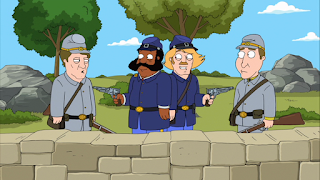


If I were a black person, I suppose I too might take at face value all statements of historical Rebels, and thus conclude the principal question of the American Civil War was whether or not black people were foreordained by God to be slaves. But as a white person who may know a bit more about the way white people think than a lot of non-whites, I'd say that the Civil War was predominantly a war between two groups of white people, and the fate of black slaves was simply the "bone" over which the two dogs were fighting.

One can find innumerable justifications for slavery. often religious in nature, in the records of Confederacy advocates. But the primary justification, since slavery became an American institution around 1620, was economic. In addition to the perks of free labor for landowners, the 3/5 compromise of 1783 ensured that even a partial count of the slaves in southern states would result in a greater allotment of delegates in the federal government. While many reformers objected to slavery on moral grounds, it seems likely to me that the Republican legislators who introduced the ban on slavery in U.S. territories were more concerned with breaking the hold that Southerners had on the government. (Notably, seven presidents prior to the Civil War were born in the above-mentioned Virginia.) The fact that the northern states had few if any laws against slavery suggests that had it been economically advantageous for those states to harbor as many slaves as the south did, there might never have been a Civil War at all.

In another essay I applied Buber's above remarks to the "peculiar institution," noting that:

It would seem obvious to me that the real-world injustice of slavery is all about what Buber calls the "I-it" relationship, of an "I" (the slaver or slaveholder) reducing a sentient being (the slave) to the status of an object.
And yet, in the above quote Buber stipulates that every Thou is fated to "continually enter into the condition of things." Human beings have been enslaving other human beings for centuries, and while not all institutions of slavery are equally motivated by profit, it would be naive to assume no economic advantage, particularly in the case of African slaves. One online writer, whom I've not been able to locate again, remarked that sub-Saharan Africa was virtually a "one-stop shopping" for the slave trade. For whatever reason, black people were one of the favorite targets of the Arab slavers since the ninth century. African slaves were commonly employed throughout the Middle East and were even traded as far abroad as China.

The fact that "everybody did it" doesn't make it right, of course, and the making of people into things, no matter who does it-- is fundamentally immoral. However, it is also very nearly inevitable, given the tendency of human beings to judge the morality of their ingroups in terms of self-interest; and to efface the fact that said ingroups have usually attained their position by debasing or marginalizing other peoples. American Southerners were indubitably dishonest about not admitting that they wanted slaves because slaves were profitable. But I don't think that they were dishonest in interpreting the Civil War in terms of a battle between the interests of two groups of white people. This interpretation became encoded in culture and literature as the "brother against brother" trope, and this had made it possible for the re-united culture to tolerate the honoring of war heroes of the Confederacy, even in some northern states.

In modern times, however, Confederate monuments, and any and all paraphernalia associated with honoring the famed "Lost Cause" (Rebel flags, names on public schools) are charged with sending the wrong message. The mayor of New Orleans endorsed this interpretation, stating categorically that Civil War monuments contributed to the city's "exclusionary attitudes." He further stated that "now is the time to take stock of, and then move past, a painful part of our history."

Many defenses of the monuments assert that they want to see history preserved. This is not precisely my defense, for I'm quite aware that monuments and paraphernalia for any cause cannot present a sophisticated view of history. In my opinion the main reason that the descendants of the Confederacy insurrection want the monuments is one of ego-gratification. I can't say that none of them have any desire to use Southern memorabilia as a means, say, to rally against the supposed evils of multiculturalism. But I find it unlikely that all of them do, and to those that simply want the pleasant illusion of the "brother vs. brother" theme, the insistence that Black Americans' feelings should be honored above their own is not likely to lead to greater collegiality. Indeed, I suspect that these sort of demands only foster more "exclusionary attitudes," rather than supporting the cause of diversity.

Friedrich Nietzsche wrote, "Our ancestors pay the price for who we are." If there are any people on this planet who possess absolutely no interest in validating their ancestors, I'm not aware of them, and I don't agree with the mayor that a given ingroup can simply "move past" their history. Ideally the ingroup should be cognizant of the ways in which their ancestors debased or marginalized other peoples, but the idea of defining any ingroup's heritage purely in terms of those acts is mere rhetoric that springs only from-- guess what-- self-interest. I suppose it might be empowering for Black Americans to imagine White Southerners going around, for the rest of their lives, wearing sackcloth and ashes for the sins of their ancestors.

But it's not going to happen. And any rhetoric that seeks that end is also-- a Lost Cause.