Showing posts with label Alfred. Show all posts

Monday, August 22, 2016

Comin' In On a Wing and a Prayer: Batman & Captain America


Batman/Captain America (October 1996)
"Batman & Captain America"
John Byrne

Doug: It's hard to believe this, as well as many of the other latter-day wave of DC/Marvel crossovers, is 20 years old. Seems like only a few months ago I eagerly awaited this offering to reach my 30-year old paws. Even in the mid-90s, if John Byrne was involved, a project was still going to be big news. But... did this disappoint then, and what about now as seen through the eyes of a curmudgeonly middle-aged school teacher?


No, in answer to the first question, it did not disappoint then. John Byrne's one of those guys who "gets" comic book history. Well, for the most part (the Vision debacle, for which he shall never be forgiven on this space, aside). This book is one big homage, or love-in, or whatever else you want to call it with the Golden Age of these two lead characters. Right from the Batman's first appearance, we can see that Byrne is emulating the style of Dick Sprang, mostly fondly remembered for illustrating the adventures of the Dark Knight Detective in the 1950s. But here I go again, getting ahead of myself. Of course we first need to give you that nifty little plot summary called the 100-Word Review:

Toward the end of the War, Captain America and Bucky are ordered Stateside in order to investigate millionaire Bruce Wayne, believed to be secretly bankrolling sabotage of the Gotham Project (known to history as the Manhattan Project). Batman and Robin are tracking down the Joker, who has been stealing secrets of the Project. During Cap’s surveillance of Wayne, he and Batman learn one another's identities and collaborate to find the Joker. They find that the Joker and the Red Skull are themselves collaborating, but the unpredictable Joker soon turns on the Skull – and that means war of another kind!


If you've never laid eyes on this book, it's a 64-page prestige format graphic novel. And it looks great, which brings us to...

The Good: Yes, it does look great! The art is splendid throughout and the coloring (credited to Patricia Mulvihill) is phenomenal. I don't know that I'm qualified to discern or discuss coloring innovations of the 1990s, but it's fairly obvious that Mulvihill was able to employ then-modern computer coloring techniques without losing the four-color charm that many of us cling to. 

Byrne's pencils are magnificent. Some criticisms (maybe just of mine) of Byrne in this period are that his art had become flat, or scratchy, or that his figures' torsos were sometimes oddly elongated. None of that is here. In fact, if you ask me to compare eras of Byrne's career, I'd gladly put this alongside his work in the Claremont/Byrne/Austin heyday of the Uncanny X-Men or his collaboration with Dick Giordano in the Man of Steel limited series. It's that good. 

His writing is spot on as well. I mentioned at the top the homages to Dick Sprang's art. Byrne captures the spirit of the era in his writing as well. It's not over-the-top sappy or dated in any negative way. But you can just hear Cap or the Batman talking "that way" if you were watching this on film at a Sunday matinee. The inclusion of Sgt. Rock and Easy Company, when Sgt. Fury and his Howling Commandos would have been included, was a nice touch. Great job of further blending the universes.

There are a few twists in the story that caught me off guard when I read this the first time twenty years ago, and again a couple of weeks ago when I re-read it. That the Joker would double-cross the Red Skull because the Skull was a Nazi seemed strange -- was it the racism, the world conquest, or the supreme egomania that turned off the Clown Prince? It was never stated, but the Joker's seeming patriotism struck an odd note. I'm not saying it was bad... not at all. In fact, it was good because it was so unexpected.


In addition to the wonderful splash of the Batcave, late in the story there is (of course) a perilous trap, timed to kill Batman and Bucky (the crossover with the sidekicks was fun). It definitely hearkened to the days of the cliffhanger endings popular in the serials of the 1940s as well as to the 1966 Batman television series.

Byrne gives a "thanks" to Roger Stern for the epilogue of the story. It's a nifty "What If?", as 20 years after the War Batman and Robin are patrolling the ocean for any signs of the Joker... Junior. "Jr.", huh? Well, this ain't yer daddy's Batman and Robin. Nope -- this is Dick Grayson wearing the mantle of the Bat and Bruce Wayne, Jr. as Robin. And as they pilot the Bat-sub, what's in that ice floe they find up ahead? I think you know what (or who) it is...


The Bad: I guess if I have one complaint it's that Bucky got a little short-shrifted in this story. He has a moment here and there, but largely it's Robin who does the more-heroic stuff. Bucky sort of comes off as a whiner, which I felt was interesting given that I'd have assumed Bucky to be older at that time than Robin -- maybe a little more mature. Too, and if we are to believe the Winter Soldier retcon (which obviously wasn't a thing yet when Byrne penned this story), I'd have liked to have seen Bucky as a bit more take-charge. But then, and as I've said, whenever I was reading the Invaders I never thought of Bucky as carrying out any "collateral damage".

Oh, and another thing -- when the Joker stole the atomic bomb, Fat Boy, and it went off in the Atlantic after our heroes worked their (lucky) magic, what are we to assume? In our reality, the bombs dropped on Japan were nicknamed Fat Man and Little Boy. So in this story was there only one bomb, and if so, was the atomic destruction of Hiroshima and Nagasaki not to pass? This is in no way a situation that ruins this story for me. Far from it. But it just left me to wonder. Sooooo many universes! Someone should write a Crisis...


The Ugly: Nada.

Check this out if you're able. It's been reprinted in one of the Crossover Classics volumes, and can probably be found at your LCS or online for only a buck or two. It was a nice half hour diversion, and one I'm glad that after all these years I read again.

Thursday, July 28, 2016

Face-Off: Alfred or Jarvis?


Martinex1: Today's Face-Off question is: Alfred Pennyworth or Edwin Jarvis?  Who do you prefer? What do you say about these supporting characters?

Butler to the Bat?

Or Servant to the Super-Team?

Alfred as portrayed on television's Batman by Alan Napier.

Jarvis was portrayed by James D'Arcy on Agent Carter

Alfred has been a Lego!

Jarvis has been a super-computer!

Michael Caine has played the butler!

And Jarvis was played by Ultron when he became the Crimson Cowl!


Monday, March 14, 2016

The Dark Knight Returned; But Was He Batman? Part Four


Batman: The Dark Knight (June 1986)
"The Dark Knight Falls"
Frank Miller-Miller/Klaus Janson

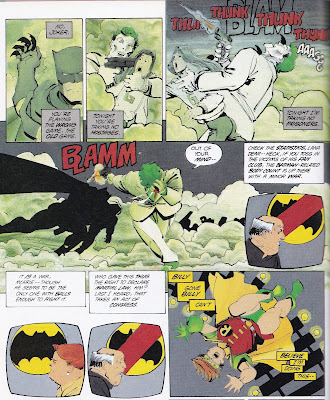
Karen: Time for a showdown. Well, a couple of  showdowns, actually. But the one everyone seems to remember, and has apparently become the major 'take-home' point of TDKR 30 years later, is the battle, both on a physical and political level, between Batman and Superman. As we've seen in our previous three reviews, this story is overflowing with ideas and themes that can be analyzed and argued, but the one that has risen above the rest is the confrontation that closes out this issue. But before we get to that, there's quite a bit that happens in this concluding part of the story.

Doug: You hit the nail on the head with the "big fight" being all that seems to be remembered from this story. There aren't too many marketing images from Batman v Superman that do not feature Batman in all his armored-up glory. But upon my re-re-read (yep - I've read this issue twice recently for today's comments) I think I was more interested in the first part of the story than the second half. And to be blunt, I'm really not sure what they were fighting about. There -- I said it.

Karen: Well, ostensibly, Superman was there to shut Bats down. But it's always been about their philosophies, right? Or Miller's take on them, in any case. Before the big battle, we see a Batman who is progressively more injured, more damaged, who obviously cannot continue his fight too much longer. After his final encounter with the Joker, Alfred patches him back together, but he's in bad shape and barely keeping it together. He has come to rely on his new Robin more and more. The sense of the endgame is near. But that is mirrored in what's happening globally, where the Soviets have responded to the U.S.'s use of Superman in Corto Maltese by launching a 'meganuke' at that country.

Doug: The Batman's escape from the Tunnel of Love, where the now-dead Joker was further desecrated by a) Batman spitting on the corpse's face as he left, and b) the fact that the body was rigged to explode in fire, effectively removing the Joker from the plane of physical existence, was all quite exciting. And maybe I'll answer my own quandary about the what Superman and Batman were fighting over: it's not really politics, although that seems to keep coming up. I think Frank Miller hits on something that was mostly latent through the latter Golden Age and the Silver Age, and that's the methodology employed by these two heroes. I think they both want the same outcomes; but there "point A to point B" is so drastically different. Case in point -- Batman has no interest whatsoever in moving forward with any alliance with the Gotham City Police Department. In fact, I'd have to say that as he suggested at the end of TDKR #3 ("tonight it ends, Joker"), he really saw no relationship at all with the police moving forward. This is a Batman who is comfortable with his mortality.

Karen: On the surface their goals might sound the same -"protecting people" -but I'm not sure it means the same thing to the two of them. You have to think that Superman lives on such a broad scale that it's hard to compare to Batman's, which seems focused on just Gotham. I have to admit, I like the idea of them having the same goals but different methods. This has been done, and done well, in a few places; off the top of my head, I recall the animated "World's Finest" feature from years back. But here, it seems like Batman has developed a real grudge. He just wants to put Superman in his place!


Doug: Adjacent to Batman's escape and patching up by Alfred is another vignette about the former Mutants gang. As we saw previously, many of the gang members have become the Sons of the Batman. Yet at the beginning of TDKR #3 we saw a splinter group of neo-Nazis, and in this issue we see yet another group of thugs disguised as "Nixons". Man, Miller was all over the place. As I said earlier, we haven't exactly close read this graphic novel, but if you chose to do so the depth of analysis one could articulate boggles the mind. 

Karen: Reagan, Nixon -I wonder if this would have any meaning at all for someone younger than 40 reading it? Before we jump into a discussion of Superman's diversion of the nuke and the results, I have to say I had to laugh at the depiction of Reagan going on the air in a radiation suit to tell America that's there's good news and bad news, and "those Soviets are pretty bad losers, yes they are."


Doug: For Miller wanting to make Superman out as the "bad guy" of the World's Finest team, he sure seems to hold Superman's powers in high regard. As we saw in the previous issue, Superman could pick up a radio transmission miles away. He does that here as he listens to the Reagan message. And away he goes! We should also remember that this is the pre-revamp Superman, when John Byrne de-powered Kal-el in the Man of Steel mini-series.

Karen: Everything goes to Hell when the Soviets fire off a nuclear weapon called a 'coldbringer.' Superman prevents it from hitting a populated area, but when it detonates in a desert it throws up a huge cloud that blacks out the sun, and it simultaneously emits an electromagnetic pulse that disrupts all electronics. The blackout in Gotham leads to both gang members and citizens behaving badly -that is, until Batman takes charge. I have to say, Batman on a horse is quite a sight.


Doug: I thought it was powerful how Miller and his colorist wife, Lynn Varley, chose to portray Superman and the bomb as silhouettes. The rest of the world, sky, etc. was colored "normally"; the stark contrast, and that it was all blacks, played on the emotions -- the impending sense of doom.


Karen: The scenes of Superman dealing with the nuclear missile were awe-inspiring. Particularly the ravaged Superman, flying up towards the nourishing sun, only to be struck by lightning -the red coloring in this panel is very effective. The idea that Superman is able to absorb solar energy stored in the Earth -and his reverence for the Earth -was also a very intriguing idea.


Doug: They were, and the coinciding chaos that the bomb wrought seems equally as apocalyptic. You mentioned the Gothamites behaving badly -- even worse than before (see our comments on one Byron Brassballs in our previous review). One scene that Miller used -- and I don't fault him, as this was 1986 -- was of a jet airliner crashing into a Gotham skyscraper. While the building did not come down, I still find myself sensitive to images like that. Way back when we did our spoiler-filled Man of Steel post, I commented that 9/11 remains a raw nerve for me. So to the horse...


Doug: Remember last time when I thought it was just a bit of a hoot to see Bruce Wayne and Clark Kent out for a pony ride? Ha! Talk about foreshadowing. Of course a rich guy like Bruce Wayne would have stables, if nothing else as mere props to keep the playboy image alive. But what a cool plot point to be able to use. Batman on a horse. And leading a bunch of teenaged thugs who, living in a huge city, may have never even seen a real horse. Not only has the world gone to Hell in the wake of the blast, but Gotham City seems now worse off than ever. Thank your lucky stars for heroes like Jim Gordon, though. The aged cop tries his best to be a leader, but the masses scoff. But when he pulls the metal that speaks business from its holster, he gets some attention.

Karen: In Batman and with Gordon and his gun, we're basically shown that the only way to keep order is through strength. I mean, that's the only way I can interpret this. Even Commissioner Yindel backs down and just lets Batman run the show. You mentioned Batman's fascism in a previous review. Well here it is in all its glory. The stuff with everyone pulling together is nice and all, but no one listens until the threat is there. And, yup, old Byron Brassballs is back again in the thick of it.

Doug: Like you, I had not thought of Superman being able to draw solar energy from the Earth itself. However, that was also not without a political/environmental statement from Miller. Did you notice that as Superman drew upon the Earth's energy, the nuclear winter immediately set in where it had not been before? That's some commentary on us, kids. The battle for the streets of Gotham rages, as Batman and his minions strive to restore order. Gordon, searching frantically for his wife, Sarah, finally finds her. They embrace, as the snow begins to fall.

Doug: Back at Wayne Manor, Bruce Wayne receives a guest -- Oliver Queen. Queen's recently out of jail, and it sounds like he engages in a little sabotage, even terrorism if I read the implication correctly. He tells Wayne that it's going to come down to a battle to the death between he and Superman. The Law simply cannot abide by the methods of the Batman. No crime in Gotham under the watch of the Sons of the Batman? True. But the cost... Oliver asks his old friend that he'd like to have just a small piece of Superman when the time comes, and alludes to the fact that his amputated arm was somehow the fault of the Man of Steel. A short while later, a slender ray of heat vision carves "WHERE?"  in the snow on the Wayne estate. In a strong but normal tone, Bruce Wayne utters, "Crime Alley". 


Karen: It makes sense that Miller would choose Queen, DC's outspoken liberal, as Batman's ally here. Seeing him missing his left arm was jarring when I first read this. I still find it hard to believe Superman would have personally removed Oliver's arm, but he could have brought him in to the authorities, who would have done it. In any case, there's a vendetta here on Queen's part. The newscast, which says Gotham is the only safe city, was also disturbing, because as you note, that 'safety' is supplied by Batman's thugs. It's like the safety of any repressive society. You're safe but you're not free.

Doug: I think we could make that statement of the present-day Middle East. It's a tough cost/benefit conversation about the former strongmen -- they were devils, yes... but there was order. I'm certainly not qualified to make any judgments about that, but there're certainly arguments to be had or made on both sides of the issue.

Doug: Alfred has helped Batman prepare for what will be his final fight. A suit of armor and various technological enhancements have produced a Batman as we've not seen before. And he has a plan, timed to the minute. I have to tell you, I found this a bit uncomfortable when I first read it 30 years ago, and I've not strayed from that opinion in subsequent readings. Just some of the attitude of the Batman toward Superman... "I know you won't be late, Clark. You hate to stay up late." "I've had worse times." -- as six missiles knock Superman around the skies above Crime Alley. For a kid who grew up with Adam West in reruns and the Super Friends on Saturday mornings, this was a little jarring to my sensibilities. Batman levels the playing field as we know he can -- at times, I've felt he was the DCU version of Reed Richards or Tony Stark -- and early on the fight is actually Advantage: Batman. But we know that cannot last.

Karen: I know that when I first read this, when it first came out, it was all pretty thrilling. But as I've said before, with the perspective of many years, I find it now to be more off-putting than anything else. It's just not a view of Batman that I care for. But within the context of the story, Batman is going all out. He's getting his "grand death" as he puts it. He so desperately wants to beat the tar out of Superman. Funny, I realized that that terrible line in the recent commercials for the Batman v. Superman film, where Batman says to Superman something about "I'm going to show you what it means to be a man" is right out of this book, as here Batman says, "It's way past time you learned what it means to be a man." They really are using every bit of this book! You cannot see me shaking my head, but I am shaking my head...


Doug: The ending seems final. Batman -- dead. Alfred -- dead. Wayne Manor -- destroyed. But of course the Batman had one more thing up his sleeve. I again got a mixed signal with Superman's reaction at the funeral of Bruce Wayne. Ally or enemy? And then came the coda... the Sons of the Batman would continue to operate. But under rules that one might assume would stress civil rights first. We can hope. 


Karen: Well, partner, that seems an unlikely hope. I have to admit, I am pretty sure I at least picked up the first issue or two of the sequel to this, but I have no memory at all of the story! Re-reading this after many years was a real adventure. It's become such an iconic story, the inspiration for so much that has come after. It was hard to separate that from the story itself and not consider that during the review, but for the most part, I think we managed. Actually, reading this now, the Batman's sense of impending mortality makes more of an impression than before. That's the thread running through the four issues that really ties it all together. Batman comes back for one last grand mission - to save Gotham, essentially, but he also wants to wrap up some loose ends. This was a more driven, more brutal Batman than ever before, one who had come to a lonely, empty place and filled it with his own type of fulfillment -beating down every thing that stood in his way. It may be unfair to blame Miller for the excesses of later writers, who took what should have been a standalone version of Batman and used his themes in the character's regular books, but his version of Batman has become the template for the Caped Crusader. Certainly for us Bronze Age readers, it was -and is -a shock to the senses.


Doug: But we're not done yet! Join us tomorrow for a sort of epilogue to today's conversation, as we'll take a gander at Frank Miller's original script for the battle royal pictured above. We think you'll find it interesting how he originally played it out in his mind, and then how it landed on the printed page. See you again Tuesday.


Monday, February 29, 2016

The Dark Knight Returned; But Was He Batman? Part Three


Batman: The Dark Knight (May 1986)
"Hunt the Dark Knight"
Frank Miller-Miller/Klaus Janson

Doug: Everyone having fun? I am. While we haven't gone so far as to close read this graphic novel, I will say that going through it another couple of times as we frame these discussions has shed new light -- and revived some old lights -- on story elements, the art, the politics, and so on. I'm not sure now how many times I've read this story... could be around six or seven. And each time Frank Miller makes me consider things, whether or not I've paid them notice before. I think that's the staying power of this book. Comics fans often kick around the term "holds up". While certain aspects of the story are dated, I find that now-historical aspect part of the allure. Face it -- Frank Miller created this in 1985-86; how could it not be a product of his perception of his times? And this is a historical piece of literature. We've been talking about the difficulty in separating this as a comic book from this as a comic industry influence. But with the passage of time, now that's part of the story. And us chewing on it's merits as a standalone versus the suits and creators who smelled money like sharks smell blood and ran with it? I'm sure that's not what Miller set out to do. Has he himself milked the trend? You betcha. So this is complex, and I am enjoying going through it with you.
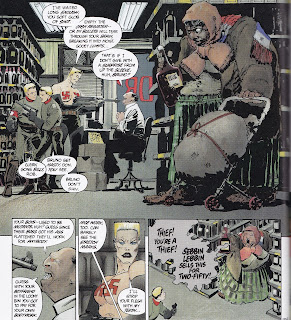
Doug: Karen remarked last week that what led the Batman to victory over the Mutants leader was not his ability to out-physical that monster, but to outsmart him. It's a great bridge to the second half of the book, where we'll find a Batman who is more Darknight Detective than Bat-hulk. And it starts right from the get-go, with Batman in disguise (a most ugly disguise... like someone threw hot oil on H.R. Pufnstuf's face). And what the heck did you make of the Nazi broad? And was she a she? Man, I could be scarred for life from that scene. I thought it was an interesting point that this little faction of former Mutants had not signed up with the Sons of the Batman. But splinter groups won't last long in the anarchic streets of Gotham City.

Karen: 'Bruno' was surely meant to be shocking in 1986 but now would probably elicit more protest as being insensitive than anything else. But I much prefer a Batman that tries to solve problems with his brain over one that pummels his way through everything. After defeating the Mutant Leader, and bringing a new Robin on-board, Batman has been reborn. He's firing on all cylinders again. 

Doug: I agree. And despite the level of violence that will get really ratcheted up as we move through this issue, there is a certain comfort zone in the first several pages of the tale.

Doug: Some of Miller's political commentary is quite troubling, but he does a brilliant job of using it to show just how far Gotham has fallen. The scene that's on my mind is when the advertising exec. pushes the disabled man onto the subway tracks. That scene is also our entry point for the arrival of Superman to the story, but it's really alarming nonetheless. But I will say that Miller's pessimism is perhaps not far off from our world of 2016, where mistrust, racial profiling, and a code of "no snitching" seems to rule the nightly news stories. And so what of Superman? I really liked the way he was introduced. It may seem corny to some, but I was digging the whole "faster than a speeding bullet" litany of his powers. Very dramatic.

Karen: I was wondering if the advertising exec -'Byron Brassballs' -- I mean really -- was supposed to look like Bernhard Goetz, the infamous Subway Vigilante? He looks a bit like him to me, anyway. Although given Miller's apparent worldview, I would think he would be a Goetz supporter. Superman's introduction gives him a properly mythic, larger than life feel. All the better for when he is eventually torn down?


Doug: I did an image search for Bernie Goetz upon your suggestion, and I'd say ol' Byron is definitely a stand-in for 1984's subway shooting vigilante. Weird, huh? I thought Miller used this character to stand out to the reader as just preposterous. But really, I think he's being used to parallel what some in the media and in politics were saying about the Batman. In answer to the issue you just raised, I guess I don't know where Miller stood.

Doug: Jim Gordon's exit from the book was perfect -- crusty and honest, as you'd expect him to be. The scene at his banquet was nicely juxtaposed with the discovery of the little robots (er, little CREEPY robots). A trend running through the early part of this volume is the growing relationship, training if you will, between the Batman and our new Robin. I have always loved the repeated, "If you do X, you're fired." Cracks me up every time. So the stake-out at Abner's apartment is our springboard into The Dark Knight #3's special guest-villain, the Joker. I got a chill over the three panels where he thinks to himself, "Just can't sleep. Should sleep. Should be fresh tomorrow. Tomorrow I go free."

Karen: As much as the concept of Robin should make absolutely no sense, I like Batman being balanced by Robin. Besides the "you're fired" dialog, I also liked how as he's chastising Robin while they are jumping and running across the rooftops, he throws in a fatherly "careful" here and there. This relationship is good for him. Having someone to care for provides some healing for this still-traumatized man.


Doug: Carrie Kelly is a great bridge between generations. Batman marvels at what she knows about the technology he's employed in various scenes. An "immigrant user" himself, Carrie takes to certain gadgets and mechanical workings as we now see today's youngsters -- quickly and without hesitation.


Karen: As for the Joker, I think in our off-line discussion I had mentioned how I did not care for his depiction in this. You're right, he's creepy, but I've never cared for that sort of romantic-obsessive angle, which I think Miller originated and others picked up on later. It just seems too easy. The Joker always looked a little feminine, and I suppose it's one way to go, but it doesn't ring true to me. I always thought Joker's challenge with Batman was more a contest of wills.

Doug: I didn't mind the caricature of Ronald Reagan. While of course not entirely accurate, it was not all that different from how he was being portrayed at the time in various media. At times I got the same vibe that I did when watching the Genesis video "Land of Confusion". I also think that Superman has been vilified since this story, the so-called Big Blue Boy Scout. But what's wrong with that? Superman himself relates how, after the trouble that forced the heroes underground (how many times has some sort of registration act been written into a comic story?) he was able to cut a deal that allowed him to operate in secret. And as the sworn protector of his adopted planet, what's wrong with that? I think Miller chose to go anti-establishment and so made Superman his whipping boy.
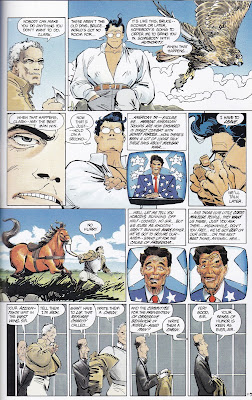
Karen: Yes, nothing novel about Reagan being portrayed as something of a nitwit, or senile. Things like that had been going on even when he was running for Governor of California. Superman does wind up as the patsy according to Miller. It's been a long time since I read this, and I haven't re-read issue #4 yet, so I don't recall if we ever get all the details on why the heroes were driven underground. Superman makes allusions to it. But it  does sound like Superman decided to play by the rules, to accept everyone being forced off the field, if he could still play, and that does seem pretty wimpy. He's Superman, for God's sake, isn't he supposed to stand up for truth, justice, and the American Way? The way Miller depicts it, he's an errand boy for the government. That's bothersome. Hey -doesn't this sound a bit like what we may see in the Civil War movie in a few months?

Doug: Yes it does, and that bothers me. I didn't read much of Civil War when it came out -- really the first scene where Nuklo goes off and Bill Foster is vaporized set a tone for me that I didn't want to partake in further. Interesting there, though, and here as well, that the guy who stands up for the ideals of freedom is to be portrayed as the bad guy. Iron Man's, and Batman's here, brand of fascism is "heroized". Maybe I'm missing something all the way through threads like this, and the Mutant Registration Act, etc. as well. 

Karen: Don't get me started on Civil War. [Umm... you brought it up ;) ] Thankfully that's pretty far out of our Bronze Age zone. I think the film will be sufficiently different from the comic that I'll be able to enjoy it (I hope). But here, with Superman, Miller's presentation is just so one-sided -when he has him thinking things like "I gave them my obedience and my invisibility. They gave me a license and let us live," it's hard to look on him as heroic. Yes, he's doing it so he can save people, but again, it's at the pleasure of the US government, which we've been shown is corrupt, and I guess I'm just a child of the 70s, that irks me. 

Doug: I think with Superman we have to determine what is the greater good. Certainly in this post-9/11 world in which we dwell these issues of "greater good" have been raised often with the Patriot Act and various similar ideas, such as body scans from the TSA. Every opportunity benefit has opportunity costs, right? But Miller is wearing his opinions on his sleeve in TDKR.

Doug: So Bruce Wayne and Clark Kent go horseback riding. Maybe that's an odd scene, but I liked it. Miller manipulates us by playing Clark as very imperialistic -- regal. And Bruce just smirks at him. I loved how, in the middle of the conversation, Clark picked up on the news bulletin about the escalations in the Soviet activity on the fictional island of Corto Maltese and flew off to deal with it. Bruce, already set in his ways and confidant in his abilities and plans, says there's no hurry when Clark promises to resume their conversation. Bruce really wants no part of Clark's desire to talk him off his recent activities, and certainly doesn't want any part of being a "company man" like Superman has become.

Karen: Because I was never a regular DC reader, I don't know if this is/was always the case, but certainly part of Batman's appeal today is his ability to stand with 'gods' like Superman and Wonder Woman as an equal. I mean, he has no powers -at all -but by sheer force of his personality and his mental abilities, primarily, he has put himself in their ranks. In TDKR, he not only stands shoulder to shoulder with the god, he overcomes him, beats him. I think he was always highly regarded before but I think it was here that the ridiculous belief that Batman could overcome any foe began. Nowadays you can hear discussions in comic shops or see them on message boards about Batman vs. any character you want to name, and fans will come up with reasons Batman could beat that character "if he has time to plan". He has been deified, put in the pantheon even though in reality, he could never compete with these super-powered foes. Batman shouldn't really exist in the same universe as Superman, or Green Lantern. But he does, so we make the best of it. It's fun. But it stretches credulity to think this normal guy could survive a fight with any of these super-beings. But then, that's the ultimate wish fulfillment, isn't it?


Doug: And of course DC has gone so far in the past 15 years or so to refer to their Big Three as the "Trinity". Now if that doesn't have godly overtones...


Doug: The escalation of Cold War events is really just an appetizer to the meal that will be served in TDKR #4. The climax of this issue is the showdown with the Joker, which ties directly into the Clown Prince of Crime's coming out on the David Letterman Show. Oh wait -- the David Endochrine Show. So what was Miller saying there? The endocrine system produces hormones that regulate, among other things, reproduction and sexual urges. So is that why Dr. Ruth Westheimer was a guest on the show the same night as the Joker? Does this affirm your posit above that Miller was playing the Joker as this romantic-obsessive counterpart to the Batman's repressed urges?

Karen: You got me on the Endochrine thing. I just thought that was the strangest name to come up with. I'm not sure what Miller was trying to say there. And Dr. Ruth! I had forgotten about her, but she was everywhere back then. Yeah, the whole sexual repression thing, the lipstick, the scene down in the tunnel, it just seems too obvious to me. But I'm rarely happy with the way The Joker is portrayed. I can't stand The Killing Joke -not just The Joker, but the whole thing. So what do I know...


Doug: But before the Batman/Joker fireworks begin, there are others to deal with -- literally. In a scene foreshadowing what Miller would write about a year hence (in "Batman: Year One", Batman #404, February 1987), Batman thinks, "Fighting cops. It's been awhile..." Commissioner Yindel has ordered her police to surround the Late Night studios, as she is positive the Joker will make a play. She's also pretty daggone sure the Batman will show up. Right on both counts, Commissioner. I really liked the scene in the air and on the rooftops -- sure, Batman's outside the law, and one could argue that it's what allows the Joker to pull off his plan. But it's an exciting scene that speaks to Batman's skill, strength, and determination.


Karen: Yes, and so are the following scenes, with the congressman and Selina Kyle. After Batman and Robin escape, crashing through the window, Batman radios Yindel to go save the Governor. It made me think about how this relationship is starting, and where it could be in five years. Would Yindel still be chasing down Batman, or at some point, would she grudgingly form an alliance?

Doug: If that is a veiled request to get my opinion on or even participate in a review of TDKR2, you are barking up the wrong tree. Man, was that ill-advised and flat-out bad!


Doug: I found the scenes with Selina Kyle troubling. I did not care for the angle Miller took with Selina in "Batman: Year One", the seeds of which seem to have begun here (although much later in her life, obviously). Why go that route? I don't know that various creators through the years have always treated the Bob Kane/Bill Finger characterizations as gospel, but this seems such a departure from how Catwoman has ever been depicted. Miller seems to resolve the sexual tension between the Batman and Catwoman that was always there, from the funnybooks to the 1966 film and television series. But that Selina is a madam, and of course in that "Year One" story a prostitute herself is way off for me.

Doug: I'll add that had that initial scene (see below, at left) been stretched out, it would have given the same tense, uncomfortable vibe as the scene in The Dark Knight where the Joker confronts Rachel Dawes (Maggie Gyllenhaal). At this point the Joker (and the Batman) seemed to be at a point of no return. So the tension created when the Joker approached Selina Kyle really had me on pins and needles. And then to see the way it played out a short while later. It's tough to know just what is implied, but I think some very vile actions took place. And Robin's reaction says it all. What that girl went through at the end of this story, no child her age should even have to think about. It really puts into perspective what the life of Dick Grayson must have been like had comic books been written with a R rating as this one was. I suppose the danger faced by Jason Todd during "A Death in the Family" would have been oft-happening circumstances.
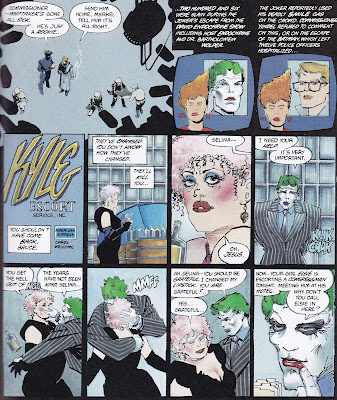
 

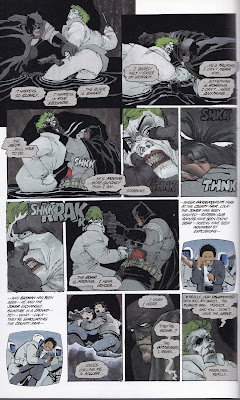
Karen: Batman winds up with Joker in the Tunnel of Love. See? I'm not projecting anything! Batman is shot, stabbed, and yet he still is able to think about how a "gun is a coward's weapon." So he uses his hands on Joker. But despite all his guilt over Joker's murders, he doesn't kill him. I wish people would remember this rather than the fight with Superman! I thought that this was the Batman I knew - regardless of everything, when it comes down to it, he chooses not to kill Joker. OK, he does break his neck to paralyze him, but all things considered, I think Joker was getting off easy.


Doug: What seems a focal point to me, though, is that more than once Batman thinks to himself something along the lines of "this ends tonight". One way or another, one or both of them will end up dead when this has all played out. And, given that Batman had mused to himself on multiple occasions about a "good death" or "not a good death", it seems to me that any death at the hands or machinations of his mortal enemy would qualify as a "bad death". Batman had to know this would end in the Joker's death -- how, who can say? The unpredictability of the Clown Prince certainly held off any chance at anticipation. I agree with you that the Batman stopped short of killing the Joker, but are his actions any less shocking than what we saw from Superman at the end of Man of Steel? By the time he kills himself (and I wouldn't have the slightest idea how the physiology of breaking one's own neck, already with a broken neck would work), the Joker had taken a bat-star (that's what I'm going to call it -- the batarang would be larger) to the eye and would have taken a fair amount of physical abuse. And the pressure on the Joker's face when Batman grabs hold would not have in any way been pleasant. I agree with you that the Joker deserved what he got - a court of law would have sentenced him to die, no doubt. But he's in the Batman's court now. And isn't that Miller's point to this story, after all?


Related Posts with Thumbnails