Showing posts with label Kurt Busiek. Show all posts

Friday, August 5, 2016

Date Night: Untold Tales of Spider-Man Annual '96


Untold Tales of Spider-Man '96  (1996)
"A Night on the Town"
Kurt Busiek-Mike Allred/Joe Sinnott

Redartz:  Hello everyone, and welcome back to the 1990's. Yes, the decade who's comics have a rather checkered reputation; but fear not. Today we will look at a little Silver Age gem, as told by Kurt Busiek and illustrated by Mike Allred (who gave us "Madman" and inked by the one and only Joe Sinnott. 

Some may be familiar with "Untold Tales of Spider-Man", a title published all too briefly during the 90's. The kicker was that these stories took place during the Lee/Ditko era of Amazing Spider-Man, and fit into continuity between the original issues of ASM. In fact, they even provided a chart breaking down what issues went where, for those inclined to pursue it. Some issues of "Untold" featured such veterans as Doc Ock, Vulture, and Sandman. Some introduced 'new' foes, such as the Scorcher and Batwing. The cast included all the Lee/Ditko faces, including Liz and Flash, Harry Osborn, even Fred Foswell and Bennett Brant (Betty's brother, killed in ASM 12). Other characters were also added, as Busiek and artist Pat Oliffe took this fun book and had a blast with it. These comics were great and are well worth a read; you could probably find all of them in a dollar box.

Today, however, we are looking at the first Annual the title offered. The story, in a nutshell (a brief aside- the credits in this book tout a story suggestion by Paul Dini, comics writer extraordinaire): 


Spider-Man is about to capture a gang of hoods, when his friend/rival the Human Torch swoops in and upstages him, taking the credit. Spidey decides to get even with the Torch...

 and visits the Baxter Building. There he asks Sue Storm for a date (not expecting success). Sue, feeling neglected by Reed, actually accepts! Incidentally, I think Mike Allred did a nice job of giving the book a Silver Age look. And Joe Sinnott's inks certainly give the FF a familiar look.


The Torch, of course, is quite dismayed by events. Peter Parker, on the other hand, is beside himself with excitement. He floats through a day at school, but runs afoul of the old Parker luck when Betty Brant calls that evening. I sense Allred channeling Ditko here, especially with Betty's look...


 While Sue and Spidey go out, the sulking Torch figures he'll fix the webslinger- he hunts down the Sub-Mariner, and tells Namor that Spidey has kidnapped Sue.  Subby takes the bait...


The scene of Peter and Sue sharing a pizza is wonderful. I love the expression on Peter's face in the last panel. Of course, this is a Marvel comic, and it's been too quiet. At this point Namor rather dramatically intrudes upon the couple...


Now the fireworks ensue,  and for awhile Namor gives Spiderman his lumps. And as fate would have it, who but Jolly Jonah Jameson, and Betty, show up on the sidewalk below the battle. They are quickly endangered by a pile of rubble, courtesy of the Sub-Mariner's temper.

Meanwhile, Sue summoned the rest of the FF, who are less than pleased to discover the cause of the commotion...


In a scene reminiscent of Daredevil 7, Namor witnesses Spider-Man's selfless courage as he acts to save Betty and Jonah, and begins to question his initial assessment. But the webslinger is pretty ticked. Yet before things deteriorate further, the FF show up with explanations. The Torch smirks as Spidey leaves, but later Spidey pays a silent visit to Johnny's garage and gets one last bit of payback...


This story is a lot of fun, with the guest stars, the action and the humor. Actually, the whole package is a lot of fun. Taking a leaf from the classic Spider-Man Annual #1, the creators give us a feast of special feature pages following the main story. We get villain pin-ups by the likes of Sal Buscema, Gil Kane, Jim Mooney and Klaus Janson. We get "How Kurt Busiek and Pat Olliffe Recreate Untold Tales", in the spirit of "How Stan and Steve create Spider-Man" from that 1964 Annual. We get a couple more feature pages, and even a recipe for Aunt May's wheatcakes!  That's a lot of four color goodness for a cover price of 1.95. And that's definitely the way to make an Annual...


Monday, April 13, 2015

The Day She Died: Marvels 4


Marvels #4 (April 1994)
"The Day She Died"
Kurt Busiek-Alex Ross

Karen: This final issue of Marvels deals with what many see as the transition point from the Silver Age of Marvel to the Bronze Age -the death of Spider-Man's girlfriend, Gwen Stacy. With it, we also have the death of innocence in comics and the death of Phil Sheldon's faith in the heroes, or perhaps his faith in the world in general. I found this last issue in many ways a difficult read, as I sort of internalized Phil's struggle, having now pretty well disconnected from new comics, yet still yearning for the comics of my youth. I'm positive I was over-thinking things!

Doug: Kurt Busiek and Alex Ross certainly chose several incidents and developments, in addition to the featured tale, to demarcate the Silver Age from the Bronze Age. Seeing it all in one place really does show the reader (and long-time fan, as so many of us are) how time had led to an expansive new Marvel Universe. I don't recall having the same feelings toward Phil Sheldon the first several times I read this mini-series that I've had this time. I don't know that I'd say I bear the guy (character...) any animosity, but he's certainly way more flawed to me now than I've ever perceived him in the past. I think we've both questioned his reliability as a husband and parent, although there's no doubt about his financial provision. But here, he walks a creepy obsessive line in a few regards that's a bit uncomfortable to me.

 
Karen: This story opens with Phil achieving his long-sought after success with the publication of his book, Marvels, but he still seems to have an emptiness to him. He's bitter over the way the rest of the world treats the heroes, ungrateful for their sacrifices, and he grows fixated on trying to do something about it. When Spider-Man is implicated in the death of police Captain George Stacy, he decides to work to clear the web-slinger's name. Phil takes this up as a personal crusade of sorts, partly in counter-point to J. Jonah Jameson's senseless vendetta. He speaks to various people who were at the crime scene, including Dr. Octopus, but what really pulls him in deeply is getting to know Capt. Stacy's daughter, Gwen. He sees in her a beautiful, innocent young woman, full of life, and has an epiphany of sorts: it didn't matter if people believed in the Marvels or not -- they weren't here for that. They were here to save people like Gwen. As a reader, you can see where this is going.


Doug: I loved some of the visuals in this book. Even though there was no action, the scene where Sheldon and his new assistant visit Luke Cage is well done. The scene you mention with Phil visiting Octavius in prison is great -- what a smirk the good doctor wears! And late in the book the way Ross portrays Phil's in-home darkroom is excellent. If you've ever been in one (and I come from a family of printers), it's spot-on.

Karen: After all these years, the book is still brilliant to look at. I did enjoy that scene with Dr. Octopus a great deal - it was just chilling. Shortly after this, we are taken back to that fateful battle between Spider-Man and the Green Goblin from Amazing Spider-Man #121, and that horrible fall. Phil sees it from a vantage point almost level with the pillars supporting the bridge. He knows, instantly, that Gwen is dead. He can't comprehend it -- how could the hero not save her? Of course, that's likely how most of us reading that  issue felt as well. Again, Phil stands in for the longtime comic fan. Things had changed. Things were changing. The earlier encounter with Luke Cage, Hero For Hire, was another indicator - the world we knew was becoming different, more complicated.

Doug: And that's where I was going with my initial comments at the top. From the Kree-Skrull War to Daredevil shacking up with Natasha in San Francisco, there were so many specific vignettes that when taken together showed how the comfort of the Silver Age had given way to new, different, and sometimes uncomfortable circumstances in the Bronze Age.


Doug: So Richard Starkings and the boys at Comicraft lettered in the fateful "snap" when Spider-Man's webline reached Gwen's legs, the recoil breaking her neck. I had forgotten that a few pages later Sheldon remarks that he can still hear the "flat snap" across the water. He contrasts what he knows to be true with accounts that it had been the fall that killed Gwen Stacy. Just as Gwen had symbolized innocence in that Spider-Man tale from over 40 years ago, she stands in that role here in Marvels.
 

Karen: Yes, I noticed that too, that damn snap has always made me feel queasy. It's been said by many that Gwen's been far more important in her death than she ever was in her comics life, and certainly the implications of her death informed the decade that came after.

Doug: But what did you make of Phil's visit to see Gwen? I guess if Ross hadn't drawn her to look just as beautiful as Jazzy Johnny Romita ever had, maybe I wouldn't make anything of it. But Sheldon kept going back to see her. Yeah, he was wanting to get her to exonerate Spider-Man in the death of her father. But the scene when they walk through the Atlantean vessels was just a little odd to me. And in the days after Gwen's death, I couldn't decide if Phil was obsessed with Spider-Man's failure -- did that burst his personal Marvels balloon? -- or if he was overly distraught with her death. 

Karen: A middle-aged man, obsessing on a beautiful young woman...well, it happens all the time. A little disturbing but I do think there was that layer to it. Loss of innocence, loss of youth, longing for the past, his own personal success -there was a lot tied up with Gwen in Phil's mind. Phil tries to continue work on his next book with his assistant, Marcia, but his heart isn't in it. As he's going over photos with her, he sees Hawkeye and the Hulk fighting Zzzax on TV (from Incredible Hulk #166), and he snaps. He's done. He can't do it any more; he's 'too close' to it all. But he tells Marcia to carry on -- she can use everything to make the documentary she discussed. He's ready to retire. Phil steps outside and beckons the young paperboy over and tells Marcia to get a picture of him and his wife with a nice, normal kid. Little Danny Ketch.

Doug: Danny Ketch. The 1990s Ghost Rider. Yes, a nod to bring this historical love letter to the then-present, but to me now, it just leaves me flat. Is Danny Ketch even still in the MU?

Karen: Certainly in 2015 Danny Ketch doesn't seem all that relevant, does he? Taken as one long piece, I enjoyed Marvels a great deal, although it did make me feel that living in that universe would probably not be such a wonderful experience! Phil's questioning -- why are the Marvels here? -- his quasi-religious take on them, would surely be one shared by many people. It's interesting that this is not addressed in comics. Of course, Stan Lee and Jack Kirby went the other route, with people giving the heroes a hard time right from the beginning. People were motivated by fear rather than love or awe. So Phil is an oddball. But I feel he also fills in for us readers who came in either in the Silver or early Bronze ages and have a longing for those days. He has developed an obsession with the heroes and misses the days, during the WWII, years, when they seemed perfect and were idolized. I can understand this, to some degree. I suppose I don't want cartoon cutouts but I also don't enjoy the extreme moral ambiguity I've found in a lot of recent books I've happened to pick up. But in any case, Alex Ross' art is phenomenal throughout the series. It never wavers and brings not only realism but the right amount of fantasy -sequences in this issue with Namor's Atlantean army is pure Ray Harryhausen Saturday-matinee stuff -the art just transports you. 

Doug: If super-heroes were real in today's reality-TV, tabloids-dishing-constantly-on-celebrities sort of culture in which we here in America find ourselves mired, they would be at the top of the food chain in terms of public notice. I don't know if the media would brand any of them as bad guys... shoot, not even the bad guys themselves! Who today doesn't love a good villain? And yes -- Alex Ross's art sucks the reader right into the story. He was the perfect choice to tell this story, and Kurt Busiek for the most part transferred the four-color stories of his (and our's) youth to this wonderful reimagining. In reflection, maybe Phil Sheldon was the perfect protagonist. As he'd felt as a younger man that he couldn't measure up to the Marvels, could never be the perfect man, in the end that's how he truly was. So what Busiek and Ross crafted was a main character with those wonderful feet of clay, manufactured by the one and only House of Ideas.


Monday, March 23, 2015

Judgment Day: Marvels 3


Marvels #3 (March 1994)
"Judgment Day"
Kurt Busiek-Alex Ross

NOTE: As in the past, we're apologizing up front for the quality of the art scans in today's post. Doug happened to have a digital copy of today's featured issue, but in attempting to convert the images for use some distortion took place. Hopefully you'll still get some utility from our images.


Doug: It's funny how a mood can change, even on the same subject matter. Two weeks ago Karen led off our comments on Marvels #2 by stating that she had a real sense of melancholy after reading that book. I'd argue that her (and mine, as well) feelings were due in no small part to the ugly way in which the citizens of New York's Homo sapiens community reacted to the coming genetic apocalypse allegedly to be wrought by Homo so-called superior. The dominant thread in today's fare is also the apocalypse -- yet I found myself on the edge-of-my-seat giddy as I re-read this for perhaps the fourth time. Alex Ross, in paying tribute to the source material of Jack Kirby and Joe Sinnott, really knocked the Galactus storyline out of the park.

Karen: I suppose it's stating the obvious to say there are a lot of strong visuals in this issue. But it deals with one of the most significant storylines in comics history. 

Doug: I'm trying to think of another Marvel story that would be splash-page worthy (the equivalent of Elaine Benes' "sponge worthy"), and I don't think there is one. Stan, Jack, and Joe truly crafted a tale of universe-shaking proportions and the decision to retell it in full pages was a stroke of genius! Every one of the 8+ full-pagers contains so much majesty, so much peril...


Karen: I like the way those spectacular scenes are juxtaposed with those of everyday people, including Phil Sheldon, dealing with what may very well be their last day on Earth. For all that Ross is adept at portraying epic moments, he gets all the little ones right too. 

Doug: The other thread running not only through this issue but the two previous installments is the personality of Phil Sheldon. We noted from the get-go that he has some hang-ups. Early on, it was feelings of inadequacy that led him to postpone his wedding with his fiance' Doris. Now here, 25 years later (real time, which seems about right -- Ross draws Sheldon as looking to be around 50), he's as absent from his domestic situation as any superhero. When I think of how many times Peter Parker stood up his aunt, or Gwen, or Mary Jane, it seems that Sheldon has done that just as often to his wife and two daughters. And even when he's home he seems to be emotionally barren to them.

Karen: He appears to have obsessed on the 'Marvels' -- is he a reflection of the reader? The issue sets  up his disconnect with his wife and family, but then through the crisis with Galactus, Phil seems to recognize that they are more important to him than his job, or chronicling the doings of the super-beings. Yet, at the end, he leaves his family again to get pictures of Count Nefaria. So what has really changed? He criticizes his fellow citizens for not showing the Fantastic Four, and the other Marvels, the respect they deserve, yet how much respect does he show his family? I don't know -- I just can't figure out how I feel about Phil, honestly.


Doug: I agree. He seems duty-bound, as the heroes he wishes to portray on film. And I cannot decide if he is in love/awe of the Marvels from an existential standpoint, or if it is the potential to profit off their existence with his proposed book of photographs that drives him. Why does he continue to take the photos? He's good at it -- much better than Peter Parker, for example, simply because Sheldon has to work at it. Unlike Parker, he doesn't have the luxury of suspending some high-tech camera from a lamp post while the action takes place. Does he drive himself, indeed putting himself in harm's way over and over because he is obsessed with being a part of this epoch in human history, or is it the lure of financial gain, of financial independence in his golden years that pushes him to place all his energies on his vocation? The character does bother me in that I don't feel like I can get a handle on who he is and what he's all about. Your point about the potential that he is a reflection of the reader, of the comic fan who can't get enough is interesting. Might Phil Sheldon be a "real life" completist?

Karen: That's where I was coming from. With each issue his need to get closer to the Marvels, to make others understand their importance and share his obsession, seems to grow. Although I think he does want to profit from them, his motives seem to be based more from hero worship or even a quasi-religious drive -and doesn't that sound like fandom at its worst?

Doug: So aside from the Sheldon interest, another aspect of this series that continues to captivate me is the research that Busiek and Ross did in crafting their plot. Right from the splash page, there are a bazillion bits and pieces of Marvel history on display. It's really visually appealing to see it presented as if it were real -- and the inclusion of newsmen we know such as a very young Tom Brokaw and John Chancellor adds authenticity to this man-on-the-street perspective.


Karen: Oh, indeed, the effort that went into weaving together all of those past tales was impressive. The book I'm using has an index in the back that lists all the comics they drew upon for each issue of Marvels. For the splash page alone, they reference  Avengers #16, and Tales of Suspense #s 66, 69-72. It made me so curious, I looked at those Iron Man stories on my DVD and saw that Stan Lee and Don Heck stretched out a fight between Iron Man and the Titanium Man over three issues! 

Doug: And speaking of perspective, I know you and I and certainly some of our readers have criticized some of Ross's questionable lay-outs on his Marvel 75th anniversary covers. I don't have that problem in Marvels #3 at all -- in fact, during the entire Galactus sequence is made even more dramatic due to the way Ross renders the crowd scenes. His shots looking straight down on the spectators adds tremendous scale to the battle atop the Baxter Building, and the times he uses an upshot to show Sheldon and the other journalists from their skyscraper windows is equally effective.


Karen: I went back and looked at Fantastic Four #48-50 to see those original scenes and it's really amazing to see the way Ross takes what Kirby and Sinnott did and then interprets it. He's very faithful to the source -- the shot of Galactus blasting the Torch, you still have the thick, billowing black smoke, for example, but in Ross' composition, we have both Galactus and the Torch in the same frame, giving us a sense of the space god's size. Or when Reed curls into a ball and knocks Galactus off the Baxter Building momentarily, we get the shot from a slightly different angle, with Galactus' foot in our face, again, giving a sense of size. The full page shot of him halting his fall , floating above the Manhattan streets, is spectacular. Another item of note: Ross is completely faithful when reproducing Kirby's wild machinery -- I checked and every odd screw, coil, and gizmo is copied exactly!
 

Doug: What did you think of Ross's Peter Parker? He's certainly snarky-looking, which fits that scene perfectly. But I'll tell you -- I got a real Andrew Garfield vibe off Pete. And you know how I'd feel about that!


Karen: Oh, I laughed, but you can understand Phil's ire! And yes, Andrew Garfield could have played that scene well.

Doug: Lastly, we'd be remiss if we didn't hit on a few of the cameos in this issue. In addition to the above named journalists, did you catch the Monkees? 

Karen: Oh yeah, of course, how could I miss Mike Nesmith's beanie hat? There were a lot of faces that looked familiar, but I couldn't place them. Maybe it's just due to Ross' realism. As one of our readers mentioned, I do think Ross makes Foswell look like Don Knotts. I thought Kurt Busiek himself was a reporter in one panel. I also thought the man in the restaurant bar behind Phil's family on the next to last page might have been Stan Lee, but not so sure about that one.


Doug: Yes to all those, and then some. And Ross even managed to work his father, Clark Ross, into a crowd scene -- years before he would be the model for Norman McKay, the cipher in DC's Kingdom Come! I can't tell you how strange it was to meet Mr. Ross at an art gallery show in Chicago that featured Alex's DC Comics work -- the page cometh to life!

Doug: Join us in two weeks for the conclusion, a portrayal from Busiek and Ross that I feel was just as gut-wrenching as the Conway/Kane/Romita/Mortellaro source material. 

Monday, March 9, 2015

Monsters: Marvels 2


Marvels #2 (February 1994)
"Monsters"
Kurt Busiek-Alex Ross

Karen: I finished Marvels #2, and it put me in a melancholy mood, which I'm pretty sure it has every time before. The initial stuff with the Avengers battling the Masters of Evil is very exciting of course. The great shot of Giant-Man looming over Phil has to be one of the most talked about visuals from Marvels; it certainly makes an impression. Say, I actually found a website, Comic Coverage by Mark Engblom, that did a panel-by-panel comparison of the battle in Marvels #2 with the one in Avengers #6; here's the link. It was interesting to see the way Ross had changed perspective and yet kept all the details from the original Kirby drawings, right down to the same civilians in the scenes!

Doug: It's amazing how "brightly optimistic" this issue opens, because like you I recall what's coming in the later parts of the book. You know, at first I thought it was funny that the first time we see the Avengers corresponds to their adventure six issues into the group's history. But then I asked myself what they'd done publicly ahead of that; the big brouhaha against Zemo's goons seemed fitting then.

Karen: I think we've both discussed before how some of the very early Marvel books are less than exciting. I know I was extremely disappointed when I read the Marvel Masterworks collection of the first ten issues of X-Men; I thought it was deadly dull for the most part. The early issues of the FF and Avengers were also hit or miss.

Doug: I was reading Kurt Busiek's commentary that is tucked in between the first two issues of Marvels in the tpb I'm using. He talks at length about the research both he and Alex Ross did for this mini-series and some of the roadblocks they encountered. The story that really struck me was how to fit the X-Men, given their own continuity, into the Reed & Sue wedding. Talk about continuity issues -- Busiek tells that to the best of his reading and inferencing, the X-Men had to participate in the wedding in about a 4-hour window in the middle of one of their own adventures. How's that for being thorough?

Karen: That's either extremely diligent, or just insane. Maybe both!


Doug: As in the first issue of the series, we see genuine "hero worship" directed at Captain America. This is magnified in the second issue as he seems to be the greatest of the Marvels. Though technically powerless (certainly as compared to his Avengers teammates), we get the impression that Busiek and Ross are giving Cap the Superman treatment -- the so-called "greatest hero of them all".


 Karen: But after this of course came all the ugliness over the 'mutant threat.' Even after having read this a half a dozen times it still got to me. Seeing Phil, our everyman, pick up that brick -stomach churning. I realized that the reaction of his neighbors reminded me of a Twilight Zone episode (I had to look up the title) - "The Monsters are Due on Maple Street' - where aliens just cut power to some houses and let human paranoia and fear take their course. I can't help but think Busiek might have been influenced by that. In the back of the book I'm using, Ross explains how the look of the mutant girl the Sheldons are harboring was based on a Wally Wood character from a 1953 EC comic. I mean, when you see it, it's a dead ringer! Ross really doesn't pull any punches with the child either: at first you're hit with revulsion, yet this is undeniably a frightened little girl, and you can feel that coming out of the page. Just like Phil, quickly you shift from fear to sympathy. Yet for Phil, he has to fear for the safety of his family. This is one of the very few stories that dealt with mutants that actually got across a real feeling of what it would be like on Marvel-Earth during mutant paranoia. However, I didn't feel that Busiek and Ross explained why the fear was not more widespread to all super-heroes. They did have the debates with Professor X and Trask but how would the public know how Giant-Man or some of the other characters got their powers? This was true of course during the Lee/Kirby era as well, so it wasn't really their job to explain anything. I guess it's one of those things that just bothers me. But the mood they get across here is much more affecting than anything from that earlier era.


Doug: I have also always wondered what, at least in the public eye, set the X-Men apart from other super-powered beings. Maybe it goes back to Magneto's ramblings about Homo superior and mutants being the next step on the evolutionary scale, superseding Homo sapiens? And I agree that taking the focus off the longjohn types and putting it squarely on folks like us does add to the tension over the perception of this "threat". So think about it -- Communists, mutants, Kennedy had been assassinated, the civil rights issues... for the denizens of the Marvel Universe, these were unsettled times to say the least.

Karen: Oh, I get the whole idea of humanity being driven out by the mutants, but honestly, who could tell which super-powered hero was a mutant and which wasn't? Just because they say so? Never made any sense to me. But the overall value of the X-Men as an analogy for the outcast in society was valuable enough that it was worth "just rolling with it."

Doug: As to this book's visuals, I can't think of another image that is as "Wow!" as the Giant-Man image... except perhaps two others: I love the full-pager with Galactus on his knees, picking himself up while levitating several stories above the street. And I am always washed over in trepidation when I see the panel with the Green Goblin perched on the window sill of Gwen Stacy's apartment, her body limp in his arms. Ugh... talk about foreboding.

Karen: There are so many stunning images from this series -and it was just four issues! Hard to believe when everything seems to be stretched to 12 issues any more. I really don't think Marvels gets the credit it is due. People talk about Watchmen and Dark Knight with such reverential tones, but for me, I'd much rather look at this series any day. I'd rather examine and admire my heroes than tear them down.

Doug: I've often wanted to read Watchmen again -- I've only ever read it once, in serialized form as I purchased it. I'm sure I'd get much more out of it in tpb form, which I own.

Doug: So let's have a discussion on the title of this story, as I feel it ties directly into your comments above about Phil Sheldon's getting sucked into the scenes with the angry mobs. How do you interpret "Monsters"? At first blush, it's obviously about the "mutant menace", right? Or is it Busiek being ironic? I don't feel that this story is overtly "preachy", yet I think in your reaction to Sheldon's behavior you've hit on what is perhaps the true meaning -- it's not the mutants who are the monsters, is it? 

Karen: I think it's pretty clear who the "Monsters" are (funny -- my version of the books does not include titles). I agree that the story is not too preachy -- perhaps it is bordering on it, but I think when you take the books as a whole, it's more the progression of Phil's attitude toward both the Marvels and the public. 

Karen: OK, let's not forget the cameos: How about Maude herself, Bea Arthur, at Alicia Masters' exhibit? And it looked to me like Alicia was modeled after actress Linda Hamilton. Tony Stark looked like Timothy Dalton.

Doug: Agreed on all fronts -- and don't forget Phil riding the elevator with Jack and Jackie Kennedy (which again is somewhat morbid as the events in these stories would have taken place in 1964...). Of course the wedding page has some special guests of the Richards', notably Rob and Laura Petrie (Dick Van Dyke and Mary Tyler Moore) and the Beatles! Clark and Lois also made a second appearance at the Daily Globe's New Year's party, this time with Jimmy Olsen on tow.


Doug: And if the big purple robots put a start in everyone, that's nothing. Wait until the next big fellow draped in purple shows up. And what an issue that will be -- splash page city! 

Monday, February 23, 2015

A Time of Marvels: Marvels 1


Marvels #1 (January 1994)
"A Time of Marvels"
Kurt Busiek-Alex Ross

Doug: What's this? A comic book review that's not in our "Arc of Triumph?" series? Yep -- we told you that in our revised "anything goes at any time" schedule we'd try to get back to doing our famous (shoot, world-renowned!) partner reviews. So here you go. And no, we didn't pick this just to rile the Alex Ross haters among our regulars... Although we'd lie if we didn't say we joked about it back in the planning meeting! We don't know how long it will take us to get through these four issues, but we can tell you we're looking forward to taking another look at this landmark series.
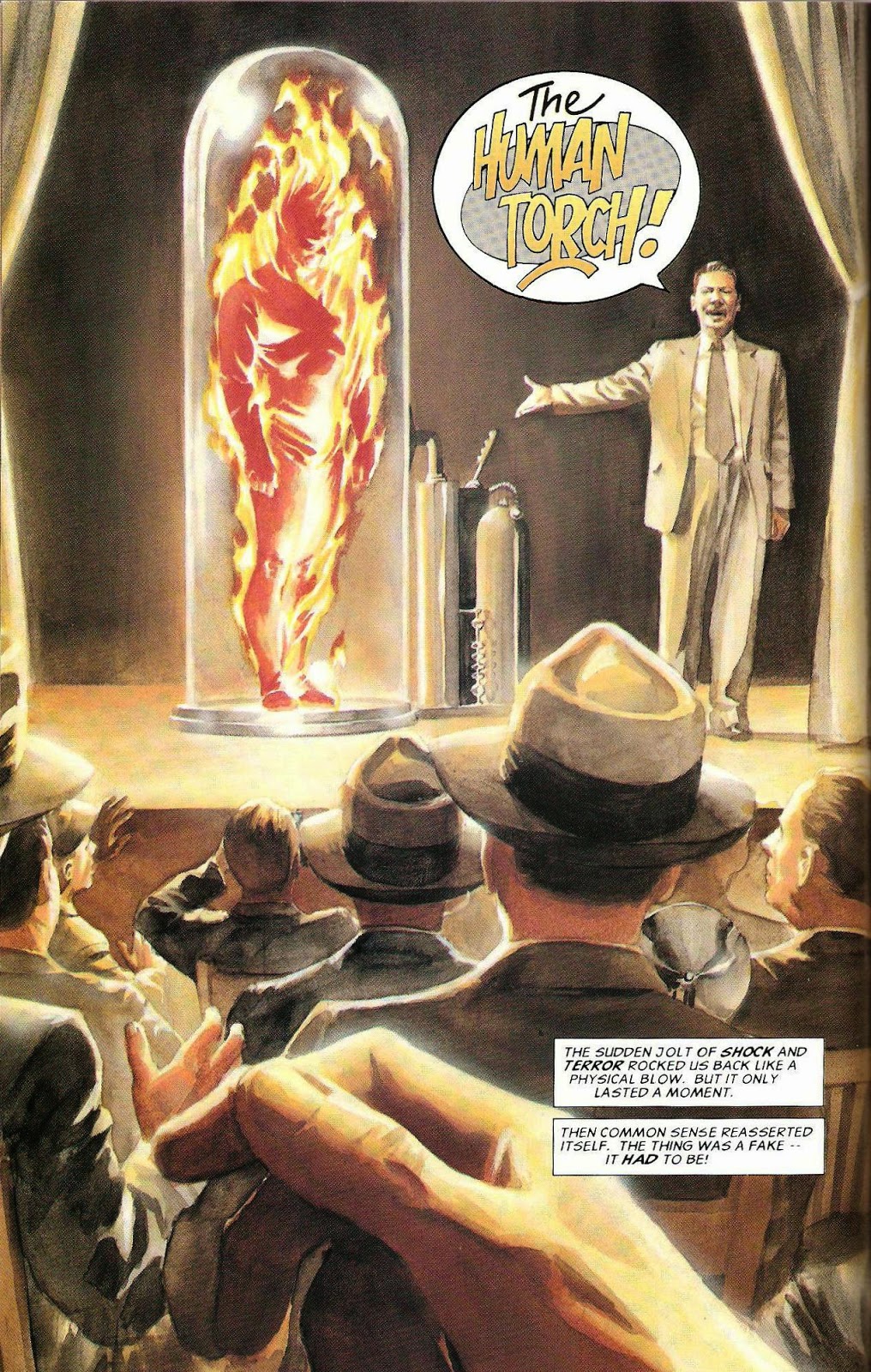
Doug: As I was getting myself mentally prepared for this write-up -- you know, brain calisthenics and such -- I was struck with the notion that this series may have been every bit a part of the 1990s and all that was wrong with it. I don't mean that in the sense that this was a sub-standard story (as much of the 90s was filled) or that the creators were "trendy". Instead, I was thinking about the format. You'll peek back to the top of the post and see the cover date was the very beginning of '94 and I'm wondering if this book was the first to sport a "premium" cover (not a variant, but a fancier material)? If you've never owned the periodical version of this story, you may not know that each issue featured a full-page painting by Ross (in today's case, of the Original Human Torch) layered over by an acetate cover that featured a black printed border with the appearance of die-cut lettering at the top. Of course numerous knock-offs ensued -- lots of painted books, and Marvel copied itself with the acetate overlays for a couple of issues in the big "Atlantis Attacks" annuals cross-over.

Karen: I'm using the hardback edition from 2008, which includes Marvels #0 as well as numerous sketches, promo art, and photo references. I nearly forgot about the goofy acetate covers! Before I started reading I tried to recall my mindset at this particular time. I was only buying comics occasionally, having a hard time getting back into regular series. Like many other people, my mind was completely blown by Alex Ross' art. I couldn't believe he was painting comics! The absolute realism of it all sucked me right in. And Kurt Busiek's history wrapped up in an everyman tale was handled masterfully.

Doug: I am reading from the trade paperback that has Giant-Man on the cover -- not sure of the year, but it also includes the Torch story from Marvels #0 (which I just love). Hey, how exciting was it when the Torch was spied in one of the early scenes of Captain America: The First Avenger? Anyway, I really don't remember how or why I bought the first issue, but I do recall meeting Alex Ross at a small comic show near O'Hare right after the first issue came out. In fact, he was giving away the promo poster for the series, which featured the cover of Marvels #2 (the Angel taking flight). I had a nice chat with him, and he autographed the poster; it still hangs on the wall of my comic room. I agree about Busiek's script -- there is just so much detail! No way this was done "Marvel method" -- Ross must have received exhaustive notes from Busiek. Of course, knowing Alex's appreciation for comics history, I am sure he had a mighty hand in the plot and execution of this story.


Karen: There are so many things we could talk about here, just with the first issue. Of course, through-out the series we are peppered with cameos, of both celebrities and sort of displaced comic book characters. I just love getting to see a very young J. Jonah Jameson as a beat reporter back in 1939, already annoying everyone around him.
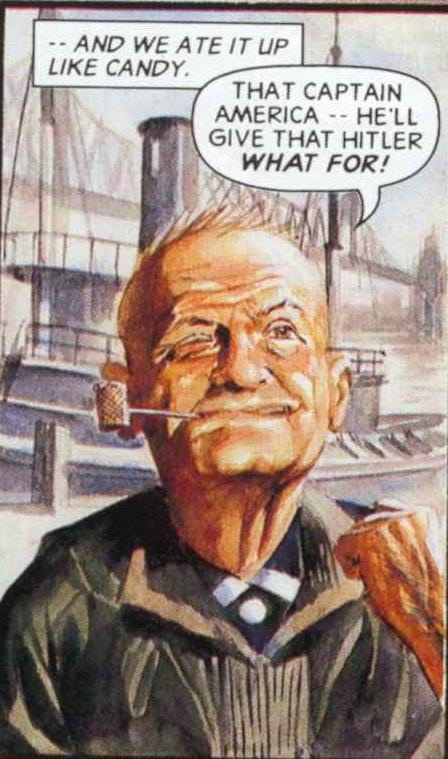

Doug: I am pretty certain that ol' JJJ is never named in this story. I can check again, but I made a conscious effort when reading this last week to see (because my memory told me that on previous readings he had not been identified). But of course we all know who he is. I thought it was a nice homage to Marvel in general to make Martin Goodman the publisher of the Daily Bugle. And Ross's depiction of Goodman was spot-on. I also enjoyed the cameos in this first issue, including Clark Kent and Lois Lane, and what looks to be a very young Billy Batson peddling newspapers. Those sorts of "Easter eggs" really made this a visual treat on top of your aforementioned praise of Ross's realistic paintings.

Karen: You're right, JJJ is never named as such, but that haircut, the mannerisms, little phrases ('when I run the Bugle') -it's pretty much obvious, and delicious. But Busiek makes him more than a caricature; JJJ earns his stripes, chasing down stories and facing the catastrophes these 'Marvels' bring. It actually provides some depth to his later hatred of Spider-Man and other super-heroes, if you consider he saw Namor nearly drown all of New York! Two other notable cameo appearances are Popeye (why?) and a young Nick Fury, not in the war yet. I like how Ross draws him with a shadow over his left eye. Another great Easter egg of a sort is Ross' homage to Edward Hopper's 'Nighthawks' painting when Sheldon and JJJ have a run-in with the Torch late one night.


Doug: Of course the story also had a few "weirdities", such as Namor prancing around in his birthday suit. I have a reprint of Marvel Comics #1 (which actually reprinted the Crown Prince's first appearance from Motion Pictures Funnies Weekly) and the Sub-Mariner was wearing his trademark trunks throughout. So in spite of a heaping helping of his naked butt, I did enjoy the way Ross drew his ankle wings. They were huge! And c'mon -- if they actually were going to be used for flight, they'd have to be larger than the way we've generally seen them depicted. The panel where the Torch engages Namor and they wrangle over a steel girder is a lot of fun, and I've always loved the 2-page spread of the tidal wave crashing onto New York with a tiny Human Torch streaking across the top of the image.

Karen: Yeah, naked Namor...I did a little research and came back empty handed, so to speak. I couldn't find anything from Ross that indicates why he chose to do that. I suppose the logical conclusion would be that someone living underwater wouldn't wear clothes. But it did surprise me when I first saw it. Interestingly, in the back of my book, hand-written next to some of the sketches for Namor it says 'Freddie Mercury' but I don't think he wound up looking much like Queen's lead singer in the finished product.

Doug: Busiek did a solid job of making Phil Sheldon an interesting protagonist. I think his point-of-view is very believable, as an ordinary man who has come through the Great Depression with a renewed optimism, yet distressed at the coming events in Europe. But the arrival of the "Marvels" makes him feel small, and insecure as a man. His worry about being able to protect his loved ones, and whether it is wise to even consider bringing children into such an unsettled future drew me in. But his reverence for Captain America was noteworthy. As remarked in the story, he was "one of ours", and that set him apart from the Torch and Namor. 

Karen: The American public, ever fickle. It was completely believable to me that the crowd was swayed by the newsreels to suddenly accept the Torch and Namor as "our" boys. And then Captain America come on the scene -so big and strong, perfect chin, wrapped in the red, white and blue -well, he was manufactured to be The American Hero. Don't get me wrong, from childhood to now, I've loved Cap and that sense of honor, justice, morality, all the qualities that made Steve Rogers a hero regardless of the Super-Soldier formula. But let's face it, he was a pre-fab hero, before there was even a Madison Ave marketing racket to push him out. 

Doug: I think in Busiek playing up the hot/cold aspect of the crowd he was playing along with a trope Stan Lee had used throughout the Silver Age.

Doug: So you're saying Cap was a forerunner of the Monkees? 


Karen: Ha! You and I have been doing this so long, we're so in synch -I almost said "like the Monkees!" But yes, the way Cap is built up for the public, it's PR at least, propaganda at worst. Phil Sheldon's concern over both the war in Europe and the rise of the super-beings is understandable. But his decision  to delay marrying his girlfriend Doris -I don't know, maybe because I'm a woman, it all seemed rather foolish. The idea of having to "protect" her, and not being able to do that in the face of these new beings, diminishing him, making him unworthy -he really had an inferiority complex going on here! Not that it's an impossible reaction but it seemed a bit like he was running away to me.

Doug: I agree that Sheldon seemed off base with his line of thinking. Why wouldn't he feel better about protecting Doris if he had married her and could be around her more? You know, above you talked about how quickly the crowd turned, but Busiek does a nicely subtle job of showing really how their world turned. At the beginning of this first issue Sheldon remarked how they'd beaten the Depression and how everyone's spirits were up -- they were invincible. Yet just a few months later Hitler had become a serious focal point in all their lives, and the advent of the Marvels complicated life even more. I think Steve Martin's album "Let's Get Small" could have been a mantra. But hey -- if Phil hadn't decided to abandon Doris, we'd have not had the pleasure of being introduced to Willie Lumpkin!

Karen: I did smile when I saw Willie Lumpkin -or 'Bill.' And hey, Mickey Rooney was in the theater audience too.

Doug: Alex Ross flirted with racism just enough to really give some of the war scenes a bit of Golden Age authenticity. His depiction of the Japanese soldier bordered on caricature, but stopped short of crossing that line. Busiek did include the term "Japanazi", which again was a nice throwback to a different time.


Karen: Was "Japanazi" a term that people actually used back during the war years? I've often wondered if it was something made up in the comics... I don't know if I've seen it anywhere else. ...OK, I looked it up and apparently it was a term used on war posters of the time period (I saw a few, including one with Popeye), so I suppose it's legit.

Doug: I have all of the Fleischer Superman cartoons on DVD, and I think the term is used somewhere in those. But I could be misremembering (that's so Brian Williams...). So what did you think of that last scene -- the assault on the Nazi stronghold? Sort of made the Invaders look like the minor leagues!

Karen: It's a breath-taking scene! I love the high, overhead angle -I know we've talked about Ross overdoing it recently on some covers with the odd angles but this one really works for me. I could identify eight of the ten heroes but had trouble with two of them. The ones I recognized were Cap and Bucky (and this Bucky is quite obviously a kid, being carried by Cap the way he is), Namor, the Vision, the Destroyer, and the Black Widow (none of these three related to the later Marvel versions), the Blazing Skull, and the two Torches. From the reference section in the back of my book, I found the identities of the other two: the Thunderer and the Black Marvel. These are some pretty cool-looking cats. More appealing than most of the Liberty Legion! I know some of these characters have been brought into current or recent books, like the Skull and original Vision.

Doug: Yes, Ross's depiction of the very young James Buchanan Barnes does fly in the face of Ed Brubaker's thoughts on the character's age during the war. Personally, I always thought of him as Ross does. However, I fully accepted that he must have been closer to 16 in the Liberty Legion story that ran through Invaders #s 5-6 and Marvel Premiere #s 29-30. And in regard to the coolness of those Golden Age heroes: I have so tried to get into that material but it's just so difficult. The art and the stories are so crude as compared to the stuff we focus on (late 1960s-mid 1980s) that I just can't do it. I've several times been ready to pull the trigger on the Golden Age volume in the Marvel Firsts series but have always talked myself out of it.

Doug: In our next installment, we'll delve into Marvels #2 and the dawn of the Silver Age! No promises when that will be, but this has been fun getting back into the "what we do around here" of comic reviews.

Tuesday, February 17, 2015

Monday, January 19, 2015

BAB Firsts (the 1st Versus): Who ya Got? Kang the Conqueror or Ultron?


This post was originally published on February 17 2010

Doug: The New Year brings with it some new features here on the BAB blog. Today we'll begin a semi-regular series called "versus", where we'll pit two opposing yet similar entities against each other -- not in some faux battle, but more along the lines of who we've liked better, why one is better than the other at "X", and so on. Today it's the two greatest nemeses of the Avengers, but who knows? Next time it could be Elton John versus Billy Joel! Maybe later it'll be Karen's favorite baseball player versus my nominee. So let's get on with the debate.

Doug: I guess any discussion like this can't help but start with one's personal preferences -- hey, throw objectivity out the window! So I'll begin by saying that I like the "Celestial Madonna" storyline better than I like the "Bride of Ultron" (but close -- how does one choose between two masterpieces?) -- those would be my favorite Avengers stories involving these two do-badders.
Karen: Well, you already know I'm biased! I mean I did write a whole article on Ultron for Back Issue! (on the shelves now! -Doug). Both Ultron and Kang are great adversaries for the Avengers, but I give the edge to the mad robot because of the emotional response he always evokes from the team. He's definitely the black sheep that no one wants to talk about. The son of Hank Pym, father of the Vision, and he's tried to make wives out of both the Wasp and Mockingbird. There's a lot of twisted history there! On top of that, throw in indestructible adamantium skin, and you've got a heck of a threat.

Doug: Yeah, I wouldn't discount any of that, and I would never say that I don't like Ultron. I don't know... there's just something about Kang, time travel, and the possibilities. I will admit that I've read some bad Kang stories -- the "Council of Cross-Time Kangs" that ran in the Avengers #290's didn't do much for me. I think the intent was good, and there were some good elements, but overall I didn't like it.

Doug: I really like "Celestial Madonna" 1) for the scope of it and 2) for the little extras: the Legion of the Unliving (good Kang add-on), the origin of the Vision, as well as the origin of Mantis. Kang's certifiably maniacal, he has an interesting goal, and scribe Steve Englehart executes a grand tale. I'll admit that the story ends on a clunker in GS Avengers #4 when Kang is ridiculously shoe-horned back into the story, but there's redemption in the pages of the "Serpent Crown Affair" that ran shortly thereafter. Kang's the star of the substory involving the Wild West heroes and Hawkeye, Thor and Moondragon, and meets a memorable end in combat against Thor. Really good stuff, with art by a young George Perez.

Doug: I'd be remiss if I didn't give a shout-out to two fine Kurt Busiek stories -- the "Kang Dynasty" and Avengers Forever. Although Perez was not along for either ride, the art in both stories was ably handled by Ivan Reis, Brent Anderson and Keiron Dwyer and Carlos Pacheco (respectively). While "Kang Dynasty" is a bit long (I believe 16 issues total), either would be recommended as two latter-day Kang classics.

Karen: Kang has given Earth's Mightiest a huge heaping of trouble time and again (no pun intended). Doug, you know I am also a fan of the "Celestial Madonna" saga, and it was fascinating how Englehart explored the different identities of Kang -how he connected Kang, Rama Tut, and Immortus. That's one of the cool things about time travel stories: you have endless possibilities to play with.

Karen: That being, said, I think I can toss out some of Ultron's greatest moments here and find that they measure up nicely. I think his rebirth as an adamantium-coated nightmare in Avengers 66-68 is a great early example of just how devastating he could be. The "Bride of Ultron" storyline upped the ante quite a bit; now, instead of just wanting to kill Pym, we saw Ultron also wants to supplant him and take what is his - his wife! Disturbing on a lot of levels, and it certainly left the Avengers shaken.

Karen: But Kurt Busiek -funny how that name has popped up again, isn't it? - came up with the most dangerous and devastating Ultron story yet, "Ultron Unlimited", in the third volume of Avengers. Not only does the maniac take over an entire nation, slaughter its people and turn them into cyber-zombies, he kidnaps five Avengers with plans to use their brain patterns to create an entire android race under his dominion! The remaining Avengers have to battle their way through hundreds of Ultrons to get to the true villain, giving Thor a chance to utter the famous line, "Ultron, we would have words with thee." Besides the thrilling battles, we also learn a startling fact, one that makes absolute sense, of the kind where you slap yourself in the head and say, "Of course! Why didn't I see that before?" It is revealed that Pym used his own brain patterns when he created Ultron - in effect, Ultron really is Pym's son, he has a piece of him inside him. No wonder these encounters always weighed so heavily on Pym - Ultron's actions were reflecting something inside of Pym!


Doug: That Thor line you cited is one of the all-time greats! You're making a great argument here -- were you a lawyer in a former life?? But seriously, let's evaluate: both characters have evolved through different incarnations involving technology as well as personality, both have taken on Avengers teams showcasing line-ups that could truly be called Earth's Mightiest Heroes, both have raised some serious Cain on the Earth in terms of destruction, human casualties, etc., and both seem to keep popping up every few years. You could argue, too, that Kang's constant pining after Ravonna creates a love interest somewhat akin to Ultron's quest to make himself a complete man/robot by fulfilling that need with Jocasta, etc. Kang and Ultron are head and shoulders above any other nemesis the Avengers have faced, based on longevity alone!


Doug: So if our faithful followers determine that your argument was stronger, should I feel badly? Negative -- because in this "versus", could one really go wrong on a rainy day with a stack of comics featuring either super-baddie?
Related Posts with Thumbnails