Doug: Today is known as "Black Friday" here in the States, so in honor of that, let's discuss some more of our favorite longjohn types! And as a sidenote, it took me years to fully grasp the concept of "black" in "Black Friday". As a history guy, I was always stuck on "Black Tuesday", that day in 1929 when the stock market crashed and the Great Depression began. Ironically, the "black" in "Black Friday" also has to do with money, but in the opposite way -- Black Friday signifies the beginning of the Christmas shopping season, a time when retailers should see their balance sheets shift over from the "red" to the "black". Whoo... don't know if anyone else needed that lesson, but I'm glad I finally figured it out! Now, on to the comics!!
Showing posts with label Black Talon. Show all posts
Showing posts with label Black Talon. Show all posts
Friday, November 28, 2014
Who's the Best... Character With "Black" in His/Her Name?
Doug: Today is known as "Black Friday" here in the States, so in honor of that, let's discuss some more of our favorite longjohn types! And as a sidenote, it took me years to fully grasp the concept of "black" in "Black Friday". As a history guy, I was always stuck on "Black Tuesday", that day in 1929 when the stock market crashed and the Great Depression began. Ironically, the "black" in "Black Friday" also has to do with money, but in the opposite way -- Black Friday signifies the beginning of the Christmas shopping season, a time when retailers should see their balance sheets shift over from the "red" to the "black". Whoo... don't know if anyone else needed that lesson, but I'm glad I finally figured it out! Now, on to the comics!!
Monday, January 14, 2013
BAB Classic: The Comics Code Authority: Revised to Relax, Part 3
“At Last: The Decision!”
Gerry Conway, Jim Shooter, Steve Englehart-George Perez and John Tartag
Avengers #152 (October 1976)
“Nightmare in New Orleans”
Gerry Conway (Englehart plot)-John Buscema and Joe Sinnott
NOTE: This post was originally published on July 24, 2009.
Doug: We’re back, with another look at Marvel’s expansion of formerly no-no characters and/or characteristics, as laid down by the Comics Code Authority from the mid-1950’s to the early 1970’s. In this installment, we look at the return of Wonder Man to the Avengers – but not in the Superman form he’d shown waaaayy back in Avengers #9. Nope – this time, he was a zuvembie!!
NOTES: The zombie-like Zuvembie has the power to control her victims. She places them in a dream-state then commands them. Once in her midst she likes to chop them with hatchet and drink their blood. (http://www.gwthomas.org/zuvembie.htm)
Doug: Over at The All-New, All-Different Howling Curmudgeons blog, there was a nice conversation about this topic. Rather than cut-and-paste their discussion, I’ll leave it to you, the reader, to explore on your own (it really is good stuff to help us along here!!): http://www.whiterose.org/howlingcurmudgeons/archives/011063.html
Karen: I’ve read that Roy Thomas came up with the term “zuvembie” when Marvel did Brother Voodoo in Strange Tales (a few years before this story). It makes sense, since Thomas is such a REH buff.
Doug: So now I am wondering when Marvel started to produce new material featuring Simon Garth, the Zombie? How does that dovetail with this Wonder Man story? According to The Appendix to the Handbook of the Marvel Universe (a site chock full of fantastic history!) (http://www.marvunapp.com/Appendix/), the Zombie’s first appearance was in Menace #5 back in 1953; he was seen next in 1973 in Tales of the Zombie – but that was a Marvel B&W magazine and outside the confines of the Code! But did the Zombie not see the light of four-color day? To the best of my knowledge, Simon Garth does not cross over to the Marvel Universe until Daredevil Annual #9 (1993).
Karen: There’s a fun interview between Stan Lee and Roy Thomas in Comic Book Artist #2, where Roy explains how Stan wanted to add more monster mags to the Marvel line, and came up with titles (Vampire Tales and Tales of the Zombie), but no content! In order to fill the magazines, Roy had to act quickly. He had seen that zombie story in Menace by Stan and Bill Everett, and used that as the genesis for the Zombie. Roy apparently came up with the “Simon Garth” name and idea, and then handed it to Steve Gerber to write.
Karen: Oh, Black Talon. What a terrible get-up. He looks like an evil Foghorn Leghorn.
Karen: I have to say, Avengers sure had a lot of fill-ins around this time. It was aggravating.
Doug: Issue #152 features a trip to New Orleans to discover the reason Wonder Man is alive.  More than that, I was really preoccupied with the upgrade in Wanda’s powers. She seems like a cross-section of Marvel Girl and Zatanna. Her probability-altering powers have been replaced by powers of clairvoyance/discernment, and of “hexes” that generate force. While I thought Gerry Conway wrote everyone “in-character” (why do I feel the need to keep bringing that up today?), it’s a darker Vision we see with the presence now of a revived Simon Williams – whose very brain patterns form the basis for the Vision’s artificial mind.
Karen: Bringing back Wonder Man was a nice way to unsettle what had become a comfortable existence for the Vision. He began questioning his identity all over again.
Doug: The villain du jour is a voodoo priest named the Black Talon – one of many African-American characters created in the 1970’s to bear the name “Black” (Black Lightning, Black Goliath, et al.). He doesn’t get a lot of screen time, and proves to be not much of an obstacle against the Avengers. He summons some dark god, and refers to another whom he (and Wonder Man) serves. The story basically ends with not much resolved, other than Wonder Man is not the only zuvembie.

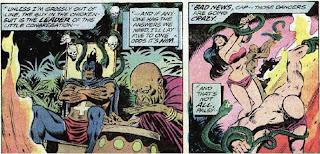
Doug: So, the verdict on the living dead walking once again among us? That’s just it – there are plenty of walking dead in this story, and I would guess they had been around in other books around this time. Does changing the name from zombie to zuvembie lighten the load? I would say no, and then ask what the big deal was. As we mentioned earlier in our posts on the Man-Wolf, Marvel in this day never really delved into the ramifications of just what a creature like a werewolf or a zombie would do, or mean, or how they would behave, etc. It seems they are more for exploratory purposes at this point, and not for deep introspection by the writers.
Karen: It’s particularly amusing when you consider how many zombie titles are on the market now. To the best of my knowledge, none of the zombies – or zuvembies – in the books we’ve talked about were flesh-eating ghouls. In fact, they were probably not much different from the Frankenstein Monster, who had been appearing in Marvel books for years! The Code was essentially unnecessary at that time for Marvel, as they did a good job of policing themselves. Stan had set certain standards, and at least at that point in time (the mid-1970s), Marvel was standing by them. I wonder what Stan would make of a book like Marvel Zombies?
Subscribe to:
Posts (Atom)