Although John
Cooper-Clarke's caustic brand of "talking in tune" initially earned
him the label of the new wave George Formby, he soon won recognition as the
British punk scene's poet laureate. Following the Innocents EP and the 1978
album Où Est la Maison de Fromage? (Both on Martin Hannett's Rabid Records), Disguise
in Love was Clarke's major-label debut. This album finds the Manchurian bard at
his adenoidal, alliterative best, delivering some of his more memorable
satirical verses. Fixated on the daily, warts-and-all miseries of life in post-war
Britain and beyond, Clarke casts a wide misanthropic net, taking on everything
from track suits to extraterrestrials. The Invisible Girls (featuring Bill
Nelson, Pete Shelley, and Martin Hannett) provide musical backing that
complements each poem, from a minimal, heartbeat-style jogging groove
("Health Fanatic") to a cheesy disco pastiche ("Post War Glamour
Girl"). Clarke's performance works well with these arrangements,
especially on "(I Married A) Monster From Outer Space" (a story of
intergalactic love gone wrong set to sci-fi electronics) and "Readers'
Wives," on which lurid observations on D.I.Y. Polaroid porn are adorned
with an appropriately kitschy soundtrack. Clarke's ear for the rhythms of everyday
language and his galloping, sometimes staccato delivery can be best appreciated
on two unaccompanied pieces: "Salome Maloney," an apocalyptic tale of
ballroom dancing and death, and "Psycle Sluts 1&2," an
amphetamine-paced paean to biker women praised by Frank Zappa as an example of Clarke's
"exquisite diction." While it's a testament to Clarke's comic
sensibility that these tracks remain laugh-out-loud funny, it's also important
to recognize him as an innovator. Just as pop writers like the Mersey poets
made Clarke's work possible, so Clarke opened the doors for numerous
(less-talented) ranters and popular wordsmiths such as Attila the Stockbroker, Joolz,
Seething Wells, and Benjamin Zephaniah.
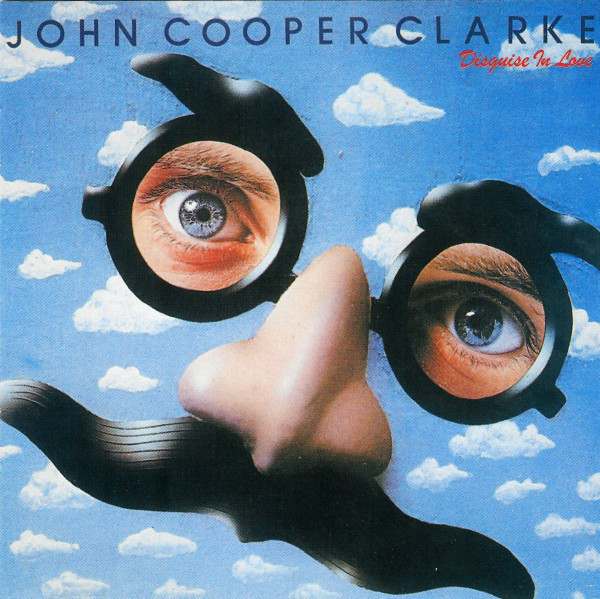
For
many, the decision on John Cooper Clarke still rests on the combination of
words and music. People who remember the singles and who've copped listens of
this album have complained that the music gets in the way of Clarke's dazzlingly inimitable wordiness.
This is crap, not just because solo Clarke is too dry in repeated and large
doses but because the music on this album is FUNNY!
This
album could be the perfect Eno-song album. The eleven poems - two unaccompanied
and nine soaked in cool electronic shuffles, soothed by pretty mechanical
patterns - are suffused with an erotic intensity and gossamer fragility that's
really convincing. They are laid over short, evocative aural landscapes that
include 'coitus interruptus' dub effects, voice treatments, echoes, whimsical
little melodies, overlapping rhythms, layered guitars, spacey bass and silly
sound effects.
The
music itself is put together by a number of experienced Manchurian hands.
Martin (Zero) Hannett, a brand new whizz kid of the mixing board who has
produced two of this decade's classics in “Spiral Scratch” and “Jilted John,”
produces the album and composes the music with a guy called Hopkins (blowed if
I can remember his christian name). Guitarists Peter Shelley and Bill Nelson
are known to have contributed. The 'compositions' are executed with much
humour, insensitivity and craft. The record is produced for Rabid
Entertainments, which should give you some idea of the way to approach it.
Lopsided. John Cooper Clarke and friends are making machine music and telling
us to go get stoned.
The
likes of Clarke's verbal virtuosity and dexterity had been unknown since that
great eccentric, aristocrat and surrealist Edith Sitwell. He has an exquisite a
sense of the trivial as Henry Green's; his words are as energetic and as sick
as Evelyn Waugh's. There is both the concentration on evil and seediness of
Graham Greene and the continual sense of his own inadequacy that he shares in
some ways with Philip Larkin.
Clarke
is a poet who reports from the dusty, mediocre, useless and distasteful corners
of real life. Thugs, sluts and flabby flesh. Inadequacy, revenge and the
grimness of the sexual experiences. All political, religious, sociological and
psychological implications are not incidental. His poetry is brilliant: verse
not as poetry (which is produced under the kind of pressure that 'cannot' be
faked) but as devious and didactic criticism. And his poems tell stories.
Side
one starts with a bang. The exuberant northern wit of “I Don't Wanna Be Nice”
sounds like Eno producing The Slits. It features the first definitive Peter
Shelley solo since “Friends Of Mine” at the Doncaster Outlook mid-77, even if
it was played by Bill Nelson. Five minutes of the maniacal “Psycle Sluts 1
& 2” follows: alliteration, spit, protruding imagery, breathlessness, the
glorious rhythmic energy of the unaccompanied John Cooper Clarke.
The
small fun of “(I've Got A Brand New) Tracksuit” combined with the meticulous
Eno-cum-Diddley structure adds up to major fun, which in itself proves the
worth of the comic musical settings. The fun-highbrow music intensifies the
words' hilarity so that, like the best comedy albums, it can be played again
and again.
Side
one finishes with a run of Clarke's better poems. “I Was A Teenage Werewolf”
has a marvellous hook, “Readers Wives” is a classic observation, has the
lushest Eno parody and so is therefore best cut on the record, and “Post War
Glamour Girl” is the single.
Side
two opens with “(I Married A) Monster From Outer Space,” set inspirationally to
gratuitous electronic weirdness, with Cooper Clarke's quivering voice echoed
for more unpredictable atmosphere. The next piece is again a dry unaccompanied
burst, a frantically detailed piece of trivia about ballroom dancing no doubt
dedicated to Eric Morley my younger brother. The unmistakeable message of
“Health Fanatic” has snug Eno-electronic support and a hilarious dub-coughing
playout. The tragi-comic “Strange Bedfellows” is tearful and mechanical
featuring an ice cold Bill Nelson solo that may well be by Peter Shelley. And how
else to finish but with a flattened soft-soul smooch to back up a gentle lament
for the trapped middle-class middle-aged woman in “Valley Of The Lost Women.”
Just to unsettle you, it drifts into the distance with casual despondency. Side
two finishes with a whimper.
Cooper
Clarke resolutely avoids the serious and the sentimental for the grotesque and
the irresistible. He is a gifted and zestful perpetrator of sardonic morality.
The deadpan choice of music (right at the beginning of '77 the plan was to have
poetry backed by Tom Waits-type cocktail or tinkling) is inspired. It's noise
of the times (bland/electronic/disco) for observation of the times, as suitable
in context as Jim Parker's swinging nostalgia arrangements for John Betjeman's
slight poems on the poet's
Charisma
albums, nasal and lazy. The problems of how to handle John Cooper Clarke on
record, away from the advantageous atmosphere of a live recital, have been
handled triumphantly. Clarke leads two separate lives. If you really are
worried about muzakle interference - don't. The music is cute and all integrity
is retained.
The
'familiar world' is cruelly, gaily or sadly dislocated. After you've played
this record, what do you do? (EJACULATE!!) and start all over again.
Paul Morley