Showing posts with label Soundtrack. Show all posts

Saturday, 4 April 2026

Various Artists - The Crow Soundtrack

The 1994 soundtrack for The Crow is widely regarded as a foundational 90s time capsule that masterfully mirrors the film’s brooding, gothic atmosphere. By rejecting standard radio hits in favour of original compositions and unique covers, the album creates a cohesive, "rain-soaked" sonic landscape that blends industrial, grunge, and dark alternative rock. Standout contributions like The Cure’s "Burn" and Nine Inch Nails’ visceral cover of "Dead Souls" are frequently cited as career highlights for the artists, while Jane Siberry’s "It Can’t Rain All the Time" provides a haunting emotional anchor. While some critics find the mid-album industrial tracks occasionally repetitive or the overall sound a product of its era, the collection remains a three-time platinum success that continues to set the bar for narrative-driven film curation.
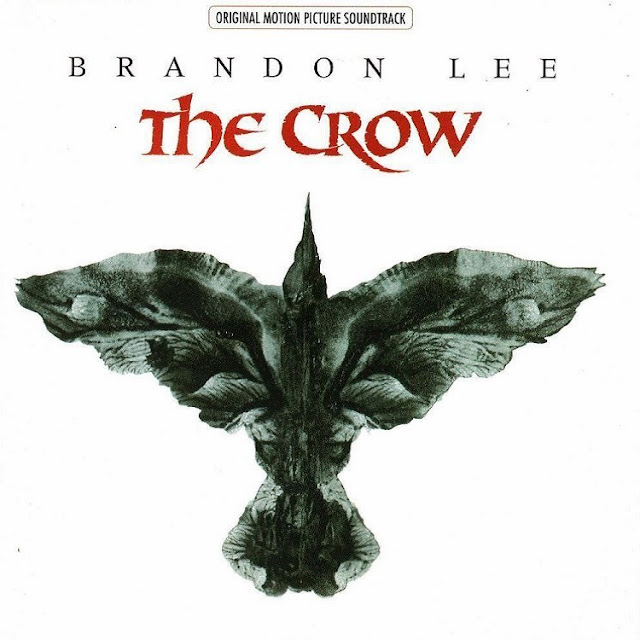

Directed by Alex Proyas, The Crow (1994) is a seminal gothic action-fantasy film that transcends its origins as a comic book adaptation to become a hauntingly beautiful urban fairytale. Set in a decaying, rain-soaked Detroit, the movie follows Eric Draven, a rock musician who is resurrected by a mystical crow exactly one year after he and his fiancée were brutally murdered. It is a visceral exploration of grief, vengeance, and the idea that true love is stronger than the grave, brought to life through a noir-inspired aesthetic and stylized, poetic violence.
At the center of this dark masterpiece is Brandon Lee, who delivered a mesmerizing and career-defining performance as the tortured anti-hero. Lee imbues Eric Draven with an uncommon vulnerability and soulful intensity, balancing quiet fury with moments of ebullient wit and deep compassion. Critics frequently note his remarkable physicality and charismatic presence, suggesting he was a rising star on the verge of superstership akin to icons like Keanu Reeves.
Tragically, the film's legacy is forever inseparable from Lee’s death, caused by a negligent on-set shooting accident just eight days before production wrapped. His passing at only 28 years old turned the film into a somber testament to his talent and a cult classic that feels as though "art imitated death". Completed using pioneering CGI and stunt doubles, the finished product stands as a fitting final tribute to an artist who died escaping his father's shadow.
The accompanying soundtrack serves as the perfect auditory companion, acting as a sonic time capsule of the 1990s alternative rock and industrial scenes. By prioritizing original compositions and unique covers over established hits, the album achieves a rare atmospheric cohesion. Standout tracks like The Cure's "Burn" and Nine Inch Nails' cover of "Dead Souls" are considered essential cuts of the era, while Jane Siberry's "It Can't Rain All the Time" provides a haunting emotional anchor for the film’s themes of hope amid tragedy.
Thirty years later, The Crow remains a visually distinctive landmark in cinema that continues to influence fashion, music, and the darker tone of modern superhero adaptations. While sequels and remakes have followed, none have matched the singular impact or emotional resonance of the 1994 original. It is more than just a revenge thriller; it is a poetic and enduring reminder of Brandon Lee’s brilliance and the timeless power of undying love.

Various Artists - Pump Up The Volume (Soundtrack)

In a sense, Pump Up the Volume was the second in Allan Moyle's Disillusioned American Youths trilogy, released ten years after the new wave runaway drama Times Square and five years prior to the truly horrid record shop angstfest Empire Records. Like Times Square, and to a somewhat lesser extent Empire Records, Pump Up the Volume's major players are music obsessives who immerse themselves in rock groups that float away from the mainstream radar. In this case, the protagonist is pirate radio DJ Hard Harry (Christian Slater), a hyper-hormonal high-school student who takes great delight in playing the likes of Leonard Cohen and Sonic Youth for his audience of confused, angst-ridden schoolmates. The soundtrack reflects much of what is played during the movie, including Soundgarden's pre-fame "Heretic," Concrete Blonde's version of Cohen's "Everybody Knows," the Pixies' "Wave of Mutilation (U.K. Surf)," and two songs that deal with the movie's theme of censorship, Above the Law's "Freedom of Speech" and Bad Brains' (with Henry Rollins) cover of the MC5's "Kick Out the Jams." Unfortunately, Was (Not Was)' delightfully perverse "Dad I'm in Jail" is excluded, as is Nora Diniro's lusty ode to Hard Harry ("Jam me, jack me, push me, pull me," etc.). At any rate, the Pump Up the Volume soundtrack works well for those who want a decent snapshot of early-'90s alternative music. And if you're feeling nostalgic for that frustrating period of your life when you looked like Christian Slater but couldn't get any girls to pay attention to you, it works equally well.

Various Artists - Atomic Blonde

Atomic Blonde is a violent, neon-drenched pleasure romp. Charlize Theron is in her finest action form as an ass-kicking MI6 agent who can crack a man’s skull in — or sometimes with — a fine pair of heels. But her best accessory? The film’s killer soundtrack, a mix of ‘80s synthpop that elevates it above typical action-genre fanfare. With every superbly choreographed move Theron takes, there is an equally perfect song added for garnish. The film leans into its 1989 setting by collecting some of the best songs of the decade, then unleashing them at the most unexpected moments. Nena’s “99 Luftballoons” is the background track for a brutal interrogation; ‘Til Tuesday’s “Voices Carry” becomes a ballad of tension as two characters struggle for their lives. Not a single song in the film feels like a whiff, whether it’s David Bowie / Queen’s “Under Pressure” or Depeche Mode’s “Behind the Wheel.” Atomic Blonde relishes cheeky use of diegetic sound. Theron uses George Michael’s “Father Figure” to give herself a noisy cover when she finds herself pinned down in an apartment. Other scenes see characters blasting the scene’s music from their radios, only for the track to cut at the most dramatic moment. There’s a defiant, synthpunk feel to Atomic Blonde, from the spray paint-style on-screen captions for time and place to Theron and James McAvoy’s equally stylish hairstyles. But it’s the film’s soundtrack that truly reveals its personality — and makes its best scenes unforgettable moments that will continue playing in my mind on loop.

Saturday, 22 July 2023

Various Artists - Saturday Night Fever

Disco's most popular document was, at the time of its release, also one of its least representative: Saturday Night Fever is disco for straight, white males. A phenomenon 30 years ago, John Badham's B-movie and its accompanying 2xLP soundtrack not only made John Travolta a star, but escorted the music out of gay discotheques and black nightclubs and into the glare of the mainstream. However, it did so by diluting disco's more extreme elements to create a safer, more marketable package. Even then, conservative audiences saw disco culture as a Sodom and Gomorrah rather than an alternative Eden. The recent surge of interest in the era-- specifically in Peter Shapiro's excellent history Turn the Beat Around, but also demonstrated by groups like Scissor Sisters and Franz Ferdinand-- only sets disco's outsider nature, as well as this collection's shortcomings, in sharper relief.