Mostrando entradas con la etiqueta Anthony Marwood. Mostrar todas las entradas

miércoles, 4 de mayo de 2016

Royal Scottish National Orchestra / Martyn Brabbins SALLY BEAMISH Violin Concerto - Callisto - Symphony No. 1

Sally Beamish has enjoyed a productive association with BIS, which now releases three works involving full orchestra. The Violin Concerto (1994) is among her most immediate statements: its three movements, prefaced by quotes from Erich Maria Remarque’s novel about the First World War, All Quiet on the Western Front, proceed from a powerfully rhetorical conflict between soloist and orchestra, via a ruminative “intermezzo”, to a tense finale whose outcome is decisive if far from affirmative. Vividly scored (with some evocative writing for cimbalom), the work is ideally suited to Anthony Marwood’s blend of incisiveness and eloquence – as is Callisto (2005) to Sharon Bezaly’s resourceful flute playing. Here inspiration came from Ted Hughes’s translation of Ovid’s Metamorphoses, Callisto’s transformations being represented by four types of flute and the “celestial beings” of Diana, Jove and Juno respectively by horn, trombone and trumpet – resulting in music by turns capricious, plangent and transcendent.
Yet the First Symphony (1992) leaves the strongest impression here. Beamish’s first work for orchestra is a set of double variations that integrates traditional Scottish bagpipe music with a paraphrase on Psalm 104, the outcome being a seamless though cumulative span that unfolds with truly “symphonic” inevitability. It makes no mean impact in this performance, Martyn Brabbins drawing a committed response from the Royal Scottish National players, who are hardly less attentive in the concertos. Spaciously recorded and with informative notes by the composer, this disc is ostensibly a first port of call for those new to Beamish’s music. (Gramophone)

domingo, 1 de diciembre de 2013

The Florestan Trio SCHUBERT Piano Trio in B flat major, D898 - Trio movement in B flat major, D28 - Notturno in E flat major, D897

Hyperion is thrilled to be able to unite the remarkable talents of The Florestan Trio, deemed by Classic CD as 'among the finest chamber ensembles of the present day', with one of Schubert's greatest masterpieces, the magnificent Piano Trio in B flat major, D898. Of all the large-scale works of his last years, D898 is one that reflects the popular image of the carefree, companionable Schubert, pouring out a stream of spontaneous melody. From its soaring opening theme to the sublimated echoes of Viennese popular music in the finale, the music exudes life-affirming energy.
The 'Notturno' (so titled by the publisher) in E flat was the original slow movement of the B flat trio. Schubert's reasons for its eventual replacement remain unclear, but the work now stands alone most effectively as an entity of sustained melody and tranquillity.
The last work, the single-movement 'Sonate' (the composer's designation) was written when the composer was just 15. He was in self-consolatory mode and D28 was his immediate response to losing his treble voice, and with it his place in Vienna's Imperial Chapel Choir. An early work with apparent influences from Mozart, it is a work of great insight, lyricism and charm that reflect the despondent teenager's determination to lift his spirits.

'This stands out among modern recordings of this fine work [and] the Movement in B flat makes a freshly endearing bonus. This will be hard to beat and one eagerly awaits the E flat major Trio' (Gramophone) 

sábado, 30 de noviembre de 2013

The Florestan Trio SCHUBERT Piano Trio in E flat major D929

The estimable Florestan Trio completes its "cycle" of Schubert Piano Trios with this recording of the E-flat major trio, a performance as wonderfully incisive as its earlier rendition of the trio in B-flat major. While the present recording was made in late December 2001, a full year after the first, Hyperion still managed to secure the services of the same engineer (Tony Faulkner) to work his magic with these terrific players, so there is a uniformity to the sound that is comforting and will smoothly pave the way for a two-disc set at some point. In the meantime, anyone who loves this work may still want to shell out full price for this disc, as it represents Schubert performance at the highest level.
While the Florestan members play with impeccable unity, pianist Susan Tomes still stands out slightly, thanks largely to her amazingly graceful phrasing. Listen to the way she manages a pianissimo in the feather-light background triplets in the development of the first movement while gradually increasing the intensity of the bass line. Of course, her partners are no slouches either. Violinist Anthony Marwood's playful, lilting phrasing of the main theme in the Andante negates any sense of lethargy, and cellist Richard Lester's observance of dynamics (especially in the opening of the first movement) is letter-perfect. Besides the group's over-arching feel for this music, the unanimity of attack and the fastidious, carefully measured attention to dynamics marks their performance as being truly special and consistent with their fine account of the B-flat trio, offering a sort of reference model for avid score readers. For instance, in the second movement, they reserve enough power to distinguish the double- and triple-forte passages in a way that indicates without doubt the climactic moment, even if there is a tendency to want to bang out the earlier accented parts with some abandon.
As a filler item, the Florestans offer the first version of the finale, which was cut by Schubert most likely at the urging of performers and publishers concerned about the length of the work (itself already more than 43 minutes with all the repeats, as presented here). Ninety-eight bars in the development section have been restored, representing two cuts and adding about two minutes of music starting at 6:00 on track 5. Some of it is repetitive (the staccato eighth-note "cimbalom" passages) and while the rest adds some drama to the whole event, it doesn't alter the overall view that its exclusion makes little difference. A case against performing this original version at all is found in the liner notes, quoting a letter from Schubert to his publisher exhorting performers (and the publisher) to "scrupulously" observe the cuts in the last movement. So, to justify this full-price release, the Florestans perhaps had to push their luck and buck their muse's wishes. (Michael Liebowitz, ClassicsToday.com)

miércoles, 20 de noviembre de 2013

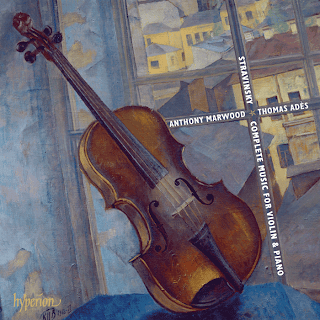
Anthony Marwood / Thomas Adès STRAVINSKY Complete Music for Violin & Piano

Stravinsky’s relationship with the string section of the orchestra, and with the violin in particular, was a love-hate affair. For a long time during and after the First World War he more or less gave up writing for strings altogether, finding their tone ‘much too evocative’, as he put it after completing The Rite of Spring, ‘and representative of the human voice’. Then suddenly, in 1928, he came out with a ballet score, Apollo, written exclusively for strings and uninhibitedly tender and expressive in precisely the way he had previously so pointedly rejected. Apollo seems to have ‘corrected’ his attitude in general, and within four years he had composed two major works for violin solo, the concerto with orchestra of 1931 and the Duo concertant with piano of 1932. Soon after that he made most of the transcriptions recorded here.
Why Apollo turned out as it did is one of the great Stravinskian mysteries. But the violin works that followed had a clear and specific origin. Towards the end of 1930, Stravinsky’s German publisher, Willy Strecker, introduced him to a young Polish-American violinist by the name of Samuel Dushkin and invited him to write a concerto for Dushkin to play and Strecker’s firm, Schott, to publish. Dushkin was a fine, if not great, violinist; but above all he was an intelligent and cultivated musician who it transpired could give Stravinsky—not a string-player—sympathetic advice on technical matters. After the premiere of the Violin Concerto, in Berlin in October 1931, Stravinsky began work on a recital piece for violin and piano which he and Dushkin would be able to programme without all the expense and paraphernalia of orchestral concert bookings. There were undoubtedly complicated motives behind the Duo concertant, as the new work would be called. Dushkin had an exclusivity on the concerto for a certain period, but after that there was no way of forcing agents to prefer him to other, more famous virtuosos, with whom, on the other hand, Stravinsky (who was desperate for concert engagements) might not want to work. A recital, by contrast, could be offered as a package. Their first appearance in this form was in Milan in March 1932. But it was at once apparent that joint repertoire would be a problem. They played the concerto (with piano), and a suite Stravinsky had made from the ballet Pulcinella in 1925. But otherwise they played solos. Stravinsky had no interest in performing the standard duo repertoire. His own Duo was not yet ready and even if it had been they would have had barely fifty minutes’ music. How to remedy this crucial problem at a time when concert bookings were falling, politics and economics were starting to close in on orchestral planning, and Stravinsky needed to make the most of his personal notoriety and the relative popularity of his best-known works?
The answer he and Dushkin came up with is to be found on the present disc. Soon after the Milan concert Stravinsky wrote to Strecker that the two of them were at work on what he called ‘un joli Kammerabend’—a pretty chamber-evening—of violin pieces, including of course the Duo concertant, together with transcriptions of pieces from Petrushka (the ‘Danse russe’) and The Firebird (the ‘Berceuse’), and a completely new suite from Pulcinella which he christened Suite italienne. Later that summer they added further pieces from The Firebird and the early opera The Nightingale; and in the next year or two the little Pastorale (originally a vocalise composed in St Petersburg in 1907), and most notably the suite, or Divertimento as Stravinsky called it, from his recent Tchaikovsky-based ballet The Fairy’s Kiss. These various arrangements were pressed into service as they became available. The Duo concertant had its premiere in a Berlin radio concert in October 1932, and isolated recitals followed in 1933. In 1934 they undertook their first proper tour, in England as it happens, with concerts in Manchester, Liverpool (where Stravinsky found himself at a memorial lunch for Elgar the day after that master’s death), Cambridge, London and Oxford. Later that year there was a French tour, and in 1935 Dushkin accompanied Stravinsky on the composer’s second tour of the United States, playing recitals or the concerto (with orchestra) in cities as far-flung as Minneapolis, St Louis, San Francisco, Denver and Washington D.C., and baffling the frontiersmen with the discovery that the notorious composer of terrifyingly modern music which few of them had heard seemed on the whole to be a natural and rather gifted melodist. (Stephen Walsh)