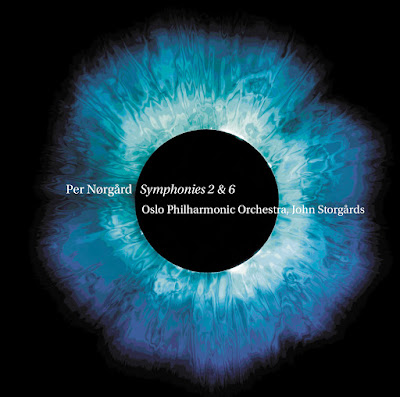
‘As if God the Father had thrown down pieces of a mosaic from the floor of heaven and asked me to work out the pattern.’
Not Per Nørgård’s words, of course, but those of his 1950s confidant
Jean Sibelius in relation to his own Fifth Symphony. Nørgård’s Fifth was
premiered in 1990 in a concert that included Sibelius’s; both are
post-crisis, breakthrough scores and both represent a maturing of that
concept of symphonic ‘flow’ that is so important to the two composers -
the idea that once you get the symphonic river moving, the material will
emerge readily enough.
Nørgård lets the listener decide how many movements the Fifth has but the material clearly springs from its opening gesture,
as tectonic plates judder into a new position, allowing ideas to pour
forth. The ensuing process is tight and controlled, even if the
impression is of music that is entirely out of the composer’s control in
its impulse and liquidity. Nørgård often uses ostinatos, chaconnes or
even single-note anchors to pin the discourse down, but they never
curtail its freewheeling spirit. Even when textures are at their most
fragmentary, the thread remains; the river keeps flowing. The detail in
the writing - articulation bestowed upon single instruments in the
tiniest of gestures - is beguiling.
So are these performances.
Listening across the orchestra is vital in this music, just as in
Sibelius. The Oslo Philharmonic sound settled at the foundations while
suggesting spontaneity on the surface. Storgårds offers a touch more
nimbleness and translucence than Sakari Oramo, who started this Dacapo
cycle with the Vienna Philharmonic. The brass and percussion offer
extreme restraint and delicacy. The Oslo string sound is tight but can
be wholly embracing too.
Never more so than when it appears to wrap the rest of the ensemble in a fog in the Fourth Symphony’s chilling second movement.
In this piece we sense the disintegration of the tonal principles that
were prominent in the earlier works towards something that, in Nørgård’s
hands, is harmonically even more beautiful - the music getting more
complex while getting less complicated. In that, the Fourth looks
forward to the Fifth; in its slipping into grooves - the truest of them
both unsettled and unsettling - it points towards the Sixth and Seventh.
The symphony’s game of opposites is expertly realised by Storgårds, as
when the dark second movement ‘Chinese Witch Lake’ glances in the
direction of the light first movement ‘Indian Rose Garden’ in a fleeting
gesture at the symphony’s close.
On a second disc,
we have the chance to hear where those two pieces came from and what
they led to. Nørgård’s Second Symphony is that most rooted in the
‘infinity series’, the integer sequence discovered by the composer in
the 1960s that controlled a number of his works of the period. As Frank
Lehman suggests in a lucid explanation of Nørgård’s exact algorithm on
his Unsung Symphonies blog, the result is music that is ‘locally
unstable but globally secure’.
For ‘globally secure’ read exceptionally well-formed:
a spinning out of the first 4096 notes of the infinity series across a
single movement span where bells herald each of the 16 phases and every
fourth phase is capped by an exquisite brass ‘screen’. To begin, a
delicate unison slides gradually into a semitone, and then the symphony
is off on its way - cumulatively beautiful, structurally tangible and
deliciously pure. The Oslo Philharmonic’s ability to collectively recede
as if into a minimalist canvas, parts emerging thereafter with
brightness and intent without distorting the contours, makes this
performance. In music that’s deceptively tricky to pace, Storgårds
delivers - again.
The Sixth Symphony is less cosmic and more rooted,
but the river is still flowing: through rapids in the first movement
into dark volcanic rock in the low-brass passacaglia of the Lentissimo
and eventually towards the serene waterfalls of the finale. There’s
intense joy in the music’s foibles; the slow movement’s wah-wah trumpet
almost sees it sidle into that nightclub dance that comes to fruition in
the Seventh Symphony. After the spasmodic Fifth, the Sixth feels like a
work of new beginnings, despite a title that playfully suggests the
opposite; you best hear what annotator Jens Cornelius describes as a
‘humorous game with the infinite’ in the symphony’s pregnant ending.
In this piece,
Storgårds paints a more even, subtler picture than Thomas Dausgaard
with the DNSO. In the Fifth, Storgårds offers more colour and character
than Leif Segsterstam with those same Danish forces while also avoiding
his fellow Finn’s histrionics. The rootedness Storgårds finds in the
Second and Fourth Symphonies also puts him in pole position after
Segerstam’s pioneering recordings; there is a Brendel-like eloquence and
inevitability here.
It was about time we had new recordings of these symphonies,
works that are absolutely worthy of reappraisal by new generations even
in their relative youth. These are magnificent performances, presented
with comprehensive booklet-notes by Cornelius and an introduction by
Storgårds himself. That I fully expect new recordings to take their
place in 30 years or less is a testament to the music’s relevance and
strength.
(Andrew Mellor / Gramophone)