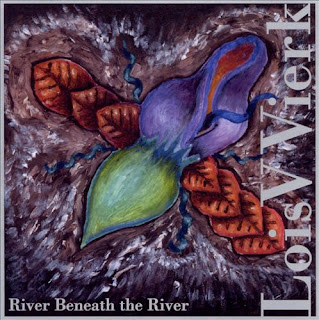
River Beneath the River features four compositions, covering a ten-year span in the life and work of the composer. It is meant to be a kind of introduction to Lois V. Vierk's work, a primer for the uninitiated, or a "greatest hits" for the aficionado, and is one of the prestigious Tzadik catalog's most welcome additions. The title track, a string quartet from 1993 commissioned by Kronos -- but played here by violinists Eva Gruesser and Patricia Davis, cellist Bruce Wang, and violist Lois Martin -- features several Vierk trademarks. First there is the sense of stillness that slowly evolves into glissando movement. It begins as a downward slide into the point of stillness, but before reaching it, the second trademark comes into play, as systematic activity and movement travel ever upward to a polyphonic epiphany. Energy accumulates until the violins become almost free within the score, placing you on the edge of your seat. Next is a string quartet commissioned by a dance troupe, the flowing "Into the Brightening Air," first written in 1994 and reworked in 1999.
The third piece, "Jagged Mesa," is perhaps the most serene and beautiful piece on the album. So gradual is its unfolding, so long are the intervals between the predominate fourths and fifths, that it feels as if the piece is one long unraveling ball of yarn. Perhaps the best-known work here is "Red Shift" (1989), for electric guitar, synthesizer (played by Vierk herself), cello, and percussion (courtesy of Jim Pugliese). It is as close as possible to rock in the post-classical age. Glissando is the strategy here, as the work slides from its somber, spare beginnings into a near-operatic frenzy. "Red Shift" has yet to be equaled as a single piece that brings the visceral dynamics of rock together with the sophistication and emotional control of classical music. (
Thom Jurek)