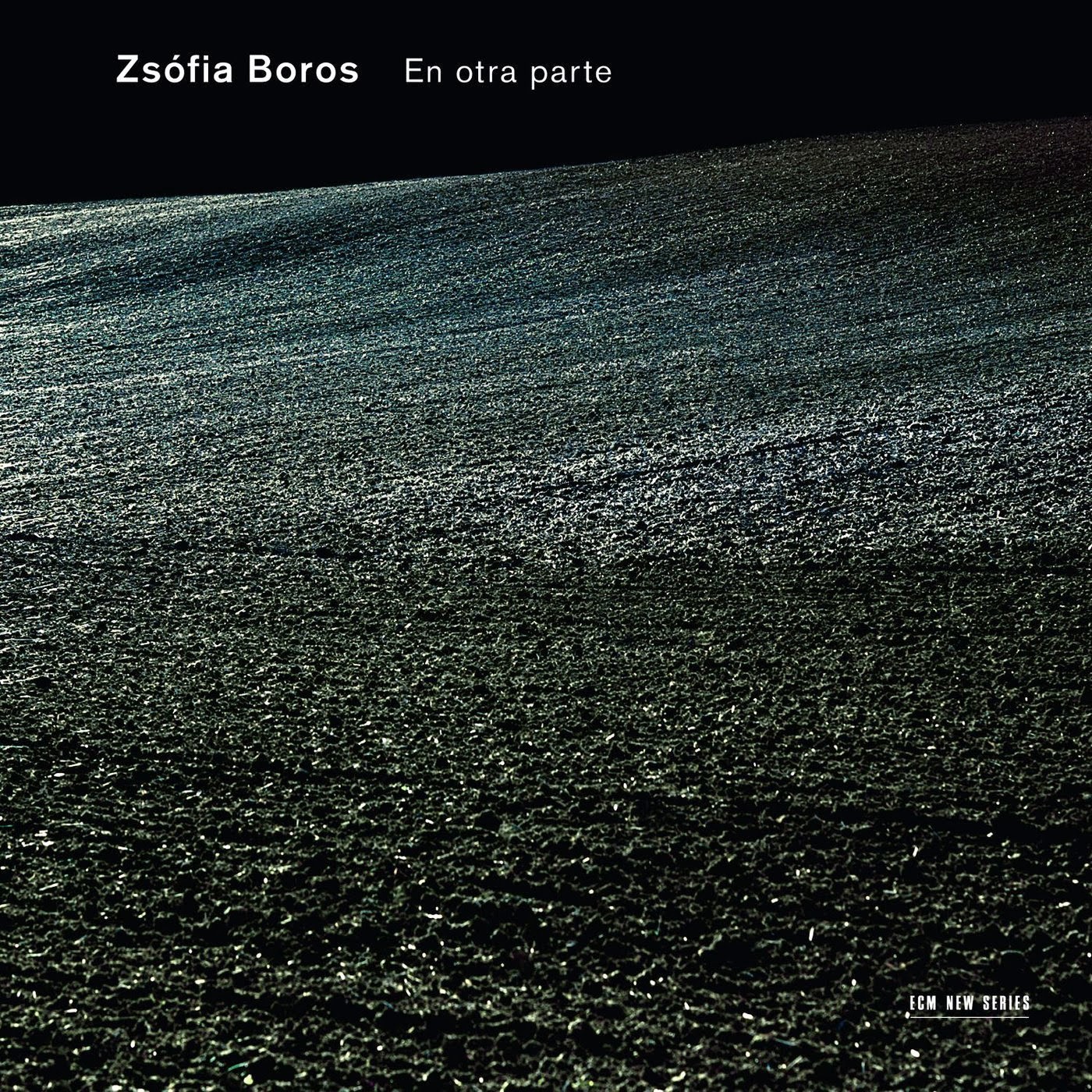
The evocative ECM debut of the highly-talented Hungarian guitarist
Zsófia Boros (born 1980) addresses a broad range of composition for her
instrument, on this recording drawing primarily on music of the
Americas. At the centre of
En otra parte is music of Leo Brouwer
(b. 1939), the Cuban composer who viewed the guitar as an orchestra and
once declared that it has “no limits”. Brouwer’s work has been a major
reference for Boros from the beginning of her musical journey. “Often I
think I am holding the choice of music in my own hands,” she writes,
“but later I wonder if the music has chosen me as a medium. My approach
is always very intuitive; when a piece of music grips or touches me, I
want to reflect it – to become a mirror and convey it.”
Boros first heard Brouwer’s “Un dia de noviembre” at a concert when she
was around fifteen. Playing the piece changed, she says, the nature of
her relationship to music. She studied at the Bratislava Music
Conservatory, the Bela Bartok Conservatory in Budapest, and the
University of Music and Performing Arts in Vienna, but gained her most
important insights less through analysis than through “building up a
direct relationship with every single note, every individual pitch” in a
composition, through the experience of playing. “For me, pitches are
like people; they have their own voices, their own durations, and yet
their true character only comes to the fore in relation to other tones.”
Zsòfia Boros is the recipient of numerous awards, taking First Prizes at
the North London Music Festival, the Concorso Internationale Val
Tidone, the Paganini Competition in Parma, and the Premio Enrico
Mercatali in Gorizia.
Boros’ choice of material uncovers affinities between music of diverse
sources and intention. Her CD booklet quotes Roberto Jarroz’s
“Todo comienza en otra parte” (engl.: “Everything begins somewhere else”)…
From contrasts and juxtapositions a compelling album is shaped. Boros:
“The stories of this album connect with one another in that they touched
me with all their protagonists from the first encounter from beginning
to end. I came to know them and now we are almost like old friends.”
Notes on a few of them: The programme opens with “Canción triste”, long a
favourite amongst guitarists, by Francisco Calleja (1891-1950), the
Spanish guitarist and composer who spent the last part of his life in
Uruguay and Argentina.
“Callejón de la luna” by Spanish guitarist-composer Vicente Amigo (b.
1967) pays tribute to the spirit of flamenco: “The organization of the
musical tale is less important than the feeling of it,“ says Amigo. “I
can start at the end or the beginning and explore and insert many themes
upon the main theme, adding little messages along the way.”
“Se ela perguntar”, a waltz by prolific guitarist-composer Dilermando Reis (1916-1977) counts now as a Brazilian standard.
Music from Argentinean sources includes “Cielo abierto” is by Quique
Sinesi (b. 1960), a guitarist who has combined tango with elements of
folk music, and drawn on the rhythms of candombe and milonga. In the
1980s he played extensively with Dino Saluzzi. “Te vas milongas” is from
Abel Fleury (1903-1958), the composer-guitarist who loved the regional
music of Buenos Aires and helped to propagate it. “Eclipse”, meanwhile,
is from Argentine-born English guitarist Dominic Miller. Initially
inspired by Jimi Hendrix, his studies in classical music and jazz also
inform his work.
And Ralph Towner (born 1940), the North American composer of “Green and
Golden”, needs little introduction here. His unique body of work,
conventionally filed under ‘jazz’ has been greatly influenced by baroque
music, contemporary composition, Brazilian music.
The composers whose work has been selected by Boros have been wanderers
between worlds, musically, philosophically and geographically.
En otra parte was recorded in Lugano in 2012 and produced by Manfred Eicher.