Mostrando entradas con la etiqueta Elena Carzaniga. Mostrar todas las entradas

sábado, 5 de enero de 2019

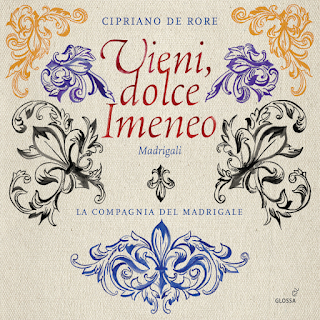
La Compagnia del Madrigale CIPRIANO DE RORE Vieni, dolce Imeneo

With Vieni, dolce Imeneo, La Compagnia del Madrigale make another important halt on their compelling journey across the territory of Italian secular song with a disc devoted to one of the most significant, yet these days somewhat bypassed, composers: Cipriano de Rore. De Rore was a Fleming who enjoyed great success notably in the Italian courts of Ferrara and Parma – but with a prestige which extended up and across Europe. He composed in many genres, but it is the secular madrigal – recorded here – where his skill was most valued, for example in creating extended and expressive melodic lines coupled with innovatory pre-echoes of the seconda pratica so triumphantly expressed – albeit amidst great criticism – by Claudio Monteverdi.
Recordings – all also on Glossa – of madrigals by Marenzio, Gesualdo and Monteverdi have already demonstrated musical pleasures such as an uncommon vocal blend and delicacy, and a meticulous dynamic control exhibited by the richly experienced members of La Compagnia del Madrigale, and those delights are to be experienced with these 19 madrigals by Cipriano de Rore, composed late in his career.
With texts by Petrarch, Ariosto and assorted court poets for these madrigals, essay-writer Marco Bizzarini highlights one of the principal characteristic features of de Rore’s mastery when he points to the disc’s title track, Vieni, dolce Imeneo: the ideal union between poetry and music.

miércoles, 28 de junio de 2017

La Compagnia del Madrigale CLAUDIO MONTEVERDI Il pianto della Madonna

With Il pianto della Madonna, a collection of spiritual compositions by Claudio Monteverdi, La Compagnia del Madrigale provide a stunning follow-up to their award-winning recording of the Fifth Book of madrigals by Luca Marenzio – both releases from Glossa. The singers of the ensemble have returned to their favoured Piedmontese recording location in Roletto to create a vivid sound picture of the desire in Monteverdi’s own time to bring the “heavenly harmony” of the composer’s secular works into the service of the religious domain (and that despite Post-Tridentine restrictions on such secular “intrusions”).
Here, for example, is presented the spiritual version of the celebrated Lamento d’Arianna from the lost opera AriannaIl pianto della Madonna – and sung in a distinctive polyphonic reworking prepared especially for La Compagnia del Madrigale. Pastoral concerns in Monteverdi’s madrigals, such as in the Fourth and Fifth Books, make way for reflections on the Crucifixion or the Nativity through the new religious texts supplied by the likes of Angelo Grillo and Aquilino Coppini, which nonetheless fit the music more than aptly. Included also are some of Monteverdi’s own religious compositions, as published by Giulio Cesare Bianchi, and including the extensive Litaniae lauretanae.
In the booklet essay Marco Bizzarini brings his deep understanding of the interplay of words and music in Italy in Monteverdi’s time, underscoring the skill, experience and sheer musicality of La Compagnia del Madrigale. (GLOSSA)

Il pianto della Madonna.pdf