Mostrando entradas con la etiqueta Gary Trosclair. Mostrar todas las entradas

jueves, 3 de marzo de 2016

LOIS V. VIERK Simoom

Chicago composer Lois V. Vierk's first signature album was released in 1990 on the XI label (for Experimental Intermedia), and contained compositions written from 1981-1986. All of Vierk's compositions are deeply influenced by, and indebted to, Gagaku, the Imperial Court music of Japan. The three pieces here reveal Gagaku's influence in their sonorities and microtonalism rather than in strict thematic structure. "GO Guitars" (the word go means the numeral five in Japanese) is an aggressive piece for five guitars all tuned microtonally around E. The volume is high and the pitch is a wavering, shimmering glissando around sonorities. These all change as the tempo is increased and the notes fall off the board, moving the intersecting tones around to create new ones between E and G. "Cirrus" for six trumpets is a study that La Monte Young copped later for a trumpet work of his own. A choir of trumpets plays a drone tone at the top of the middle register, and one or two others play prescribed melodic improvisations around the one tone, using a limited amount of pitches. Finally, cellist Theodor Mook plays all eight parts of "Simoom." The piece begins with microtonally composed thirds in the cello's middle register. Eventually, shorter and then longer glissandi begin to enter the picture, forcing the instrument to move upward toward its higher register to realize all the tonalities presented in the score. As the limits of the high register are breached, a dramatic conclusion is reached as the glissandi are scored as hyperactive structures in the low register with repeated notes -- thirds, fourths and sixths -- carrying it to its conclusion. While not as compelling as her Tzadik release, Simoom reveals Vierk as a composer of depth, technique, and dynamic complexity, whose use of microtonality foreshadowed her later command of its language. (

miércoles, 2 de marzo de 2016

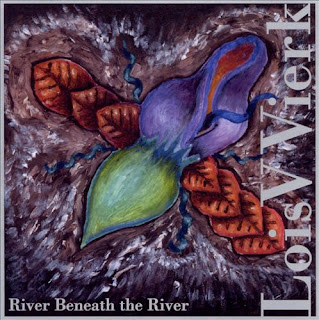
LOIS V. VIERK River Beneath the River

River Beneath the River features four compositions, covering a ten-year span in the life and work of the composer. It is meant to be a kind of introduction to Lois V. Vierk's work, a primer for the uninitiated, or a "greatest hits" for the aficionado, and is one of the prestigious Tzadik catalog's most welcome additions. The title track, a string quartet from 1993 commissioned by Kronos -- but played here by violinists Eva Gruesser and Patricia Davis, cellist Bruce Wang, and violist Lois Martin -- features several Vierk trademarks. First there is the sense of stillness that slowly evolves into glissando movement. It begins as a downward slide into the point of stillness, but before reaching it, the second trademark comes into play, as systematic activity and movement travel ever upward to a polyphonic epiphany. Energy accumulates until the violins become almost free within the score, placing you on the edge of your seat. Next is a string quartet commissioned by a dance troupe, the flowing "Into the Brightening Air," first written in 1994 and reworked in 1999. The third piece, "Jagged Mesa," is perhaps the most serene and beautiful piece on the album. So gradual is its unfolding, so long are the intervals between the predominate fourths and fifths, that it feels as if the piece is one long unraveling ball of yarn. Perhaps the best-known work here is "Red Shift" (1989), for electric guitar, synthesizer (played by Vierk herself), cello, and percussion (courtesy of Jim Pugliese). It is as close as possible to rock in the post-classical age. Glissando is the strategy here, as the work slides from its somber, spare beginnings into a near-operatic frenzy. "Red Shift" has yet to be equaled as a single piece that brings the visceral dynamics of rock together with the sophistication and emotional control of classical music. (Thom Jurek)