Mostrando entradas con la etiqueta Rolf Lislevand. Mostrar todas las entradas

martes, 21 de agosto de 2018

Rolf Lislevand DIMINUITO

Rolf Lislevand lutes, vihuela de mano; Linn Andrea Fuglseth voice; Anna Maria Friman voice; Giovanna Pessi tripleharp; Marco Ambrosini nyckelharpa; Thor Harald Johnsen chitarra battente, vihuela de mano, lutes; Michael Behringer clavichord, organ; Bjørn Kjellemyr colascione; David Mayoral percussion.
 On “Nuove Musiche”, his highly successful ECM debut released in spring 2006, Norwegian master lutenist led his own group of international early music virtuosi. The album presented ravishing and most unorthodox accounts of mostly Italian instrumental music from the early Baroque. Based on Italian Renaissance sources from the 16th century – madrigals, chansons and virtuoso lute music – the new programme goes even further back – from the “seconda pratica” of monophonic expressiveness to the “prima pratica” of polyphonic complexity.
Once again putting a strong emphasis on improvisation, Lislevand and his colleagues disclose the astounding modernity and emotional wealth in the music of composers such as Giovanni Antonio Terzi or Joan Ambrosio Dalza. Most of the music stems from the Veneto region of Italy where, at that period, strong influences of oriental and eastern music could be felt. Lislevand’s group translates this with a lush scoring for deep instruments, both stringed and plucked. The album title “Diminuito” refers to the praxis of virtuosic ornamentation of vocal lines, the “diminution” of larger rhythmic and harmonic units in most agile runs, scales and arpeggi. The album was recorded in St. Gerold with line-up including the delightful sopranos of Anna Maria Friman and Linn Andrea Fuglesth. (ECM Records)

sábado, 16 de junio de 2018

Rolf Lislevand / Concerto Stella Matutina NUOVE INVENZIONI

Rolf Lislevand and Concerto Stella Matutina first worked on a project in 2011, which would result in a prosperous collaboration in concert series and now, the release of their first CD together. The album is a mix of baroque and jazz as well as improvised passages with music arranged for the 12 people orchestra by Andrea Falconieri, Giovanni Girolamo Kapsberger, Girolamo Frescobaldi, Johann Heinrich Schmelzer and Vincenzo Albrici. Bringing the elements of baroque and jazz together and developing a new kind of music by optimizing the instruments of Early Music and giving each instrument section its moment on the recording was the goal of this release. With this intimate and well mixed recording, the musicians did not aim to create crossover music or fit into any other genre but rather generate a sound that is a symbiosis of different musical elements.
 
Virtuoso of the lute and Baroque guitar Rolf Lislevand is one of the most charismatic figures in today’s early music scene. Lislevand, whose solo recordings have won numerous awards, has been professor of lute and historical performance at Trossingen Musikhochschule since 1993.
 
Since the establishment of the Baroque orchestra 2005 the number of engagements at home and abroad has been growing. Concerto Stella Matutina has its own concert series in Vorarlberg and has gained an ever growing core audience in a very short time. The musicians, next to the interpretation of familiar masterpieces, also pay special attention to forgotten works of the 17th and 18th centuries.

miércoles, 23 de agosto de 2017

Paolo Pandolfo FORQUERAY Pièces de viole avec la basse continuë

Marin Marais and Antoine Forqueray represent the two leading figures from the world of the French viola da gamba with – in the opinion of a contemporary in Hubert Le Blanc – the former playing like an angel and the latter like a devil. And fiendishly difficult to play, of course, are many of the pieces brought together in the volume prepared by Jean-Baptiste Forqueray (“le fils”) in 1747, two years after the death of his father, and drawn from sketches and memories. These Pièces de viole avec la basse continuë, dedicated to Princess Henriette of France (the younger of Louis XV’s twin daughters), serve as a final and grand homage to an instrument, which after seventy years of an absolute rule was by that time starting to cede territory to the cello...
Glossa is now bringing back into circulation – in a newly-prepared edition – the recording which introduced Paolo Pandolfo to the label, where he was joined by a starry group of fellow performers in Guido Balestracci, Rolf Lislevand, Eduardo Egüez and Guido Morini. The exemplary texts of Edmond Lemaître and Pierre Jaquier further enhance a legendary album, one which confirmed Pandolfo, now some fifteen years ago, as one of the greatest viola da gambists of our own present times. (GLOSSA)

miércoles, 26 de abril de 2017

Ensemble Kapsberger / Rolf Lislevand ALFABETO

The Alfabetos are guitar tablatures which were used until the end of the 18th century, they scored the chords as letters as jazz and rock music tablatures noxadays do. These simplified scores tell the essential, giving the players all the freedom to improv and use their virtuosity. For a long time, Rolf Lislevand played the electric guitar, some rock and a lot of jazz music and just a little bit of classical guitar to enter the conservatory. Pat Metheny leads him to jazz guitar, but the real hit comes from a lute concert by Hopkinson Smith. He starts learning how to play the lute and other early instruments. Ever since, he has shared his time between the baroque and the jazz or alternative stages along his improvisations. 'The baroque music offers much room, there is always air around it' (Rolf Lislevand): Alfabeto proves that baroque music was born in the street, that it was above all a music to dance (folias,...), basically intended to entertain people...His musicians in his ensemble are virtuoso improvisers, they dare everything with as much freedom as possible. Three baroque guitars phrase, nuance, launch solos and rhythms, they converse with Arianne Savall's aerial vocalizations, Pedro Estevna's imaginative drums or Bjorn Kyellemyr, one of Charlie Mingus's disciples, who leaves her his double bass for some colascione. (Naïve)

jueves, 9 de marzo de 2017

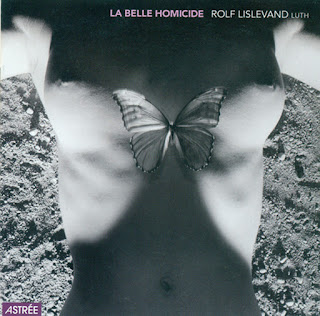
Rolf Lislevand LA BELLE HOMICIDE

Award wining soloist Rolf Lislevand using a eleven-course baroque lute gives a revelatory recital of unaccompanied seventeenth century French lute music on the Astrée Naïve label. Lislevand states in the booklet notes that probably never since the period when this lute music was written has such beautiful music been performed by so few people. His sentiments are pretty accurate and I cannot understand why such wonderful music has been ignored for so long. 
The popularity of the lute began to fade as the popularity of the violin increased and the lute became virtually obsolete with the advent of the pianoforte. The last great lute composers were J.S. Bach who significantly composed several lute suites and Handel who was utilising lute parts in his last opera Deidamia in 1741. 
These compositions are successfully written for the most part in the style of short dances and grouped together in sets or suites. The characteristic fashion of the time of labelling each piece with a poetic or descriptive designation is used although the titles bear little or no resemblance to their character and expression. ‘La Belle Homicide’ the title of this Astrée Naïve release uses the name given by composer Denis Gaultier ‘de Paris’ to one of his works which was one of the most popular of the period. 
Lislevand uses the manuscript of lute works from seven different French composers compiled by Barbe which is in itself a guarantee of the quality of the selected works. They are not arranged in any particular manner other than their common mode and tonality. Barbe was not afraid to join several of the pieces together by different composers into a more continuous work. To me, a non lute player, the seven French composers sound remarkably similar in style and owing, I guess, to the way that they are phrased I observed that it was virtually impossible for me to sense what notes were coming next.
If the listener has not read the explanation in the booklet notes it can come as a shock to hear several seconds of animal, bird and reptile calls at the beginning of three of the pieces. We are informed by the soloist that the recording sessions were undertaken in Maguelone Abbey in France at night and the nature sounds were left to provide atmosphere to the proceedings. Furthermore, for reasons of spontaneity and realism, some of Lislevand’s instrumental tuning and experimentation made during the recording sessions have not been edited out as can be heard on track 11 between points 1:44-1:52.
In the informative yet rather high-brow booklet notes lutenist Lislevand discusses how he finds the term ‘historical authentic performance practice’ now to be burnt-out and states that a new term ‘historical perception practice’ has arisen from the ashes, which explains what a performer desires to attain, subscribing to a specific attitude and belief. Somehow this all seems rather pretentious! I must say just how much I love the packaging of this Astrée Naïve release, in particularly the imaginative art work. 
The lute playing is exceptionally fluent and the phrasing is perfectly judged with a sense of real involvement and empathy for the works. Through Rolf Lislevand’s amazing playing of these excellent compositions and near perfect acoustics this release was a revelation to me and touched my emotions in a most unique way leaving me with a remarkable sense of spirituality that I have never previously experienced with any recording. 
The sound quality is in demonstration class and I could easily imagine being alongside the lutenist during the actual night recording session. I urge listeners who wouldn’t normally purchase a recital of lute works to hear this superlative recording. (Michael Cookson)

sábado, 13 de agosto de 2016

Rolf Lislevand DIMINUITO

This recording is all about the Italian renaissance, how it understood itself, how we understand it today and how we would have understood it if we had been contemporary with it, because no other period in European music’s history was as contemporary with itself as was the renaissance. During the 16th century, humanistic inspiration had led to the most equilibristic levels in all arts and had stretched the human mind to the highest achievements and skills flourishing in a landscape of youth, spring and rebirth of all of mother earth’s beings.
Diminutions, divisions, or glosas were one of the renaissance’s unique inventions. Technically it means embellishing a melody into a much more flavored and elaborated melody in faster movement and shorter rhythmical values, presuming that the simple melody still remains in the listener’s mind. This supreme discipline of ornamentation became a new work of art in itself.
The original composition on the other hand was reduced to a humble servant of this invention – an object of abuse for an instrumental protagonist without further empathies neither consideration of its origin.
It is like the game of drawing lines through numbered points on the last page of newspapers: creating shapes and figures making lines from a number to another. Melodies are like these shapes and contours of a drawing, and each numbered point is the plucked sound, drawing lines from one attacked sound to another one, believing that a figure eventually occurs in our imagination!
The art of diminution almost completely denaturalized the plucked instruments in the same way it has done to the electric plucked instruments in our own days. The distorted sound of an electric guitar made it a bowed string instrument and changed all its musical logic. The diminutions allowed the plucked string instrument to regain some of the qualities of the human voice, the phrasing, coloring and dynamics. By means of fast and small melodic figures which make bridges and reinforce the shape of the simple melody, the lute suddenly appears as protagonist, soloist and conductor, wowing a patchwork of colors, shadows and lights and in a unique way adding value to the simple and beloved, but all to well known melody. (ECM Records)

martes, 24 de mayo de 2016

Rolf Lislevand LA MASCARADE

 In this inspiring album – his first solo disc for ECM – Norwegian early music performer Rolf Lislevand turns his attention to the music of two composers from the court of Louis XIV: Robert de Visée (c. 1655-1732) and the Italian-born Francesco Corbetta (c. 1615-1681), and plays their masterpieces with historical awareness and an inventiveness which belongs to the tradition. De Visée wrote about playing what the instruments themselves called for, advice Lislevand takes to heart here, adding improvised introductions to passacaglias from both composers.
On La Mascarade, Lislevand uses two contrasting instruments. He plays the theorbo, the dark-toned and earthy king of the lutes, and the Baroque guitar, with its sparkling, crystal-clear sonorities. The 17th guitar, smaller than its modern counterpart, had five pairs of strings, tuned in unisons and octaves. “Musicians of four centuries ago had already developed the instrument’s playing style to explore all the possibilities of surprising strummed rhythms and harmonies, often very modern-sounding to our ears. Moreover the instrument’s many different tunings prefigure the experimental tunings used by improvising musicians today… It seems that guitar players of the seventeenth century did exactly what guitar players have done ever since: compose music with the guitar on their knees by listening to the exciting new sounds that unexpectedly occurred when they put their fingers on new and unusual places on the fingerboard.”
Where the Baroque guitar had no bass register, the theorbo was effectively a bass lute: “Together these instruments create a chiaroscuro in music, an image in sound of the Baroque theory of that magic tension that exists between light and darkness.”
Francesco Corbetta’s virtuosity was first celebrated outside his native Italy. In his fascinating liner notes, Lislevand reports that Corbetta charmed Charles II in London, “and left a whole court strumming on small Baroque guitars.” Robert de Visée was Corbetta’s student In Versailles, and went on to become one of the Sun King’s composers, as well as his guitarist and theorbo player. “De Visée played his own music at court,” writes Lislevand, “occasionally in the king’s bedroom, while the monarch was taking supper. On request he would play his guitar walking two steps behind the king during the daily royal promenade of the gardens of Versailles – the first Walkman in musical history.”

miércoles, 11 de febrero de 2015

Rolf Lislevand NUOVE MUSICHE

Is it fair for baroque to sound so sensual? An elegiac soprano voice wafts above an instrumental piece by Giovanni Girolamo Kapsberger. Flamenco rhythms underpin a passacaglia. Then suddenly we hear the typical harmonies and ornaments of Celtic folk music. Is that how this music really sounded in Italy in the early 1600s? Of course not. But what the Norwegian lutenist and guitarist Rolf Lislevand and his six colleagues bring off on Nuove musiche, their début album for ECM, has all the earmarks of a manifesto. Their vibrant and literally unheard-of readings of early baroque music from Italy are meant to grab the listener directly, as if it really were 'new music'.
'For years people tried to play early music as closely as possible to the way it was played at its time of origin', Lislevand explains 'But that's a philosophical self-contradiction. The first question is whether it's possible at all to replicate the performance of a musician who lived centuries ago. As far as I'm concerned, reconstruction is not really interesting at all. Do we really want to act as if we hadn't heard any music between 1600 and the present day? I think that would be dishonest. With this recording we say goodbye once and for all to early music's authenticity creed.'
This doesn't mean that anything goes - on the contrary. Lislevand, who learned his craft at the famous Schola Cantorum in Basle, has been professor of lute and historical performance practice at Trossingen Musikhochschule since 1993. He has turned out many prize-winning recordings, some of them with his Kapsberger Ensemble, which forms the core of the musicians on Nuove Musiche. He avidly scrutinises every available scrap of information on what he plays and how to play it properly. But those are only the preconditions for a convincing performance. After all, one vital element in baroque music was improvisation: 'Pieces were played to meet the needs of the moment', Professor Lislevand points out. 'To play strictly according to the notes on the page would be tantamount to lying, for the scores were written in a sort of shorthand. They presuppose a good deal of knowledge and self-assurance from the player.'
Take the percussion instruments, for instance. We know they were used, but nobody around 1600 bothered to write down the parts. So we have no way of knowing for sure how they were used. Did they only serve as timekeepers, or was their timbre exploited as well? Lislevand has very strong views on the subject: 'The idea that it wasn't until today that we could freely express our feelings is not only naive but arrogant. Personally I believe that the people of the 17th century were much richer and more self-aware than we assume today.' It is only natural, then, that the percussionist Pedro Estevan offers a huge range of expressive sounds and rhythms on Nuove musiche.
Lislevand searches for points of contact between the 400-year-old pieces on this recording (by Kapsberger, Pellegrini, Piccinini and others) and the musical horizons of today's performers. Usually the starting point is the passacaglia, a set of increasingly dramatic variations on an unchanging bass pattern. Passacaglias formed the core repertoire of the lute and guitar books of the 17th century. 'They thrive on chromaticism, harsh dissonances and offbeat rhythms. If the composers tried to get these effects, then we have every right to go even further. My idea is simply to develop and elaborate things already there in the material. Arianna Savall's melody really does come from the Kapsberger toccata itself. Everything there that smacks of echoes from current popular music is already contained in the pieces. I just coax it out.' (ECM Records)