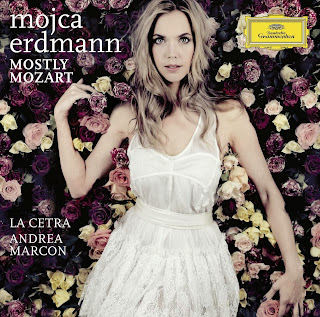
The Muses have been revered as a source of divine inspiration since the
time of classical antiquity and are said to encourage artists to give
of their exceptional best. From this point of view, the Hamburg soprano
Mojca Erdmann seems like a figure from the distant past. Although she
is still at the beginning of what promises to be a major international
career, she has already inspired a number of contemporary composers,
including Aribert Reimann and Wolfgang Rihm. Indeed, Rihm even wrote
the main role in his operatic fantasy Dionysos with the young soprano
in mind. Her performances in the world premiere at the 2010 Salzburg
Festival proved a tremendous personal success.
For her debut with Deutsche Grammophon, however, Mojca
Erdmann has chosen a very different type of programme in the form of
works by Mozart and his contemporaries: “Mozart has accompanied me all
my life. Although my father is a composer and contemporary music has
always played a major role in our lives, for me there is nothing to
beat singing Mozart, even though I feel an immense respect for him. You
know exactly how it should sound, but it’s insanely difficult to
achieve this.”
No one listening to Mojca Erdmann’s singing would suspect
for a moment that she finds Mozart difficult. Indeed, her voice is
almost ideally suited to the Austrian genius’s music. Her lyric soprano
voice is remarkable not only for its beauty but also for its great
flexibility and bell-like tone. And she enchants her listeners not just
with her voice itself but also with the unconcealed emotionality of
her singing: “Mozart goes straight to my heart. That may sound a little
dramatic, but that’s how it is. He touches something deep inside me,
and sometimes the tears come unbidden to my eyes. It’s impossible to
say why this should be so, but this magic may well be the secret of his
success.”
At the heart of the present album is Pamina’s famous aria,
“Ach, ich fühl’s, es ist verschwunden!”, for which
Mojca Erdmann has
deliberately chosen a slow tempo: “I was keen to express something very
inward, very vulnerable. The listener should be able to gaze into this
woman’s soul, the soul of a woman who is at her wits’ end and no
longer knows where to turn. Her only release seems to be death. What
interests me most of all is how exactly he intended his tempo
indications to be interpreted. Above all with Pamina I’d love to know
whether it would have worked for him if the aria were taken really
slowly. Although it says ‘Andante’, it has to be as slow as this for
me. If I sang it any quicker, there would no longer be any emotional
depth to it.”
The Mozart arias feature alongside works by some of Mozart’s
contemporaries and forerunners, works that have been almost completely
forgotten but which Mojca Erdmann discovered while preparing for this
release. They immediately aroused her interest: “In a letter to his
father, Mozart writes very enthusiastically about the music to Ignaz
Holzbauer’s opera Günther von Schwarzburg, for example. For me, it was
interesting to see what Mozart thought about his fellow composers and
how his own music is related to theirs. There are certainly a number of
similarities. The aria from Paisiello’s Nina, for instance, starts in
exactly the same way as ‘Ruhe sanft’ from Mozart’s Zaide.”
Mojca Erdmann was also surprised by the two arias from
Salieri’s Les Danaïdes. Ever since Miloš Forman’s film Amadeus, Salieri
has been viewed by the wider public as the man who murdered Mozart.
Less well known is the fact that as a composer he was for a time more
successful than his younger colleague. Mojca Erdmann, too, is
enthralled by the musical quality of Salieri’s works: “Both arias are
very short, but in spite of their brevity they are wonderful
masterpieces. What Salieri packs into these two minutes is simply
incredible.”
The result is an album that avoids the well-worn paths of
the standard repertory and introduces listeners to some of the most
beautiful arias from the early-Classical and Classical periods. One
such composer is Johann Christian Bach, the youngest son of Johann
Sebastian and a great influence on the young Mozart’s style. Another is
the Viennese composer Ignaz Holzbauer, who wrote over two hundred
sinfonias and fifteen operas, most of which have now fallen into
neglect. Giovanni Paisiello wrote more than one hundred operas and in
his own day was one of the most famous composers in Europe. His works,
too, have largely disappeared from the repertory, although they often
dwarfed the compositions of his contemporaries with their melodic charm
and dramatic intensity.
But the biggest surprise remains Mojca Erdmann’s voice. In
her astonishing combination of technical mastery, tonal beauty and
consummate expression she affords impressive proof of what Mozart
singing can be like today.
(Tristan Wagner 1/2011)