Mostrando entradas con la etiqueta Beatrice Rana. Mostrar todas las entradas

martes, 5 de noviembre de 2019

Beatrice Rana RAVEL Miroirs - La Valse STRAVINSKY Petrushka - The Firebird

Since her silver medal at the 2013 Van Cliburn Competition, I’ve followed the career of Beatrice Rana with great interest. When introducing friends who aren’t musicians to her recordings, I usually mention a couple of things. Rana, who is the daughter of two professional pianists, tells the story that, when she was very young, it was easier for her to communicate with the piano than with speech. She is as authentic as they come and plays everything, be it the Goldberg Variations or the Prokofiev Second, as though nothing in the world could be more important. Rana’s new Warner release, recorded in June and September of this year, beautifully captures pre war Paris with Ravel’s Miroirs and two of Stravinsky’s ballets for Diaghilev, with La valse thrown in as a post-war snapshot. 
Though we had a taste of Rana’s Ravel in Gaspard de la nuit on her first recording after the Cliburn (Harmonia Mundi, 2/14), the pieces here underscore the originality of her approach to the composer. Her seemingly infinite variety of touch, particularly at the quiet end of the dynamic spectrum, stands her in good stead, say, with a piece such as ‘Noctuelles’, where acutely differentiated levels of pianissimo make it difficult to distinguish the protean flight of the moths from the dust in their wake. Rana communicates her musical imagery with an ease and economy that belies its power. The heat in ‘Oiseaux tristes’ is almost palpable, muting the birds’ song as it wilts the entire landscape. Even a threadbare warhorse such as ‘Alborada del gracioso’ emerges freshly vibrant with a blend of uncommon harmonic emphases and kinetic vitality.
As evocative as the Ravel pieces undoubtedly are, the two Stravinsky ballet transcriptions belong in a category that can only be described as conjury. When all is said and done, you may ask yourself, as I did, where did these brilliant colours evoking Bakst come from, this protean energy punctuated by such rhythmic authority, these reserves of power? Or perhaps find yourself pulling out your Monteux or Boulez to see if the orchestral originals could really sound so prosaic in comparison.
There’s no question that Rana is an immensely resourceful pianist who can pull off dazzling effects when warranted. But it is her sane, thoughtful music-making, inerrant in focus, often strikingly original and always from the heart, that sets her apart. Not many 26-year-olds in my experience can boast artistry so satisfyingly complete. (Patrick Rucker / Gramophone)

martes, 25 de septiembre de 2018

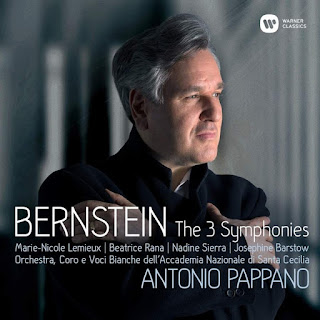
Antonio Pappano / Orchestra dell'Accademia Nazionale di Santa Cecilia BERNSTEIN The 3 Symphonies

Leonard Bernstein was the Honorary President of the Orchestra dell’Accademia Nazionale di Santa Cecilia from 1983 until his death in 1990. Temperamentally they were exceedingly well suited. Their ethos, their extrovert nature, to say nothing of their innately operatic manner, made them a good fit. And there’s something of Bernstein’s dynamism and eclectic, all-embracing nature in the person of Antonio Pappano whose penchant for, and love of, jazz for starters ticks one of the many boxes that this music demands. So here we have it: the three ages of Lenny the symphonist, fittingly signed off with that short, sharp, wacky jam session Prelude, Fugue and Riffs.
Let me say straight away that these performances come at us with a theatricality that puts them firmly ‘on stage’ where they belong. All three pieces are essentially about the process we all go through to ‘find ourselves’, except that in Bernstein’s case the question of belief and faith was to haunt him, trouble him, from first to last. How to reconcile being Jewish with his essentially agnostic nature. That The Age of Anxiety is flanked by the soul-searching of the Jeremiah and Kaddish Symphonies is nothing if not ironical.
One should give credit for the fact that Symphony No 1, Jeremiah – his very first orchestral work – sprang so fully formed from his imagination. For sure it is mightily filmic, a piece whose movement titles ‘Prophecy’, ‘Profanation’ and ‘Lamentation’ portend and indeed deliver biblical gestures; but the piece is big-hearted, too, and paradoxically there is an almost guilty jubilance in the central ‘Profanation’ movement – a destructive hedonism in which Bernstein’s composerly prowess advances in leaps and bounds, powering forwards on the back of driving rhythms and self-evidently American syncopation. We are pre dating and predicting here the prairie-pounding Scherzo of Copland’s Third Symphony and the Santa Cecilia players fully relish the heat of it (flaring trumpet fanfares and all) only to slink back into the singing melody of the Trio section which hardly needs saying could only have been penned by Bernstein. Then there is resonance in the closing lamentation for the fallen city of Jerusalem (the political overtones will never have eluded Lenny) with Pappano’s solo casting (inspired throughout this set) hitting precisely the right declamatory tone with Marie-Nicole Lemieux’s ripely theatrical delivery.
The Second Symphony, The Age of Anxiety after WH Auden’s tremendous prose poem, is I think Bernstein’s finest concert work – still hugely underrated in some quarters. This searching dark night of the soul, evolving as it does from that lonely two-part clarinet counterpoint at the outset (the musical equivalent of Edward Hopper’s Nighthawks and one of Bernstein’s most inspired ideas), uses an interlocking variation technique to great effect, each new idea emerging from the last notes of the previous one to create not just a sense of evolution but of new beginnings, too.
Again, Pappano’s choice of the audacious young Italian pianist Beatrice Rana – a rising star if ever there was one – is right on the money. She has the razzle-dazzle in spades, of course, but it is the mercurial throwaway manner (cool, and then some, the jazzy ‘Masque’ at the heart of the piece brilliantly on point) that really excites. That and her ability suddenly to look inwards and to thoughtfully reflect on what is past and what is to come. She and Pappano communicate great kinship in the piece and that inexorable build to the cathartic peroration has impressive inevitability. One of those eternally hopeful Bernstein sunsets or sunrises, depending on your viewpoint.
Symphony No 3, Kaddish, is still the most problematic of the three symphonies for me, one in which the music seems almost incidental to Bernstein’s spoken text. That text – highly emotive as it is – has always struck me as more therapeutic for him than it has ever been for the listener. What we have here is essentially a melodrama, a public venting of his troubled relationship with God, the Father. But Pappano has played an absolute blinder in casting Josephine Barstow in the Speaker’s role. She is tremendous and far and away the most exciting, the most affecting, the most probing narrator of any on disc. One can all too easily forget that she was an English scholar and an actress before she was a singer. She is blistering in her voicing of Bernstein’s angry confrontations with his ‘Tin God’ while the music for its part wrestles with its thorniness, finding respite in the central lullaby and the glorious ‘rainbow’ theme which Bernstein, one feels, knows all too well is the manifestation of his true self. But it is Barstow that makes the piece work as never before in my view and it is Pappano who should take credit for knowing all too well that she would.
Lenny’s Benny Goodman inspired-jam session Prelude, Fugue and Riffs is the most pertinent of postscripts to this terrific set. Alessandro Carbonare emerges from the orchestra to lead his feisty combo through the seven action-packed minutes where classical sleight of hand meets jazz improv. Hard to believe it’s written down. But then that was the general idea. (Edward Seckerson / Gramophone)

martes, 2 de enero de 2018

Beatrice Rana CHOPIN 26 Préludes - SCRIABINE Sonate No. 2 Op. 19

In June 2011, Beatrice Rana, at the age of 18, became one of the youngest winners of a first prize at the Montreal International Musical Competition. As well, she won each of that year’s special prizes for which she was eligible. She is, said Le Devoir, “not only a pianist but, above all, an artist.” Following this success, Beatrice was invited to play with several orchestras, including the Orchestra Internazionale d’Italia, the Südwest- deutsche Philharmonie, and the Aarhus Symfonieorkester in Denmark. She also performed as a guest artist with the Orchestre symphonique de Québec, the symphony orchestras of Edmonton, Saskatoon and Winnipeg, the Malaysian Philharmonic Orchestra, and the Violons du Roy (Quebec). At only 19 years old, she is invited to play in famous halls and with major organisations and festivals worldwide, including the Tonhalle Zürich, Montreal’s Pro Musica, the Società dei Concerti in Milan, the Vancouver Recital Society, the Festival Berlioz de la Côte Saint-André, La Roque d’Anthéron international piano festival, the Festival de Radio France et Montpellier, the Folle journée de Nantes, the Flâneries musicales de Reims, the Festival Busoni in Bolzano, and the Festival de Lanaudière in Quebec. Winner of numerous prizes at international competitions (the Muzio Clementi Competition, the Concours Interna- tional de San Marino, and the Bang & Olufsen PianoRAMA Competition), Beatrice Rana began studying the piano when she was 4, and became a student of Benedetto Lupo at the Conservatoire Nino Rota, from which she graduated at the precocious age of 16. She now studies in Hanover with Arie Vardi.

domingo, 26 de febrero de 2017

Beatrice Rana BACH Goldberg Variations

For her second Warner Classics release, young Italian pianist Beatrice Rana turns to a pinnacle of the solo keyboard repertoire and a composer she has described as “my first love”: Johann Sebastian Bach. Her interpretation of his epic Goldberg Variations bears out Le Monde’s judgement that “Beatrice Rana certainly has nothing left to prove when it comes to technique, but what makes an impression are her calm maturity and her sense of architecture,” and Gramophone’s that she is “a fully developed artist of a stature that belies her tender years.”

Bach was the composer who most obsessed Beatrice Rana as a child, and in a recent interview with Pianist magazine, she confessed that it would be his music, and above all the Goldberg Variations, that she would choose if she had to devote her life to a single composer. As she said: “I’m very happy to be going back to Bach … It’s best to avoid Bach in competitions … you can’t expose yourself to be totally killed by the jury! But Bach is my first love; now I am allowed to play it in public and I’m really looking forward to that.” (Warner Classics)

domingo, 29 de noviembre de 2015

Beatrice Rana / Orchestra dell'Accademia Nazionale di Santa Cecilia / Antonio Pappano PROKOFIEV Piano Concerto No. 2 - TCHAIKOVSKY Piano Concerto No. 2

Maestro Antonio Pappano insisted he wanted to record with Beatrice Rana, the 22-year-old Italian pianist championed by Martha Argerich who shot to stardom when she claimed the Silver Medal and the coveted Audience Award in the 2013 Van Cliburn International Piano Competition. On that occasion, Huffington Post described the seasoned competition winner’s performance as ‘an endlessly fascinating piece of humanity that had the orchestra riveted on every note’. Warner Classics signed this young piano sensation in mid-2015; the Italian virtuoso now makes her label debut with the Orchestra dell’Accademia Nazionale di Santa Cecilia under the baton of Sir Antonio Pappano. Recorded in Rome, the formidable programme pairs two Russian masterpieces: a thrillingly fresh take on the warhorse of Tchaikovsky’s Piano Concerto No.1 in B-flat minor – an indispensable repertoire benchmark and calling card for concert pianists all over the world – and Prokofiev’s stormy, emotionally charged Piano Concerto No.2. This coupling is a bold statement for a musician who ‘possesses an old soul that belies her twenty years, and more than a touch of genius’ (Gramophone), but the soloist believes she has ‘the right character’ for this kind of music: ‘People say that South Italians are very dramatic!’