skip to main |
skip to sidebar

I have heard of books like this, but I have never read one. And by books like this I mean a book that analyzes a band by their songs. And the CLASH have the right person for this. Martin Popoff has written more reviews than anybody in the history of music writing. Martin knows how to tell a story through a review. But this book, unlike review writing, allows Martin the opportunity to dive deep into each song. This seems like a dream for review writers at least once in their life. To expand their expertise in a granular way. And if there is ever a band to do this for it would be the CLASH. The CLASH had a lot to say and they had a lot of important things to say. So the format is suited for the subject matter.
One other thing I will say about the author. Martin used to listen to songs for music that might be copyright infringements. So he has a trained ear for listening to songs and song structures. This also make him suited for a song by song analysis of a band. And the CLASH had a ton of influences. Each record up until their last would show off their ever broadening listening tastes.
Martin approaches this book in a chronological order. Starting with the first release and moving backwards. Starting with the first song and moving to the last. That makes sense when approaching a band with a big back catalogue. You start at the beginning. But Martin also goes through different country pressings because the first album had different songs that weren't released in England on the first release. And it came out a year or two later in North America. So this book captures every song officially released by the CLASH. It is through. Thorough in that every song is looked at. Thorough in that photos and gig flyers are matched with a song being looked at. Thorough in what gets covered in the review.
The reviews include possible meanings for the lyrics. With the CLASH there were texts and subtexts that need to be taken into consideration. Double entendres. There is consideration for influences. Historical looks at what the band was going through is probably the most interesting part of these reviews for me. They help tell the story of the song, but in so doing you get the story of then band. And then there is the musical analysis. As has already been mentioned the CLASH had a broad and ever expanding range of musical influences. Martin also compares the song with the rest of the CLASH's back catalogue. Sometimes there is insight into the songs by way of studio stories. You get a look at how the songs developed as a band. Even "Cut the Crap" gets reviewed and is used to illustrate the dissolution of the band.
Overall Martin creates a biopic for the only band that mattered. And what better way to judge a band then through their art. I learned so much about a band that I thought I knew everything about.
(Yoageur Press - www.quartoknows.com / Martin Popoff - http://www.martinpopoff.com/html/the-clash-all-the-albums-all-the-songs.html)
On December 21st, Nick Smash hosted a talk on the impact that the Clash had on Toronto with radio hosts Alan Cross and Ivar Hamilton. But think of it as metaphor for the impact that the Clash had on Toronto in general.
Nick starts out with some thoughts on the importance of the Clash. This is backed up by Allan Cross experience of finding out about the Clash on Winnipeg radio. That's where he first heard them and how they stood out. And then trying to find them at the local record store. It was a behind the counter purchase (in other words the special records were not in the regular racks).
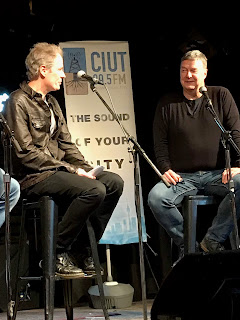
Ivar Hamilton had some stories about a variety of punk shows that happened back in the day. the crowd got involved as a hive mind experiment with people sharing stories about shows and the particulars. Nick's brother Simon told the back story to the infamous New Music interview with the Clash at the O'Keefe Centre. And then the piece de resistance was an interview that Ivor Hamilton did with Joe Strummer in '86(?). Could have been the last interview with Joe Strummer in Toronto and he talked about the number of projects he was involved with. There was also a great story about Joe Strummer trying to play the CFNY studio that was on Yonge Street. Something happened where he could not play and he retreated to the street to do a busking session.
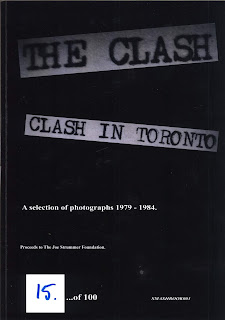
The event was a launch party for a new book that Nick Smash has curated called "Clash in Toronto: A selection of photographs 1979-1984". Photographers who made contributions include Simon White, Don Pyle, Erik Christensen, Joe Coffey, Carm Ferrari, Randy Johnston, Ivor Levene, and Paul Till. The book argues that in the absence of a rock and roll museum, publications like this have to collect these moments. Nick's thoughts along with those of the photographers collect memories for the four times that the Clash played Toronto. I am not sure of there are any copies left, but f you are interested in one reach out to Nick Smash on facebook. Proceeds for this book are going to Strummerville.
Chapter synopsis of "No Means No: Going Nowhere" written by Mark Black
The author starts out by exploring his introduction to No Means No, which like many punk rock stories involves a sibling. This happens in a number of ways, but in Mark's particular circumstance begins with an older brother moving from Glace Bay on Cape Breton Island to Nelson, BC, which for people not familiar with Canadian geography is pretty close to the farthest distance you can travel in Canada. In phone conversations Mark would get his brother to tell him about punk bands that he had seen. Not many, if any, bands would make it to Glace Bay. But Nelson was on the way to shows in Vancouver. It was his brother's difficulty with describing No Means No that intrigued Mark about the band. "Dance of the Headless Bourgeousie" was Mark's introduction to No Means No's material. This is more recent in terms of No Means No's back catalogue, but then we are talking about thirty years worth of music. "Going Nowhere" was the only song from that record that Mark considered punk sounding upon his first impressions. This bibliophonic has to be read through the lens of Mark Black, which is great because I know Mark from having put on a show for a band I was in and he made a lasting impression on me as an interesting kid. The book gave me an opportunity to learn more about him as well as No Means No.
The Myth is Real
This first chapters gets into how the Wright Brothers started playing music. This is good background which involves being army brats. Having moved around the country I think that might partially explain why No Means No were such tour hounds. The Wright Brothers may not have been very grounded to one community. Mark also explains that there was an 8 year difference between the brothers and playing music would be a great way to bridge that generation gap. John, the youngest brother, had some training with a school band. Rob was inspired by the Calgary punk scene, the Sex Pistols and Devo. In 1979, DOA played the university and that became a turning point for hooking them on the local punk scene. You often hear the story about Black Flag playing their first shows in little towns and when they came back the next year a scene was starting up. The same was true for DOA up in Canada and the experience had worked it's magic on the Wright Brothers. They also talk about the Ramones being a keystone group, which also figures into the author's story with his older brother coming to pick him up at baseball practise. This revisiting of ones roots may also explain the development of the Hanson Brothers and there are plenty of examples that followed like Criminal Damage and Hard Skin. Anyway the Wrights joined a cover band before starting No Means No to get some experience. The band was called Castle and the two would write original music outside of band time. They recorded a song on Rob's four track called "You're so Blind" which was a long meandering song with progressive song structures that evolved while playing them. That is kind of what Black Flag became. The first Wright brothers release had a Wire inspired number called "SS Social Service". The A Side was a Devo meets Joy Division song called "Look here comes the wormies" and together this became a No Means No / Mass Appeal split single that Ray Carter wrote about in the "All Your Ears Can Hear" compilation.
Victoria
Punk bands have a good track record with writing insightful songs about their home town. No Means No is no exception. And yet without the song, which I didn't even know existed, No Means No are identified with Victoria. They are an unofficial ambassador for the province's capital. I stayed in Victoria for week and although I knew of other bands I kept thinking of it as No Means No's hometown. The song "Victoria" appears on "Mr. Right and Mr Wrong: One down and Two to go". The title of the LP is a play on the Meatmen song given the band's loss of Andy, but the song "Victoria" is a play on the Kinks number by the same name. They just changed the lyrics to talk about unpleasant truths of this retirement city. The song is actually produced through a Hanson Brothers collaboration, but the song gets credited as a No Means No song. This chapter goes on to explore things about Victoria which might help account for bands like the Neos. And conversely the chapter explains why people like Jesus Bonehead would escape to the larger metropolis of Vancouver.
Stock Taking
This chapter explores the thinking behind No Means No. This starts with an exploration of the name which is taken from an anti-rape slogan. The band doesn't really help with interpretations or explanations. This gives Mark creative licence to apply etymology to punk band names in general and No Means No in particular. Mark starts exploring the meaning behind songs and uses an example with the song that the book is titled after as an example of how songs can be wildly misinterpreted. Mark was working on a TV show about John Wayne Gacy at the time and thought the song was about him. No Means No resist providing explanations because they want the listener to apply their own meaning to the song. I get this although it can be annoying when you are looking for insight into a song. It could also be seen as a cop out with not wanting to provide explanations. Or it could be that the band thinks the subject matter is too ordinary to explain and as a result self-evident. The information vacuum on No Means No's material does have us debating and I wonder if a book like the "Stranglers: Song by Song" might be due for No Means No. This book starts it off with an interpretation of the "World Wasn't built in a day." John Samson from the Weakerthans notes that No Means No writes songs about "Existential darkness". Ford Pier remarks at the band's ability to frame complex philosophical musings in a way that doesn't sound to show offish. "Victoria" gets used to demonstrate layers of cerebral thought.
Canada is Pissed
This chapter explores Andy Kerr. He was in the Infamous Scientists a band that is confused as being the band that morphed into No Means No. And Mark breaks down a number of areas for the confusion. "Canada is Pissed" was an Infamous Scientists song which No Means No would cover later on and only helps to add to the confusion. The Infamous Scientists broke up in 1982. The band had John Wright playing in the band at the end. No Means No asked Andy to join No Means No which he did in 1983. This chapter is the closest thing to a discography which is only for the Kerr years which is roughly the first ten years. Mark writes about the importance of the "Wrong" album and delves into the song "Two Lips, Two Lungs, and One Tongue" as the punk version of the human condition. I remember taking a second year philosophy course which covered the basics in this area with Hobbes and Rousseau and I had never tried to apply this to a punk song. It does make sense out of the song, but I also think that this is another example of transference by the author. Psycho analysts would have a field day with this.
Blitzkrieg Hops
This chapter explores the origins of the Hanson Brothers starting out with fun facts about the characters in the Paul Newman film "Slapshot" where the characters come from. This hockey goon squad becomes the alter ego for the Ramones tribute band. The three chord side project of dumbed down songs is a head scratcher when compared to the cerebral and chord complicated No Means No. Searching for the Wright Brothers roots is how to make sense of this. The traumatic break with Andy Kerr left the band searching after what had been a fairly intense period of creativity in their first decade. The break of a jam band that combined three chord punk with their love for hockey, which is a genetic disposition for Canadians, and the particular area of goon culture within hockey allows for the worlds of punk and hockey to co-exist. Andy's roommate, Tom Holliston of the Show Business Giants, was asked to play guitar. He became Tommy Hanson. Bits of the Hanson Brothers discography get laid out on this chapter. Fun facts like "Sudden Death" being a tribute to DOA's "The Prisoner". The band also started up a campaign to get Dave "Tiger" Williams into the Hockey Hall of Fame.
I'm Doing Well
This chapter starts out by explaining how Tom comes to join No Means No. It was on a Hanson Brothers tour of Australia and New Zealand in 1993. Tom played guitar differently and the transition wasn't easy. Lots of people, including myself, considered No Means No over after Kerr left. I haven't listened to an album post Kerr until this book. Mark makes the case that the band has never stopped being No Means No. John worked with Tom for a year to get him up to snuff. And the reason why they stuck with Tom was chemistry. Something you can't teach. This chapter is mostly about Tom's transition.
My Game
The third Hanson Brothers release comes out in 2002 with an homage to Black Flag's "My War". This release saw a new drummer in Mike Bramm, who would become Mikey Hanson. Mike was playing in a band called Freak Accident but was known for playing in Fang and Capitol Punishment. This release had the worse production and inspired the brothers to go back and re-mix this record and then everything which started up Wrong Records, the band's own label.
Heaven is the dust beneath my shoes
Starts out with an observation that bands that sing about themselves, exemplified by the tour song is usually a sure fire sign that it is over. But really this discussion serves to point out that No Means No lyrics are grounded having never written a tour song. The Wright brothers grew up with an anti-music industry attitude and they share how ordinary they are by talking about how the band plays jeopardy in the van to pass time. But there is a tour story too juicy to keep to themselves which is the time when their van got ripped off in Poland. The band does get the van back after paying ransom for it, but the story about the dangers of 2nd world gangsters and negotiating a lie to the police so that they could leave the country is exciting and revealing.
'Til I Die
This chapter can be read as a contemplation. It starts out as a contemplation of No Means No lyrics. The band wrote about their experiences which is what they know. Mark uses the song "This town", which suggests there was unfinished critiques not found in "Victoria". No Means No wrote on equal fitting with their audience which is evidenced in songs like "Mr. In Between" or "The Graveyard Shift" or "Now" or "The World wasn't built in a day" or "Stock Taking". But the song "One Fine Day" seems to sum up what No Means No is about with the challenge of every day life. This is a similar story that Black relates with his dad. And No Means No was a band that allowed Mark to connect with his older brother that moved across the country. The Wright Brothers started playing together as a way of connecting. And perhaps this book is a way of connecting to No Means No because there is an air of unapproachability to the band which is really and clearly not the case as "Going Nowhere" points out again and again and again.
The publication is almost sold out so Mark recommends that you read it through your public library.
 This feels like
a book that is part of a series. In 2003, MCR published Inferno Punx, which was
a photo book capturing the Japanese scene. Inferno Punx captured bands from
1989 to 2003 and it was pretty incredible. Ten years on MCR is publishing this
new book. This book contains photos by Fuyuki Kataoka. This book has no photo captions,
no explanations, nor any diary outtakes. It is just photos. This has me looking
at the pictures extra carefully looking for clues on who is in the photo. There
is an index at the back of the book but I didn’t find this on the first few
leaf throughs. Most of the photos are black and white shots, which adds a starkness
to the shots that is well suited for punk. Some of these photos date back to
1999 at the earliest. Some of the bands captured in this book are FRAMTID,
WARHEAD, PERSEVERE, LAUKAUS, REALITY CRISIS, FUCK GEEZ, POIKKEU, and countless
others. There are a lot of close ups of singers in mid action so Fuyuki must
have been in the pit when he was trying to capture these moments. They are
incredibly animated. There are also lots of pictures that look like they are
set up shots with bands and punks in street scapes that remind me of the
classic shots of the SEX PISTOLS and the CLASH and the BUZZCOCKS in those professional
glossy punk magazines that you find out before you find out about fanzines.
What I am trying to say is that these look like classic shots of a more recent
scene proving punk’s not dead. But we didn’t need the EXPLOITED to tell us
that. Photo and Destroy is unrefutable evidence. (MCR Company – 157 Kamiago
Maizuri / Kyoto 624-0913 / Japan / www.dance.ne.jp/~mcr/)
This feels like
a book that is part of a series. In 2003, MCR published Inferno Punx, which was
a photo book capturing the Japanese scene. Inferno Punx captured bands from
1989 to 2003 and it was pretty incredible. Ten years on MCR is publishing this
new book. This book contains photos by Fuyuki Kataoka. This book has no photo captions,
no explanations, nor any diary outtakes. It is just photos. This has me looking
at the pictures extra carefully looking for clues on who is in the photo. There
is an index at the back of the book but I didn’t find this on the first few
leaf throughs. Most of the photos are black and white shots, which adds a starkness
to the shots that is well suited for punk. Some of these photos date back to
1999 at the earliest. Some of the bands captured in this book are FRAMTID,
WARHEAD, PERSEVERE, LAUKAUS, REALITY CRISIS, FUCK GEEZ, POIKKEU, and countless
others. There are a lot of close ups of singers in mid action so Fuyuki must
have been in the pit when he was trying to capture these moments. They are
incredibly animated. There are also lots of pictures that look like they are
set up shots with bands and punks in street scapes that remind me of the
classic shots of the SEX PISTOLS and the CLASH and the BUZZCOCKS in those professional
glossy punk magazines that you find out before you find out about fanzines.
What I am trying to say is that these look like classic shots of a more recent
scene proving punk’s not dead. But we didn’t need the EXPLOITED to tell us
that. Photo and Destroy is unrefutable evidence. (MCR Company – 157 Kamiago
Maizuri / Kyoto 624-0913 / Japan / www.dance.ne.jp/~mcr/)

The
title says it all. The author has taken the best parts of every punk
documentation book that I have seen and combined them into one. If you have
read Ian Glaspar’s “Trapped in a Scene” there is a lot of great historical
stories. Peter Jandreus takes these stories and works them down into a bite
size bit which is in keeping with the encyclopedia format. Frank Manley put
together one of the first national discographies in the form of “Smash the
State”. Jandreus’s comprehensive lists of band releases fills out the band
profiles. And his discography includes a scale for worth of the records which
makes it ideal for record collectors. It is the best of all worlds really with
what has been done in the arena of punk books. Short of writing the amazing Chris
Walter like band biographies, Jandreus has found the perfect in between
collection of great stories and documentation. And they totally remind me of
the old Funk and Wagnells that my parents had, just with punk content. One
advantage to Jandreus’s book over Wikipedia is that some of these bands might
be too small to include in the on-line source. The reason why I bought this book
was because I wanted to do more research on ASTA KASK and I was frustrated by
the hype writing that made up the majority of my web searches on the band. In a
brief read I was able to learn about the important role that the band played in
the Swedish scene by building a studio in their old rehearsal space which they
let any other punk bands use for free to record. You can see how a resource
like this would prove to be super important. And as I flip through this book I
find myself doing more on-line searches to track down bands that I know little
about. In addition, this book organizes everything alphabetically by band which
is the encyclopedia method. This makes it easy to search a band but I wonder if
Ian Glaspar’s method of regional writing isn’t a better method when writing a
national scene account. It is certainly easier to follow the band
intersections. Like all good books this brings up more questions with the answers
and the best review I have read of this book is by Stuart Schrader which draws
some of that out. You can read it on-line at http://stuartschrader.com/writing/book-review-encyclopedia-swedish-punk-1977-1987.
But even with the shortcomings this is the best of its kind that I have read
and a rich and valuable resource for Swedish punk. I hope someone applies this
model to scenes in Japan and Germany and Italy and Finland and anywhere there
is a Bloodstain comp. (Premium Publishing – Sankt Goransgatan 159 / Box 30184 /
SE-104 25 Stockholm / Sweden / www.premiumpublishing.com)


“One afternoon I was flipping through the delete bins in the back of a Yonge Street record shop when this music came on over the stereo. In a wave of goose bump rush I hurried to the front to confirm what I already instinctively knew – it was the first Ramones album.”
Don also captures what it is like as an underage teen when going to shows.
"The first “bar” show I went to was the Crash ‘n Burn where my worries about being asked for ID disappeared as the door person took my money without question or a second notice.”
Nobody I know captures that nervousness, but most of us experienced it. This also describes the difference between bar show and those bigger concert hall shows that were all ages.
The story of the Toronto punk scene begins with some old movie houses, namely the Roxy and then the New Yorker, which housed the first shows when not screening John Waters or Alejandro Jodowsky films.
Don also adds to the punk rock archeology going on about the Toronto punk scene with a band called the HATE.
“The Hate performed one of the most memorable gigs I witnessed at the Turning Point as the singer Angie Ignorant stormed the stage with his cock impaling a photo of Pierre Trudeau, urine spraying the audience from what looked like Pierre’s mouth.”
Trouble in the Camera Club has some of the most accurate descrptions of the early Toronto punk scene releases. Here is Don’s review of the first VILETONES ep.
“Screamin’ Fist”, the first song on the first single by the Viletones is perfection in it’s goose bump inducing heaviness – the bass playing sixteenths on one note, then one big chord, a furious drum roll and then the whole band pounding one dirty chord. The record’s dynamic production and intensity were never matched again.
Don goes on to write about TEENAGE HEAD, the CURSE, the UGLY, the CARDBOARD BRAINS, the POLES, and the DEMICS with critical ear as only a music fan could. The accuracy of the description makes me think that Don missed his calling as a music reviewer, but this would just be one of his many talents.
“So many people have a desire to be given a finite defintion of punk, but so much is left out of the true story. Imagine a thousand embers sparking at once but all separate from each other, it became a movement, the thing that got called punk.”
Some of the early punk bands that Don got to see included XTC, the SLITS, the UNDERTONES, GANG OF FOUR, and BILLY FURY. Some photos that made it in the book include the CLASH, the RAMONES, BLONDIE, IGGY POP, and the DEAD BOYS.
Don also pays tribute to the flyer.
“Posters stapled to wooden telephone poles and handbills put up in the couple of used clothing shops were coded transmissions that could only be comprehended by those tuned to the same frequency. Cheap photocopies were the new thing.”
There are a lot of flyers used in the layout. Lots I have never seen before giving another added layer of historical relevance to this book. Photos, flyers and ticket stubs along with the stories make for the best scrapbook I have ever seen on the Toronto punk scene. In this Don’s reflections are more than mere artifact. He provides analysis. Sometimes it is favourable as in the VILETONES review already expressed and other times critical.
“In retrospect, I see aspects of how conservative punk was. Long hair and wide pants were not allowed, women were rarely equal and “faggots” were often reviled even though the origins of the scene were in gay discos and with homo art cliques. In so many cases, the new gestures and poses playing out were still firmly rooted in traditional images of rock stardom and bad seed mythology, despite the cleansing effect we dreamed punk would have on the old vision.”
Don pulls no punches making this a trusted account of the times. It is one of the most accurate records I have read of the period and it is easy to read because Don is so excited by his discoveries in music, which happened to coincide with punk. I couldn’t put it down and although the photos are spectacular don’t cheat yourself out of the insight provided by Don’s recounting of the times. This appealed to the historical musicologist in me.
I also noticed that the price is the same in Canadian as it is in American prices reflecting the strength of the Canadian dollar. We are on par with the Americans. Subtle but reflective of the unintended case made about our punk scene. (www.ecwpress.com)

To begin with I want to say that I was not a huge fan of the Dayglos going into this book. I saw the first show that they played in Toronto and the re-telling of that story in this book is far better then my recollection of it, but all the funny shit about the camera crew was true. The fact that the cops made the place a sweatbox is true. I can believe that Bonehead almost passed out from heat exhaustion because that’s what it was like back in the days at Ildiko’s. Those summer months the walls of the club were literally sweating. Truth be told that was an amazing show. But the Dayglos stayed here for the summer. And they didn’t practice. And they got progressively worse to the point where I would stand outside while they were on just so I didn’t have to sit through another shitty Dayglo set. And I was a fan of “Feed us a Fetus”. But I never bought another Dayglos record after that. I just felt used by the band. But Chris Walter has done it again. Just as Chris wrote about Personality Crisis in his last book and turned me into a fan and made me want to find out more about the long lost Winnipeg scene, “Argh Fuck Kill” has converted me into a Dayglos fan. I appreciate learning about Murray Acton being a guitar virtuoso at an early age. This explains why the Dayglos had so many great songs. In the chapter titled “Sick Young Fucks” Walter tells how Acton switched from metal to jazz fusion in tastes of music. The Mahuvishnu Orchestra became a big influence in his learning. And music was turned to because the boys were getting in trouble playing pranks with pipe bombs and Beatles record or spiking the punch at the school dance with qualudes. These are pranks that read like they were scenes straight out of “Fast Times at Ridgemont High”. The exception is they really happened in the DAYGLOS lives and “Fast Times at Ridgemont High” was fiction. The final transition to punk came when Acton was listening to CITR and he heard a Dead Kennedys song. The intricacy of the song impressed the hell out of him and he was a convert. Acton also loved the Neos. The Neos became one of his primary inspirations. That makes me proud because I released a later period band of one of the Neos called Mexican Power Authority who shaped themselves after the Neos. I agree with Acton that the Neos were well ahead of their time. This book does not go into the Victoria scene quite the way “Warm Beer and Wild Times” explored Winnipeg, Calgary, Vanmcouver, and L.A. Part of that is because the Dayglos stayed put. The other explanation is that Victoria is a smaller scene and so there is less to talk about, although the comp “All Your Ears Can Hear” suggest otherwise. Nonetheless RED TIDE, POINTED STICKS, NO MEANS NO, SICK SENSE, and MR. PLOW make it into the story. The scene histories are part of what I love about Chris’s band biographies. You get snapshots of punk from the scene that spawned the band. Hearing about the Nostril houses and the House of Beep in the last book helped give insight into the shaping of Personality Crisis. And the road thirsty Dayglos were shaped by their dull surroundings of Victoria. Victoria made them get out there and tour for decades like no other band in the underground has. Victoria can be credited for why this band has endured the kind of hard knock life of the road for so long. Driving across this country is a thankless task although in the Dayglos case their fans have been most appreciative. And with Cretin’s recollection of past shows, he does remember the reaction and feeds off it. Some of my favourite stories found in this book are the ones from shows. Others are the stories behind the Dayglos recordings. The insight into the songs has really turned me into a Dayglos fan. Walter has given me an appreciation for what the Dayglos were saying. It wasn’t “Stupid Songs” they were singing. In fact that was a song about pop-culture often misinterpreted as a song explaining the Dayglos repertoire. I also appreciate finding out all the details behind the censorship case brought against them by the Nepean Police. The irony that “Here Today, Guano Tomorrow” came to this cops attention because his daughter wanted her dad to illegally make copies of the records were not lost in the story. That this was a censorship case that was misinterpreted by all the players involved was alarming. Even folks like Jello Biafra didn’t really back the Dayglos. Ben Hoffman withheld royalties from the band practically starving them on the road which the band referred to as the White Bread and Baloney tour. The allegations that Ben Hoffman made money from the trial while the band suffered is shitty to learn because Fringe was run out of the local record store in Toronto, the Record Peddler. And somehow the Dayglos perservered. Back in the day the Dayglos were always talked about in association with the Jaks Skate Team. But it wasn’t until later developments that Jaks members became Dayglos members. I also didn’t realize that the later singer, Gymbo, has been living in Toronto running Shred Central up until this week, whereby we learn via the Globe and Mail that the park is being gutted for yet another space wasting condo. There are a lot of crazy stories in this book. Stories that capture the wildness of punk. Stories that do the Dayglos justice. Stories that would make Howard Zinn proud if Howard were a punk. Stories that would make Hunter S. Thompson blush. Dayglo Abortions have remained one of the most misunderstood bands in punk, until now. Thank Chris for that. (http://www.punkbooks.com/)

Alan O’Connor is an Associate Professor at Trent University in the Cultural Studies program. For those who don’t know about Trent University this post secondary institution in Peterborough has the best Cultural Studies program in the country and is comparable to Berkeley’s program back in the 60s. So it should not be a surprise that a book on DIY punk labels would come out of an institution like Trent. It should not come as a surprise that Alan would write it. Al;an has been immersed in radical politics for a lot longer than than I have known of an activist movement. And Alan was the catalyst behind anarchist punk ventures in this city, like Who’s Emma. Alan went across America visiting all these punk run anarchist spaces in order to get an idea of the kind of space that Toronto needed before getting people involved in what grew out of a gig space collective. Who’s Emma flourished for a couple of years as a book store meets record store meets show space. So when Alan went back out on the road to see what made punk labels tick I knew something was up. Alan interviewed 61 labels differing in size and intent. Some from Canada, some from Spain, but most of them were from the US. What emerges is an exhaustive study on the DIY phenomenon from a record label standpoint. I have to tell you that I have a bias for this book. Alan asked me to proof a manuscript of this book and I have to say that it blew me away when I first read it. The ability to piece together punk rock from the label side of things is amazing. And there was lots of things I didn’t know about. But Alan tells all. Lots of people think that punk rock was compromised from the outset by major label intervention. Alan demonstrates how the early DIY roots started with the RAMONES and slowly evolved as the lessons of the last generation got passed on in an almost oral tradition fashion. DIY grew out of necessity. It was the only way for the punk scene to be documented. From the RAMONES and Sire to the DC scene with Dischord DIY became a way of life pretty quickly. But BLACK FLAG and the DEAD KENNEDYS had major label involvement in the beginning. Their negative experiences led to starting up SST and Alternative Tentacles. Bomp, Posh Boy, Slash, Frontier, Dangerhouse, Subterranean … they all have their lessons that shaped the DIY credo that evolved. MRR and CRASS records had huge influences on there developments, but there are others. There is a fascinating amount of history around punk labels written here and make the book read as well as any historical account of punk. And Alan’s book covers generations of punk so it can’t be situated with any specific era of punk. This book covers it all. Alan also applies a lot of Pierre Bourdieu’s writings of the French Theatre subculture to punk but this is to analyse class and ideals within labels. This reveals some notable things about labels and people behind them, but really reinforces what we know about the middle class. This book is excellent. The unpublished interviews are great. Our zine got to run one on Subterranean, which was amazing unto itself. I can only imagine what the others are like. Well the interview with Lengua Armada is included as an appendix, which like the content of this book becomes an example for DIY research like so much of his resource material. This is an excellent account on all levels. (Lexington Books / 4501 Forbes Blvd., Suite 200 / Lanham, MD / 20706 / USA / www.lexingtonbooks.com) - SP