Showing posts with label Historically Inspiring. Show all posts

Monday, 10 October 2011

Historically Inspiring No 6 "Charge of the Union Brigade" by Mark Churms


At about 2.00pm the Union Brigade crashes through the ranks on Napoleons Ist Infantry Corps. The 2nd Royal North British Dragoons (later known as The Scots Greys) on the far left of the line, plow through Marcognets division, only Duruttes division will escape intact. With Brigade General Ponsortby at their head, elements of the now disordered Cavalry charge on to the French artillery. Even though, at close quarters, the Gunners and attached Infantry are no match for the wild Scots, they desperately try to save their 12 pounder field pieces. However the British heavy Cavalry is now out of control and Napoleons retribution will be swift. From the undulating ground before Paillotte comes the thunder of hooves and the deadly lances of 4th Regiment and the 3th Chasseurs a Cheval. In the confusion many of the British soldiers are completely unaware of the onslaught as the fresh French Cavalry sweeps through their flank. Ponsonbys mount leaps through the mud as the exhausted Brigade is herded together for the final kill. Even against all odds the brave men continue to fight. The Brigade General himself will shortly be sabred by Sergeant Urban as he attempts to capture the eagle of the 4th Lancers.
The picture was painted in 1991 by Mark Churms who I think is my favourite modern day military artist, here's a link to Mark's website, there are some breathtaking paintings there.www.markchurms.com. If this painting doesn't get you into the Napoleonic period, nothing will.

Ray


Thursday, 9 June 2011

Historically Inspiring No 5 - An Incident in the Rebellion of 1745.

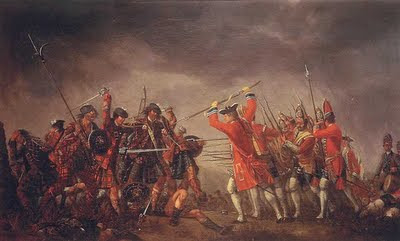
An incident in the rebellion of 1745, by David Morier

Another one of my historically inspiring painting's is, The Battle of Culloden 1746, by David Morier.
I've previously painted and owned armies for both the English and Scots, for the Battle of Culloden in both 15mm and 25mm. Due to lack of funds, I had to sell both. My fellow Reject, Postie buying them all. Although he now wants me to buy back the 25mm figures, I must admit to being sorely tempted, but my financial adviser, (the wife), doesn't seem to agree! Maybe one day eh? For some reason I seem to be drawn the Lace War period, at the moment I'm painting figures for both the Nine Years War and the French Indian Wars.
     This is a painting depicting the Battle of Culloden in 1746, during the Jacobite Rebellion of 1745, where the Jacobite army was defeated by Hanovarian troops. It was painted in 1746, not long after the battle. The artist is said to have used Jacobite prisoners for his models of the tartan, trews, and great kilt/belted-plaid wearing Jacobite soldiers, and for this reason the painting is considered a reliable depiction of Highland male clothing of the time. In particular, that some of the individual Jacobite soldiers are shown wearing several different tartan patterns all at the same time is considered a significant indication of the lack of a "clan tartan" concept at the time.
     The picture portrays the Jacobite attack on Barrells, The Kings Own Regiment of Foot, (later the 4th Foot), In a matter of minutes Barrells's regiment lost 17 men and suffered 108 wounded out of a total of 373 officers and men, including their commander Richard Rich who lost his left hand and nearly his right arm. Barrell's were smashed apart and temporarily lost their colours!

      David Morier was born at Bern, Switzerland. Nothing is known of his early career before 1743 when he was introduced to William Augustus, Duke of Cumberland, by Sir Everard Fawkener, possibly in Germany where the Duke was on campaign. His first notable painting was an equestrian portrait of George II (Royal Collection), with a view of the battle of Dettingen (27 June 1743) beyond, which was later engraved by Francis Simon Ravenet and published by the artist.

     Morier is principally known for small military equestrian portraits with battles or reviews in the background, including many of the duke of Cumberland and several of George II, and also for depictions of soldiers, detailing their uniform (principally in the Royal Collection and at Wilton House, Wiltshire). In 1746 he undertook a commission to commemorate the Duke's victory against the Jacobites, The Battle of Culloden (Royal Collection). The present work is likely to have been undertaken during the same period. In 1747 Morier accompanied his patron to the Low Countries, painting Royal Artillery in the Netherlands and a series of sixty pictures of the allied troops under the duke's command (all of which are in The Royal Collection). In 1751 the first British uniform regulations were issued by royal warrant and Morier, made Limner to the duke with a salary of £100, embarked on further series, including the light dragoon regiments raised in 1759 and 1760. When the Duke of Cumberland died in 1765, his second home, Cranbourn Lodge, Berkshire, housed 106 of these paintings and only works by Morier hung in the picture gallery.
     A founder member of the Society of Artists, Morier exhibited at its first show in 1760, and then in 1762, 1765, and 1768. In the mid-1760s he undertook an important commission for the earl of Pembroke, which included eight paintings of the 15th light dragoons. He also produced several small paintings for George III for 10 guineas apiece, but after June 1767 royal patronage ceased and he fell into financial difficulty from 1768 until he died at Clerkenwell, London, in early January 1770. He was buried on 8 January at St James's, Clerkenwell Green, at the expense of the Society of Artists.


Friday, 8 April 2011

Historically Inspiring No 4 The Death of General Wolfe

The Death of General Wolfe, by Benjamin West, 1770
OK, its official, I'm getting back into my long abandoned French Indian Wars project. I've got a quite large collection already but they're not finished yet, and in all truth probably won't be for some time. I've just finished painting up the 30 15mm figures for the British 55th foot and it's really got my juices going, they've been sitting in a box undercoated for a year, I bought the undercoat at last years Salute that's how I remember!. I fancied a break from painting Posties damn Napoleonic Russians, they driving me crazy, green, green, green and some more dark green!!!!
Anyway I was searching the web for a decent FIW picture, and came across probably the most iconic painting for the period, The Death of General Wolfe, by Benjamin West. It's a beautiful painting with tons of uniform detail and as it's painted only 11 years after the death of Wolfe you'd hope that the men portrayed were dressed historically accurate for the period. Here's a link to learn a little more about the artist Benjamin West, Link
As well as trying to keep the Mrs and the kids happy, work, painting Posties figures, trying to paint my own figures, I'm also currently trying to make some Indian longhouses, I'm quite pleased with the results so far, of course when they're done I'll take a few pics and post them here on the blog. I'm also doing a little research into FIW skirmish rules, I've already bought a few sets and am not sure what to do, I guess it means I may have to write my own, groan!!! As if I'm not busy enough already???
Have a great weekend everyone!!!!!
Ray

Monday, 21 February 2011

Historically Inspiring No 3 DAK motorcycle and sidecar

Motorbike with sidecar (BMW) and mounted MG34 of the
21st Panzer-Division, German Afrika Korps
Many moons ago, as a child my first foray into any type of wargame was the famous box of Airfix soldiers, me and my brother used to set the soldiers up then throw marbles at them, I shudder to think doing the same to my new rather expensive collection today. My favourite troops were the German Africa Corps, I don't know why but they were always the first troops I picked. Then one year as part of my 8th birthday I got a WWII kids colouring book, the black line drawings were all taken from photos of the war, its sad but I can still remember turning to page 16 and finding the picture above, I was in awe and coloured the picture with great care and delight. The picture then found pride of place next to my Leeds United team posters from Shoot magazine. Recently my pal The Angry Lurker bought loads of Flames of War figures, they looked great so I made that fateful decision to halt painting the 15mm FIW figures I had been furiously painting away and get some DAK and 8th army figures, I ploughed into both armies spending far too much money and time on them, near completion I came to my senses and sold the lot on ebay and at Tonbridge wargame show. I had mixed feelings after, Damn I shouldn't have sold them!!! but I needed the dosh to finish the FIW project I started the previous year. Then what did I do,... I talked myself into buying into another period along with my other pal Richard, 15mm NYW. What's it all about???

Saturday, 19 February 2011

Historically Inspiring No 2 Rush up the Anse du Foulon 1759


Another inspirational picture for your enjoyment, it's from one of my favourite periods, The French-Indian War or the Seven Years War in America. The pictures shows the mad scramble up Anse du Foulon, by the British army, on the 13th September 1759, trying to get foothold on the Plains of Abraham, which they did. This then led to the famous British victory at the Battle of Quebec.
My current project of the Nine Years War has put a temporary hold on my FIW 15mm skirmish figures, I will get back to them soon, fingers crossed!

Monday, 14 February 2011

Historically Inspiring No1 Napoleon, Near Moscow

There are countless Historical paintings and pictures online, that have, and do inspire me to get the painting brush out. Sometimes they have inspired me to spend my hard earned dosh on a completly new periods as I'm sure they have with some of you reading this now. So I thought I'd post a few of these pictures.
The first in the new series is "Napoleon, Near Moscow, waiting for a Boyer deputation by Vasili Vereshchagin.
I love the mood of this painting, the fog of battle, Napoleon, standing hands behind his back,  waiting alone while his army celebrate. I'm not sure if Napoleon looks as if  the weight of the world is on his still on his shoulders or a weight has just been lifted.


Napoleon, Near Moscow, waiting for a Boyer deputation
by Vasili Vereshchagin