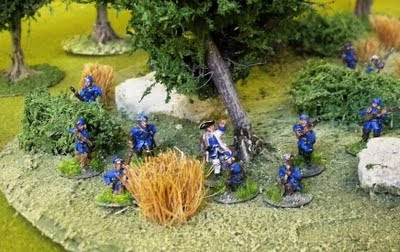
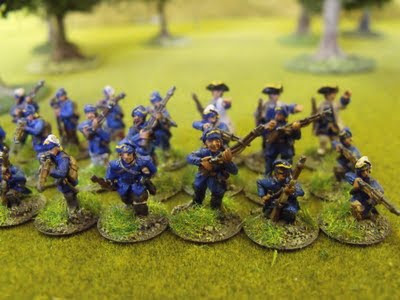
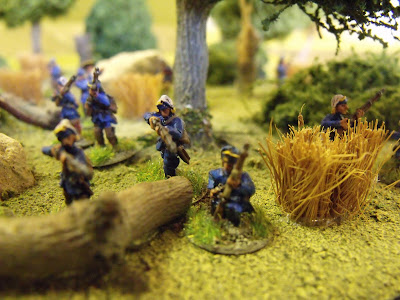
Another newly painted unit for my French & Indian project, these figures are from the new 15mm Blue Moon range and in my opinion they're some of the best out there. I only found one problem with the pack and that's that the three officers have a coat on, while all the rank and file are in their waistcoats, it would have been nice to have a few officers dressed in waistcoats too, but never mind I'm sure I'll cope!!
As their title suggests, the colonial regulars consisted of a number of independent companies with a variable establishment. By 1757, a company was ordered to consist of one captain, one lieutenant, two ensigns, three sergeants, four corporals, two cadets, two drummers, and fifty-four soldiers. In fact, the companies were chronically under strength, and Governor Vaudreuil's complaint in 1757 that the colonials were 250 men short was all too typical.
Some of the companies were formed into a battalion in 1757 for service with Montcalm's regular army battalions. Twenty-four companies of colonial regulars were stationed at Louisbourg during the 1750s, although Louisbourg was not even considered part of New France, but a separate colony of "Isle Royale" with its own establishment.
The assignments of colonial regulars varied greatly. Some were posted to garrison the major fortified cities of Quebec and Montreal, while others were subdivided into garrisons for the small fortified outposts guarding the frontiers and supply routes. Small detachments were sent to protect the advance trading posts, which supplied the profitable fur trade of New France.
Officers from the Compagnies Franches de la Marine were selected to organize and command war-parties of Canadian militia and their unpredictable Indian allies, for swift raids across the New England borders. These war-parties usually included at least one company of colonial regulars to provide a dependable disciplined nucleus for the improvised units.They became experienced bush fighters and a match for the Indians in their own hit-and-run style of fighting. Their skill in moving and fighting over the rugged Canadian terrain was far superior to that of the regular army units.
The colonial regulars formed the backbone of the French push down the Ohio valley, which began in 1752 to limit the westward expansion ofthe New England colonies. In July 1755, the operation culminated in the defeat of Major-General Edward Braddock's column of British regulars at The Battle of Monongahela by a mixed force of colonial regulars, militiamen, and Indians.
From February to April 1756, about 60 men from the Compagnies franches de la Marine took part to the expedition against Fort Bull which captured and destroyed the fort. From May to August, a few companies took part to the operations on Lake Ontario where the French captured and destroyed Fort Oswego. Several companies were also left at Carillon to defend the place until late October.
From January to March 1757, 300 men from the Compagnies Franches de la Marine took part to a raid on Fort William Henry, destroying the fleet of small vessels destined to the invasion of Canada. In July and August, a converged battalion of Compagnies Franches de la Marine accompanied Montcalm's force in his expedition against Fort William Henry which was captured and destroyed.
On March 13 1758, Indian scouts located a party of Rogers' Rangers near Fort Carillon. A small detachment of the unit was among the party sent against them. They skirmished with them in what later became know as Th Battle of Snow Shoes. In mid June, some 600 Troupes de la Marinewere ordered to move to Carillon. These troops were kept in reserve at Carillon with the 3rd battalion of Berry Infanterie. By mid July, additional companies had reached Carillon and Montcalm formed 2 battalions (Valterie and Lacorne) of 1,000 men each from the Troupes de la Marine. These units which also included some Canadians were placed under the command of M. de Rigaud. Valterie’s battalion encamped near the Fall while Lacorne's battalion was posted at the head of Lake Saint-Sacrement (actual Lake George) with orders to reconnoitre this lake. On July 8, several companies took part in the victorious battle of Carillon. Additional companies arrived during the battle and immediately joined the fight. At the beginning of September, Lacorne's battalion retired to the Fall leaving only 200 men to guard the outlet of Lake Saint-Sacrement. Between November 1 and 5, the entire French army quitted Carillon to move to its winter quarters, leaving detachments from various battalions to guard the fort.