ORIGINAL RELEASED ON LP LIBERTY LBS 83158
(UK, November 1968)
Note: Also released as "Urban Spaceman"
with that track added as the first one.
 The great lost psychedelic album. On their second album the Bonzos knock off the trad jazz parodies and pair their surreal lyrics and wild imaginations with rock music to match. Neil Innes still gets to sing the catchiest songs - "Beautiful Zelda", for instance, examines the perils of dating a space alien - but Vivian Stanshall beats him with what could be the band's mission statement, "My Pink Half Of The Drainpipe". Plus there's the amazing Love parody "We Are Normal" («and we dig Bert Weedon!»). The summit, though, is the too awesome for words "Rhinocratic Oaths", which, with its cheery narration («You should get out more, Percy, or you'll start acting like a dog, ha ha ... He was later arrested near a lamp-post») reveals the Bonzos ultimate truth: that there is nothing so lunatic as what passes for everyday life. (Hey, that Dada/Doo-Dah wasn't in their name for nothing.) If you have any spark of imagination or individuality, you must get this record. (in RateYourMusic)
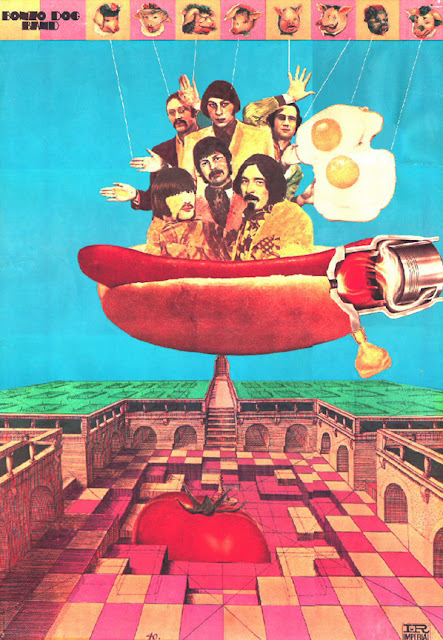
And now a little of history...
The Bonzo Dog Dooh Dah Band was formed in the period 1962-1965, named after George Studdy's famous 1920s/30s postcard puppy Bonzo Dog and the Dada anti-art movement. Their early success occurred in a number of London pubs and the club circuit of North-East England. They drew from the comedy and novelty songs of 1900-1930, wore 1920s garb and followed the eccentric music hall tradition in their antics and comic sketches, leading to comparisons with The Temperance Seven, Spike Jones and His City Slickers and Sid Millward's Nitwits. Besides, perhaps, the Mothers of Invention (with whom they were sometimes compared), the Bonzo Dog Band were the most successful group to combine rock music and comedy. Starting off as the Bonzo Dog Dada Band, then becoming the Bonzo Dog Doo-Dah Band, and then finally just the Bonzo Dog Band, the group was started by British art college students in the mid-'60s. Initially they were inclined toward trad jazz and vaudevillian routines, but by the time of their 1967 debut album, they were leaning further in pop and rock directions.
A brief appearance in the Beatles "Magical Mystery Tour" film bolstered their visibility, and Paul McCartney (under the pseudonym Apollo C. Vermouth) produced their single "I'm the Urban Spaceman," which reached the British Top Five in 1968. The Bonzos really hit their stride with their second and third albums, which found them adding elements of psychedelia to their already-absurdist mix of pop, cabaret, and Dada. The Bonzos could be side-splitting, but their records held up well because they were also capable musicians and songwriters, paced by Neil Innes and Viv Stanshall (both of whom wrote the lion's share of their best material). The group attempted to move into more serious and musical realms with their 1969 LP "Keynsham", which, unsurprisingly, was acclaimed as their weakest effort. They broke up shortly afterward; Viv Stanshall made some obscure solo recordings (he was also the grandstanding narrator on Mike Oldfield's "Tubular Bells"). Neil Innes collaborated with members of Monty Python, upon whom the Bonzos were a large influence, as well as writing the songs for and performing in the Beatles documentary spoof, The Rutles.