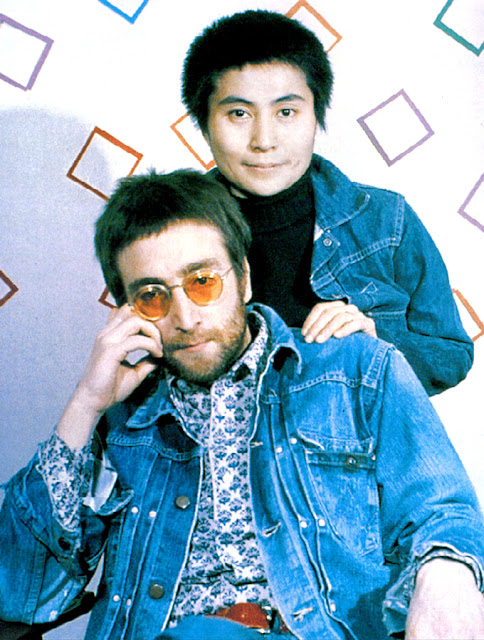
Together with his wife, Yoko Ono, John Lennon spent New Year 1970 in Aalborg, Denmark, establishing a relationship with Ono's former husband, artist Tony Cox, and visiting Cox and Ono's daughter Kyoko. The visit coincided with the start of what Lennon termed "Year 1 AP (After Peace)", following his and Ono's much-publicised bed-ins and other peace-campaign activities throughout 1969. To mark the new era, on 20 January 1970, the couple shaved off their shoulder-length hair, an act that Britain's Daily Mirror described as "the most sensational scalpings since the Red Indians went out of business". Lennon and Ono pledged to auction the shorn hair for a charitable cause, having similarly announced that they would donate all future royalties from their recordings to the peace movement. Also while in Denmark, the Lennons, Cox and the latter's current partner, Melinde Kendall, discussed the concept of "instant karma", whereby the causality of one's actions is immediate rather than borne out over a lifetime. Author Philip Norman writes of the concept's appeal: «The idea was quintessential Lennon – the age-old Buddhist law of cause and effect turned into something as modern and synthetic as instant coffee and, simultaneously, into a bogey under the stairs that can get you if you don't watch out.»

On 27 January 1970, two days after returning to the UK, Lennon woke up with the beginnings of a song inspired by his conversations with Cox and Kendall. Working at home on a piano, Lennon developed the idea and came up with a melody for the composition, which he titled "Instant Karma!" It just took him an hour to complete the writing, and then he telephoned bandmate George Harrison and American producer Phil Spector, who was in London at the invitation of the Beatles' Apple Corps manager, Allen Klein. According to Lennon's recollection, he told Spector: "Come over to Apple quick, I've just written a monster”. The recording session took place at Abbey Road Studios, on the evening of that same day. Lennon's fellow musicians at the session were Harrison (electric guitar), Klaus Voormann (bass), Alan White (drums) and Billy Preston (organ). Lennon later recalled of the recording: «Phil (Spector) came in and said, 'How do you want it?' And I said, '1950s' and he said 'Right' and BOOM! ... he played it back and there it was.»

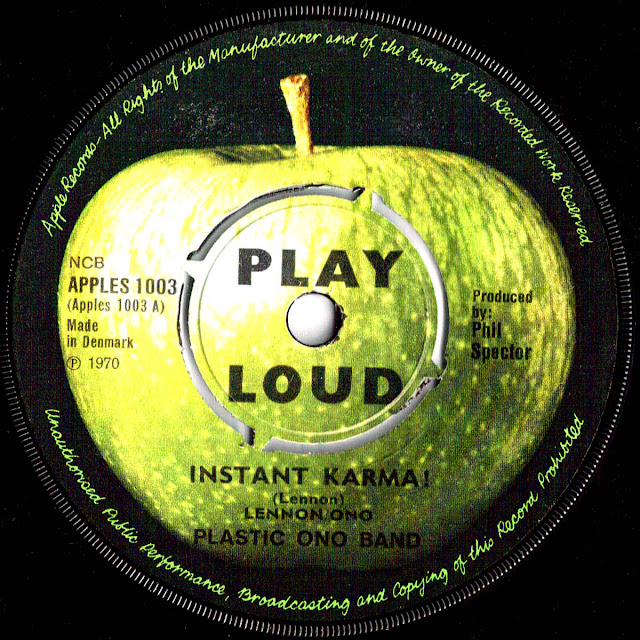
Apple Records issued the single on 6 February 1970 in Britain – credited to the Plastic Ono Band – and on 20 February in America, where the A-side was retitled "Instant Karma! (We All Shine On)" and credited to John Ono Lennon. Spector remixed "Instant Karma!" for the US release without Lennon's knowledge. On the B-side was Yoko Ono’s “Who Has Seen the Wind?”, wich was produced by Lennon. "Instant Karma!" was commercially successful, peaking at number 3 on America's Billboard Hot 100 chart, number 2 in Canada, and number 5 on the UK Singles Chart. The single also reached the top ten in several other European countries and in Australia. The release took place two months before Paul McCartney announced the break-up of the Beatles, whose penultimate single, the George Martin-produced "Let It Be", Lennon's record competed with on the US charts. "Instant Karma!" went on to become the first single by a solo Beatle to achieve US sales of 1 million, earning gold certification by the Recording Industry Association of America on 14 December 1970. Until Lennon's death in December 1980, "Instant Karma!" remained his sole RIAA-certified gold single.

In 1970, Lennon and Ono went through primal therapy with Arthur Janov in Los Angeles, California. Designed to release emotional pain from early childhood, the therapy entailed two half-days a week with Janov for four months; he had wanted to treat the couple for longer, but they felt no need to continue and returned to London. In July, Lennon started to record demos of songs he wrote that would show up on "John Lennon/Plastic Ono Band", and on one particular day, the 26th, Lennon recorded numerous demos of his song "God", which features the line "I don't believe in Beatles". Lennon's therapy was never completed due to the expiry of his US visa. With the experience he received from the therapy, he was able to channel his emotions into an album's worth of self-revelatory material. Recording began at Abbey Road Studios on the 26th September and ended one month later, using Lennon, Klaus Voormann, and Ringo Starr as the core musicians, with Phil Spector and Billy Preston each playing piano on a track. "Plastic Ono Band" refers to the conceptual band Lennon and Ono had formed in 1969 of various supporting musicians they would use on their various solo albums. Spector played piano on "Love" but Lennon and Ono produced the album largely on their own, as Spector was unavailable during most of the recording sessions. Spector mixed the album for three days towards the end of October.

The cliché about singer/songwriters is that they sing confessionals direct from their heart, but John Lennon exploded the myth behind that cliché, as well as many others, on this first official solo record, creating a harrowing set of unflinchingly personal songs, laying out all of his fears and angers for everyone to hear. "John Lennon/Plastic Ono Band" was received with high praise. Critic Greil Marcus remarked, «John's singing in the last verse of 'God' may be the finest in all of rock.» The album featured the songs "Mother", in which Lennon confronted his feelings of childhood rejection, and the Dylanesque "Working Class Hero", a bitter attack against the bourgeois social system which, due to the lyric "you're still fucking peasants", fell foul of broadcasters. The same year, Tariq Ali's revolutionary political views, expressed when he interviewed Lennon, inspired the singer to write "Power to the People".
Original released on LP Apple PCS 7124
(UK 1970, December 11)


 "John Lennon/Plastic Ono Band" was a revolutionary record - never before had a record been so explicitly introspective, and very few records made absolutely no concession to the audience's expectations, daring the listeners to meet all the artist's demands. Which isn't to say that the record is unlistenable. Lennon's songs range from tough rock & rollers to piano-based ballads and spare folk songs, and his melodies remain strong and memorable, which actually intensifies the pain and rage of the songs. Not much about Plastic Ono Band is hidden. Lennon presents everything on the surface, and the song titles - "Mother," "I Found Out," "Working Class Hero," "Isolation," "God," "My Mummy's Dead" - illustrate what each song is about, and chart his loss of faith in his parents, country, friends, fans, and idols. It's an unflinching document of bare-bones despair and pain, but for all its nihilism, it is ultimately life-affirming; it is unique not only in Lennon's catalog, but in all of popular music. Few albums are ever as harrowing, difficult, and rewarding as "John Lennon/Plastic Ono Band".
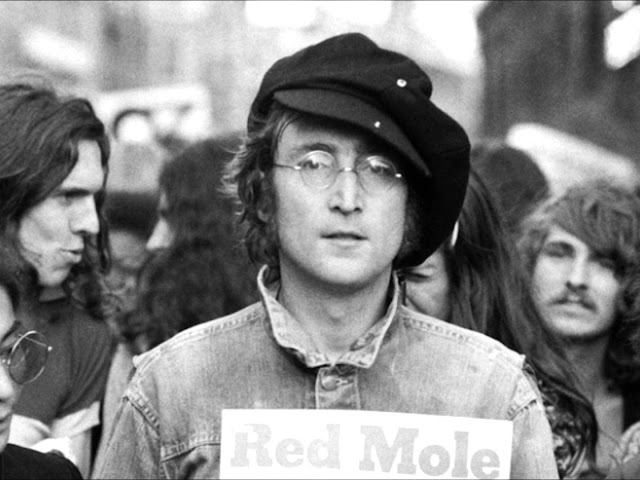

"Power to the People" was recorded at Ascot Sound Studios on 22 January 1971, during early sessions for Lennon's "Imagine" album. The single was released on 12 March 1971 in the UK and 22 March 1971 in the US. The song was written by Lennon in response to an interview he gave to Tariq Ali and Robin Blackburn, published in Red Mole. As Lennon explained: «I just felt inspired by what they said, although a lot of it is gobbledygook. So I wrote 'Power to the People' the same way I wrote 'Give Peace a Chance,' as something for the people to sing. I make singles like broadsheets. It was another quickie, done at Ascot.» Backing vocals were supplied by Rosetta Hightower and "44 others". Phil Spector, John Lennon, and Yoko Ono were credited as producers. The single (with Ono's "Open Your Box" on the B-side) was released on March 12 in the UK and on March 22 in the US. It was Lennon's fourth solo single. In April, Lennon also became involved during a protest against Oz magazine's prosecution for alleged obscenity. Lennon denounced the proceedings as "disgusting fascism", and he and Ono (as Elastic Oz Band) released the single "God Save Us/Do the Oz" (1971, July 7) and joined marches in support of the magazine.

Original released on LP Apple SW 3379
(US 1971, September 9)
 John Lennon closed the "Plastic Ono Band" album with his belief that "the dream is over". He opened his next album, "Imagine", by offering the world a new dream. Written in March 1971, the album's title track is the song most identified with John Lennon, his most beloved composition. The inspiration for "Imagine" came from a prayer book comedian-activist Dick Gregory gave John and Yoko. «It is in the Christian idiom,» John told Playboy, «but you can apply it anywhere. It is the concept of positive prayer. If you want to get a car, get the car keys. Get it? 'Imagine' is saying that.» The lyrics were also greatly influenced by Yoko's book Grapefruit. «In it are a lot of pieces saying, imagine this, imagine that,» John said. «Yoko actually helped a lot with the lyrics, but I wasn't man enough to let her have credit for it. I was still full of wanting my own space after being in a room with the guys, all the time, having to share everything.» "Imagine" was recorded over the course of seven days (June 23 > July 5) at Tittenhurst Park with additional recording at the Record Plant in New York, and John and Yoko once again co-producing with Phil Spector. When the album was released in September 1971, John and Yoko moved from England to New York City, where they took an apartment on Bank Street in Greenwich Village. «It's the Rome of today, a bit like a together Liverpool,» John said of New York. «I always like to be where the action is. In olden times I'd like to have lived in Rome or Paris or the East. The Seventies are gonna be America's.»
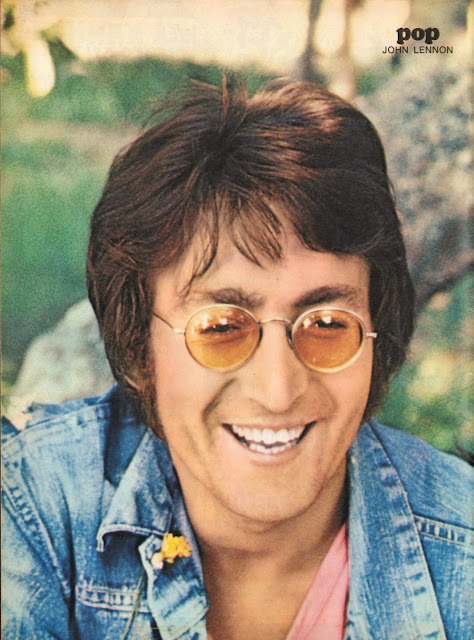
Like "Give Peace a Chance", "Imagine" became an anti-war anthem, but its lyrics offended religious groups. Lennon's explanation was, «If you can imagine a world at peace, with no denominations of religion - not without religion, but without this 'my god is bigger than your god' thing - then it can be true.» Critical response to the new album was more guarded. Rolling Stone reported that "it contains a substantial portion of good music" but warned of the possibility that "his posturings will soon seem not merely dull but irrelevant". "How Do You Sleep?", was a musical attack on McCartney in response to lyrics from "Ram" that Lennon felt, and McCartney later confirmed, were directed at him and Ono. However, Lennon softened his stance in the mid-1970s and said he had written "How Do You Sleep?" about himself. He said in 1980: «I used my resentment against Paul … to create a song … not a terrible vicious horrible vendetta […] I used my resentment and withdrawing from Paul and the Beatles, and the relationship with Paul, to write 'How Do You Sleep'. I don't really go 'round with those thoughts in my head all the time.»
Lennon and Ono moved to New York in August 1971, and in December released "Happy Xmas (War Is Over)". The song was the culmination of more than two years of peace activism undertaken by John Lennon and Yoko Ono that began with the bed-ins they convened in March and May 1969, the first of which took place during their honeymoon. The song's direct antecedent was an international multimedia campaign launched by the couple in December 1969 – at the height of the counterculture movement and its protests against America's involvement in the Vietnam War – that primarily consisted of renting billboard space in 12 major cities around the world for the display of black-and-white posters that declared "WAR IS OVER! If You Want It – Happy Christmas from John & Yoko". Although this particular slogan had previously appeared in the 1968 anti-war songs "The War Is Over" by Phil Ochs and "The Unknown Soldier" by the Doors (which features the refrain "The war is over"), its subsequent use by Lennon and Ono may just be coincidental; there is no evidence to confirm whether or not they were acquainted with these earlier works. Lennon was the first among the former Beatles to release an original Christmas song after the group disbanded in 1970. "Happy Xmas (War Is Over)" would be followed by George Harrison's "Ding Dong, Ding Dong" (1974), Paul McCartney's "Wonderful Christmastime" (1979) and Ringo Starr's album I Wanna Be Santa Claus (1999). From 1963 to 1969, the Beatles issued special recordings at Christmas directly to members of their fan club.

In early October 1971, with not much more than bare-bones melody and half-formed lyrics, Lennon recorded an acoustic guitar demo of "Happy Xmas (War Is Over)" in his suite at the St. Regis Hotel in New York City, where he and Ono were living at the time. Ono would receive co-writing credit, but the actual extent of her contribution at this initial stage is unclear since she did not participate in the demo, which was atypical of their collaborations. Another demo of the song was made in late October, after the couple had taken an apartment in Greenwich Village. As with his previous two albums, "John Lennon/Plastic Ono Band" and "Imagine", Lennon brought in Phil Spector to help produce. The first recording session was held the evening of Thursday, 28 October, at the Record Plant studio. After the session musicians – some of whom had performed at one time or another as members of the Plastic Ono Band – laid down the basic instrumental backing and overdub tracks, Lennon and Ono added the main vocals. One of the four guitarists present filled in for Klaus Voormann on bass when his flight from Germany was delayed. Ono and the session musicians, including Voormann, recorded the single's B-side, "Listen, the Snow Is Falling", the following day. The Harlem Community Choir – featuring thirty children, most of them four to twelve years of age – came to the studio on the afternoon of 31 October, to record backing vocals for the counter-melody and sing-along chorus. Photographs for the original sleeve cover were also taken during that session by Iain Macmillan.

Apple Records released "Happy Xmas (War Is Over)" in America on 1 December 1971 (Apple 1842). Issued in 7" single format on transparent green vinyl with a card-stock picture sleeve, the pressing bore two label variations, one of which displayed a sequence of five images that showed Lennon's face transforming into Ono's. This sequence was originally featured on the reverse cover of the exhibition catalogue for Ono's career retrospective This Is Not Here, presented in October 1971 at the Everson Museum of Art in Syracuse, New York. A dispute between music publisher Northern Songs and Lennon over publishing rights delayed the release of "Happy Xmas (War Is Over)" in the UK until 24 November 1972 (Apple R 5970). The initial British run was issued in 7" single format on opaque green vinyl with the picture sleeve and variant label, but it sold out quickly and had to be repressed on standard black vinyl.