Mostrar mensagens com a etiqueta tom waits. Mostrar todas as mensagens

segunda-feira, 3 de março de 2025

Lazy trip to heaven on the wings of your love


Original Released on LP Asylum 5061 
(US 1973, March 6)


Singer / songwriter / pianist Tom Waits is more than a chip off the Randy Newman block. Though he sounds like a boozier, earthier version of same and delights in rummaging through the attics of nostalgia, the persona that emerges from this remarkable debut album is Waits' own, at once sardonic, vulnerable and emotionally charged. His voice is self-mocking, bordering on self-pity, and most of his songs could be described as all-purpose lounge music... a style that evokes an aura of crushed cigarettes in seedy bars and Sinatra singing "One for My Baby." Though it would sound like an unpromising idiom in which to work, what Waits does with it is very daring and almost entirely successful. In both his songs and in his lazy, strolling piano playing, he parodies the lounge music sub-genre so perfectly that we wonder if he's putting us on or if he's for real, and it is his especial triumph that in the end he has it both ways: He is able to deliver whole both the truth and the sham of the music. (Stephen Holden in Rolling Stone)


Tom Waits' debut album is a minor-key masterpiece filled with songs of late-night loneliness. Within the apparently narrow range of the cocktail bar pianistics and muttered vocals, Waits and producer Jerry Yester manage a surprisingly broad collection of styles, from the jazzy "Virginia Avenue" to the up-tempo funk of "Ice Cream Man" and from the acoustic guitar folkiness of "I Hope That I Don't Fall in Love With You" to the saloon song "Midnight Lullaby," which would have been a perfect addition to the repertoires of Frank Sinatra or Tony Bennett. Waits' entire musical approach is stylized, of course, and at times derivative - "Lonely" borrows a little too much from Randy Newman's "I Think It's Going to Rain Today" - and his lovelorn lyrics can be sentimental without being penetrating. But he also has a gift for gently rolling pop melodies, and he can come up with striking, original scenarios, as on the best songs, "Ol' 55" and "Martha," which Yester discreetly augments with strings. "Closing Time" announces the arrival of a talented songwriter whose self-conscious melancholy can be surprisingly moving. (William Ruhlmann in AllMusic)

domingo, 17 de maio de 2020

"One From The Heart" - OST (Special Edition)

Original released on LP CBS 70215
(Europe, February 1982)


This is a special edition of the soundtrack from Francis Coppola's mythical movie. I've always adored "One From the Heart" and that's the reason I've extended in July 1999 the original album into this one, adding dialogues from the movie and also 2 bonus tracks by Tom Waits. So, if you are a fan of the movie you must profit this occasion to get something unique, which you won't find anywhere else.
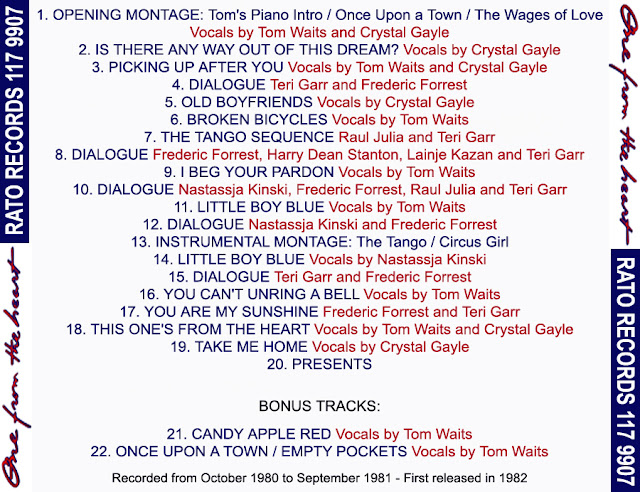
"One From the Heart" is the score to the most misunderstood of Francis Ford Coppola's films. Far ahead of its time in terms of technology, use of color, montage, and set design, its soundtrack is the only thing that grounds it to earth. Coppola's movie is a metaphorical retelling of the exploits of Zeus and Hera set in Las Vegas. Coppola claims to have been taken with the male-female narrative implications of the track "I Don't Talk to Strangers," off Tom Waits' "Foreign Affairs" album. That cut was a duet with Bette Midler. Midler wasn't available for "One From the Heart", however, so Waits chose Crystal Gayle as his vocal foil. The result is one of the most beautifully wrought soundtrack collaborations in history. Along with producer Bones Howe, Waits and Gayle cut their duets largely from the studio floor, live with the small combo-style studio band that included the saxophonist Teddy Edwards, drummer Shelly Manne, trumpeter Jack Sheldon, pianist Pete Jolly, and bassist Greg Cohen, among others. 
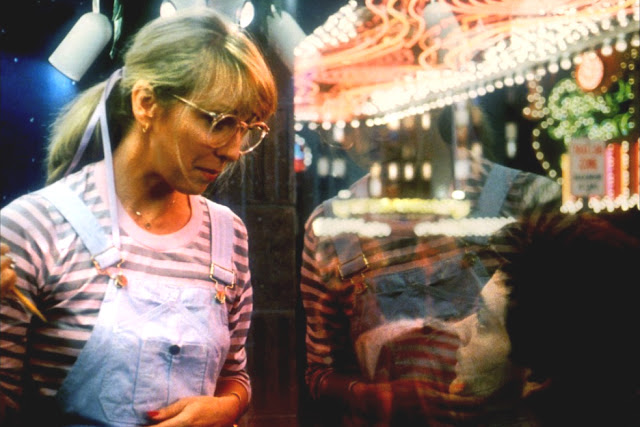

The opening cut, a Waits piano intro that flows into the duet "Once Upon a Town," is a study in contrasts: first there are the stark ivories and the tinkle of a coin falling upon a bar before Waits' then-still-smoky baritone (now ravaged indescribably) entwines with Gayle's clear, ringing, emotionally rich vocal, and then joined by Bob Alcivar's string orchestrations before giving way to a jazzed-out down-tempo blues, where the pair sing in call-and-response counterpoint about the disappointments in life and love.
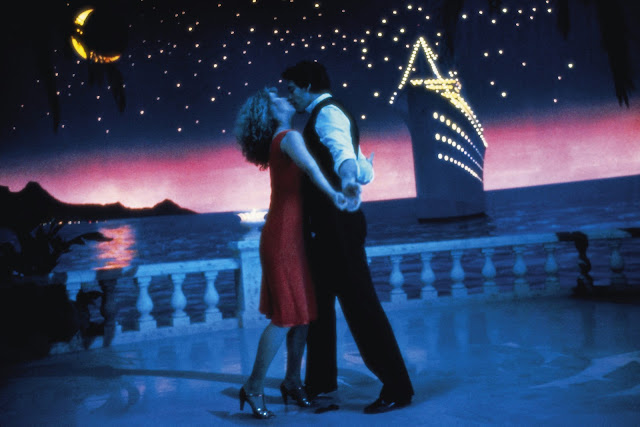

These are echoed a couple of tracks later in another duet, "Picking Up After You," which is the ultimate starstruck breakup tune. And while there are only four duets on the entire set, they are startling in their ragged intimacy, contrasted with a stark yet elegant atmosphere and cool noir-esque irony. Gayle's solo performances on the set, which include the mournfully gorgeous "Is There Any Way out of This Dream," with beautiful accompaniment in a tenor solo by Edwards, and the shimmering melancholy of "Old Boyfriends," are among the finest in her long career. 
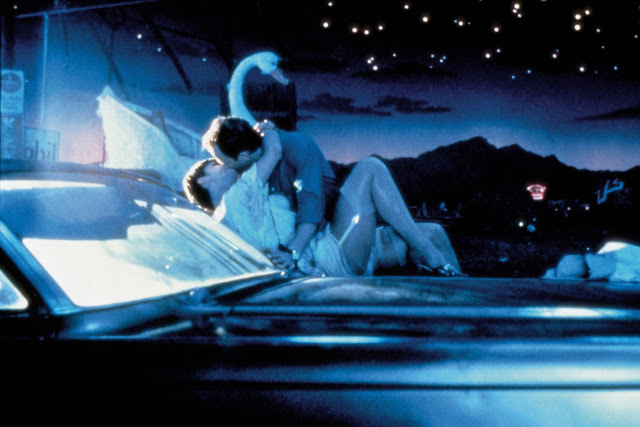

For his part, Waits' "I Beg Your Pardon" and "You Can't Unring a Bell" fit deftly into his post-beat hipster canon, though they are offered with less droll irony and more emotionally honest flair here than they would have if they were on his own solo recordings. Likewise, the piano and vocal duet of "Take Me Home" offers Waits' piano as a canny and intuitive counterpart to the deep sensuality of Gayle's vocal. "One From the Heart" is a welcome addition to any soundtrack library to be sure, but also an essential one to the shelf of any Waits or Gayle fan. (Thom Jurek in AllMusic)


domingo, 17 de março de 2019

TOM WAITS: "Foreign Affairs"

Original released on LP Asylum K 53068
(UK, September 1977)

Tom Waits' fifth album for Asylum foreshadowed changes that would alter his career over the next six years. It signals a musical restlessness that fueled his next two records ("Blue Valentine" and "Heartattack and Vine2), and resulted in his writing a film score and leaving the label for Island, where he was given greater artistic control. He leans less on comic relief here and more on fully formed story songs. The album contains more ballads than most of his records do, but they were the most effective vehicles for the kind of storytelling he was trying to get to. The song "I never Talk to Strangers" inspired director Francis Ford Coppola to shape the characters for his film "One from the Heart" (he also convinced Waits to score it, leading to Waits' iconic collaboration with Crystal Gayle). Produced and engineered by Bones Howe, "Foreign Affairs" was recorded live in studio by a quintet that included West Coast jazzmen Jack Sheldon on trumpet, saxophonist Frank Vicari, bassist Jim Hughart, and drummer Shelly Manne. Further accompaniment was provided by an orchestra arranged and conducted by Bob Alcivar. Introduced by the instrumental "Cinny's Waltz," which sounds like a cinematic cue, it's followed by the bluesy, alone-on-a-Saturday-night longing expressed in "Muriel." The aforementioned "I Never Talk to Strangers" is a duet with Bette Midler. It offers a lyric dialogue between two beleaguered veterans who find themselves (again) the last patrons in a bar at closing time. 

Their clever, direct exchange is sweetened by smoky tenor sax flourishes, swelling strings, and brushed snares behind Waits' piano. He doesn't discard his Beat Generation influences, though. Check the fingerpopping swinging medley of his "Jack & Neal," with Al Jolson's "California, Here I Come" as a travel guide to a gone-daddy-gone road trip. The ghost traces of "Tom Traubert's Blues (Four Sheets to the Wind in Copenhagen)" are heard in a borrowed melody from a saloon waltz with a cupful of bittersweet nostalgia in the lovely "A Sight for Sore Eyes." The lengthy "Potters Field" checks the harmonic charts of Richard Rodgers' theme for "Slaughter on Tenth Avenue" and Gershwin's "Rhapsody in Blue" (with Gene Cipriano's clarinet) before digging deep into sparse, noirish, blues-jazz. Its lyric is as dark and dramatic as "Small Change (Got Rained on with His Own 38)," creating a narrative worthy of a Sam Fuller film. "Burma-Shave" is a solo piano and vocal paean to the memories of drives Waits took with his father through life's seedy side. While the funky blues-cum-rhumba in "Barber Shop" adds swagger and pop to Waits' post-beat lyricism, the closing title track returns to the ballad to offer a bittersweet meditation on the perspective of "home": What it represents in the heart as opposed to what it actually is - all from a guy living at the Tropicana Motor Hotel. "Foreign Affairs" is one of the most unjustifiably overlooked titles in Waits' catalog. It holds its appeal - and sounds less dated - than many of his more popular entries. (Thom Jurek in AllMusic)

sábado, 16 de março de 2019

TOM WAITS: "Nighthawks At The Diner"

Original released on Double LP Asylum SYSP 903
(UK, October 1975)

Tom Waits' first two albums, 1973's "Closing Time" and 1974's "The Heart of Saturday Night", documented his estimable strengths as a songwriter, but they didn't always give much of a sense of the personality that came through in his live performances. In front of an audience, Waits transformed himself into something resembling a minor character from a Jack Kerouac novel, a witty but bedraggled hipster from the seedy side of Los Angeles. His third album, 1975's "Nighthawks at the Diner", was designed to show off Waits as an entertainer as well as a tunesmith; producer Bones Howe set up a nightclub facsimile in a recording studio, paired Waits with a solid band of jazz-inclined studio musicians, brought in an audience, and recorded what was in essence his first live album. As entertainment, "Nighthawks at the Diner" is one of Waits' most thoroughly enjoyable albums. He's clearly jazzed by the presence of an audience, and his skills as a storyteller are marvelous. Much like Lou Reed's Live: Take No Prisoners, this is an album where the between-song patter sometimes outshines the songs, and there's no arguing that Waits is a very funny guy who plays brilliantly to a crowd, spinning eccentric, evocative tales of life on the bad side of town that make it all sound like a ball. The band is excellent, too; bassist Jim Hughart, drummer Bill Goodwin, pianist Mike Melvoin, and sax player Pete Christlieb give Waits the ideal three-a.m. ambience to bring the songs to life. If "Nighthawks at the Diner" has a flaw, it's that Waits' beatnik spiel sometimes overwhelms the music, and a number of the "songs" are more spoken word routines than anything else. But "Better Off Without a Wife" and "Nobody" show he hadn't lost the ability to write a memorable song, sing it all the way through, and make it connect. And if this plays more like a "show" than a "concert," it's a show you'd gladly pay to hear more than once. "Nighthawks at the Diner" is a must for Tom Waits fans, and while beginners might not get as strong a sense of his music as they would from many of his other albums, it's hard to imagine anyone not being charmed by it. (Mark Deming in AllMusic)

terça-feira, 5 de março de 2019

A Small Change For Tom

Original released on LP Asylum 7E 1078
(US, October 1976)

The fourth release in Tom Waits' series of skid row travelogues, "Small Change" proves to be the archetypal album of his '70s work. A jazz trio comprising tenor sax player Lew Tabackin, bassist Jim Hughart, and drummer Shelly Manne, plus an occasional string section, back Waits and his piano on songs steeped in whiskey and atmosphere in which he alternately sings in his broken-beaned drunk's voice (now deeper and overtly influenced by Louis Armstrong) and recites jazzy poetry. It's as if Waits were determined to combine the Humphrey Bogart and Dooley Wilson characters from Casablanca with a dash of On the Road's Dean Moriarty to illuminate a dark world of bars and all-night diners. Of course, he'd been in that world before, but in songs like "The Piano Has Been Drinking" and "Bad Liver and a Broken Heart," Waits gives it its clearest expression. "Small Change" isn't his best album. Like most of the albums Waits made in the '70s, it's uneven, probably because he was putting out one a year and didn't have time to come up with enough first-rate material. But it is the most obvious and characteristic of his albums for Asylum Records. If you like it, you also will like the ones before and after; otherwise, you're not Tom Waits' kind of listener. (William Ruhlmann in AllMusic)

Tonight'll Be Like Nothin' You've Ever Seen


Original released on LP Asylum 7E-1015
(US, October 1974)


If "Closing Time", Tom Waits' debut album, consisted of love songs set in a late-night world of bars and neon signs, its follow-up, "The Heart of Saturday Night", largely dispenses with the romance in favor of poetic depictions of the same setting. On "Diamonds on My Windshield" and "The Ghosts of Saturday Night," Waits doesn't even sing, instead reciting his verse rhythmically against bass and drums like a Beat hipster. Musically, the album contains the same mixture of folk, blues, and jazz as its predecessor, with producer Bones Howe occasionally bringing in an orchestra to underscore the loping melodies. Waits' songs are sometimes sketchier in addition to being more impersonal, but "(Looking For) The Heart of Saturday Night" and "Semi Suite" are the equal of anything on "Closing Time". Still, with lines such as «...the clouds are like headlines/Upon a new front page sky» and references to «a 24-hour moon» and «champagne stars,» Waits' imagery is beginning to get florid, and in material this stylized, the danger of self-parody is always present. (William Ruhlmann in AllMusic)
Related Posts Plugin for WordPress, Blogger...