Mostrar mensagens com a etiqueta who. Mostrar todas as mensagens

sábado, 30 de maio de 2020

THE WHO: "The Who Sell Out" (DeLuxe Edition - mono + stereo + bonus tracks)

Original released on LP Track 613 002
(UK 1967, December 16)

Pete Townshend originally planned "The Who Sell Out" as a concept album of sorts that would simultaneously mock and pay tribute to pirate radio stations, complete with fake jingles and commercials linking the tracks. For reasons that remain somewhat ill defined, the concept wasn't quite driven to completion, breaking down around the middle of side two (on the original vinyl configuration). Nonetheless, on strictly musical merits, it's a terrific set of songs that ultimately stands as one of the group's greatest achievements. "I Can See for Miles" (a Top Ten hit) is the Who at their most thunderous; tinges of psychedelia add a rush to "Armenia City in the Sky" and "Relax"; "I Can't Reach You" finds Townshend beginning to stretch himself into quasi-spiritual territory; and "Tattoo" and the acoustic "Sunrise" show introspective, vulnerable sides to the singer/songwriter that had previously been hidden. "Rael" was another mini-opera, with musical motifs that reappeared in "Tommy". The album is as perfect a balance between melodic mod pop and powerful instrumentation as the Who (or any other group) would achieve; psychedelic pop was never as jubilant, not to say funny (the fake commercials and jingles interspersed between the songs are a hoot). [Subsequent reissues added over half a dozen interesting outtakes from the time of the sessions, as well as unused commercials, the B-side "Someone's Coming," and an alternate version of "Mary Anne with the Shaky Hand."] (Richie Unterberger in AllMusic)

THE WHO 2nd Album

Original released on LP Reaction 593 002 (mono)
(UK 1966, December 3)

The Who's second album is a less impressive outing than their debut, primarily because, at the urging of their managers, all four members penned original material (though Pete Townshend wrote more than anyone else). The pure adrenaline of "My Generation" also subsided somewhat as the band began to grapple with more complex melodic and lyrical themes, especially on the erratic mini-opera "A Quick One While He's Away." Still, there's some great madness on Keith Moon's instrumental "Cobwebs and Strange," and Townshend delivered some solid mod pop with "Run Run Run" and "So Sad About Us." John Entwistle was also revealed to be a writer of considerable talent (and a morbid bent) on "Whiskey Man" and "Boris the Spider." (Richie Unterberger in AllMusic)

THE WHO Debut Album (mono + DeLuxe Edition)


Original released on LP Brunswick LAT 8616 (mono)
(UK 1965, December 3)


An explosive debut, and the hardest mod pop recorded by anyone. At the time of its release, it also had the most ferociously powerful guitars and drums yet captured on a rock record. Pete Townshend's exhilarating chord crunches and guitar distortions threaten to leap off the grooves on "My Generation" and "Out in the Street"; Keith Moon attacks the drums with a lightning, ruthless finesse throughout. Some Maximum R&B influence lingered in the two James Brown covers, but much of Townshend's original material fused Beatlesque hooks and power chords with anthemic mod lyrics, with "The Good's Gone," "Much Too Much," "La La La Lies," and especially "The Kids Are Alright" being highlights. "A Legal Matter" hinted at more ambitious lyrical concerns, and "The Ox" was instrumental mayhem that pushed the envelope of 1965 amplification with its guitar feedback and nonstop crashing drum rolls. While the execution was sometimes crude, and the songwriting not as sophisticated as it would shortly become, The Who never surpassed the pure energy level of this record.


The history behind the making of "My Generation" is an interesting one.  Initially, The Who recorded an album comprised mostly of cover material, the songs they had been playing in their live set.  Before the album’s scheduled release date, June 1965, advanced copies were forwarded to the music press for review.  When the critics reacted negatively to the lack of original material The Who’s management team, Kit Lambert and Chris Stamp, along with producer, Shel Tamly, postponed the release and asked Pete Townshend come up with some more songs.  What Pete returned with was solid gold and The Who’s debut LP, "My Generation", was released six months later.  It’s kinda strange when you think about it, but here’s one instance where we may owe music critics some thanks.


terça-feira, 26 de maio de 2020

THE WHO Last Album

Original released on CD Polydor 7743036
(EU 2019, December 6)


It's not billed that way but given the Who's productivity since their initial split in 1982, it's difficult not to view 2019's "Who" as the band's final album. It's only their second album in 37 years, and if it takes them another 13 years to complete a third - that's the length of time separating "Who" from 2006's "Endless Wire" - both Pete Townshend and Roger Daltrey will be well into their eighties, a seemingly unlikely age for new work by rockers. Then again, the Who have long outlived Townshend's youthful desire to die before he gets old, a fact he began to contend with during the mid-'70s, when he chronicled his middle-aged disappointment on "Who by Numbers". "Who" doesn't sound much like "Who by Numbers". Keith Moon and John Entwistle are long gone, Daltrey's voice has been sanded away to a gravelly rumble, and Townshend found himself rejuvenated by playing with bassist Pino Palladino and drummer Zak Starkey. A different rhythm section along with the aftermath of aging does mean "Who" feels polished and precise, but if the group has swapped kinetic energy for professionalism, they're not exactly settled. Much of the credit should go to Townshend, who continues to wrestle with emotions and ideas that are just outside his grasp, setting his struggle to music equal parts muscle and mark. There are a few new wrinkles, such as the smooth, soulful "I'll Be Back," the album's most romantic moment. It's one that's needed. Elsewhere, Townshend attempts to find his place in a world in turmoil, coming to terms that he's fine with the passing of time, but that doesn't prevent him from throwing barbs. Daltrey responds in kind, treating the songs with care and respect. Age has diminished his range but increased his sensitivity, a combination that benefits "Who", since he handles vulnerable moments like "Break the News" with sensitivity and mines "All This Music Must Fade" and "I Don't Wanna Get Wise," discovering their undercurrent of defiance. After all these years, it becomes clear that the relationship between Daltrey and Townshend - the singer serving as the songwriter's best interpreter and editor - is at the core of the Who, which is why "Who" feels like a Who album: The two still bring out the best in each other. (Stephen Erlewine in AllMusic)


domingo, 25 de agosto de 2019

The ROLLING STONES Rock And Roll Circus

Original released on CD ABKCO 1268-2
(UK, October 1996)

The "Rolling Stones Rock and Roll Circus" became a thing of legend when the Rolling Stones refused to air it. Recorded in early December 1968, the show became famous for several reasons before it was officially released in 1996. First, fans of the Who were allegedly in for a treat with a performance of their mini-rock-opera "A Quick One While He's Away." Second, it featured an appearance by a supergroup known as the Dirty Mac, consisting of John Lennon and Eric Clapton on guitar, Keith Richards on bass, and Mitch Mitchell (of the Jimi Hendrix Experience) on drums. Last, it reportedly featured the last appearance of Brian Jones with the Rolling Stones before his death. This just had to be great. Right?! Well, in retrospect it is easy to see why this was shelved. the Who's performance is tight, but not as exciting as some claim it to be. Jethro Tull and Marianne Faithfull's performances are dull. The Dirty Mac is just okay, worth it mainly to hear Keith Richards play some thumpin' bass, an instrument he only turned to on occasion. (I must admit that I love the loathed "Whole Lotta Yoko" - I am clearly the target audience for that shit!) the Rolling Stones' set is relatively listless, save for "Parachute Woman," which is a revelation, far and away better than the version on "Beggars Banquet". They even mime over "Salt of the Earth," which is unfortunate. Probably the best thing on here apart from "Parachute Woman" is Taj Mahal's banger "Ain't that a Lot of Love," which gives the album a pulse it is lacking elsewhere. This expanded edition, available officially on vinyl for the first time, sounds fantastic. The bonus material is largely mediocre, of historical interest only, though the Dirty Mac's "Warmup Jam" provides some sloppy fun. Diehard fans of the various groups represented here will all probably claim to like this more than they really do. The event, with its ill-conceived circus theme, the Stones' version of Magical Mystery Tour (which at least had some brilliant music), is nothing more than a decent set of performance across what amounts to a missed opportunity. (in RateYourMusic)


This is the most interesting archival release of the Rolling Stones since "More Hot Rocks", 20 years ago, and the first issue of truly unreleased material by the Stones from this period. And the Stones have some competition from the Who, Taj Mahal, and John Lennon on the same release. Filmed and recorded on December 10-11, 1968, at a North London studio, "Rock and Roll Circus" has been, as much as the Beach Boys' Smile, "the one that got away" for most '60s music enthusiasts. The Jethro Tull sequence is the standard studio track, but the rest - except for the Stones' "Salt of the Earth" --is really live. The Who's portion has been out before, courtesy of various documentaries, but Taj Mahal playing some loud electric blues is new and great, the live Lennon rendition of "Yer Blues" is indispensable, and the Stones' set fills in lots of blanks in their history - "Jumpin' Jack Flash" in one of two live renditions it ever got with Brian Jones in the lineup, "Sympathy for the Devil" in an intense run-through, "Parachute Woman" as a lost live vehicle for the band, "You Can't Always Get What You Want" as a show-stopping rocker even without its extended ending (no Paul Buckmaster choir), and "No Expectations" as their first piece of great live blues since "Little Red Rooster." (Bruce Eder in AllMusic)

terça-feira, 23 de abril de 2019

"See me, Feel me, Touch me, Heal me..."


Original Releases:
US - 2 LP Decca DXSW 7205 (1969, May 17)
UK - 2 LP Track 613 013/4 (1969, May 23)


From the blows of the album’s opening number “Overture”, "Tommy" makes its mark as a unique concept record. For one thing, at the time it was written, concept albums were scarce and wild, its predecessor only being "Sgt. Pepper’s", from the Beatles. What’s so unique about "Tommy" is that sounds different from the other Who records because of being volatile and electric, like the other Who records, "Tommy" happens to be somewhat laid back in comparison. Townshend trades his electric guitar which he smashed on stage, for a humble acoustic guitar on a good percentage of the tracks on "Tommy". And when he does play his electric guitar, rather than making it raw, punky, and obnoxious by using massive amounts of feedback, his electric playing is made to seem grandiose and dramatic, with a thespian presentation by limiting the playing to explosive chords and by dividing them into quick picks of four.

John Entwistle has dropped his wowing bass playing for a more grounded role, more often than not standing silent in the background. But he adds his ox flair with his ostentatious trumpeting. He makes the militant theme with his flair on trumpet, and slowly emerges as quite the brass player. Keith Moon is what he’s always been - a coked up crazy man who drives his Rolls Royce into swimming pools, but justifies his actions with some absolutely insane drumming. Sure, it might be a little unruly and random, but his talent on drums is very well received and quite frankly, awesome. And another thing very different about "Tommy" as well is that Townshend also takes up the role of lead vocals much more often than on other Who albums.


Pete Townshend's own candid telling of the story of "Tommy"'s conception. was the zenith (and, ultimately, the end) of his creative partnership with the band's producer / manager Kit Lambert. Lambert's utter belief in Pete's ability to take a bunch of West London mods into a studio to forge a coherent statement that came to be known as 'rock opera' was the fire that lit the fuse. Townshend had already attempted the concept format with his semi-successful "A Quick One". In reality this and "Tommy" had much in common.


Both showed the composer to be fast outgrowing his r 'n' b roots to become an accomplished explorer of themes and moods. ("Tommy"'s true glory lies in its extended instrumental passages that, while being a little repetitive, blend themes gloriously). And both had librettos which were, somewhat shakey. Yet, while "A Quick One" concerned a woman's extra marital affair with a train driver, "Tommy" took itself slightly more seriously. In fact, the quality so roundly hits you between the eyes that you wonder how on earth anyone put up with anything less over these three decades. Every slip, every bum note and every wobbly vocal merely makes it more precious. Tommy we can hear you…


Pete Townshend possibly feels a lot like David O. Selznick, the producer of the movie "Gone With The Wind" in fearing that he will only be remembered in his obituary by his creating that one work, as Townshend, like Selznick, seems to have been spending his time after completing their most important work in trying to top it. To my mind, Townshend should have no regrets about not topping "Tommy", as it is easily one of the two or three most important albums and works in the entire Rock canon, similar in importance and possibly superior in quality to "Sg. Pepper's Lonely Hearts Club Band" and "Blonde on Blonde", to name just two others high in the ranks of great Rock albums. Some writers have said that "Tommy" is more like an Oratorio or a Song Cycle than it is an Opera, but I disagree. Neither of these other two genres requires a plot, and an Opera does, and "Tommy" has a plot. I prefer to think of it as a selection of arias and instrumental passages from which some bridging dialogue has been left out. My biggest problem with this plot is that the actual event that triggers "Tommy"'s autism is only hinted at in the most vague of terms.


It is easy to believe that it was a murder, but the lyrics of 'You Didn't Hear It' never come even close to saying exactly what the event was. On the other side of the coin, the great majority of the songs on the album "Tommy" directly support carrying the story forward. Practically the only exception is the Sonny Boy Williamson classic "Eyesight to the Blind". It is probably symptomatic that only "Pinball Wizard", "I'm Free", and "Sensation" out of the 24 cuts in "Tommy" really work for the Who outside the context of the whole work. It is also interesting to see that the two cuts describing episodes of sadism were written by Entwistle and not Townshend. Listening to this album reminds one just how much their performances were a collaborative effort between the original four, and how much we miss Keith Moon and John Entwistle today. We can only say that with "Tommy" and numerous other works and recorded performances, the memory of the Who will live forever.

terça-feira, 6 de novembro de 2018

THE WHO: "Odds & Sods" (12 Bonus Tracks)

Original released on LP Track 2406 116
(UK, October 1974)
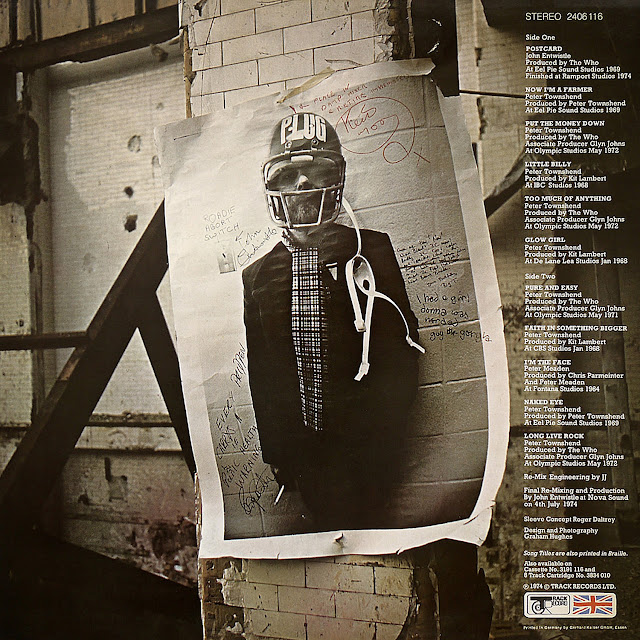
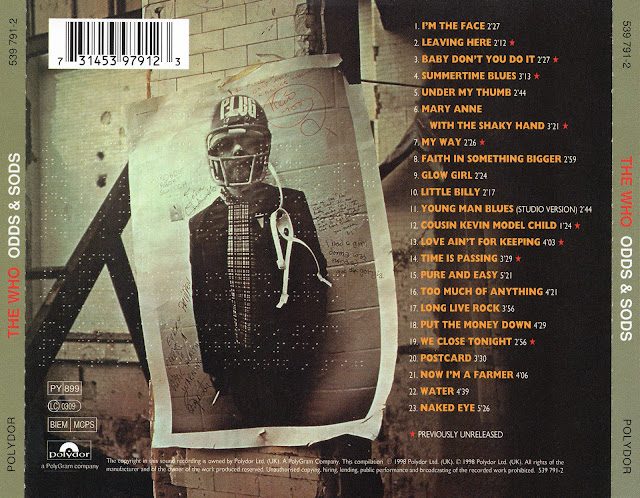
A bonus review for a bonus album - fair, wouldn't ya say? This was a collection of outtakes, rarities and other such collectors' items released originally to fill a free year, then re-released in 1998 with more than twice as many tracks for the obsessives and completionists. There's a rough, though not rigid, chronological order here. We start with "I'm The Face" - a pleasant little R&B tune that was one side of the first single The Who ever released, back when they were called The High Numbers - and we end with "Naked Eye", a song that can also be found on the bonus track edition of "Who's Next". As far as I can tell, there aren't any outtakes from the "Quadrophenia" sessions, although "Water" has enough dull musicianship and rawk gawd posturing to sound like one. Aside from that one, though, the "Who's Next" outtakes are pretty much all totally awesome, and a couple of 'em even sound better than some of the album tracks. What did we do to deserve "Gettin' In Tune" instead of "Put The Money Down"? The latter's great - it's all mountainous and monolithic like the best songs on that album, but it's also got some convincingly macho swagger and a nice sense of humour. "Time Is Passing" ain't bad either, though the country 'n' western parody at the beginning is maybe a leetle too arch for a bunch of middle-class Englishmen. Then again, they don't shy away from self-parody on this thing either - just listen to "Long Live Rock"! Ridiculous tune, but it pretty much entirely eliminates the need for AC/DC's "Rock And Roll Ain't Noise Pollution", and, come to think of it, does a great job parodying just about every single 80s hair metal band before any of them even existed. It's no necessity, but as far as joke songs go it ain't bad at all.
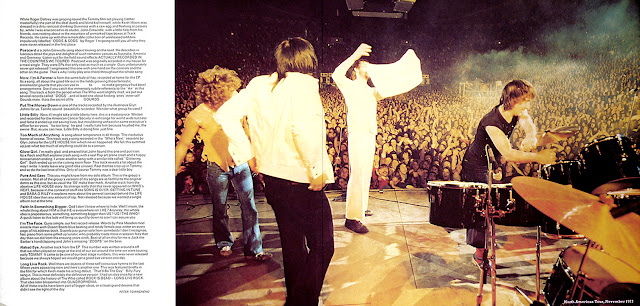
Most of the other stuff is kinda scattered. There are two more joke songs: "Now I'm a Farmer", notable mostly for some lead vocal silliness from Moon, and "Little Billy", which sounds like a silly Entwistle song even though Townshend apparently wrote it. There's also "Cousin Kevin Model Child", which I guess is a joke song of some kind, but which elicited a verbal, audible reaction of 'What the fuck is this shit?' from me when I heard it; skip it, and also skip the studio version of "Young Man Blues" (super corny imitation-American accents ruin it), the rock version of "Mary Anne With the Shaky Hand" (no less boring for all the rocking - in fact, possibly more boring for being longer), "Too Much of Anything" (too much of nothing, more like), and "My Way" (a fairly generic Eddie Cochran cover). There's a bunch of other stuff which is only really interesting from a historical perspective, like "Leaving Here" (Daltrey's first attempt at machismo on the mic), "Faith In Something Bigger" (a perfectly pleasant early pop tune that ultimately lacks identity), and "Under My Thumb" (a cover of the Rolling Stones song that fails because it's one of those songs only Mick Jagger could sing properly). 
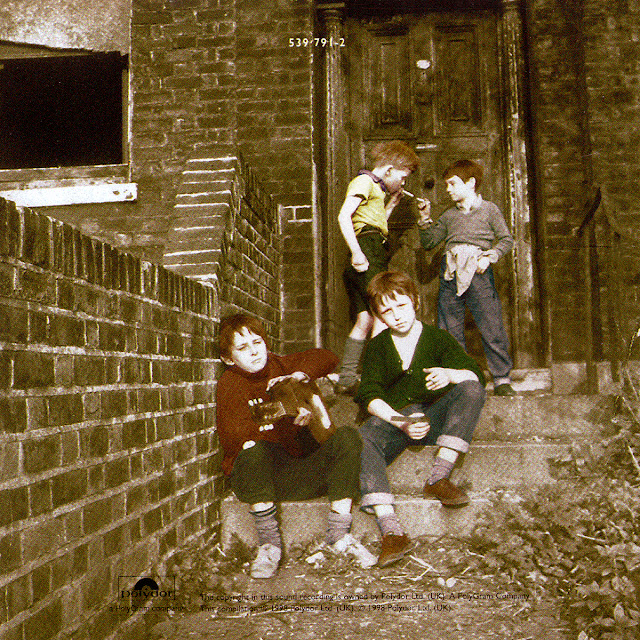

There are, however, some gems buried here: "Baby Don't You Do It", which contains some excellent drunken angst-over-breakup from Daltrey and some more of that destructive guitar feedback Townshend left behind after the debut; "Glow Girl", which is a nice, psychy little pop tune that ends on a genderswapped version of that "it's a boooy, Mrs. Walker, it's a boooy" bit from "Tommy" (no idea which was written first); "Pure And Easy", which sounds kind of like one of them endearingly corny Yes pop songs from their earlier albums; and "We Close Tonight", which confuses me because it's got elements you tend to find in early Who songs coexisting with the trappings of their later stuff, but which sounds cool anyway. The three I haven't commented on - the studio version of "Summertime Blues", the rock version of "Love Ain't For Keeping" and the Entwistle tune "Postcard" - are all unspecial, unremarkable but nonetheless pretty good tracks that wouldn't stink up your collection if you felt the need to have 'em. Also, I can't deny that it's kind of interesting to hear The Who's career trajectory represented here in miniature; in just an hour and 20 minutes you get pretty much the entire story of The Who's existence up to this point, and it's a nice reminder that they were, for all their faults, a supremely interesting and unique band that were never content to remain in one place for very long. Vitality flows through the veins of this record, even on the bad songs - let's just see how long they could keep that up... (in RateYourMusic)
domingo, 28 de outubro de 2018

THE WHO - "Who's Next" (+ 7 Bonus Tracks)

Original released on LP 
Decca 79182 (US 1971, August 14)
Track 2408.102 (UK 1971, August 25)

Much of "Who's Next" derives from Lifehouse, an ambitious sci-fi rock opera Pete Townshend abandoned after suffering a nervous breakdown, caused in part from working on the sequel to "Tommy". There's no discernable theme behind these songs, yet this album is stronger than "Tommy", falling just behind "Who Sell Out" as the finest record the Who ever cut. Townshend developed an infatuation with synthesizers during the recording of the album, and they're all over this album, adding texture where needed and amplifying the force, which is already at a fever pitch. Apart from "Live at Leeds", the Who have never sounded as LOUD and unhinged as they do here, yet that's balanced by ballads, both lovely ("The Song Is Over") and scathing ("Behind Blue Eyes"). That's the key to "Who's Next" - there's anger and sorrow, humor and regret, passion and tumult, all wrapped up in a blistering package where the rage is as affecting as the heartbreak. This is a retreat from the '60s, as Townshend declares the "Song Is Over," scorns the teenage wasteland, and bitterly declares that we "Won't Get Fooled Again." For all the sorrow and heartbreak that runs beneath the surface, this is an invigorating record, not just because Keith Moon runs rampant or because Roger Daltrey has never sung better or because John Entwistle spins out manic basslines that are as captivating as his "My Wife" is funny. This is invigorating because it has all of that, plus Townshend laying his soul bare in ways that are funny, painful, and utterly life-affirming. That is what the Who was about, not the rock operas, and that's why "Who's Next" is truer than "Tommy" or the abandoned Lifehouse. Those were art - this, even with its pretensions, is rock & roll. (Stephen Erlewine in AllMusic)
Related Posts Plugin for WordPress, Blogger...