Showing posts with label MONSTER MUSIC. Show all posts

Saturday, March 2, 2024

KRAFTWERK MEETS CALIGARI


Musical interpretations of the first feature length horror movie, DAS CABINET DES CALIGARI (THE CABINET OF DR. CALIGARI, USA, 1920) have been numerous, including works by Giuseppe Becce (now lost), Walter Sickert, In the Nursery and ex-composer/guitarist for BE BOP DELUXE, Bill Nelson. Now, one-time member of the seminal German electronic band, Kraftwerk, Karl Bartos has thrown his beret in the ring with his own score.

After I gave it a listen, I found it to be exquisite and to be one of, if not the best I've heard. This article from ELECTRONIC SOUND (February 2024) discusses both the film and its influence on cinema, as well as Bartos talking his composition.


Karl Bartos discussing his score:

Friday, March 18, 2022

NOSFERATU ELECTRIC GUITAR!


Can you believe it? Just announced by ESP guitars is their super limited Nosferatu edition. Designed by Dumitru "Dino" Muradian, and created using a unique hand-burned technique, on 15 of these bloodsuckers will be made.


Believe it or not, this is not the first Nosferatu guitar that ESP has produced. A couple of years ago Mettalica's Kirk Hammett, who himself is a huge horror fan, had a signature edition made.


And, if  you've got an extra 20 minutes to spare, here is a guitarist's collection of other horror-themed electric guitars from ESP:

 -ESP/LTD KH 602 Custom Graphic "MUMMY"
 - ESP/LTD KH 602 Custom Graphic "BRIDE OF FRANKENSTEIN"
 - ESP/LTD KH "NOSFERATU"
 - ESP/LTD KH-WZ "WHITE ZOMBIE"
 - ESP/LTD HORROR SERIES "THE PREDATOR"
 - ESP/LTD HORROR SERIES "ZOMBIEFEST"
 - ESP/LTD BELA LUGOSI "TALES FROM THE GRAVES"
 - ESP/LTD BELA LUGOSI SINGLE CUT
 - ESP/LTD BELA LUGOSI Custom Graphic " BRAM STOKER DRACULA"
 - ESP - E-II - M-II BNF " BLACK NATURAL FADE"


Thursday, January 13, 2022

PAURA IS "FEAR" IN ITALIANO


Released by Decca Records on October 1, 2021 on CD and vinyl, "Paura: A Collection of Italian Horror Sounds" is a set of mostly short pieces from the soundtracks of Eurohorror films during their heyday from the 70's and 80's. Distinctive for their moody and atmospheric melodies and ambient sounds, they remain popular, in large part due to the work of Ennio Morricone and Goblin. The title, "Paura", is the italian term for "fear".

From Decca Records:
PAURA explores the horror repertoire from the precious CAM Sugar archives taking us on a hypnotic journey into the labyrinths of fear, through the different variations that Italian horror took on from the esoteric and supernatural to the slasher films of the early 1970s; to reinterpretations of Romantic literature and gothic fiction to the splatter films of the ‘80s; and from witchcraft to metropolitan horror This is not a real “best of” but an eclectic menu full of mysterious voices, childlike lullabies, sweet melodies, obsessive music boxes, obstinate harpsichords, crazy distortions and threatening synthesizers, conceived as a succession of sequences, as if a film edit The new collection includes some of the most creative music ever written and strives to do justice not only to some of the best known composers in this genre, but also to many great unsung composers: From celebrated composers like Ennio Morricone, Riz Ortolani & Stelvio Cipriani to long-forgotten personalities who fed the industrial backbone of Italian cinema such as Daniele Patucchi, Marcelo Giombini & Berto Pisano Includes 6 previously unreleased tracks plus 3 tracks released on vinyl for the first time and 5 tracks available commercially for the first time (originally released only as a limited promo item)

TRACKLIST:
  1. Ennio Morricone – Mio Caro Assassino from MIO CARO ASSASSINO / MY DEAR KILLER (1971)  
  2. Bruno Nicolai – La Notte che Evelyn Uscì dalla Tomba (Long Version) feat. Edda Dell’Orso from LA NOTTE CHE EVELYN USCÌ DALLA TOMBA / THE NIGHT EVELYN CAME OUT OF THE GRAVE (1971)  
  3. Bruno Nicolai – La Dama Rossa Uccide Sette Volte (Edit) from LA DAMA ROSSA UCCIDE SETTE VOLTE / THE RED QUEEN KILLS SEVEN TIMES (1972)  
  4. Stelvio Cipriani - Tribal Shake from REAZIONE A CATENA / A BAY OF BLOOD (1971)  
  5. Stelvio Cipriani – Il Sesso del Diavolo (Finale) from IL SESSO DEL DIAVOLO / SEX OF THE DEVIL (1971)
  6. Stelvio Cipriani – Deviation - M1 from DEVIATION (1971)  
  7. Riz Ortolani – L’Etrusco Uccide Ancora (Titoli) from L’ETRUSCO UCCIDE ANCORA / THE DEAD ARE ALIVE! (1972)  
  8. Daniele Patucchi – Giallo in Tensione from FRANKENSTEIN ‘80 (1972) 
  9. Ennio Morricone – Ansimando feat. Edda Dell’Orso from MACCHIE SOLARI / AUTOPSY (1975)  
  10. Manuel De Sica - Black Dream from MYSTERY TOUR (1985)  
  11. Paolo Gatti, AlfonSo Zenga – Cerro Torre from CESARE MAESTRI: IL RAGNO DELLE DOLOMITI (1980)  
  12. Berto Pisano - Greta from LA MORTE HA SORRISO ALL’ASSASSINO / DEATH SMILES ON A MURDERER (1973)  
  13. Sante Maria Romitelli - Bambola Sensuale from LA ROSSA DALLA PELLE CHE SCOTTA / THE SENSUOUS DOLL (1972)
  14. Adolfo Waitzman – Languidamente from PENSIONE PAURA / HOTEL FEAR (1978)  
  15. Nico Fidenco – Il Demonio in Convento from IMMAGINI DI UN CONVENTO / IMAGES IN A CONVENT (1979)  
  16. Ettore De Carolis - Flavour of Death from IL CAVALIERE, LA MORTE E IL DIAVOLO (1983)  
  17. Marcello Giombini – Un Gioco per Eveline – M11 from UN GIOCO PER EVELINE (1971) 
  18. Carlo Maria Cordio - Absurd from ROSSO SANGUE / ABSURD (1981)  
  19. Stelvio Cipriani – Devil Dance – 1:20 performed by Goblin from UN’OMBRA NELL’OMBRA / RING OF DARKNESS (1979)  
  20. Daniele Patucchi – E Tanta Paura – M2 from E TANTA PAURA / PLOT OF FEAR (1976)
  21. Marcello Giombini – Orinoco: Prigioniere del Sesso – M19 from ORINOCO: PRIGIONIERE DEL SESSO (1980)
  22. Franco Micalizzi - Bargain With The Devil #3 from CHI SEI? / BEYOND THE DOOR (1974) 
  23. Stefano Liberati - The Prophecy (Vers. A) from I PENSIERI DELL’OCCHIO (1978)  
  24. Luigi Ceccarelli – Walking Through The Shadows from DIFENDIMI DALLA NOTTE (1981)  
  25. Daniele Patucchi – Minaccia Sulla Città – from BELVE FEROCI / WILD BEASTS (1984)
Purchase the CD or LP at Decca Records.

Preview Paura below:


Saturday, September 11, 2021

LULLABY FROM THE BLACK LAGOON


Bah-Bah-Baaa! Who can forget this brassy, 3-note blast that announces the titular character in THE CREATURE FROM THE BLACK LAGOON whenever he appears on screen? The most famous of the Universal monster movies of the 1950's, the film was also complimented by a great soundtrack composed by Henry Mancini (!), Herman J. Salter, Herman Stein, Milton Rosen and Robert Emmett Dolan. It was Stein who wrote the signature cue for the Creature.

Back in the late 90's and early 2000's, the market exploded with a slew of monster movie soundtracks from different sources. One company in particular, Monstrous Movie Music, was responsible for releasing numerous complete lost gems from horror and science-fiction films.

CREATURE FROM THE BLACK LAGOON (AND OTHER JUNGLE PICTURES) was released in 2000. It included the complete score for CFTBL, cues from the MGM Tarzan films and the score for THE ALLIGATOR PEOPLE. Makes for great listening, folks, when you're in the mood for a for a movie soundtrack.
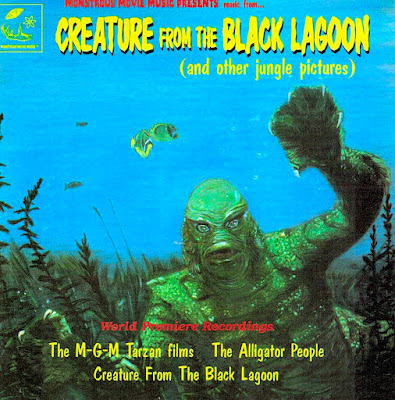

MMM-1952     Total Time: 64:28
 
The M-G-M Tarzan films (1934 - 1942)
(Tarzan And His Mate, Tarzan Escapes, Tarzan Finds A Son!, Tarzan's Secret Treasure,Tarzan's New York Adventure)
(Herbert Stothart, Sol Levy, William Axt, David Snell, Daniele Amfitheatrof)  [5:07]

  1. Fanfare  (Snell)/A Cannibal Carnival  (Levy)  (1:35)
  2. In The Woodland  (Stothart)  (1:16)
  3. Tarzan Montage  (Snell)  (:26)
  4. End Title  (Amfitheatrof)  (:13)
  5. New End Cast  (Stothart)  (:30)
  6. My Tender One  (Axt)  (1:07)

Creature From The Black Lagoon (1954)
(Herman Stein, Henry Mancini, Milton Rosen, Hans Salter, Robert Emmett Dolan) [35:34]Creature Masks

  7. Main Title  (Stein)  1:17
  8. Prologue  (Stein)  1:48
  9. The Webbed Hand  (Stein)  :33
10. The Diver  (Mancini)  1:07
11. Marine Life  (Mancini)  :30
12. Almost Caught  (Salter)  1:19
13. Digger’s Failure  (Mancini)  :48
14. Unknown River  (Mancini)  1:09
15. Tale Of The Mermaid  (Dolan)  1:06
16. Salvage Of The Lady Luck  (Rosen)  4:05
17. Duke’s Little Helper  (Mancini)  :34
18. Kay And The Monster, Part 1  (Stein)  2:35
19. Kay And The Monster, Part 2  (Stein)  1:51
20. Tony Visits Port Royale, Part 1  (Stein)  1:50
21. Brad Rescues Tony, Part 2  (Rosen)  1:22
22. Henry’s Trap  (Rosen)  :50
23. Clay Meets A Badman  (Rosen)  2:25
24. That Hand Again  (Stein)  1:02
25. Monster Caught  (Mancini)  1:04
26. Minyora’s Plan  (Mancini)  :59
27. Monster Gets Mark, Part 1  (Mancini)  2:14
28. Monster Gets Mark, Part 2  (Mancini)  2:49
29. End Title  (Salter)  1:54
30. End Cast  (Stein)  :27

The Alligator People  (1959)
 (Irving Gertz)    [16:16]

31. Main Title  2:00Our Mascot!
32. Truth Serum  1:51
33. Shocker (Part II)  :47
34. Dark Memories  :59
35. The Swamp  1:12
36. Cobalt Bomb  1:11
37. His Mother  1:05
38. Shocker (Part I)  1:24
39. Get That Gator  :21
40. Alligator Head  1:54
41. Paul’s Death, Part I  :46
42. Paul’s Death, Part II  :57
43. The End  :17
44. Alligator Piano  1:28

 (Valeria Kellyova, solo piano)
 (Terry Glenny, electric violin)

45 - 49: “Bonus tracks!”

What sealed the deal for me on this purchase, was this sheet music with the Creature's signature theme and signed by Herman Stein!


Saturday, October 31, 2020

A SONG FOR HALLOWEEN


For me, outside of Bobby "Boris" Pickett's "Monster Mash", "It's Halloween!" exemplifies the holiday more than any other, mainly because of it's minor-key, slightly creepy tune and one that was played on a turntable (yes, an actual turntable) when I was in elementary school in the early 1960's. I recall the recording was sung by a man, the melody, and some of the lyrics -- the rest is just a fading, pleasant and nostalgic memory.

The song seems to have survived as a perennial favorite for kids as I have seen references from people on forums who mention hearing it in school as late as the 1990's.

The lyrics were written by Harry Behn and the music was by Milton Kaye. "Halloween" is included in the songbook, "Music Now and Long Ago", published in 1956.

Here is Behn's bio from the Library of Congress:

Harry Behn was born September 24, 1898, in Yavapai County, Arizona. He graduated from Harvard University with an S.B. in 1922. He worked as a scenario writer for motion pictures and was chiefly associated with King Vidor’s films. Behn taught writing at the University of Arizona from 1938 to 1947 and founded the University of Arizona Press in 1960. He published his first book of poetry, Siesta, in 1931, and, at the urging of his children, began writing children’s books. In 1949, he published The Little Hill, a book of poetry for children. Behn wrote and translated poetry for children, especially haiku, and drew on the poetic heritage of Robert Louis Stevenson in his use of the “child’s voice,” as well as on what critics called “a thread of transcendentalism.” He also wrote fiction for older children and young adults, including The Faraway Lurs (1963). Behn illustrated many of his works and received several graphic arts- awards for his artwork. He died on September 6, 1973.

These are the lyrics, as accurately as I can ascertain:

It's Halloween!
by Harry Behn

Tonight is the night
When dead leaves fly
Like witches on switches
Across the sky,
When elf and sprite
Flit through the night
On a moony sheen.
It's Halloween!

Tonight is the night
When leaves make a sound
Like a gnome in his home
Under the ground,
When spooks and trolls
Creep out of holes
Mossy and green.
It's Halloween!

Tonight is the night
When pumpkins stare
Through sheaves and leaves
Everywhere,
When ghouls and ghost
And goblin host
Dance round their queen.
It's Halloween!

If you want to play it yourself, here is a sample of the sheet music from singingamesforchildren.com:


And here is the song performed by Dany Rosevear on YouTube, who looks like a kindly old schoolteacher! There are other versions of the melody out there, but this one is from the original songbook.


BONUS! Here is another Halloween poem by Behn that I came across on the web (punctuation mine):

Ghosts
by Harry Behn

A cold and starry darkness moans
And settles wide and still,
Over a jumble of tumbles stones,
Dark on a darker hill.

An owl among those shadowy walls,
Gray against gray,
Of ruins an brittle weeds, calls
And a soundless swoops away

Rustling over scattered stones,
Dancers hover and sway,
Drifting among their own bones
Like the webs of the Milky Way.

HAPPY HALLOWEEN, EVERYBODY!

Friday, October 9, 2020

THE HAUNTED SEANCE OF DR. DRUID


Some may think that the Monster Craze ended with the decade of the 1960's, but not so! Monsters and other creepy things continued on well into the seventies.

One of the memorable sidelines from this era was the multitude of "Halloween albums" that were produced.

Wholly unique was this 1973 recording (with sleeve art by Ron Cobb) from the Electric Lemon Record Company entitled, DR. DRUID'S HAUNTED SEANCE. Now considered by collectors as rare (one is currently being offered on eBay for $129), it has popped up now and again as a digital copy (see below).


From Electric Lemon Records CD re-issue:
Spirits Abound! Spooks Around! A Spook show in your parlor!

An classic gem from the vaults now on CD! Doctor Druid is back ... and has he got a paranormal haunted séance for you. You will now be able to resume spirit séances in your very own parlor with the return of the original Doctor Druid, the world's most renown psychic, spiritualist, and parapsychologist extraordinaire! Once a popular  LP record album available from James Warren's Famous Monsters Of Filmland Captain Company, Doctor Druid's Haunted Séance is now digitally remastered from the original tape master in CD form for your enjoyment, edification, amusement, amazement, and fright!

This unique CD is all you need to haunt your house (or Castle, or parlor, or tomb), as it comes complete with progressive demonstrations of supernatural emanations, inexplicable transmogrifications, paranormal incantations, plus a real live apparition!

Sound like fun? Trust us, it is!   Druid's Haunted Séance CD is a good old fashioned séance in the purest sense of the word, and with easy instructions and very little preparation, you can throw a séance that will delight, astound, spookify and terrify your friends!

Perfect for any paranormal house haunting. Make spirit contact with our spirit! Doctor Druid's Haunted Séance is the CD that will make you the spookologist of all spookdom! Performed by none other than the ethereal Doctor Druid himself, this is the kind of phenomenal spirit "happening" that you and Doctor Druid can do together.

Doctor Druid's Haunted Séance runs a full half-hour but your guests might be running long before that! The recording is a ghost show unto itself! Produced by Verne Langdon and Milt Larsen (he who built the magic castle). Liner notes by Forrest J Ackerman and cover by Ronn Cobb. Recorded with paranormal pride in a haunted séance parlor in Horrorwood, Karloffornia.

Compact Disc in Jewel case

Originally recorded in 1974

CD released in 2008

Electric Lemon Record Company (USA)


Tracklist
A1 Introduction
A2 Music Of The Mind
A3 Auditory Test
A4 Concentration
A5 Hypnotism
B The Haunted Seance


Credits 
Manufactured By – Lemon Records
Published By – Brookledge Music Co.
Record Company – Electric Lemon Record Co.
Copyright (c) – Electric Lemon Record Co.
Co-producer [Associate Producer] – Sandy Spillman
Cover [Art] – Ron Cobb
Engineer – Paul Elmore
Executive-Producer – Milt Larsen
Featuring [Paris Opera Pipe Organ] – Erik (Verne Langdon)
Liner Notes – Forrest J. Ackerman
Producer, Composed By [Haunted Seance Suite] – Verne Langdon

Notes
Notice: This record is intended for entertainment purposes only; responsibility for any psychic phenomenon which may occur (either directly or indirectly) as a result of playing this record will not be assumed by the manufacturer.

Side 1 Duration - 13:01
Side 2 Duration - 16:25


A Dr. Druid mask was even produced by Verne Langdon.

From his website:
DR DRUID MASK
$285.00
From the macabre mind of Verne Langdon and the arcane artistry of Ron Cobb come’s a truly one of a kind mask. now equipped with glow in the dark features, this is a must have!


Thursday, June 25, 2020

I'M IN LOVE WITH A MONSTER!


How about a song? This upbeat, infectious tune by Fifth Harmony from HOTEL TRANSYLVANIA 2 is sure to provide you with a little -- and probably much-needed -- pick me up.

Sunday, July 7, 2019

HOW THE EXORCIST CHANGED THE SOUND OF HORROR FILM SCORES


The question has been asked: "Why do so many horror film scores sound similar to 1973's THE EXORCIST? The answer lies with Poland's greatest living composer, Krzysztof Penderecki. whose work was used in the film. It is so remarkably suitable for horror films his compositions were also used by Kubrick in THE SHINING and Lynch in TWIN PEAKS. Since then soundtracks have been inspired and influenced by Penderecki, including most recently in the recent Netflix film, BIRD BOX.


Friday, June 21, 2019

RARE GREEN SLIME 45 RPM PROMO RECORD

`

It's amazing what movie studios would come up with to promote their films. This odd gem, sold at auction, was a recording of the kooky theme song from THE GREEN SLIME. The record had a "Not For Sale" notice on the label, so it may have been distributed for free at select theaters.


Following is the description from the auction house:

The Green Slime (MGM, 1969). Promo 45 Record. Science Fiction.
A special disc jockey record featuring music by Richard Delvy from the motion picture The Green Slime. One side features the song "The Green Slime," the other features "From Beyond the Stars." Starring Robert Horton, Luciana Paluzzi, Richard Jaeckel, Bud Widom, Ted Gunther, David Yorston, Robert Dunham, Gary Randolf, Jack Morris, Linda Hardisty, Kathy Horan, Ann Ault, Linda Miller, Patricia Elliott, and Tom Scott. Directed by Kinji Fukasaku. An unrestored 45 record with bright color and a clean overall appearance. Very Fine-.

Sold for $74.00 in 2012.

Friday, June 14, 2019

WHEN WHALE MET WAXMAN -- WHAT MUSIC THEY MADE


Torn again: How James Whale and Franz Waxman made a monster score


Sometimes a story is just too good to summarize. Case in point: when I came across this post at the Chicago Symphony Orchestra's website, I knew it needed to be shared with MMW's readers. It tells of James Whale meeting composer Franz Waxman in 1934 and Whale's brilliant decision to hire him to score THE BRIDE OF FRANKENSTEIN.

PUBLISHED OCTOBER 11, 2018 Authored by Dennis Polkow.

The Chicago Symphony Orchestra presented the world-premiere “live” performance of Franz Waxman’s score to James Whale’s “Bride of Frankenstein” (1935) during Halloween week in 2008 under Richard Kaufman, with Waxman’s son, John, in attendance. This season’s live-to-picture performance on Oct. 26 of “Bride” by the CSO will be conducted by Emil de Cou and also will  include a bonus screening of Mel Brooks’ “Young Frankenstein” (1974). 

On a cloudy Memorial Day in 1957, James Whale was found lying face down at the bottom of the swimming pool of his Pacific Palisades home. In a scene as meticulously crafted as any the fastidious 67-year-old British director filmed, Whale was immaculately dressed in his best blue suit and had left a copy of the novel Don’t Go Near the Water by his bedside in a last bit of gallows humor.

A hand-written two-page suicide note was addressed “To ALL I LOVE,” and carefully explained that while he had a “wonderful life” behind him, his “nerves were shot” and he was “in agony day and night” except when he was heavily medicated and that “the future is just old age and illness and pain.” Asking forgiveness and leaving assurances that his financial affairs were in order, which he hoped would “help my loved ones to forget a little,” Whale asked that he be cremated so that “no one will grieve over my grave.”

Sadly, Whale never lived to see the renewed interest in his films that would result from “Frankenstein” (1931) and “Bride of Frankenstein” being sold to television less than a year after his suicide. The fascination with these films helped spawn a Baby Boomer pop culture phenomenon: the creation of monster magazines, monster models, trading cards, board games, sweatshirts and the like mere months after Whale’s watery plunge.

“What is astonishing about James Whale was the way that he virtually created the modern horror film genre out of thin air,” said James Curtis, author of the biography James Whale: A New World of Gods and Monsters (1998; updated, 2003). “Lon Chaney had played a series of grotesque and deformed characters during the silent era who were often sympathetic, but none of them were truly supernatural. Bela Lugosi’s ‘Dracula’ was supernatural, but there was nothing sympathetic about the character. With Whale, for the first time, you have a monster in ‘Frankenstein’ who was supernatural and sympathetic.”

In addition to “Frankenstein” and its far more elaborate sequel, “Bride of Frankenstein,” Whale also directed “The Old Dark House” (1932) and “The Invisible Man.” So powerful were those films that although these were the only “horror” films Whale ever made and represent only a fraction of his filmography, he would be indelibly associated with the genre as a result.

Actress Gloria Stuart, who died in 2010 at the age of 100, was the leading lady in “The Old Dark House” and “The Invisible Man” as well as Whale’s “The Kiss Before the Mirror.” After director James Cameron heard Stuart’s lively, improvised commentary on a 1995 restoration release of “The Old Dark House” on laser disc, he cast her as Old Rose in “Titanic” (1997); Stuart received an Oscar nomination for her role in Cameron’s blockbuster.

“I adored him,” Stuart told me of Whale in 1997. “He was a real actor’s director. I worked twice with [director] John Ford, and there was no comparison. Ford would just say, ‘action,’ and left you on your own. With James, everything you were to do had been carefully thought through and worked out in the most minute detail. He was a ‘hands-on’ director in that he was into every aspect of the picture: makeup, costumes, scenery, lighting, props: everything. He was always meticulous, discerning and helpful.”

When Whale did the original “Frankenstein” in 1931, “talkies” were still a novelty and were treated much like stage plays with the attention on spoken dialogue. While musical accompaniment had fulfilled a constant narrative role in silent films, early sound films went largely without music during talking scenes so dialogue could be heard. When “Frankenstein” became a blockbuster and a larger budget was possible for a much more epic sequel, Whale knew that he wanted music to be a primary element. Rather than be used merely for credits and a few transitions, Whale envisaged a sweeping score setting the tone of each scene, and swelling and pulling back alongside action and dialogue. It became one of the earliest templates for a virtually through-composed Hollywood “soundtrack” in the contemporary sense still in use today.

In 1934, at a weekly Sunday salon hosted by writer Salka Viertel for Hollywood European refugees, Whale met German composer Franz Waxman (1906-1967), who had orchestrated and conducted Frederick Hollander’s score for Josef von Sternberg’s classic “The Blue Angel” (1930), which introduced Marlene Dietrich to American audiences. As a result, Waxman was hired to compose a score for Fritz Lang’s film version of “Liliom” (Lang had already left Germany as the Nazis came to power), which led to Waxman’s invitation to Hollywood to arrange the Jerome Kern score for “Music in the Air” (1934).

Whale admired Waxman’s score for “Liliom” (1934) and offered him the opportunity to score “Bride of Frankenstein.” Waxman’s lush and often whimsical music was a vital component of the success of that film; it was recycled endlessly in other Universal films, Westerns and serials, including Buster Crabbe’s “Flash Gordon.”

The success of that score alone led to Waxman’s appointment as head of the music department at Universal, a position he happily accepted with Hitler in charge back in his homeland. At Universal, Waxman composed music for more than a dozen films in two years before moving to MGM, where he scored Spencer Tracy films such as “Captains Courageous,” “Dr. Jekyll and Mr. Hyde” and “Woman of the Year” before landing at Warner Bros. (there, Waxman wrote his Oscar-winning and most famous scores, “Sunset Boulevard” [1950] and “A Place in the Sun” [1951]).

Although Waxman scored nearly 150 films across a more than three-decade career, he never lost his appetite for non-commercial music and in 1947 founded the Los Angeles International Music Festival, which he ran for 20 years until his death in 1967. Under Waxman’s direction, that festival had presented the West Coast premieres of more than 70 works, including those of Bernstein (Symphony No.2, The Age of Anxiety, 1951), Britten (War Requiem, 1964), Foss, Harris, Honegger, Mahler (Symphonies Nos. 3, 9 and a reconstruction of 10), Mennin, Orff, Piston, Poulenc, Schoenberg, Shostakovich (Second Piano Concerto, Symphonies Nos. 4 and 11), Stravinsky (Oedipus Rex, 1954; Agon, world premiere, and Canticum Sacrum, U.S. premiere, both 1957), Vaughan Williams and Walton, among others.

Waxman’s own Carmen Fantasy, based on themes from Bizet’s Carmen that he originally wrote for the film “Humoresque” (1946) and which Isaac Stern recorded for the soundtrack, became a best-selling recording and remains one of Waxman’s standard repertoire pieces. (A world premiere recording of Waxman’s 1959 oratorio Joshua has been released on Deutsche Grammophon.)

Waxman, along with Viennese-born Erich Wolfgang Korngold (1897-1957) and Max Steiner (1888-1971) and Hungarian Miklós Rózsa (1907-1995), are together remembered as promising young European émigré composers who, in fleeing Nazism, created the soundtrack for the golden age of Hollywood.

Five-time Ocsar-winning and 23-time Grammy Award-winning American composer-conductor John Williams, the longest-reigning and most successful film composer still working in the same Hollywood symphonic tradition, began his career in the late 1950s working as pianist, arranger and orchestrator for — who else? — Franz Waxman.

“When you’re scoring a scene from a movie, which, say, may be seven minutes long,” Williams told me in 1992 in describing a scoring process that has remained largely unchanged since his days with Waxman, “you do a timing breakdown and study those seven minutes for structure so you see where the loudest point of the music will come, the softest point, as well as what the spread in between will be. At what point will the music accelerate, at what point do you pull it back? What style of music do you want to use? What mood do you want to convey? You can almost graphically draw out a kind of gestalt if you like, or a template of the way the music will ebb and flow and work throughout the scene.

“All that is a given and is predetermined by the piece of film that you’re working with. You also keep an eye — and an ear, if you will — on the over-all effect of the music in that seven-minute scene with the rest of the music that you have done — or expect to do — within that particular film. There may be several ways of coming at all of this, but these are the parameters that are in place for that specific scene and for that specific movie, and they’re strong ones.”

Award-winning veteran journalist, critic, author, broadcaster and educator Dennis Polkow describes himself as being “a Monster Kid” for more than half a century.

[SOURCE: Chicago Symphony Orchestra Sound and Stories website.]

Saturday, November 3, 2018

THE HISTORY OF HORROR MOVIE MUSIC


What more of an excuse do you need other than it's the fall season to veg in front of the screen and watch monster movies until you turn into a pile of mush that could be mistaken for The Blob? Whether you like slasher flicks, Kaiju, or just plain vintage Universal monster movies, you will usually find an interesting soundtrack to go with it.

From the re-purposed film scores of the classic era to the synth-scapes of the 80s and beyond, horror movie soundtracks have often become as popular as the movie themselves.

Watch the video below to see how the horror music craft has evolved over the past century of movie-making, and click HERE to add some classic horror music to your record collection.


THOM YORKE'S SUSPIRIA SOUNDTRACK
Just in time for Halloween, Italian American director Luca Guadagnino is following one of the most acclaimed films of 2017, Call Me By Your Name, with a remake of the cult ‘70s supernatural thriller Suspiria. Alongside a strong cast led by Dakota Johnson and Tilda Swinton, one of the most eye-catching details about the film is that the score is by Radiohead frontman Thom Yorke.

Suspiria is Yorke’s first full-length score, but it is of course by no means the first time he and his bandmates have lent their talents to film. More than two decades ago, Yorke wrote the haunting “Exit Music” for Baz Luhrmann’s Romeo and Juliet. A few years later, multi-instrumentalist Jonny Greenwood began a parallel and increasingly prominent career as a soundtrack composer, starting with his score to Simon Pummell’s Bodysong and blossoming through repeated collaborations with Paul Thomas Anderson on films including There Will Be Blood, Inherent Vice, and Phantom Thread.

Yorke has described the process of creating the music for Suspiria as “a form of making spells,” and fittingly, where Greenwood’s soundtrack work often tends toward formal orchestration, Yorke’s is a more esoteric affair. Alongside the things you might expect—creepy one-note piano, piercing strings—are flourishes of Wicker Man–like folk (the gorgeous “Suspirium”), choral incantations (“The Conjuring of Anke”), and time-stretched atmospherics that recall Angelo Badalamenti’s work for David Lynch (“The Inevitable Pull”). Fittingly, given that the film is set in divided Berlin in the late ‘70s, there are also moments of trippy, kosmische groove that hint at Can or Cluster (“Has Ended”).

There are inevitably suggestions, too, of the soundtrack to the original Suspiria, itself one of several collaborations between director Dario Argento and Italian prog group Goblin. At a panel discussion following the new film’s world premiere in Venice in September, Yorke admitted that it took him several months to agree to score the new film, such was his apprehension at trying to follow Goblin, whose Suspiria is acknowledged to be one of the greatest horror soundtracks of all time.

In the end, he decided the best approach would be to not reference the original soundtrack at all, except in its use of “repetition of motifs, again and again and again. Part of your mind was saying, ‘Please, I don’t want to hear this anymore.’”

Listen to an example of Yorke's score below.


Click HERE for more horror movie soundtracks by rockers.

[SOURCE: Reverb.com.]

Sunday, October 22, 2017

ITALIAN HORROR SOUNDTRACKS ON VINYL/CD


Due to be released on 8 December, the "Vault of Horror: The Italian Collection", is a double vinyl LP selection of soundtracks from various Italian Giallo and horror movies. The limited edition LP includes a CD version of the tracks, as well as a 12" x 12" poster of the sleeve art.  A unique opportunity to listen to obscure film music. Pre-order at Amazon.com.


Track Listings
LP: 1
  1. Carlo Rustichelli - 'Atelier (totoli)' from 'Blood And Black Lace '(Sei Donne Per L'Assassioni)
  2. Franco Micalizzi - 'Seq 1' from 'The Last Hunter' (L'Ultimo Cacciatore)
  3. Nico Fidenco - 'Seq 6' from 'Porno Holocaust'
  4. Roberto Donati - 'Main Theme' from 'Eaten Alive' (Mangiati Vivi!)
  5. Francesco De Masi - 'New York One More Day' from 'The New York Ripper' (Lo Squatatore Di New York)
  6. Franco Micalizzi feat. Warren Wilson - 'Bargain With The Devil' from 'Beyond The Door' (Chi Sei)
  7. Stelvio Cipriani - 'Small Town Pleasures' from 'Tentacles' (Tentacoli)
  8. Roberto Donati - 'NYC Main Title' from 'Cannibal Ferox'
  9. A. Blonksteiner - 'Apocalypse' from 'Cannibal Apocalypse' (Apocalypse Domani)
  10. Carlo Maria Cordio - 'Absurd' from 'Absurd' (Rosso Sangue)

LP: 2
  1. "1. Fabio Frizzi - 'Main Theme' from 'Zombie Flesh Eaters' (Zombi 2)
  2. Fabio Frizzi - 'Mystery's Apotheosis' from 'City Of The Living Dead' (Paura Nella Citta Dei Morti Viventi)
  3. Fabio Frizzi - 'Voci Dal Nula' from 'The Beyond' (L'Aldila)
  4. Walter Rizatti- 'I Remember' from 'House By The Cemetery' (Quella Villa Accanto Al Cimitero)
  5. Stefano Mainetti - 'Main Theme' from 'Zombie Flesh Eaters 2' (Zombi 3)
  6. Walter Rizatti - 'Main Theme' from 'Bronx Warriors' (1990: I Guerrieri Del Bronx)
  7. Claudio Simonetti - 'Nuke Is Over' from 'The New Barbarians' (Nuovi Barbari)
  8. Riz Ortolani - 'The Fighter Centurions' from 'Rome 2033 - The Fighter Centurions' (I Guerrieri Dell 'Anno 2072)
  9. Ennio Morricone - 'End Theme' from 'Holocaust 2000'
  10. Nico Fidenco - 'I Celebrate Myself' from 'Emanuelle In America'"

Product Description
The golden era of Italian horror dated from the early 60's to the mid 80's. During that time directors such as Mario Bava, Dario Argento, Lucio Fulci, Antonio Margheriti, Umberto Lenzi, Joe D'Amato, Enzo. G. Castellari and more directed some of the most outrageous terror films ever. The cult following for their movies is at its height now in 2017. As well as depicting some of the most stylish and horrific on screen images their films included some of the most elegant and beautiful scores. 'Vault Of Horror - The Italian Connection' presents 20 of the most amazing film themes ever. A heady mix of funk, disco, electronic and prog rock. Featuring composers such as Stelvio Cipriani, Franco Micalizzi, Roberto Donati, Carlo Rustichelli, Nico Fidenco, Enio Morricone, Fabio Frizzi, Riz Ortolani and more. Including original soundtrack themes from 'Zombie Flesh Eaters', 'Cannibal Ferox', 'Blood And Black Lace', 'The Beyond', 'The New York Ripper', 'Tentacles', 'City Of The Living Dead' and many more. Featuring an exclusive sleeve painting by Graham Humprheys and liner notes by Italian Horror expert Alan Jones, 'Vault Of Horror - The Italian Connection' will appeal to genre fans as well as retro aficionados. As an added bonus we are including a CD version in a replica card wallet as well as a stunning 12x12" reproduction collector's art print of the sleeve painting.

Friday, August 21, 2015

'MANOS, THE HANDS OF FATE' OST COMING NEXT MONTH


Who would've thought that another movie would come along and bump Ed Wood's PLAN 9 FROM OUTER SPACE as the "worst movie of all time"? Well, loyal viewers have found another film to both scorn and revere for the same reason -- MANOS, THE HANDS OF FATE, directed by a Texas fertilizer salesman and nearly lost at one point (to which many would say, "too bad").

The 1966 film's jazzy soundtrack has been preserved for your listening enjoyment from Ship to Shore PhonoCo. With liner notes by monster melody meister, sometimes MMW contributor, and all-around swell guy, Tim Ferrante, this is a vintage release you won't want to miss.


Here's the official 411:

Oft considered one of the worst movies ever made, the jazz-centric score for Hal Warren's 1966 horror "Master"-piece MANOS THE HANDS OF FATE is forthcoming from Brooklyn's own Ship to Shore Phono Co. The company sourced its audio from the 35mm soundtrack negative that was created for making theatrical release prints. The master tapes have never surfaced, thus leaving this 35mm neg as the closest one can get to the original recorded material.

The company is offering three vinyl variants that will total a press run of 2000 LPs. Expected release date is late September 2015. More info about MANOS and how to buy the different vinyl color editions is here:
http://shiptoshore.storenvy.com/products/13817541-manos-the-hands-of-fate

Ship to Shore's soundtrack is timed to coincide with the Synapse Blu-ray DVD of the fully restored MANOS (release date: October 13, 2015). Its sourced from the original camera Ektachrome film. That's right, Hal Warren didn't use negative film...it was shot using 16mm Ektachrome reversal stock! See:
http://synapse-films.com/synapse-films/manos-the-hands-of-fate-special-edition-blu-ray/


Saturday, November 9, 2013

SHE DEMONS / THE ASTOUNDING SHE-MONSTER SOUNDTRACK


After a bit of a hiatus, Mr. Tim Ferrante, audiophile and monsterologist extraordinaire, is back with a "new" batch of soundtrack reviews. Tim has graciously offered MONSTER MAGAZINE WORLD the opportunity to reprint his movie score reviews that have appeared previously in THE PHANTOM OF THE MOVIES' VIDEOSCOPE magazine. Thanks, and welcome back, Tim!

 (This review originally appeared in The Phantom of the Movies’ VideoScope magazine.)

SHE DEMONS / THE ASTOUNDING SHE-MONSTER (1958/1957) Music composed by Nicholas Carras/Guenther (Gene) Kauer. 53 tracks, 58 mins. Monstrous Movie Music MMM-1971 $19.95

Since 1996 the Monstrous Movie Music label has preserved compositions for some of the least acknowledged film music composers. In keeping with its self-imposed mission is its recent double-feature soundtrack: Nicholas Carras’ She Demons and Guenther Kauer’s The Astounding She-Monster. She Demons was co-written and directed by Richard Cunha, a filmmaker whose 1958 release slate included three other small budget thrillers for Astor Pictures. It’s widely agreed that the Carras touch was a prominent reason the film is viewable at all – aside from Irish McCalla’s very blonde presence. The composer kept audiences interested with a rousing and rhythmic main title loaded with jungle drum beats and jazzy brass. As David Schecter writes in the CD’s 20 page booklet, “(it) provides more excitement than you will find in every scene of the movie put together.” The cue surfaces again in a modified form during an exotic dance of the grass-skirted girl gaggle of She Demons. It’s unquestionably a standout amongst Carras’ expertly handled suspense, shock and mysterioso treatments. Contrasting his tropical horror sounds is Guenther Kauer’s striking approach to The Astounding She-Monster, a 62 minute must-see gem written, produced and directed by Ronald Ashcroft and featuring Kenne Duncan, both Ed Wood alums. Again referencing Schecter’s invaluable booklet, Kauer’s $2500 fee was largely spent overseas. He enlisted associates in Germany to contract an orchestra and have his music performed and recorded there. Thanks to a favorable currency exchange rate, Kauer’s score is interpreted by a whopping 45 musicians who provide a bursting performance of the composer’s edgy and plucking trumpet blast warnings for the film’s curvaceous outer space invader. She-Monster’s score is far too sophisticated for such a film; remarkably being recorded without the availability of the movie for which it would accompany. Many of its scenes were shot without sync sound, leaving Kauer to provide the sensory jolts which might explain why he wrote 33 minutes of music. It’s unlike anything you’ve experienced, an observation that also applies to the movie itself. Although, it’s his hair-raising main title for The Cape Canaveral Monsters (1960) that has forever been this reviewer’s all-time fave composition. Perhaps it will one day appear on the Monstrous Movie Music release roster. That would be…astounding.