As regular readers of MONSTER MAGAZINE WORLD know, I will occasionally go off the grid from posting articles regarding the primary theme of this blog when I find something of interest that I want to share. Today is an example of that.
The philosophy of the Nazi Third Reich couldn't have been more hypocritical. Hitler's outcries against "moral degeneracy" was the cause of the obliteration of uncounted social institutions and the untold deaths of anyone who stood in the way of his cleansing of the German people into a more perfect Aryan race. It wasn't until years later that the truth came out about the use of drugs to prop up the German soldier with none other than methamphetamine on the artificial road to becoming the Ubermensch, a product of mostly wishful thinking.
Pervitin was manufactured by the ton by the Temmler pharmaceutical factory in Berlin. It was a meth-based stimulant that was issued to German soldiers to keep them alert and thus give them an edge on the battlefield. What it ended up doing was turning many of them into psychotic, violent, suicidal drug addicts who functioned less efficiently than was the plan. Particularly favored by the Luftwaffe, Pervitin was commonly known by various nicknames, such as "Stuka Tablets" and "Herman Goering Pills". Historian Lukasz Kamienski states that "A soldier going to battle on Pervitin usually found himself unable to perform effectively for the next day or two. Suffering from a drug hangover and looking more like a zombie than a great warrior, he had to recover from the side effects." Another unintended consequence of the abuse of Pervitin was its propensity to turn a person psychotic and violent; there were numerous reports of war crimes and soldiers turning against their officers in a meth-induced berserker frenzy.
Even Adolph Hitler, who considered his vegan lifestyle sacred, fell under the spell of his personal doctor who plied him with dose after dose of meth and drug cocktails to "keep him going." This may partly explain his sudden stubborn streak regarding battle plans and his violent tirades against his perceived incompetency of his General Staff.
The quartet of articles below describe the history of this strange chapter in World War II history. Knowing about this subtext helps us to better understand the horrors that were perpetrated by the German armed forces upon their victims.
'Pilot's Salt': The Third Reich Kept Its Soldiers Alert With Meth
For a while, the stuff seemed to be "the ideal war drug."
MEGAN GARBER
MAY 31, 2013
A bottle of Pervitin, dating from around 1940. The packing reads: "Alertness aid," to be taken "to maintain wakefulness" -- but, it continues with an exclamation point, "only from time to time"! (via Der Spiegel).
In 1972, Heinrich Böll won the Nobel Prize for literature. But before he became a writer of novels, short stories, and essays, Böll was a writer of letters. During his early 20s, which also happened to be during World War II, he was conscripted into the German military. And as he fought, serving in France, Romania, Hungary, and finally the Soviet Union, Böll corresponded with his family back in Cologne.
The letter he sent on May 20, 1940, contained not just an update, but a request. "Perhaps you could obtain some more Pervitin for my supplies?"
Just one of these pills, Böll explained, was as effective at keeping him alert as several cups of coffee. Plus, when he took Pervitin, he was able to forget, temporarily, about the trials and terrors of war. He could -- for a while, at least -- be happy.
Pervitin was the early version of what we know today as crystal meth. And it was fitting that a German soldier would become addicted to the stuff: the drug, Der Spiegel notes, first became popular in Germany, brought to market by the then-Berlin-based drugmaker Temmler Werke. And almost immediately, the German army physiologist Otto Ranke realized its military value: not only could the methamphetamine compound keep fighters (pilots, in particular) alert on little sleep; it could also keep an entire military force feeling euphoric. Meth, Spiegel puts it, "was the ideal war drug."
And it was, as such, put to wide use. The Wehrmacht, Germany's World War II army, ended up distributing millions of the Pervitin tablets to soldiers on the front (they called it "Panzerschokolade," or "tank chocolate"). The air force gave the tablets to its flyers (in this case, it was "pilot's chocolate" or "pilot's salt"). Hitler himself was given intravenous injections of methamphetamine by his personal physician, Theodor Morell. The pill, however, was the more common form of the drug. All told, between April and July of 1940, more than 35 million three-milligram doses of Pervitin were manufactured for the German army and air force.
News of meth's powers, unsurprisingly, spread. British papers began reporting on German soldiers' use of a "miracle pill." Soon, Allied bomber pilots were experimenting with the drug. Their tests ended quickly, though; while the soldiers who used pilot's salt were able to focus on their flying in the short term ... they also became agitated, aggressive, and impaired in their judgment over the long
The Germans would notice the same side effects -- the side effects (thanks, Breaking Bad!) we know so well today. Short rest periods, it turned out, weren't enough to compensate for long stretches of wakefulness. Some soldiers who used the meth died of heart failure; others ended up committing suicide during psychotic phases. Many others simply became addicted to the stimulant, leading to all the familiar symptoms of addiction and withdrawal: sweating, dizziness, hallucination, depression. Leonardo Conti, the Third Reich's top health official, moved to limit use of the drug among his forces. He was, however, unsuccessful.
As late as the 1960s, in fact, the Temmler Werke was supplying the armies of both East and West Germany with its Pervitin pills. And it wasn't until the 1970s that West Germany's postwar army, the Bundeswehr, finally removed the drug from its medical arsenal. East Germany's National People's Army wouldn't follow suit until 1988.
[SOURCE: TheAtlantic.com.]
Hitler's all-conquering stormtroopers 'felt invincible because of crystal meth-style drug Pervitin' The methamphetamine-based drug Pervitin was manufactured from 1937 onwards by the Nazis and distributed among the armed forces
Tony Paterson
Monday 14 September 2015 00:15
Hitler’s armies carried out their “Blitzkrieg” invasions of Poland and France while high on a version of crystal meth which kept them wide awake, feeling euphoric and invincible, says a new book about the Nazis’ use of drugs during the Second World War.
In Der Totale Rausch – (Total Rush), which was published in Germany last week, Norman Ohler reveals the key strategic role of the methamphetamine-based drug, manufactured from 1937 onwards by the Nazis under the brand name of “Pervitin” and distributed among the armed forces.
The drug was marketed as a pick-up pill which was designed to combat stress and tiredness and created feelings of euphoria. “In the beginning the army didn’t realise Pervitin was a drug: soldiers thought it was just like drinking coffee,” explained Mr Ohler.
But the Nazi leadership was well aware of Pervitin’s value as stimulant during combat. After having tried it in 1939 during the German invasion of Poland, the German army subsequently ordered 35 million tablets of Pervitin for soldiers before advancing on France in the spring of 1940.
The invasion of France shocked the world. In four days, Hitler’s tanks captured more French territory than German troops had managed to secure in four years of the First World War. Pervitin helped the invading Nazis stay awake, keep going and, apparently, feel great.
Mr Ohler bases his findings on months of research at military archives in Germany and the United States. Historians say his revelations will change current perceptions of Germany’s wartime military role; “The fact that the Blitzkrieg was a war fuelled by drugs, once again debunks the theory that the German army was clean,” said German historian Hans Mommsen.
The Second World War General Erwin Rommel, the so-called “Desert Fox” is said to have consumed Pervitin as if it was his “daily bread”. He was decorated by Hitler as a tank commander during the invasion of France.
Mr Ohler explains how the Nazis rejected recreational drugs such as cocaine, opium and morphine which were readily available in Germany during the 1930s and condemned them as “Jewish”. The Third Reich’s chemists were encouraged to find an alternative stimulant more suited to an Aryan Master Race. The Nazi chemist Fritz Hauschild came up with Pervitin.
“The Nazis wanted Pervitin to rival Coca Cola, so people took it, it worked and they were euphoric,” Mr Ohler explains. To ensure that millions of German housewives on the home front were not left out, the Nazis even developed chocolates containing the drug.
The book also provides insights into the role of Hitler’s personal physician, Dr Theodor Morell. The author reveals that Morell managed to conceal the fact that he was Jewish by joining the Nazi party before the war and obtaining new identity papers.
Morell is said to have made Hitler completely dependent on drugs, turning him into a virtual junkie by the time he committed suicide in his Berlin bunker in 1945. Mr Ohler gained access to Morell’s notes which reveal that he gave Hitler a total of 800 injections over a period of 1,349 days.
But more telling are Ohler’s revelations about Hitler’s growing dependence on a drug called “Eukodal” – a pain killing narcotic with double the strength of conventional morphine. He discloses that Hitler was first given the drug before a meeting with Mussolini in 1943 at a point when Italy was considering backing out of its alliance with Nazi Germany.
After two Eukodal injections, the Nazi leader felt so good that he was able to convince Mussolini to stay with Germany for the time being.
[SOURCE: independent.co.uk]
High Hitler: how Nazi drug abuse steered the course of history
Rachel Cooke
German writer Norman Ohler’s astonishing account of methamphetamine addiction in the Third Reich changes what we know about the second world war
Adolf Hitler awards the Merit Knight Cross to his private doctor, Theodor Morell, in February 1944. Photograph: Keystone-France/Gamma-Keystone via Getty Images
The German writer Norman Ohler lives on the top floor of a 19th-century apartment building on the south bank of the river Spree in Kreuzberg, Berlin. Visiting him there is a vertiginous experience. For one thing, he works – and likes to entertain visitors – in what he calls his “writing tower”, a flimsy-seeming, glass-walled turret perched right on the very edge of the roof. (Look down, if you dare, and you will see his little boat moored far below.) For another, there is the fact that from this vantage point it is possible to discern two Berlins, one thrusting and breezy, the other spectral and grey. To our left, busy with traffic, is the Oberbaum Bridge, where there was once a cold war checkpoint, and beyond it the longest remaining section of the Berlin Wall, its doleful length rudely interrupted by the block of luxury flats that went up in 2013. As for the large building immediately opposite, these days it’s the home of Universal Music. Not so very long ago, however, it was the GDR’s egg storage facility.
Does all this press on Ohler as he sits at his desk, the light bouncing off the screen of his laptop? Is it ghostly sometimes? “Yes, it is strange,” he says, smiling at my giddiness. But then he has long believed in a certain kind of time travel. “I remember the 90s. The wall had just come down, and I was experimenting with party drugs like ecstasy and LSD. The techno scene had started up, and there were all these empty buildings in the east where the youth [from east and west] would meet for the first time. They were hardcore, some of those guys from the east – they didn’t understand foreigners at all – and the ecstasy helped them to lose some of their hatred and suspicion. Sometimes, then, you could step into a room, and you could just see the past. Of course, it’s not like that now. I don’t take drugs any more. But I can remember it, and maybe that was why I was able to write this book.”
The book in question is The Total Rush – or, to use its superior English title, Blitzed – which reveals the astonishing and hitherto largely untold story of the Third Reich’s relationship with drugs, including cocaine, heroin, morphine and, above all, methamphetamines (aka crystal meth), and of their effect not only on Hitler’s final days – the Führer, by Ohler’s account, was an absolute junkie with ruined veins by the time he retreated to the last of his bunkers – but on the Wehrmacht’s successful invasion of France in 1940. Published in Germany last year, where it became a bestseller, it has since been translated into 18 languages, a fact that delights Ohler, but also amazes him.
It’s not only that he is – as Der Spiegel helpfully pointed out – a non-historian (the author of three novels and the co-writer of the Wim Wenders film Palermo Shooting, this is his first work of nonfiction). It’s that there was anything new to be said at all. Arrange all the books that have been written about the Nazis end to end and they’d be longer than the Spree.
“I guess drugs weren’t a priority for the historians,” he says. “A crazy guy like me had to come along.” Still, crazy or not, he has done a remarkable job. If Blitzed is gripping, it is also convincing. Ian Kershaw, the British historian who is probably the world’s leading authority on Hitler and Nazi Germany, has described it as “a serious piece of scholarship”.
Unlikely as it sounds, it was Ohler’s friend, the Berlin DJ Alexander Kramer, who first put him on to the idea. “He’s like a medium for that time,” says Ohler. “He has this huge library, and he knows all the music from the 20s. One night he said to me: ‘Do you know the massive role drugs played in National Socialism?’ I told him that I didn’t, but that it sounded true – and I knew immediately it would be the subject of my next book.”
His plan was to write a novel, but with his first visit to the archives that changed completely. There he found the papers of Dr Theodor Morell, Hitler’s personal physician, previously only a minor character in most studies of the Führer. “I knew then that this was already better than fiction.” In the months that followed, supported by the late, great German historian of the Third Reich Hans Mommsen, Ohler travelled from archive to archive, carefully gathering his material – and how much of it there was! He didn’t use half of what he found. “Look at this,” he says, jumping up. When he returns, in his hand is a copy of a letter from Martin Bormann, Hitler’s private secretary, in which he suggests that the “medication” Morell is giving the Führer needs to be regulated for the sake of his increasingly wobbly health.
The story Ohler tells begins in the days of the Weimar Republic, when Germany’s pharmaceutical industry was thriving – the country was a leading exporter both of opiates, such as morphine, and of cocaine – and drugs were available on every street corner. It was during this period that Hitler’s inner circle established an image of him as an unassailable figure who was willing to work tirelessly on behalf of his country, and who would permit no toxins – not even coffee – to enter his body.
“He is all genius and body,” reported one of his allies in 1930. “And he mortifies that body in a way that would shock people like us! He doesn’t drink, he practically only eats vegetables, and he doesn’t touch women.” No wonder that when the Nazis seized power in 1933, “seductive poisons” were immediately outlawed. In the years that followed, drug users would be deemed “criminally insane”; some would be killed by the state using a lethal injection; others would be sent to concentration camps. Drug use also began to be associated with Jews. The Nazi party’s office of racial purity claimed that the Jewish character was essentially drug-dependent. Both needed to be eradicated from Germany.
Some drugs, however, had their uses, particularly in a society hell bent on keeping up with the energetic Hitler (“Germany awake!” the Nazis ordered, and the nation had no choice but to snap to attention). A substance that could “integrate shirkers, malingerers, defeatists and whiners” into the labour market might even be sanctioned. At a company called Temmler in Berlin, Dr Fritz Hauschild, its head chemist, inspired by the successful use of the American amphetamine Benzedrine at the 1936 Olympic Games, began trying to develop his own wonder drug – and a year later, he patented the first German methyl-amphetamine. Pervitin, as it was known, quickly became a sensation, used as a confidence booster and performance enhancer by everyone from secretaries to actors to train drivers (initially, it could be bought without prescription). It even made its way into confectionery. “Hildebrand chocolates are always a delight,” went the slogan. Women were recommended to eat two or three, after which they would be able to get through their housework in no time at all – with the added bonus that they would also lose weight, given the deleterious effect Pervitin had on the appetite. Ohler describes it as National Socialism in pill form.
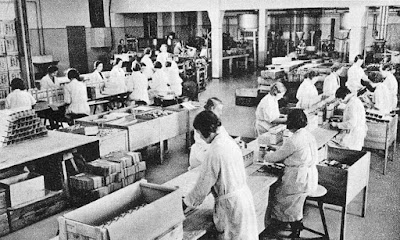
Workers at the Temmler factory in Berlin produced 35 million tablets of Pervitin for the German army and Luftwaffe in 1940. Photograph: Temmler Pharma GmbH & Co KG, Marburg
Naturally, it wasn’t long before soldiers were relying on it too. In Blitzed, Ohler reproduces a letter sent in 1939 by Heinrich Böll, the future Nobel laureate, from the frontline to his parents back at home, in which he begs them for Pervitin, the only way he knew to fight the great enemy – sleep. In Berlin, it was the job of Dr Otto Ranke, the director of the Institute for General and Defence Physiology, to protect the Wehrmacht’s “animated machines” – ie its soldiers – from wear, and after conducting some tests he concluded that Pervitin was indeed excellent medicine for exhausted soldiers. Not only did it make sleep unnecessary (Ranke, who would himself become addicted to the drug, observed that he could work for 50 hours on Pervitin without feeling fatigued), it also switched off inhibitions, making fighting easier, or at any rate less terrifying.
In 1940, as plans were made to invade France through the Ardennes mountains, a “stimulant decree” was sent out to army doctors, recommending that soldiers take one tablet per day, two at night in short sequence, and another one or two tablets after two or three hours if necessary. The Wehrmacht ordered 35m tablets for the army and Luftwaffe, and the Temmler factory increased production. The likes of Böll, it’s fair to say, wouldn’t need to ask their parents for Pervitin again.
Was Blitzkrieg, then, largely the result of the Wehrmacht’s reliance on crystal meth? How far is Ohler willing to go with this? He smiles. “Well, Mommsen always told me not to be mono-causal. But the invasion of France was made possible by the drugs. No drugs, no invasion. When Hitler heard about the plan to invade through Ardennes, he loved it [the allies were massed in northern Belgium]. But the high command said: it’s not possible, at night we have to rest, and they [the allies] will retreat and we will be stuck in the mountains. But then the stimulant decree was released, and that enabled them to stay awake for three days and three nights. Rommel [who then led one of the panzer divisions] and all those tank commanders were high – and without the tanks, they certainly wouldn’t have won.”
Thereafter, drugs were regarded as an effective weapon by high command, one that could be deployed against the greatest odds. In 1944-45, for instance, when it was increasingly clear that victory against the allies was all but impossible, the German navy developed a range of one-man U-boats; the fantastical idea was that these pint-sized submarines would make their way up the Thames estuary. But since they could only be used if the lone marines piloting them could stay awake for days at a time, Dr Gerhard Orzechowski, the head pharmacologist of the naval supreme command on the Baltic, had no choice but to begin working on the development of a new super-medication – a cocaine chewing gum that would be the hardest drug German soldiers had ever taken. It was tested at the Sachsenhausen concentration camp, on a track used to trial new shoe soles for German factories; prisoners were required to walk – and walk – until they dropped.
“It was crazy, horrifying,” says Ohler, quietly. “Even Mommsen was shocked by this. He had never heard about it before.” The young marines, strapped in their metal boxes, unable to move at all and cut off from the outside world, suffered psychotic episodes as the drugs took hold, and frequently got lost, at which point the fact that they could stay awake for up to seven days became irrelevant. “It was unreal,” says Ohler. “This wasn’t reality. But if you’re fighting an enemy bigger than yourself, you have no choice. You must, somehow, exceed your own strength. That’s why terrorists use suicide bombers. It’s an unfair weapon. If you’re going to send a bomb into a crowd of civilians, of course you’re going to have a success.”
Meanwhile, in Berlin, Hitler was experiencing his own unreality, with his only ally in the world his podgy, insecure personal physician, Dr Morell. In the late 20s, Morell had grown a thriving private practice in Berlin, his reputation built on the modish vitamin injections he liked to give his patients. He met Hitler after he treated Heinrich Hoffman, the official Reich photographer, and sensing an opportunity quickly ingratiated himself with the Führer, who had long suffered from severe intestinal pains. Morell prescribed Mutaflor, a preparation based on bacteria, and when his patient’s condition – Patient A, as Hitler was thereafter known – began to improve, their codependent relationship began. Both were isolated. Hitler increasingly trusted no one but his doctor, while Morell relied solely on the Führer for his position.
When Hitler fell seriously ill in 1941, however, the vitamin injections that Morell had counted on no longer had any effect – and so he began to ramp things up. First, there were injections of animal hormones for this most notorious of vegetarians, and then a whole series of ever stronger medications until, at last, he began giving him a “wonder drug” called Eukodal, a designer opiate and close cousin of heroin whose chief characteristic was its potential to induce a euphoric state in the patient (today it is known as oxycodone). It wasn’t long before Hitler was receiving injections of Eukodal several times a day. Eventually he would combine it with twice daily doses of the high grade cocaine he had originally been prescribed for a problem with his ears, following an explosion in the Wolf’s Lair, his bunker on the eastern front.
Did Morell deliberately turn Hitler into an addict? Or was he simply powerless to resist the Führer’s addictive personality? “I don’t think it was deliberate,” says Ohler. “But Hitler trusted him. When those around him tried to remove Morell in the fall of 1944, Hitler stood up for him – though by then, he knew that if he was to go, he [Hitler] would be finished. They got along very well. Morell loved to give injections, and Hitler liked to have them. He didn’t like pills because of his weak stomach and he wanted a quick effect. He was time-pressed; he thought he was going to die young.” When did Hitler realise he was an addict? “Quite late. Someone quotes him as saying to Morell: you’ve been giving me opiates all the time. But mostly, they talked about it in oblique terms. Hitler didn’t like to refer to the Eukodal. Maybe he was trying to block it off from his mind. And like any dealer, Morell was never going to say: yeah, you’re addicted, and I have something to feed that for you.” So he talked in terms of health rather than addiction? “Yes, exactly.”
The effect of the drugs could appear to onlookers to be little short of miraculous. One minute the Führer was so frail he could barely stand up. The next, he would be ranting unstoppably at Mussolini. Ah, yes: Mussolini. In Italy, Blitzed will come with an extra chapter. “I found out that Mussolini – patient D, for Il Duce – was another of Morell’s patients. After the Germans installed him as the puppet leader of the Republic of Italy in 1943, they ordered him to be put under the eyes of the doctor.” Again, Ohler springs up. Again, he returns with a document in his hand. “There’s not enough material to say he was an addict. But he was being given the same drugs as Hitler. Every week there was a doctorly report.” He runs his finger along the typewritten lines, translating for me as he goes. “He has improved, he is playing tennis again, the swelling of his liver is normal… It’s like he’s a racehorse.”
An unwell-looking Adolf Hitler in July 1944. Photograph: ullsteinbild/Getty Images
For Hitler, though, a crisis was coming. When the factories where Pervitin and Eukodal were made were bombed by the allies, supplies of his favourite drugs began to run out, and by February 1945 he was suffering withdrawal. Bowed and drooling and stabbing at his skin with a pair of golden tweezers, he cut a pitiful sight. “Everyone describes the bad health of Hitler in those final days [in the Führerbunker in Berlin],” says Ohler. “But there’s no clear explanation for it. It has been suggested that he was suffering from Parkinson’s disease. To me, though, it’s pretty clear that it was partly withdrawal.” He grins. “Yeah, it must have been pretty awful. He’s losing a world war, and he’s coming off drugs.”
Two months later, Hitler and his new wife, Eva Braun (like Leni Riefenstahl, another of Morell’s patients), killed themselves, as the world knows. What happened to Morell? We know he survived, but did he get away unscathed?
“I think a lot of Nazis did get away with it,” says Ohler. “But not him. He wasn’t able to shed his skin, make a new career, get rich on his memoirs – even though he could have said, truly, that he hadn’t committed any war crimes. He lost his mind. He disintegrated. He’s a tragic figure. He wasn’t evil. He was only an opportunist.”
In 1947, the Americans, having tried and failed to extract useful information from him, deposited Morell in Munich. There he was picked up by a half-Jewish Red Cross nurse who took pity on this dishevelled, shoeless figure. She delivered him to the hospital in Tegernsee, where he died a year later.
Blitzed looks set to reframe the way certain aspects of the Third Reich will be viewed in the future. But Ohler’s thesis doesn’t, of course, make National Socialism any more fathomable, and for him, perhaps, there is an element of disappointment in this, for he has been seeking to understand it ever since he was a boy (the son of a judge, he grew up close to the border with France). “It was the whole reason why I wanted to write,” he says. “I thought with writing that you could counter propaganda.”
His maternal grandfather worked as a railway engineer during the war, the head of a small station in occupied Bohemia. “One day at school we watched a film of the liberation of a concentration camp, and it was so shocking to me. That same day, I asked him about the trains going to the camps. He told me that he saw one in the winter coming from the west, and that he said to himself: these are Russian POWs. But since it came from the west, and he heard children, and it was a cattle train, he kind of realised something weird was happening.
“I wasn’t much older than 10, and I was trying to understand: what kind of person is this, my grandfather? Because he continued being a railway engineer. He didn’t join the resistance. He said the SS was guarding the train, and he was afraid, and so he just went back into his little office to continue with his drawings. He always said Hitler wasn’t so bad. In the 80s, you used to hear that a lot: that it was all exaggerated, that Hitler didn’t know about the bad things, that he created order.”
He pauses. “You think it [nazism] was orderly. But it was complete chaos. I suppose working on Blitzed has helped me understand that at least. Meth kept people in the system without their having to think about it.” His hope is that his book will be read by a younger generation of Germans who would rather look to the future than dwell on the past. Is the right rising again? Is that why he wants them to read it? “It is quite a dangerous time. I hate these attacks on foreigners, but then our governments do it, too, in Iraq and places. Our democracies haven’t done a very good job in this globalised world.” That said, he doesn’t think the new party of the right, Alternative for Germany, may be the threat it appears (in elections earlier this month, it outperformed Angela Merkel’s Christian Democrats). “The right wing always had so little purchase here [after the war] because of our history,” he says. “When I was young, you would never even see a German flag. The first time I did was in 1990, when Germany won the World Cup. So perhaps this is just a correction.”
Before I head to the airport, Ohler agrees to take me to see what remains of the Temmler factory – which last time he looked still stood in Berlin-Johannisthal, a part of the city that used to be in the east – and so it is that we set off on a bright blue day (in the movies, the east seems always to be grey and cold) in search of what remains of Dr Hauschild’s white-tiled laboratory. Twenty minutes later, we pull up in a residential street, all window boxes and net curtains, as quiet as the grave. “Oh, my God,” he says, unfolding his long, thin legs from the car. “Wow. It’s completely gone.”
For a few moments, we peer wonderingly through a chain link fence at the barren expanse of dust and concrete, and the neat white and red houses beyond it. But there’s nothing to be done: try as I might, I can’t superimpose the eery monochrome photographs I’ve seen of the factory in Blitzed on to this Technicolor suburban scene. What was almost tangible to me on Ohler’s roof, only half an hour ago, now takes on the unreal quality of a dream – or, perhaps, just a very bad trip.
[SOURCE: theguardian.com]
Pervitin, The People’s Drug: How Methamphetamine Fueled the Third Reich
Posted on April 26, 2018 19th Century, 20th Century, Death, Disease, Drugs, Law, Medical History, Vice, Violence
by Jessica Cale
Meth didn’t come out of nowhere. Like cocaine, heroin, and morphine, it has its origins in 19th century Germany. When Romanian chemist Lazăr Edeleanu first synthesized amphetamine in 1887, he couldn’t have known that his creation would evolve into a substance that would one day help to fuel a world war. Nagai Nagayoshi took it a step closer when he synthesized methamphetamine in 1893. It was transformed into the crystalline form we know today by Japanese pharmacologist Akira Ogata in 1919, at which point it found its way back to Germany, where the conditions were just right for another pharmacological breakthrough.
Drugs and the Weimar Republic
Drugs were not unknown to Berlin. Okay, that’s an understatement. Weimar Berlin was soaked in them. Not only were drugs like morphine, heroin, and cocaine legal, but they could be purchased from every street corner and were all but issued to those attending the legendary nightclubs, where any kink or perversion up to an including BDSM, public orgies, and voyeurism happened on the regular.(1)
Anita Berber Cocaine by F.W. Koebner
Dancer Anita Berber, the It Girl of Weimar Berlin, was known to go about her business wearing nothing but a sable coat and an antique brooch stuffed with cocaine (pictured). She was such an exhibitionist, the local sex workers complained that they couldn’t keep up with the amount of skin she was showing. Of all the idiosyncratic breakfasts of history, Berber’s still stands out: she was said to start every day with a bowl of ether and chloroform she would stir with the petals of a white rose before sucking them dry.
She wasn’t the only one. Having lost its access to natural stimulants like tea and coffee along with its overseas colonies in the Treaty of Versailles, Germany was in need of synthetic assistance. Norman Ohler explains:
“The war had inflicted deep wounds and caused the nation both physical and psychic pain. In the 1920s drugs became more and more important for the despondent population between the Baltic Sea and the Alps. The desire for sedation led to self-education and there soon emerged no shortage of know-how for the production of a remedy.”
Poster for an anti-drug film, 1927
Produce they did. Eighty percent of the global cocaine market was controlled by German pharmaceutical companies, and Merck’s was said to be the best in the world. Hamburg was the largest marketplace in Europe for cocaine with thousands of pounds of it passing through its port legally every year. The country of Peru sold its entire annual yield of raw cocaine to German companies. Heroin, opium, and morphine were also produced in staggering quantities, with ninety-eight percent of German heroin being exported to markets abroad.
How were drugs able to flourish to such an extent? For one thing, they were legal. Many veterans of the First World War were habitually prescribed morphine by doctors who were addicted to it themselves. It wasn’t viewed as a harmful drug but as a necessary medical treatment for chronic pain and shell shock. Further, the line between drug use and addiction was uncertain. In spite of countless people regularly indulging in everything from cocaine to heroin for medical as well as recreational purposes, few were considered to be addicts. Drug use was not a crime, and addiction was seen as a curable disease to be tolerated.
As historian Jonathan Lewy explains:
“Addicts stemmed from a higher class in society. Physicians were the most susceptible professional group to drug addiction. Instead of antagonizing this group, the regime tried to include physicians and pharmacists in their program to control drugs. In addition, German authorities agreed that the war produced addiction; in other words, the prized veterans of the First World War were susceptible, and none of the political parties in the Weimar Republic, least of all the National Socialist Party, wished to antagonize this group of men.”
Pervitin, The Miracle Pill
On Halloween 1937, Pervitin was patented by Temmler, a pharmaceutical company based in Berlin. When it hit the market in 1938, Temmler sent three milligrams to every doctor in the city. Many doctors got hooked on it, and, convinced of its efficacy, prescribed it as study aid, an appetite suppressant, and a treatment for depression.
Pervitin Landesarchiv BerlinTemmler based its ad campaign on Coca-Cola’s, and the drug quickly became popular across the board. Students used it to help them study, and it was sold to housewives in chocolate with the claim that would help them to finish their chores faster with the added benefit that it would make them lose weight (it did). By 1939, Pervitin was used to treat menopause, depression, seasickness, pains related to childbirth, vertigo, hay fever, schizophrenia, anxiety, and “disturbances of the brain.”
Army physiologist Otto Ranke immediately saw its potential. Testing it on university students in 1939, he found that the drug enabled them to be remarkably focused and productive on very little sleep. Pervitin increased performance and endurance. It dulled pain and produced feelings of euphoria, but unlike morphine and heroin, it kept the user awake. Ranke himself became addicted to it after discovering that the drug allowed him to work up to fifty hours straight without feeling tired.
Despite its popularity, Pervitin became prescription only in 1939, and was further regulated in 1941 under the Reich Opium Law. That didn’t slow down consumption, though. Even after the regulation came in, production increased by an additional 1.5 million pills per year. Prescriptions were easy to come by, and Pervitin became the accepted Volksdroge (People’s Drug) of Nazi Germany, as common as acetaminophen is today.
Although the side effects were serious and concerning, doctors continued to readily prescribe it. Doctors themselves were among the most serious drug abusers in the country at this time. An estimated forty percent of the doctors in Berlin were known to be addicted to morphine.
As medical officer Franz Wertheim wrote in 1940:
“To help pass the time, we doctors experimented on ourselves. We would begin the day by drinking a water glass of cognac and taking two injections of morphine. We found cocaine to be useful at midday, and in the evening we would occasionally take Hyoskin (an alkaloid derived from nightshade) … As a result, we were not always fully in command of our senses.”
Its main user base, however, was the army. In addition to the benefits shown during the test on the university students, Ranke found that Pervitin increased alertness, confidence, concentration, and willingness to take risks, while it dulled awareness of pain, hunger, thirst, and exhaustion. It was the perfect drug for an army that needed to appear superhuman. An estimated one hundred million pills were consumed by the military in the pre-war period alone. Appropriately enough, one of the Nazis’ slogans was, “Germany, awake!”
Germany was awake, alright.
Military Use
After its first major test during the invasion of Poland, Pervitin was distributed to the army in shocking quantities. More than thirty-five million tablets of Pervitin and Isophan(2) were issued to the Wermacht and Luftwaffe between April and July of 1940 alone. They were aware that Pervitin was powerful and advised sparing use for stress and “to maintain sleeplessness” as needed, but as tolerance increased among the troops, more and more was needed to produce the same effects.
An advertisement for Pervitin.
Pervitin was a key ingredient to the success of the Blitzkrieg (lightning war). In these short bursts of intense violence, speed was everything. In an interview with The Guardian, Ohler summarized:
“The invasion of France was made possible by the drugs. No drugs, no invasion. When Hitler heard about the plan to invade through Ardennes, he loved it. But the high command said: it’s not possible, at night we have to rest, and they [the allies] will retreat and we will be stuck in the mountains. But then the stimulant decree was released, and that enabled them to stay awake for three days and three nights. Rommel and all those tank commanders were high, and without the tanks, they certainly wouldn’t have won.”
Bomber pilots reported using Pervitin to stay alert throughout the Battle of Britain. Launches were often late at night, so German pilots would not make it to London until after midnight. As one bomber pilot wrote:
“You were over London or some other English city at about one or two in the morning, and of course then you’re tired. So you took one or two Pervitin tablets, and then you were all right again … The commander always has to have his wits about him, so I took Pervitin as a precautionary measure. One wouldn’t abstain from Pervitin because of a little health scare. Who cares when you’re doomed to come down at any moment anyway?”
Pervitin was issued to pilots to combat fatigue, and some of its nicknames—“pilot salt,” “Stuka pills,” “Göring pills”—hinted at its use. One commodore fighting in the Mediterranean described the feeling of using it while flying:
“The engine is running cleanly and calmly. I’m wide awake, my heartbeat thunders in my ears. Why is the sky suddenly so bright, my eyes hurt in the harsh light. I can hardly bear the brilliance; if I shield my eyes with my free hand it’s better. Now the engine is humming evenly and without vibration—far away, very far away. It’s almost like silence up here. Everything becomes immaterial and abstract. Remote, as if I were flying above my plane.”
As powerful as Pervitin was, it wasn’t enough. Still, whatever they needed was given to them. By 1944, Vice-Admiral Hellmuth Heye requested something stronger than would enable troops to fight even longer while boosting their self-esteem. Not long after, Kiel pharmacologist Gerhard Orzechowski answered with a newer, stronger pill called D-IX, the active ingredients of which were three milligrams of Pervitin, five milligrams of cocaine, and five milligrams of Eukodal, a painkiller derived from morphine.
Initially tested on prisoners at the Sachsenhausen concentration camp (the victims were forced to walk until they dropped, regardless of how long it took), D-IX was given to the marines piloting one-man U-boats designed to attack the Thames estuary. It was issued as a kind of chewing gum that was to keep the marines awake and piloting the boats for days at a time before ultimately attacking the British. It did not have the intended effect, however. Trapped under water for days at a time, the marines suffered psychotic episodes and often got lost.
The Hangover
No “miracle pill” is perfect, and anything that can keep people awake for days is going to have side effects. Long-term use of Pervitin could result in addiction, hallucination, dizziness, psychotic phases, suicide, and heart failure. Many soldiers died of cardiac arrest. Recognizing the risks, the Third Reich’s top health official, Leonardo Conti, attempted to limit his forces’ use of the drug but was ultimately unsuccessful.
Temmler Werke continued supplying Pervitin to the armies of both East and West Germany until the 1960s. West Germany’s army, the Bundeswehr, discontinued its use in the 1970s, but East Germany’s National People’s Army used it until 1988. Pervitin was eventually banned in Germany altogether, but methamphetamine was just getting started.
Sources
Cooke, Rachel. High Hitler: How Nazi Drug Abuse Steered the Course of History. The Guardian, September 25th, 2016.
Hurst, Fabienne. The German Granddaddy of Crystal Meth. Translated by Ella Ornstein. Spiegel Online, May 30th, 2013.
Lewy, Jonathan. The Drug Policy of the Third Reich. Social History of Alcohol and Drugs, Volume 22, No 2, 2008
Ohler, Norman. Blitzed: Drugs in the Third Reich. Houghton Mifflin Harcourt. New York, 2015.
Ulrich, Andreas. The Nazi Death Machine: Hitler’s Drugged Soldiers. Translated by Christopher Sultan. Spiegel Online, May 6th, 2005.
(1) Don’t worry. We’re definitely going to cover that.
(2) Isophan: a drug very similar to Pervitin produced by the Knoll pharmaceutical company
[SOURCE: dirtysexyhistory.com]