There are still a few lingering Holy Grail quests that
remain in the 100-year history of our beloved monster films. One that often
comes to mind is the still-lost Lon Chaney vehicle, LONDON AFTER MIDNIGHT.
Another is the presumed and most likely destroyed test footage of Bela Lugosi
in his bid as the Frankenstein monster.
Filmed on June 16 & 17, 1931, on Stage 12, Universal’s largest sound stage (which still had a standing set from DRACULA), the event was
intended to be momentous, but instead was doomed to disaster. Not a single
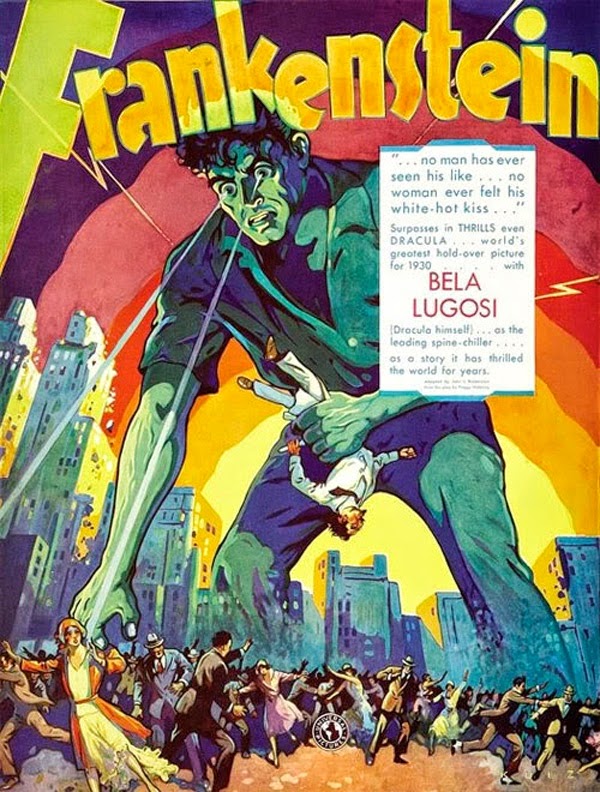
frame of film or photograph of the debacle exists today, except for a
promotional poster that shows an exaggerated, larger-than-life Lugosi trampling
a city underfoot and gazing upon the carnage with his already famous laser-beam
stare. However, from the testimony of those who were there, the monster
depicted on the poster is far afield from the one that showed up on the test
shoot.
Much has been discussed about director Robert Florey’s plum
assignment handed to him by Carl Laemmle, Jr. The task was another Laemmle pet
project -- to bring Mary Shelly’s novel to life on the silver screen as he had done with
Bram Stoker’s. Out of the gate, the biggest challenge would be: Who will play
the monster?
John Carradine claims he was considered, and, according to
him, even tested for it. No solid evidence exists of either claim, although
personally, I think he might have been a close second if Karloff had not been
“discovered”. In Laemmle’s mind,
however, the role really was Lugosi’s from the start. Lugosi, of course, was
still basking in the sudden fame he had garnered playing the title role in
Universal’s DRACULA, released just months before. Lugosi was happy, Lugosi was
proud; Lugosi might have even been a little bit … cocky. After all, wasn’t his
mailbox at Universal overflowing with love letters and offers of marriage (and
no doubt, other things) from his swooning female fans? As such, he blundered
into the part without knowing exactly who – or what – he would be playing. Nor
did he seem initially aware of how much of his European good looks would be
covered up under cotton, collodion and God knows, what else. All this was the
result of him being signed for the part by his agent without his knowledge, a
“stupid woman”, according to Lugosi’s wife, Hope.
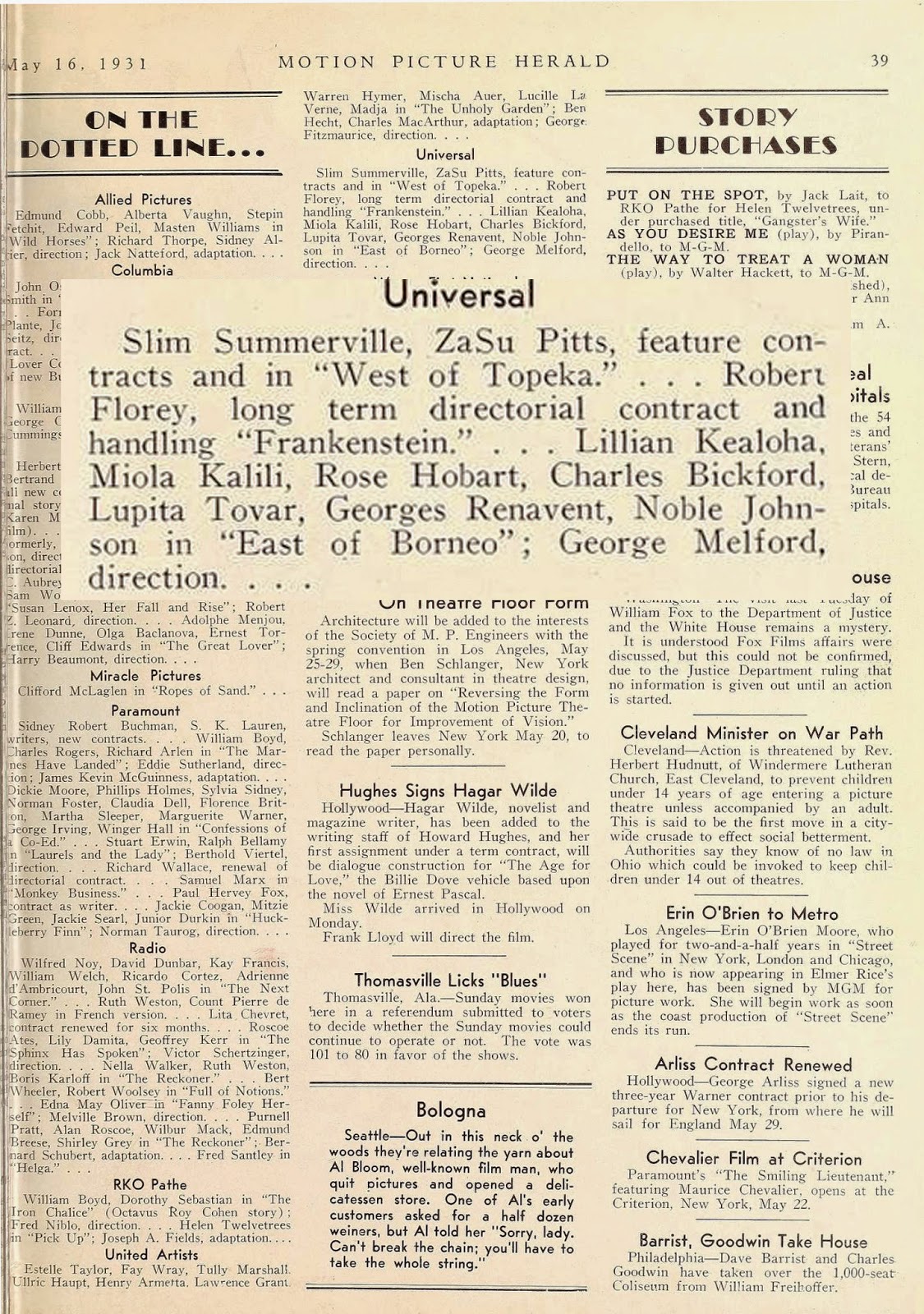 |
| MOTION PICTURE HERALD May 16,1931. |
This much is agreed upon by film historians and
Monsterologists alike: While there are plenty of anecdotes to sift through, what
happened on the day of filming is ultimately murky and remains the subject of
debate. There are enough comments from interviews and statements of the
principal participants of the test shot to piece together a framework of
events, despite the fact that some of the facts may be from an overly-biased
source and possibly or probably, not factual at all. Still, a number of authors
have, over the years, put their best asphalt boot forward and come up with a
scenario that was most likely played out on these fateful dates. While in no
way a complete documentation of the event, I will try here to distill the
information from a variety of sources I believe are trustworthy and reliable.
There were a handful of personnel on the set during the test
shot. They included:
Robert Florey (Director)
Bela Lugosi (The Monster)
Edward Van Sloan (Dr. Waldman)
Dwight Frye (Fritz)
Paul Ivano (Cameraman)
Stock actors played Henry and Victor Frankenstein
It’s probable that there were a few other personnel present
as well, such as electricians and lighting men.
The set was a hastily-built rendition of the laboratory
“creation scene”, albeit sans Kenneth Strickfadden’s elaborate electric devices. Shot
from the script written by Florey, Lugosi is said to have been laid out on a
table, hidden under a sheet for most of the proceedings, until Van Sloan lifted
the sheet and took a peek for just a few scant seconds, and utters, “It is like
a death mask – of a monster!”
Legend has it that Lugosi first donned his own makeup.
Director Florey attested that it was he who was the designer by years later
producing a sketch that he had supposedly done at the time. Interestingly
enough and not altogether unsurprising, Florey’s work was a close match to the
final version that Jack Pierce used on Boris Karloff. In any event, Lugosi’s
“hairy” makeup was rejected.
Next, Lugosi went on stage with a concoction applied by Jack
Pierce. It is unclear whose design it was, and who had a hand in its direction,
or if it was simply a preliminary design by Pierce who slapped it on the
ungrateful Lugosi in response to his being miffed on the DRACULA makeup.
Described as having a “polished, clay-like skin” (Van Sloan), the effect was
said to have been accomplished by melting a combination of makeup materials
with a hair dryer. Since Pierce was fond of having a “mad lab” of his own in
Dressing Room No. 5 (the famed “Bugaboudoir”), it is not entirely out of the
question.
The shot was a catastrophe as soon as Lugosi connected the
dots and realized he was to spend the entire film under the makeup he
supposedly created. As mentioned, like in DRACULA, he refused to let the
newly-appointed head of Universal’s makeup, Jack Pierce, work on him and
instead chose to adopt his own technique plied during his stage performances.
Pierce wouldn’t enter the fray with full creative control over the monster’s
makeup until later, until after Florey had been sacked and Lugosi shown the
door in favor of new director and monster, James Whale and Boris Karloff,
respectively. As a result of the shake up, Pierce had the distinct pleasure of working with a
more compliant and understanding actor in the makeup chair. Karloff himself
even participated in the unique and iconic creation, offering his own suggestions a
time or two.
In an interview with a “lucid” Edward Van Sloan years later,
he characterized Lugosi's test makeup as “something out of BABES IN TOYLAND” (!). He also
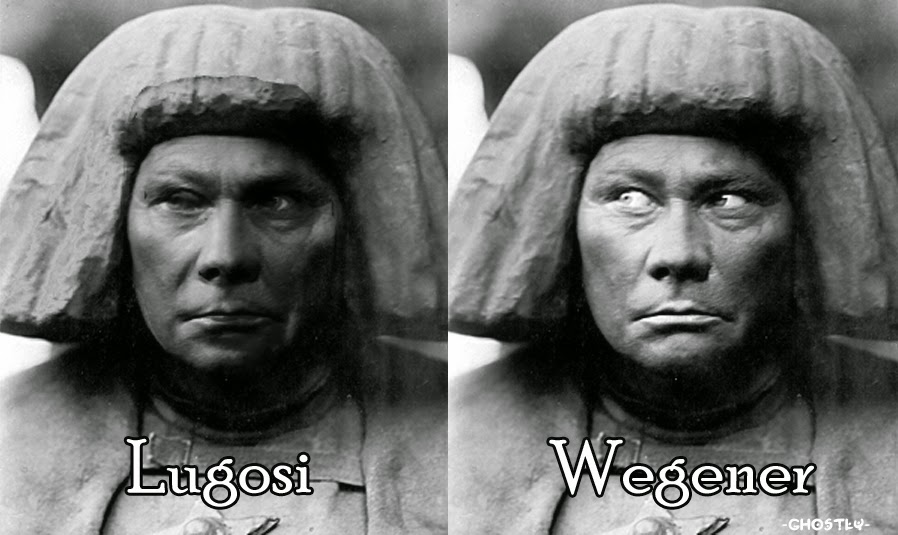
stated that Lugosi’s head “was about four times normal size, with a broad wig
on it”, making him look a lot like Paul Wegener in THE GOLEM.
Lugosi spent the shoot complaining, attempting to change his
appearance and was generally disruptive. He even threatened to get a doctor’s
note to say he was unfit for the burdens of the makeup. It was made very clear that
Lugosi wanted the role of Henry Frankenstein, not the disgraceful role of a
brute who spoke no lines.
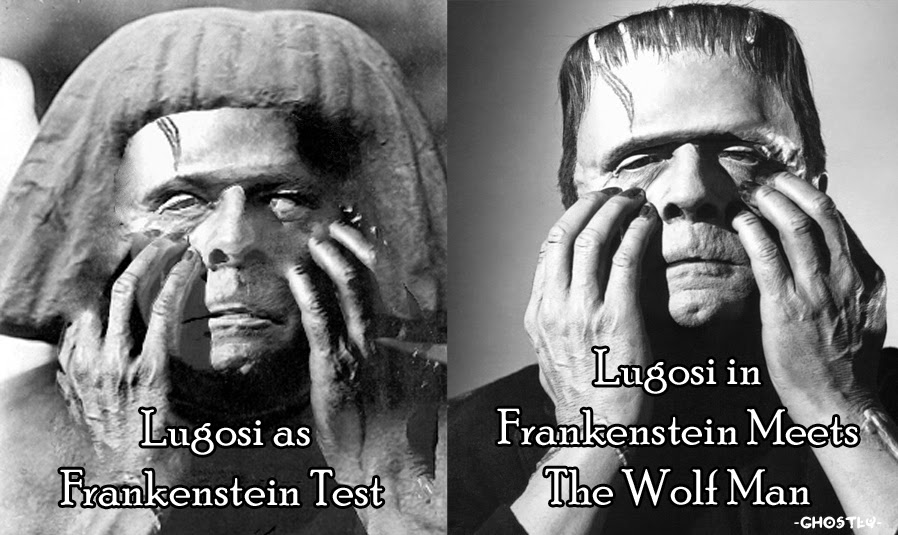
After all the ballyhoo, I remained curious as to what Lugosi
must have looked like in the very first filming of the Universal Frankenstein
legend. So, I went to work in Photoshop and, with a few portraits and publicity
stills, I attempted to recreate the implied “look”.
I ended up with two versions, the first with Lugosi’s face
superimposed over Paul Wegener’s Golem, and the second with Lugosi’s face from
when he finally did play the monster in FRANKENSTEIN MEETS THE WOLFMAN, over
again, Wegener’s Golem.
The results, as you can see, are hideously hilarious. If
they are anything close to the original, it’s no wonder why Carl Laemmle, Jr.
“laughed like a hyena” during the test screening.