Showing posts with label BIOGRAPHY. Show all posts

Friday, September 5, 2025

JOHN WYNDHAM: FATHER OF TRIFFIDS


John Wyndham Parkes Lucas Beynon Harris was born in England on July 10, 1903 and became one of the country's most respected science-fiction authors. He used a number of pseudonyms derived from his name, including John Beynon, John Beynon Harris and Lucas Parkes, but he is best known today as John Wyndham. He sold his first story. "Worlds to Barter" to WONDER STORIES which was published in the May 1931 issue.

It was later in his career when he penned the classics "The Day of the Triffids" (aka "Revolt of the Triffids") (1951) and "The Midwich Cuckoos" (1957). "Cuckoos" was released as a motion picture in 1960 as VILLAGE OF THE DAMNED and remade by John Carpenter in 1995 and "Triffids" was made into a film and released by United Artists in 1963. It was adapted many times by radio, TV and other media.

1st UK edition (1951).

1st US edition (1951).

Wyndham writing as John Beynon Harris (Lancer, 1967).

Frank Frazetta original cover (watercolor).

Following are two articles that further discuss Wyndham's life and career. The first is from AMAZING STORIES (June 1964) written by noted author and science-fiction historian Sam Moskowitz. The second is from SCIENCE FICTION MONTHLY (Vol. 1 No. 9, 1974).
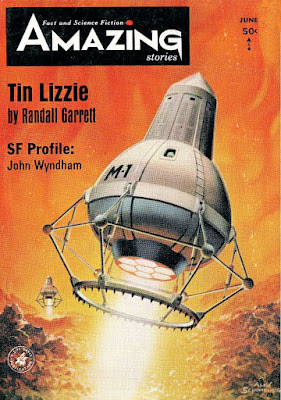
Cover art by Alex Schomberg.


Saturday, September 2, 2017

HENRY SLESAR'S BITTER LEMONADE


Like millions of other families in the 1950's and 1960's, we had a subscription to the pint-sized magazine, READER'S DIGEST. Every month would feature a wide variety of topics, including the "Reader's Digest Condensed Book", as well as short fiction stories.

The March, 1963 issue included a story that had such an impact on me, I am reminded of it to this day every time I see the author's name. The reason may surprise you, though; it wasn't the style of the story -- written in a straight-forward manner, it wasn't the characters (because I couldn't name one of them without looking), and it really wasn't the plot. No, it was none of these that made it so memorable. It was the ending that got me.

Now, I had a book with the collected stories of O. Henry (William Sydney Porter), so I was familiar with the surprise ending. But, even to this 8-year old's developing tastes in fiction, that story in READER'S DIGEST had beat all so far. The story was "The Right Kind of House" (originally titled, "The Right Kind of a House") and the author was Henry Slesar.


Henry Slesar (b. Brooklyn NY 12 June 1927, d. NYC 2 April 2002) was the son of Jewish immigrants from the Ukraine. After art training, he began his career writing ad copy and design at the young age of 17. He served in the Army Air Force during WWII.

He sold his first story in 1955. After that, he never looked back on a writing career that spanned decades. Although he is noted by genre fans for writing many science-fiction and fantasy stories, including both stories and scripts for Alfred Hitchcock's magazine and TV show, he is most renown for his hundreds of scripts that he wrote for daytime soaps.


Henry Slesar's first novel (Ziff Davis 1957).
Other notable genre work was his first novel, the paperback dramatization of the Ray Harryhausen film, 20 MILLION MILES TO EARTH (1957), and his script for TWO ON A GUILLOTINE (1965), starring Cesar Romero and Connie Stevens.

To say that Mr. Slesar was prolific is a gross understatement. TV GUIDE once said of him that he was, "the writer with the largest audience in America".

Notwithstanding his mainstream achievements, his genre literary fiction can easily stand beside the works of other great short story writers of the period, including Charles Beaumont, Ray Russell, Robert Bloch, Richard Matheson and countless others.

Like the aforementioned O. Henry, his specialty was irony and twist endings. One wonders what he might have come up with for an EC horror comic or two...

And now, here is his story, "The Right Kind of House", literally torn from the pages of the March, 1963 issue of READER'S DIGEST, from the exact same copy where I had first read it over 50 years ago.