Showing posts with label BELA LUGOSI. Show all posts

Friday, April 10, 2026

LUGOSI'S PRIVATE PHOTOS


Bela Lugosi saved a considerable amount of memorabilia from his career and even amassed at least three large scrapbooks which sold at auction on August 10, 2013 for $5,000.

The two photographs below were sold separately last week by Heritage Auctions headquartered in Dallas, Texas. The WHITE ZOMBIE photo sold for $275.00 and THE MYSTERIOUS MR. WONG photo sold for $154.00. Lugosi's Mr. Wong (a villain) was a different character than Karloff's Mr. Wong (a detective).


The stamp on the back indicates they were given to Lugosi by the Don Marlowe Agency. Marlowe had the reputation as an unscrupulous and downright flaky talent agent. For example, in September 1970 he placed an ad in CLASSIC FILM COLLECTOR that read:
Bela Lugosi – For Sale: Screen test Bela Lugosi made for the original Frankenstein. 35mm sound, running time 21 minutes; same scene is shown twice with change in lighting, etc. Between scenes camera was left running and Carl Laemmle Junior, James Whale, Colin Clive and Lugosi can be seen and heard discussing test and wardrobe Lugosi was wearing. Film can be examined and screened before purchase is made. Price: $4,000. Don Marlowe. Hollywood, Calif. 90028
What really makes this stand out as specious is that James Whale was out of the picture when this test shot is made under the direction of Robert Florey. One wonders if this was a flim-flam on the part of Marlowe.


Marlowe is nevertheless is credited with reviving Lugosi's career in the late 1940s. Among other jobs, in one roadshow, before a screening of DRACULA, Lugosi would perform a live reading of Poe's "The Tell-Tale Heart".

Tuesday, March 10, 2026

A NEW SPECIES OF 'MONSTROUS' FLOWER


If you're having a hard time finding a specimen of the Mariphasa lupina lumina as seen in WEREWOLF OF LONDON for your garden, that's because it's made up! But don't fret, there's a brand new "monster flower" on the market and it's for real.

That's right; the Hemerocallis 'Bela Lugosi' is for sale at numerous online flower and gardening sites and maybe even a nursery near you. A member of the daylily family, the 'Bela Lugosi' has what is described as "dusky purple petals" and is noted as a vigorous and strong grower.


Here's a description from Whiteflowerfarm.com :

The dusky purple petals of Hemerocallis 'Bela Lugosi' arise from lime-green throats whose color bleeds eerily into a greenish gold center. It seems to suit this Daylily's namesake, the Hungarian actor best known for his role as Count Dracula. Thanks to a vigorous habit, good bud count on well-branched stalks, and a dark flower color that lasts well in sun, this tetraploid, midseason-bloomer has garnered awards from the American Hemerocallis Society. The slightly ruffled flowers measure about 6" across. Semi-evergreen foliage.

Daylilies (Hemerocallis) are the plants every gardener dreams of. They offer glorious flowers in every shade except blue, a long season of bloom (though individual flowers last but a day), and a robust disposition that makes them easy to transplant, easy to maintain, quick to multiply, and resistant to pests. They make a carefree and colorful ground cover. It is widely regarded as one of the best purple daylilies on the market.


I wonder if the floriculturist had to license the Lugosi name? I should think the Lugosi would be honored without charging anybody for it.

What's next, a green 'Boris Karloff' gladiolus?

Monday, January 19, 2026

UNSOLVED MYSTERY: DRACULA PAINTING


I came across this original painting by comic artist Rudy Palais at an auction site and noticed it was titled, "Illustration - Bela Lugosi as Dracula". Nothing against Mr. Palais' artistic capabilities, but after scrutinizing it for a few moments--and in consideration of his unique style--I concluded that, other than a blunted widow's peak, none of the subject's other features are remotely similar to those of Bela Lugosi. Since he passed away in 2004, I suspect Palais likely wasn't afforded the opportunity to comment one way or another about identifying his painting as such.


It was sold on April 9, 2023 by Broward Auction Gallery LLC of Dania Beach, Florida for $200 plus $75 shipping and insurance. The painting itself is an oil on canvas and measures 19" W x 27" L. There is no provenance and it is undated. One thing it has going for it is that it's signed.

The auction history for this piece indicates it first came up for auction on January 23, 2021. At that time the description of the painting was listed as: "Illustration - Portrait of Man".

It was listed six more times without selling, from April 4, 2021 to July 3, 2022. Then, abruptly it was re-titled and newly identified as a portrait of Bela Lugosi as Dracula. It went unsold the first time under it's new title on October 9, 2022 and again on January, 2, 2022 until it was finally picked up for 200 bucks, six months later, at considerably less than the estimated value of $400-$500.

Now, I don't know about you, but this has the taint of chicanery about it if you ask me. If it was misrepresented in the earlier listings, there is no statement that the title was changed because of any new discovery. Consequently, if there is nothing to support the change, I suspect it was done in a deceitful attempt to add value to it. My hope is that the buyer purchased it solely because it was a work by Palais and not because it was claimed to be a portrait of Lugosi by him.

The art world has been historically rife with scams, and the foregoing only proves that they can find their way anywhere from multi-million dollar masterworks to a simple comic artist's painting. Caveat emptor!

Thursday, December 4, 2025

ACCENT ON LUGOSI


Much has been discussed about Lugosi's heavy Hungarian accent and how he dealt with it after coming to America to pursue an acting career. Most agree that it worked to his advantage for his stage and screen roles as the mysterious and exotic Count Dracula. Unfortunately, on other occasions it was challenging to land parts because of it.

In the February 1932 issue of SCREENLAND, there was a feature article citing numerous actors and actresses that struggled and overcame their native language speaking barriers and the accents that came along with them. Lugosi was among those discussed. Interestingly, the picture chosen for him was his famous 47" x  61" painting by fellow-Hungarian Géza Kende.


Sunday, November 9, 2025

LUGOSI MANSION ON THE MARKET


Bela Lugosi lived in dozens of houses and apartments from New York to Los Angeles during his career, but the most memorable of all was the Spanish Revival estate known as Villa Dorada (Dorada= golden). Now, for the first time in over 50 years it has been put on the market.

Located in the Outpost Estates in the Hollywood Hills on a 13,185 square-foot lot, it is perched on a hilltop and allows spectacular views from the famed Hollywood sign to the Pacific Ocean.

Lugosi rented the 7,400 square-foot house from then-owner Elizabeth D. Clark in the early 1930's just a few years after it was built by a Minnesota physician. One wonders how long he would have stayed there had his earnings allowed it.

Let's take a tour of this beautiful home, shall we?


Iconic ‘Dracula’ Actor’s Storied Hollywood Estate Is Listed for First Time in a Half-Century With Asking Price of $7.5 Million
By Tessa Parker | October 31, 2025 | Realtor.com

Hollywood is home to many properties with awe-inspiring A-list connections. However, few can compare with the truly incomparable mansion that has just hit the market in the Outpost Estates, nearly 100 years after it served as the dwelling of the industry's original Count Dracula.

Listed for the first time in more than a half-century, with an asking price of $7.5 million, Villa Dorada is a 1929 Spanish Revival estate that was once rented by legendary actor Bela Lugosi, who was best known for his iconic portrayal of the villainous vampire in the 1931 classic "Dracula."

Since his residence in the extraordinary estate, the property has passed through the hands of many other Hollywood bigwigs—from Oscar-winning songwriter and Frank Sinatra collaborator Jimmy Van Heusen to heiress Elizabeth Stack, daughter of "Unsolved Mysteries" host Robert Stack.

Lugosi, a legendary horror actor who died in 1956, resided there in the early 1930s, when he rented the property from the owner, Elizabeth D. Clark, just as his career took off.

Its walls have been privy to all manner of Old Hollywood glamour, yet they have also been meticulously preserved throughout its near-100-year history.

Set on a 13,185-square-foot lot along a flat cul-de-sac in the Outpost Estates, one of the Hollywood Hills’ most coveted communities, the home offers sweeping views of Los Angeles, from the Hollywood sign to the Pacific Ocean.

Over the years, the neighborhood has been home to the likes of Brad Pitt, Charlize Theron, Orlando Bloom, and Winona Ryder, among others.

But far from being splashy or over-the-top, the Outpost Estates is one of the most peaceful and scenic areas in Los Angeles, according to Compass listing agent Tom Davila.

“I’ve been a resident of Outpost Estates for 30 years and have always loved the leafy canopy of carob trees that line Outpost Drive," he adds.

“The neighborhood was one of the few developments in the late 1920s to bury all utilities underground, preserving the views without telephone poles or wires. With its celebrity residents, close proximity to film studios and downtown Los Angeles, and zoning that prohibits tour buses, Outpost Estates continues to offer both privacy and charm.”

Peace and privacy are at the very core of the Outpost Estates ethos—and nowhere is that better represented than within the gates of Villa Dorada.

The three-level, 7,400-square-foot residence is designed to maximize that feeling of security, while also taking full advantage of its incredible location, with large windows that frame the city’s glittering skyline.

Inside are four spacious en suite bedrooms, plus staff quarters with private bedrooms and a living room.

While the size and views impress, it’s the historic details that make this home truly special. Each owner has carefully preserved its 1920s charm, from the rare wood-paneled elevator and original intercom system to hand-carved wooden doors, vintage tile work, art deco doorknobs, and period chandeliers.

Through these incredible details, the current homeowner commissioned a history of the home, which has helped to build out the story and strength of this estate, a key part of the sale for agent John Zaffarano. 

“I find it fascinating the homeowner commissioned a thorough history of the home, uncovering original permits that awarded it the highest Builder Assessor ratings of the era—‘Special’ for its plumbing and electrical fixtures and the rare ‘Extra Special’ designation for overall construction, affirming its exceptional craftsmanship," he explains.

That craftsmanship sings in the home’s entertaining spaces. The estate features a step-down parlor with a built-in bar and guest bath, plus a grand ballroom on the lower level anchored by an oversized fireplace and opening directly to the backyard.

Multiple terraces on every floor invite seamless indoor-outdoor living and views across the city.

“This home is a rare jewel, one of the finest examples of the Spanish Revival period, still preserving its original integrity and thoughtful flow. Pristine magnesite floors and authentic details remain intact, honoring the home’s heritage,” notes the third agent on the listing, Kennon Earl.

Villa Dorada’s prestigious location in the Outpost Estates, combined with its rich architectural heritage, has long made it a magnet for Hollywood’s elite. The private enclave, zoned to prohibit tour buses, has served as a quiet hideaway for stars since the 1920s.

Originally commissioned by Minneapolis physician Frederick A. Dunsmoor, Villa Dorada was completed in 1930 and soon leased to Lugosi during the height of his "Dracula" fame, earning its reputation as the actor’s “daytime coffin.”

In 1946, Elizabeth Stack purchased the property, where she lived for seven years, before the dwelling was passed to Van Heusen in 1953, four years before he would win the second of his four Academy Awards.

As rumor has it, Van Heusen—who was best known for writing Sinatra's hits "Come Fly With Me," "Love and Marriage," and "High Hopes"—regularly hosted Sinatra in the property, with some suggesting that the dwelling may have served as a "bachelor pad" for the duo, along with their other longtime writing partner, Sammy Cahn.

Van Heusen sold the property in 1957, and it changed hands several more times before its current owner purchased it in 1972.

To this day, Villa Dorada remains surrounded by stars, including Pitt, who recently purchased a Spanish-style home nearby for roughly $12 million from Dave Keuning, lead guitarist for The Killers.

For buyers, Villa Dorada represents a chance to own a living piece of Hollywood history. With its blend of cinematic legacy, architectural artistry, and unmatched privacy, the estate offers a rare opportunity to step into a lifestyle once reserved for screen legends.

Whether entertaining in the grand ballroom, taking in city-to-ocean views from one of the terraces, or simply walking the elegant, tree-lined streets of Outpost Estates, residents can experience the magic of Old Hollywood every day.

In a city where history and modern luxury often collide, Villa Dorada stands as a timeless testament to both, and a once-in-a-lifetime opportunity for the discerning collector of Hollywood treasures.


Saturday, November 8, 2025

SMOKIN' MONSTERS


An old Hollywood legend has it that Bela Lugosi would walk every day for a cigar to the Hollywood Smoke Shop on Hollywood Boulevard and Wilcox, located next door to the Warner Bros. Hollywood's Theatre. While a probable apocryphal story, it is true that Lugosi was a dedicated. life-long smoker. He can be seen in countless photographs holding a cigarette, cigar or pipe.

The Hollywood Smoke Shop (bottom right)).

Lugosi boasted a large collection of pipes and from what I could discern, his tobacco of choice was Kendal Plug from Samuel Gawith. It is characterized as a medium-strength, straight (i.e. not mixed with other tobaccos such as Burley) Virginia flake and is said to smoke sweet in the bowl.


As for cigars, Bela would of course prefer top-shelf brands when he could afford them. When he could not, he fell back on what he called "El-Stinkos or El Ropos".

Decorative tile set in the entrance to the Hollywood Smoke Shop.

The following article from the Pipesmoking.com website provides a little more information about Lugosi's love of pipes, along with a nicely-written biography.


Bela Lugosi: Horror Movie Icon and Pipe Smoker
By Jeffrey Sitts | November 20, 2020 | Pipesmoking.com

Best remembered for his iconic portrayal of Count Dracula in the 1931 film adaptation of Bram Stoker's novel, Bela Lugosi is widely considered one of the greatest horror movie actors of all time. Lugosi also appeared in several films with legendary English actor Boris Karloff, delivering memorable performances that showcased his acting talents and continue to enthrall audiences decades later. While he was often typecast and his career experienced a decline in his later years, Lugosi's contributions to the horror genre are significant and his work remains highly influential. Lugosi was one of Hollywood's most mysterious actors, often telling stories and giving interviews that blurred the line between fantasy and reality, but even without embellishments he lived a fascinating life.

Bela Lugosi was born Béla Ferenc Dezső Blaskó on October 20, 1882 in Lugos, formerly located in the Kingdom of Hungary and what is now Lugoj, Romania. Bela was immensely proud of his Hungarian heritage throughout his life, inspiring him to adopt the professional surname Lugosi after his hometown. Lugosi was the youngest of four children and quickly developed a disdain for his father's strictness and formal education, reportedly running away from home at age 12 after his father's death though there are conflicting stories. "I was very unruly as a boy, very out of control," Lugosi remarked in an interview.

Lugosi later said he traveled 300 miles (it was actually 34 miles), primarily on foot, to Resita, a Romanian mining town, to work in the mines. Lugosi recalled the fear he felt working underground, saying, "There, in the dark bowels of the earth, I did sometimes think I might go mad ... there I learned my horror, now, of the darkness ... of the earth's deep darkness rather than the darkness of another world." He went on to work as a riveter building bridges and later as a machinist when he was 18, assembling large, powerful machines. However, he desired to work in theater and tried to land minor roles in performances put on by touring groups that came to town.
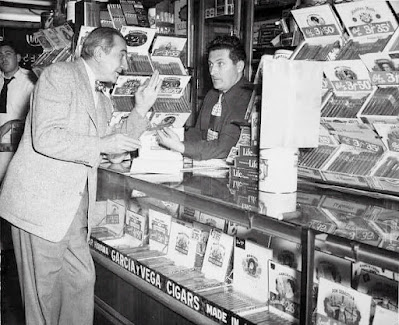
Lugosi at an unidentified cigar shop.

Early on, his lack of education proved to be challenging: "They tried to give me little parts in their plays, but I was so uneducated, so stupid, people just laughed at me. But I got a taste of the stage. I got, also, the rancid taste of humiliation. It was then I got, too, the knowledge of the main key to my character that I had the ability to focus my will, my mind, my body, my emotions into one deep and driving channel."

Records researched by Arthur Lennig, a cinema professor and author of Lugosi's biography The Immortal Count, indicate Lugosi's earliest performances occurred during the 1903-1904 season. He acted in small roles and because of his pleasant singing voice he often appeared in operettas, later joining other troupes at the end of the season and performing in several towns and cities, gradually refining his acting skills. Early in his career, he was credited as "Bela Lugossy," a name likely chosen since the y ending connotes nobility, something Lennig believes appealed to the young, hopeful actor. Lennig also mentions, "In 1911, perhaps feeling that the aristocratic name was too pretentious, he modified it and so became Lugosi."
"His former acquaintances found him to be personable, polite, friendly, but a 'loner' and a terrible manager of his finances."
During the summer of 1914, the onset of World War I, Lugosi quickly enlisted in the army even though he could have obtained a deferment due to his position in the theater. He earned the rank of lieutenant in the 43rd Royal Hungarian Infantry, served in the trenches for a year and a half, and was wounded twice in battle, leaving the service to recover in 1916. However, another biography claims he was discharged after successfully convincing army physicians that he was mentally unstable. Lugosi rarely spoke about his time in the war but it's noted in Lennig's biography that one of his most prized possessions was a gold ruble, likely obtained from a Russian soldier. "Bela" was inscribed on one side of the coin and a hole was drilled in it so Lugosi could wear it as a chain.


Years later, Lugosi told a rare war story in an interview though its validity is questionable and it's mentioned in very few sources:
"There was a moment I could never forget. We were protecting a forest from the Russians. All of us were cowering beneath huge trees, each man beneath a tree. A young officer, incautious, went a little way out of cover and a bullet struck his breast. I forgot the Russians were firing from their line with machine guns. Not a selfless man, I had one selfless moment ... I ran to him and gave him first aid. I came back to my tree and found that it had been blown to the heavens in heavy, crushing pieces. I became hysterical. I wept there on the forest floor, like a child ... not from fear, not even from relief ... from gratitude at how God had paid me back for having that good heart."
Following the war, Lugosi returned to acting at Hungary's Royal National Theater, frequently relegated to small parts while older, more experienced actors performed in leading roles. However, Lugosi was determined to succeed and his presence on such a prestigious stage attested to his talents.

An acquaintance who knew Lugosi during this time recalled in 1968:
I saw him as a young, serious actor, who came to his rehearsals punctually, with books under his arm, and tried to develop the possibilities of his roles with dedication. He usually played the roles of a young lover, especially of those who were dominated by extensive passion. He was favored by the audience. In my judgment, he was a very fine actor.
In regard to how Lugosi was offstage, Lennig's biography notes, "His former acquaintances found him to be personable, polite, friendly, but a 'loner' and a terrible manager of his finances." Financial troubles plagued Lugosi throughout his life; he frequently lived beyond his means which caused him to declare bankruptcy years later. Lajos Balint, who later became the National Theater's literary manager, was Lugosi's roommate for several years and observed the actor's peculiar spending habits. Oranges at the time were rather pricey where they lived but that didn't stop Lugosi from squeezing five of them to make a glass of juice. Another amusing story Balint recalled occurred at the outbreak of World War I when he told Lugosi many products would soon be quite expensive, such as shoes. When Lugosi asked Balint why, he explained that soldiers would need leather for their boots. After Balint returned from work one night, he saw several shoeboxes and realized Lugosi frantically purchased multiple pairs of shoes.

In 1917, the film industry was developing in Hungary and studios were hiring stage actors to star in their movies. Lugosi finally started earning leading roles, aided by his acting skills, good looks, young age, and charismatic personality. "Unfortunately, most of the early Hungarian films have been lost through neglect, deterioration, fire, or the bomings of World War II. Of about 500 films, only a dozen or so remain, and Lugosi can only be seen in one of those." (Lennig, pg. 30). Lugosi appeared in several silent Hungarian films billed as Arisztid Olt. It was the film company's attempt to appeal to audiences outside of Hungary, changing actors' names to ones that seemed more pronounceable to European moviegoers.

Between 1918 and 1920, Hungary experienced political unrest following the war and Lugosi developed a stronger interest in politics. He fervently supported the revolution and became one of the leaders of a newly created theater union in late 1918. Perhaps the poverty he experienced as a worker and later as an actor in small roles guided his radical political views, where money would not be the primary goal of the arts and they would be purer and performed with passion instead. Once the communist regime was deposed after four months, supporters were purged, imprisoned, or murdered.

"After the war, I participated in the revolution. Later, I found myself on the wrong side," Lugosi recalled years later. He and his wife Ilona fled to Vienna in 1919, crossing the border while hidden in a cart beneath a large straw mound. Encouraged by her wealthy parents, Ilona left Lugosi and returned to Hungary, while Lugosi traveled to Germany in search of acting work. After appearing in a handful of German films, Lugosi boarded a cargo ship bound for New Orleans, Louisiana in hopes of finding success in the United States. He quickly made his way to Ellis Island in New York City and was lawfully admitted to the country, becoming a naturalized citizen a few years later. Lugosi spoke no English at the time but managed to find plays performed in his native language while slowly learning English from tutors and fellow actors.
"His pipe smoking resulted in a large collection, though if he couldn't fit his thumb into the bowl of a pipe it usually became a gift for someone else."
An American theatrical adaptation of Bram Stoker's Dracula was written in 1927 and Lugosi was hired to play the titular character based on his acting ability, imposing on-stage presence, and his Hungarian accent that many found intriguing and mysterious. Initially, Lugosi almost turned down the role because of the character's lack of lines. The play ran for nine months on Broadway and was a massive success, with a run on the West Coast creating opportunities for Lugosi to act in "talking pictures" which were becoming popular.
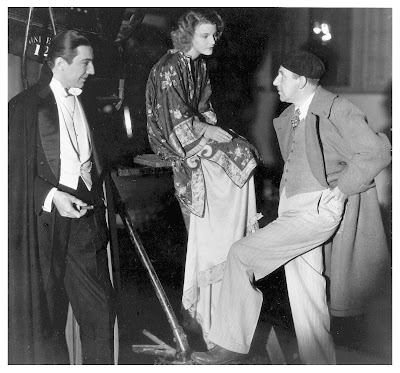
On the set of Dracula in 1931 with Helen Chandler and Tod Browning.

Following the play's success, a film adaptation of Dracula was heavily discussed but several other actors were considered before Universal Pictures selected Lugosi, after he persistently lobbied to play the part he coveted and that he accepted at a low salary. Released in 1931, it was the first sound film adaptation of Dracula and Lugosi's portrayal of the menacing Count is widely considered to be the definitive Dracula. It was a mesmerizing performance with Lugosi's slow, deliberate pacing making the character even more mysterious and compelling.

Dracula was a landmark movie that firmly established horror as a credible film genre and was Universal's highest-grossing production that year. The movie's critical and commercial success also encouraged Universal Pictures to produce several other iconic horror films, including Frankenstein, The Mummy, and The Invisible Man. While Dracula paved the way for other movies, it resulted in Lugosi being typecast as a horror villain since his performance was so brilliantly convincing.

In 1934, Lugosi began working with fellow horror actor Boris Karloff and the pair would appear in eight films together. Despite many thinking they had an intense and bitter rivalry, they maintained a friendly, professional relationship, but rarely socialized off set as their hobbies and interests were vastly different. Karloff was more successful, usually receiving top billing in films before Lugosi, who harbored no jealousy or animosity toward his co-star. Both men respected each other's work and never tried to upstage one another, performing in several excellent films such as The Black Cat, The Raven, Son of Frankenstein, and Black Friday.

Beginning in the 1940s, Lugosi's career began to decline due to a variety of factors. Studio management changed hands and Lugosi was relegated to small parts, with movies capitalizing on his name value despite him not being in a leading role. Lugosi was also diagnosed with severe, chronic sciatica, causing stabbing pains running from his pelvis into his foot that Lugosi likened to a dentist striking a raw nerve. While aspirin is often used to alleviate the pain, Lugosi's stomach ulcers lead doctors to prescribe him opiates. Lugosi became dependent on them, particularly morphine. Despite this, Lugosi was cast as Dracula for a second and final time in 1948's Abbott and Costello Meet Frankenstein, delivering an excellent performance as a suave, classy vampire in a film that parodied horror movie cliches.

The brief success was short lived and Lugosi began acting in movies directed by Ed Wood, an ambitious and eccentric director who made several low-budget films throughout the '50s. Wood had long admired and respected Lugosi, and genuinely wanted to help the struggling actor who was forgotten by Hollywood. Wood's films were poorly made and received negative reviews, but it was clear there was passion behind them and they were authentic attempts to make Lugosi a star once again.

Lugosi had several projects planned but passed away August 16, 1956 from a heart attack in his Los Angeles apartment at age 73. His funeral was small, attended by his family and close friends, and he was buried in one of his Dracula capes, a decision made by his only child and his ex-wife as they believed it's what he would have wanted. Lugosi experienced a well-deserved surge in popularity thanks to Tim Burton's 1994 film Ed Wood and Martin Landau's portrayal of Bela Lugosi. Landau won the Oscar for Best Supporting Actor and several other major awards, though Lugosi's son criticized the film's portrayal as being inaccurate. However, Landau's masterful performance was a wonderful tribute to Lugosi and brought recognition to an iconic actor who was frequently underappreciated yet supremely talented.

In addition to being a horror movie icon, Bela Lugosi was also an avid pipe and cigar smoker throughout his life. Bela Lugosi Jr. notes on his father's website, "Once he lit a cigar, if he had to interrupt his smoking, he would leave it in some inconspicuous place like a planter box outside the door." While on stage, Lugosi's fourth wife Lillian would puff on a cigar to keep it lit when he performed on stage so that he would be able continue smoking between scenes.
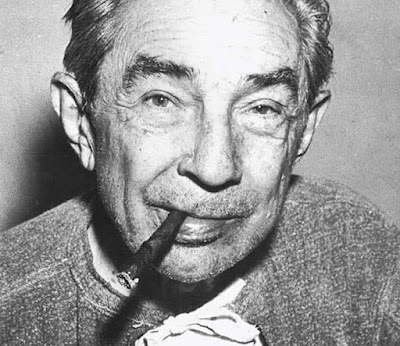
Lugosi after his release from treatment for morphine dependency smoking an "El Stinko".

American actor Lyle Talbot, best known for his work on the sitcom The Adventures of Ozzie and Harriet, mentioned Lugosi's pipe smoking in a 1976 interview:
"Lugosi was a nice man — a very intelligent man. He did have a slight accent though — but a very fine actor. We got into several conversations while shooting this picture (One Body Too Many) because he had just started smoking a pipe. Bela had never smoked one before and was all enthused about getting this pipe. But Lugosi allowed so much "cake" to accumulate in his pipe that he could hardly get any tobacco in it. "Bela," I said, "your pipe will crack if you put too much carbon inside." So he was very grateful to hear this and I cleaned out his pipe. Then, everything was okay between us.
In Gary Don Rhodes' 1997 biography Lugosi: His Life in Films, on Stage, and in the Hearts of Horror Lovers, the author notes:
Bela's great love of Hungarian food and imported sulphur water also remained fixed in the memories of his friends. Along with food, he appreciated fine tobacco. His pipe smoking resulted in a large collection, though if he couldn't fit his thumb into the bowl of a pipe it usually became a gift for someone else. The actor also adored good cigars, though when money became scarce he resorted to a cheap brand he called "El Stinko, El Ropos."
Bela Lugosi's powerful and ominous on-screen presence helped popularize the horror film genre, portraying mysterious characters and delivering enthralling performances. Lugosi's Dracula is legendary and iconic, spawning countless imitations and solidifying his reputation as a horror movie icon. Though he was often typecast as a villainous character and largely forgotten by Hollywood in his later years, Lugosi's work continues to be respected by horror fans and will undoubtedly be admired by future generations.

NOTE: The Warner Bros. Hollywood Theatre (aka Hollywood Pacific Theatre) is located at 6433 Hollywood Blvd., Los Angeles, opened on April 26, 1928 with a seating capacity of 2,700. The large building also included office and retail space and radio station KFWB. It was designated a Los Angeles Historic-Cultural Monument in 1993 and permanently closed in 2000. The Hollywood Smoke Shop opened in 1930 and closed at the same time as the theatre. To learn much more about this historic Hollywood Blvd building, go HERE.

Wednesday, November 5, 2025

SCREEN FACTS: BELA LUGOSI


This fanzine edited by Allan Barbour ran for 24 issues from 1963 to 1972. Page count varied from issue to issue and content was not limited to only horror films and actors, but included pictorials of many stars and movies from Hollywood's golden years.

The 6th issue (January 1964) contained a portfolio of photographs featuring Bela Lugosi. The photos were given to film critic and historian William K. Everson by Lugosi himself, who, in turn, kindly supplied them to Barbour to publish. Although many of them are now recognizable from various sources, at the time, the images had not yet been publicly seen.


A larger size of Lugosi's favorite portrait:


See more SCREEN FACTS HERE.

Saturday, April 12, 2025

BELA LUGOSI'S WHITE ZOMBIE TAILCOAT AND VEST


One of the more memorable villains from early sound horror films was Bela Lugosi's Murder Legendre in WHITE ZOMBIE (1932). The role fit Lugosi perfectly and he made the most of bringing out the mephistopholean wickedness that the character demanded.

His costume was a cross between undertaker and plantation master with his wide-brimmed had and long, dark clothing. Amazingly, years later, two of these pieces were found in a studio vault after 80 years and put up for auction. When the gavel dropped, the ensemble sold for an astonishing $100,000!

NOTE: There is one error in the lot details shown below: Lugosi made Universal's MURDERS IN THE RUE MORGUE before he was cast in WHITE ZOMBIE.


Lot 0783 Details:

783. Original Bela Lugosi tailcoat and vest from White Zombie.(UA, 1932) Bela Lugosi's followup to 1931's Universal Studio blockbuster, Dracula, was the ultra-low budget White Zombie, produced and directed by the Halperin brothers, setting the stage for a career that frequently bounced back and forth between A studio pictures and B movies. Lugosi played the infamous Murder Legendre, a Haitian plantation owner who turns his former enemies into zombies, whom he employs as slaves in his sugar mill. The 1932 film cemented Lugosi's reputation as a strangely seductive leading man. This iconic costume, consisting of dark blue three-button jacket with tails and five-button vest, each with internal United Costumers, Inc. tags handwritten "Lugosi" and "Bela Lugosi".The jacket was originally shot with a five-button design with the top button nearly reaching the collar. Studio tailors closed the holes (evident upon close examination) and the collar was modified for later use. The costume was worn by Lugosi in a key sequence, and was discovered buried in a studio vault where it had remained for the nearly 80 years since White Zombie finished shooting. Comes with a Warner Bros. certificate of authenticity.