You know from past posts here that I am a vocal proponent for folk horror films. The sub-genre is elusive and insinuates itself in many ways into the context of many movies.
This article explains the phenomenon and how it recently re-emerged in popularity.
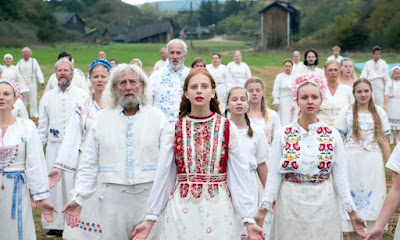 |
| A scene from the film, Midsommar. |
We Are Going Through a Folk Horror Renaissance
It’s like cottagecore, but with murder.
October 29, 2021 | nofilmschool.com
There is a chill in the air as you spot animal skulls hanging in the trees and the sound of many quiet voices calling for you in the still woods. The night is falling, and whoever is watching you doesn’t want you to leave. This impending threat is quite normal in one of the most chilling subgenres of horror out there: folk horror.
Folk horror is a subgenre that achieved a spot in the general public in 2010 after the BBC Four documentary, A History of Horror, used the term to describe a series of nihilistic British genre films focused on the occult, paganism, and ritualistic sacrifice in a rural landscape. Since the term’s debut, the subgenre has expanded to include a multitude of offerings from suffocating silence to samurai ghosts.
In recent years, the folk horror genre seems to be going through a renaissance with slow-burner hits like Midsommar. Let’s see how folk horror came to be, and how it has found a revival in modern-day cinema.
What is folk horror?
While most of the horror genre focuses on the horrors of people, folk horror finds its roots in the land. It is difficult to convey the form that specifically makes a folk horror film, but the emphasis on the evil that has seeped into the soil, the terror of the unkempt woods and forgotten lanes, the ghosts that haunt stones and patches of dark waters are key factors in the subgenre.
Folk horror takes the romantic notion of the natural world as a restorative, tranquil paradise and releases the dark potential of the landscape. The woods are hostile, with the earth filled with bones of the past. The seclusion becomes maddening as the mind is filled with local legends, myths, and old-world beliefs. Viewers have conditioned themselves to not judge those who are different from our modern lifestyle and put down their guard to welcome the beauty of nature, but once that guard is down, the dark underlayer releases its violence.
The unholy trinity of folk horror
As Adam Scovell states in his article for BFI, there is a trilogy of British films made with various ideas of the counter-culture era fueled by the flower-powered highs of the 60s and the dying optimism in the mid-70s.
The first of the trilogy, and possibly the most nihilistic of the three, is Micheal Reeves’s Witchfinder General. The film is a disturbing tale that follows a Puritan Witchfinder General, Matthew Hopkins, as he is empowered to travel the countryside to collect a fee for each witch he extracts a confession from during the English Civil War. The film shows a sadistic and cynical view of Puritanical efforts to purify the earth by dismembering those who are deemed wicked.
The second film is Piers Haggard’s The Blood on Satan’s Claws, followed by the more optimistic of the three, Robin Hardy’s The Wicker Man.
These unholy three defined the subgenre by emphasizing the natural landscape which isolates its communities and those within those communities. They also focused on the skewed moral and theological system that causes violence, human sacrifice, torture, and even demonic and supernatural summoning. By unearthing the darker side of cult-like communities and the occult, these three films would set the groundwork for what elements made up the folk horror genre.
The revival of the genre
There has been a recent boom in the folk horror genre. This recent wave of folk horror is largely due to people’s longing for a way to escape technology and the pressures and emptiness of everyday life. The feeling was more present than ever during the COVID-19 pandemic which left people searching for a way of escapism through the cottage-core aesthetic.
The subgenre is fixated on history and tradition, and placing purpose on a communities’ or individual's actions can bring a sense of comfort to the viewers. The viewer begins searching for familiarity in their own daily lives once they realize that they could never survive in the situations characters find themselves in in folk horror films.
It is also our fascination with the occult or cult-like communities that draw us into these bizarre worlds. We find ourselves deeply invested in stories of terror as the characters try to find a sense of happiness in pastoral life.
Modern-day folk horror still focuses on the darkness of the land, isolation, and the creatures that lurk in the forest, but these films also try to create empathy toward those who are suffering and find comfort in their found community.
Some of the defining movies in the revival of the subgenre include Ari Aster’s Midsommar, Robert Eggers’ The Witch and The Lighthouse, Lamb, It Comes At Night, The Wailing, and Kill List. The bizarre surrealism and otherworldliness of the films keep us just at the edge of fully understanding how the world of the film functions, requiring the watcher to fully immerse themselves into the film for the entirety of its run time.
Many of these films are inspired by folklore, myths, and customs that directly contrast our digital world. The modern-day folk horror films heavily focus on the distant relationship humans have with nature and the greed that consumes us when we do interact with the land. Some people may be looking at the land as a thesis statement to help them graduate or provide a new life or job that rewards them for taking care of the land. How the humans in the story interact with the land will ultimately lead to their deaths or rebirths.
Sure, some of these modern-day folk horror films are not necessarily terrifying, but they break down the audience's expectations to tell a much larger story that relies heavily on the relationship between humans and nature.
With production companies like A24 dominating the folk horror landscape, there is good reason to believe that folk horror is going through a revival. More and more people find themselves connected to the characters in folk horror. It encourages audiences to not isolate themselves in the woods or on an island away from society. Sometimes, isolation can be nice, but allowing that dread to consume you is a whole other monster.
Folk horror will continue to flourish, as it is one of those subgenres that allow filmmakers with any budget to create beautifully terrifying projects that feed off of a very prevalent escapist fantasy. All you need is a camera, a character, any isolated location, and a menacing presence that allows the main character to achieve their emotional arc. Combine all those elements, and you'll have a pretty darn good folk horror film in your hands.
* * *
Honestly, I had to look up the term, "cottagecore", and here's what I found: "Cottagecore, also known as farmcore and countrycore, is inspired by a romanticized interpretation of western agricultural life. It is centered on ideas of simple living and harmony with nature".
The release of the 2015 film, THE VVITCH was Robert Eggers' directorial debut and it was critically acclaimed. This review is from the April, 2016 issue of SIGHT AND SOUND.