Edited by preeminent H.P. Lovecraft scholar, S.T. Joshi, the first issue of PENUMBRA: A Journal of Weird Fiction and Criticism has been published by Hippocampus Press. Order HERE.
From the publisher:
Penumbra is a new annual journal that seeks to present cutting-edge articles on weird fiction as well as original weird fiction by some of the most talented contemporary writers in the field. This first issue contains scintillating new fiction by such veterans as Mark Samuels and Michael Aronovitz, as well as by new and up-and-coming writers such as Curtis M. Lawson, Manuel Arenas, Belicia Rhea, and others. As a “classic reprint,” we present a rare story by Gertrude Atherton.
Among the works of criticism and scholarship, Matt Cardin studies a story by Thomas Ligotti; John Tibbetts supplies a detailed overview of the ghost stories of Edith Wharton; James Goho analyzes the work of Simon Strantzas; Darrell Schweitzer assesses the eccentric tales of John Collier; and Nancy Holder demonstrates the frequency with which Sherlock Holmes has entered weird fiction over the decades. Other essays touch on the work of Edgar Allan Poe, Lord Dunsany, China Miéville, Jean Ray, and William Hope Hodgson. Mark Samuels translates a little-known essay on weird fiction by Stefan Grabinski, while Jason V Brock provides an essay on zombie films.
We also feature verse by such leading contemporary as Wade German, Adam Bolivar, John Shirley, Darrell Schweitzer, Nicole Cushing, and Leigh Blackmore.
All told, Penumbra is a rich feast of weird fiction, poetry, and criticism, showing the vibrancy of a genre that is enjoying immense popularity in the present day.
TABLE OF CONTENTS
Editorial
Fiction
- If Destiny Still Reigns / Mark Samuels
- The Truth about Vampires / Curtis M. Lawson
- Las Llorasangres / Michael Parker
- Static / Belicia Rhea
- The Slug / Jon Bockes
- Counter-Current / Michael Aronovitz
- The Crazy Mountains / Dylan Henderson
- The Hell of Mirrors / Manuel Arenas
- Door Skin / Belicia Rhea
- Classic Reprint
- The Caves of Death / Gertrude Atherton
Nonfiction
- Icy Bleakness and Killing Sadness: The Desolating Impact of Thomas Ligotti’s “The Bungalow House” / Matt Cardin
- The Cosmic Scale of Elfland / Michael D. Miller
- The Idea of the North in the Fiction of Simon Strantzas / James Goho
- I Walked with a Zombie: The Tragicomic World of the Firefly Clan / Jason V Brock
- “The Terror of Solitude”: The Supernatural Fiction of Edith Wharton / John C. Tibbetts
- Finding Sherlock Holmes in Weird Fiction / Nancy Holder
- Confessions / Stefan Grabinski
- “The Weird Dominions of the Infinite”: Edgar Allan Poe and the Scientific Gothic / Sorina Higgins
- The Psychic Sleuth Who Survived / Lee Weinstein
- The Resurgence of a Fallen Angel: Echoes of The Ghost Pirates in “The Mainz Psalter” / Hubert Van Calenbergh
- Monstrous Tourism: Petromodernity in China Miéville “Covehithe” / Rhonda Knight
- John Collier: A Weird Fantasist in Jester’s Motley / Darrell Schweitzer
Poetry
- Mormo / Wade German
- To Live at the Edge of a Black Hole / John Shirley
- Et In Arcadia Jack / Adam Bolivar
- The Mysteries of the Worm / Darrell Schweitzer
- Delirium Vivens / Nicole Cushing
- The Fantastic Flame / Leigh Blackmore
Hippocampus Press has long been a leading publisher in weird fiction and non-fiction, with an emphasis on H.P. Lovecraft and his circle. Just released is this 3-volume set of another master of the genre, Arthur Machen. Machen's tales often center around the ancient magic of the fields and hill of England, and its intersection with modern life (called "Folk Horror" these days). His "The Great God Pan" is considered to be one of the greatest weird fiction stories ever, even though it was panned by reviewers. Much of his work has been printed and re-printed over and over through the years, but this series is the first one covers his work in totality, and it's all put together by editor S.T. Joshi. This set was released at NecronomiCon Providence 2019.
Place your order HERE.
This is the first complete edition of the fiction of Anglo-Welsh writer Arthur Machen (1863–1947) ever published. It includes the totality of his short fiction, novelettes, novels, and prose poems. While there is some debate as to what actually constitutes a short story in Machen’s work—especially given his bountiful array of journalism, some of which borders on fiction—the works in this volume are unquestionably narratives that feature one or more elements of fictional composition. A substantial majority of these works are tales of horror and the supernatural—a genre in which Machen has made a lasting and ever-expanding impression.
The edition has been prepared by S. T. Joshi, a leading authority on weird fiction and the author of The Weird Tale (1990) and Unutterable Horror: A History of Supernatural Fiction (2012). Joshi has prepared textually corrected editions of the work of H. P. Lovecraft, Ambrose Bierce, and many other weird writers.
Volume 1: 1888–1895
This first volume contains his charming picaresque novel The Chronicle of Clemendy (1888), an exquisite imitation of the medieval narratives of Chaucer and Boccaccio. At this time Machen was a young journalist who had moved from his native Wales to London, and he wrote a number of humorous and slightly risqué sketches for fashionable London magazines. But then he published “The Great God Pan” (1894), one of the pioneering works in the entire range of weird fiction. It was condemned by contemporary reviewers as the work of a diseased mind. Machen followed it up with the episodic novel The Three Impostors (1895), containing the brilliant segments “The Novel of the Black Seal” (which features the Little People, a sub-human race lurking on the edges of civilization), “The Novel of the White Powder,” and other vivid narratives.
Volume 2: 1896–1910
This second volume of Machen’s collected fiction begins with Machen’s most accomplished novel, The Hill of Dreams (written in 1895–97 and published in 1907), which H. P. Lovecraft called a “memorable epic of the sensitive aesthetic mind.” It features Lucian Taylor, a young man from the country who struggles to become a writer in London. His ruminations on life, love, and authorship are extraordinarily poignant, and at one point he engages in a lengthy dream of being back in ancient Rome, in the town of Isca Silurum, near his birthplace in Wales. Later in 1897 Machen wrote a series of exquisite prose poems that were later published as Ornaments in Jade (1924). These ten vignettes display Machen’s luminous prose at its most evocative, and they touch upon the possibility of strange and wondrous phenomena concealed behind the outward façade of the mundane world. Machen’s most accomplished weird tale, “The White People,” is also found here. Its account of a young girl insidiously inculcated in the witch-cult, told entirely from her own perspective as she jots down her thoughts and impressions in a diary, achieves the pinnacle of clutching fear. A very different work is the short novel A Fragment of Life, telling of how a seemingly ordinary couple rediscover their sense of wonder in the world around them. The novel The Secret Glory (written around 1907) is a discursive novel that searingly condemns the British school system for destroying the imaginations of its pupils. The entire work—including the final two chapters, first published only in a limited edition in 1992—is included here.
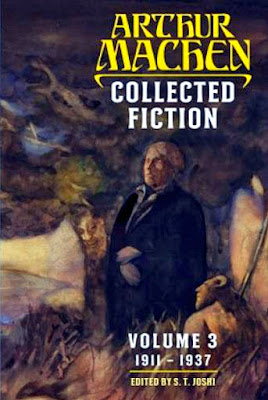
Volume 3: 1911–1937
The third volume of Machen’s collected fiction begins with a tale, “The Thousand and One Nights,” that has never before been reprinted. It continues with a succession of tales that Machen wrote during and just after World War I, a cataclysm that shook Europe to its foundations. The most famous of these is “The Bowmen” (1914), a narrative of medieval soldiers coming to the rescue of besieged British infantrymen in France was widely believed to be a true account, in spite of Machen’s repeated protestations to the contrary. Machen’s final war tale, the short novel The Terror (1916), is an imperishable depiction of the revolt of animals against humanity’s rulership of the earth. In the 1920s Machen resorted to humor and satire to convey his dissatisfaction with the increasing secularization of his era, which he felt was robbing the imagination of wonder and mystery. He also began contributing to anthologies of original weird fiction edited by Cynthia Asquith and others, producing several memorable tales as a result, including “The Happy Children” and “The Islington Mystery.” Machen’s final novel, The Green Round (1933), is a subtle tale of supernatural menace, narrated in the blandly repertorial prose that Machen had developed in his later work. He then published two final volumes of weird tales, The Cosy Room and The Children of the Pool (both 1936), which contain many memorable tales, including “The Bright Boy” and “N.”