Showing posts with label BIGFOOT. Show all posts

Friday, January 26, 2024

I WAS BIGFOOT'S LOVE SLAVE!


Maybe she strayed too far of the park trail in Bigfoot Country, but it was bound to happen anyway, wasn't it? Leave it to the degenerate minds of the (now defunct print newspaper) WEEKLY WORLD NEWS to dream this one up. Or did they?

See more WEEKLY WORLD NEWS nonsense HERE.


Friday, February 3, 2023

MY BIGFOOT MODEL


What better model kit to build here in the Pacific Northwest? I built this last year and just came across the photos I took when it was completed. I believe it was first issued back in the 80's by AMT. This is the re-issued, "Glow-in-the-dark" version. The pieces were snap-together and as usual with this type of kit it was not without its challenges. The biggest problem was getting the seams matched, and even a good amount of putty didn't completely fill them.

I customized the kit by adding moss and sticks from the trees in my yard and used a water texture for the pond from Vallejo. For the finishing touch, I added a red LED light under the base to illuminate the skull. I thought it turned out pretty creepy and this 'Squatch is definitely not of the friendly type!

The original box art.

The re-issue box art.


Saturday, December 21, 2019

FISH WITH A HUMAN FACE!


Fish With Human Face Stuns China!

A bizarre piece of footage out of China shows a fish that seems to sport the face of a human. The eerie video was reportedly filmed by a tourist visiting the city of Kunming earlier this week. While stopping a popular pond in the area, she caught sight of a strange fish, said to be a carp, in the water that appeared to possess the eyes, nose, and mouth of a person. The astounded witness mused to someone nearby "the fish has become a fairy, it has a human-like face."


The video quickly went viral in China after it was posted to the social media site Weibo with viewers offering all manner of opinions on the odd creature. Fortunately, there was nothing sinister or supernatural about the fish's unique 'condition' as the spooky visage was merely the result of markings on its body coincidentally resembling a face, likely 'enhanced' by the water. The phenomenon, so to speak, is actually not altogether rare for this particular species of fish as 'human-faced' carp spotted in England and Taiwan made similar headlines in recent years.


[SOURCE: Coast2Coast AM.]


Caught On Tape: Howl of a Bigfoot?

A chilling piece of footage from Canada features what appears to be a series of haunting howls coming from a forest and some suspect that the eerie screams could have come from a Bigfoot. The strange scene reportedly occurred earlier this month as Stargell Blackstar was grouse hunting with his wife and grandson at a rather remote wooded location around 30 miles Sioux Lookout, Ontario.

In a subsequent post of the video to YouTube, the bewildered witness says that the odd sounds lasted for around five minutes, but they were only able to film around 2 minutes of the weird event. In the footage, Stargell can be heard marveling "oh my God" as a number of unsettling howls repeatedly erupt out of the nearby forest.

At one point in the video, Stargell's grandson starts crying, which we imagine was a worrisome moment as the family probably would have preferred that whatever creature was behind the screams did not know they were there. To that end, some observers have suggested that the animal in question was the legendary Sasquatch. However skeptical viewers argue that the howls could have come from a moose or some other prosaic animal. 


[SOURCE: Coast2Coast AM.]


Canadian Professor Lost Her Job for Telling the Truth About ‘Endangered’ Polar Bears
James Delingpole | 27 Oct 2019

A Canadian university has frozen a zoologist out of her adjunct professor post as punishment for saying the unsayable about polar bears: that populations are thriving; that they are not endangered; that stories about how they are being caused to starve by melting summer sea ice are junk science #FakeNews.

Dr Susan Crockford is one of the world’s leading experts on polar bears and had held her post as Adjunct Professor at the University of Victoria in British Columbia, Canada for 15 years.

But by speaking the truth about polar bears she fell foul of environmental activists who have long treated Ursus maritimus as one of the poster children for their “the Earth is doomed and it’s all our fault” narrative. As a result, without explanation, Crockford was ousted from her position at the university.

In an interview with Crockford this week for Breitbart News, I ask: ‘Do you think you’ve been blacklisted for telling inconvenient truths?’

She replies:

“Oh I absolutely do.”

Crockford’s “crime” was to point out that contrary to environmentalists’ computer projections, polar bear populations have increased, not decreased — despite “global warming”.

“What happened was that in 2007 there was a prediction that when sea ice declined to about 42 per cent below what it would have been in 1979 that two-thirds of the polar bears in the world would be gone. That would be 10 out of the 19 sub populations that exist.

But what has happened, we find from research, is that bear numbers have not gone down but in fact have gone up by at least 16 per cent and probably more. So the bears are thriving despite the fact that sea ice has declined dramatically.”

The “polar bears starving because of melting sea ice” story has been a staple of the green scare narrative.

In 2017, for example, footage of an emaciated polar bear rummaging pitifully through trash cans became a huge international story.

The video for National Geographic attracted over two million views. It was set to tear-jerking music and accompanied by the utterly dishonest and misleading message “This is what climate change looks like.”

In fact, as Crockford explains, this was the purest green #FakeNews.

“Starving is the leading natural cause of death for polar bears. It just happens.”

If the polar bear was starving to death, it was likely the result of its being old or sick — not because of melting summer sea ice.

Crockford says:

“Polar bears do most of their feeding in the spring time, not the summer. Starving polar bears don’t tell us anything about populations.”

[SOURCE: Breitbart.com]


"Blob" Creature Mystifies Scientists

A fascinating new exhibit at a zoo in Paris showcases a mysterious and bizarre creature dubbed the 'Blob.' The strange slime mold, which will reportedly be unveiled to the public for the first time this coming Saturday at the Paris Zoological Park, boasts an array of odd and rather wondrous characteristics that have left scientists scratching their heads. "The blob is really one of the most extraordinary things on Earth today," marveled museum director Bruno David, "it's been here for millions of years and we still really don't know what it is."

What makes the blob remarkable is that it lacks eyes, a mouth, a stomach, a brain, and a nervous system, yet it can accomplish a number of things which should seemingly be impossible. For example, the creature was stunningly able to navigate its way through a maze in order to find food, which it subsequently somehow consumed. Noting that the weird slime is apparently capable of memory, adapting its behavior, and solving problems, David observed that it seems to behave "like a little animal."

To that end, however, David noted that "we don't really know if it's an animal, if it's a fungus, if it's in between." The creature is made all the more confounding by the fact that it also boasts incredible healing powers and, if merged with another of its kind, can inexplicably share information with its counterpart. And, amazingly, in one experiment, scientists cut the creature into multiple pieces and it managed to reconstruct itself in a manner akin to what one might expect from a science fiction film.

Named after the 1958 Steve McQueen film The Blob, this particular form of the perplexing organism has been known to scientists for nearly 50 years, yet continues to astound researchers by what it is capable of doing and how it appears to defy classification. Ultimately, David mused that "the blob is a living being which belongs to one of nature's mysteries." And, adding one more achievement to the list, the creature is likely to become a star attraction at the zoo, despite resembling nothing more than a small puddle of goo.


.
[SOURCE: Coast2Coast AM.]


A Cultural Historian Explores an Old Mental Hospital, and Why They Scare Us
They are haunted, but not by ghosts.
By Troy Rondinone | 31 October 2019

RISING 200 FEET OUT OF the hills of rural West Virginia, a clock tower looms over a vast and empty collection of buildings that once housed thousands of people diagnosed with mental illness. After being shuttered for more than 20 years, since 2007 the Weston State Hospital has been open for business again under its original name—the Trans-Allegheny Lunatic Asylum—and caters to tourists interested in some combination of history and the paranormal. Some buildings are off-limits and most of the site is without electricity, but a considerable portion of it awaits the curious and the brave. As I pulled in to the vast, park-like grounds, the imposing, cut-stone main building leered in the late afternoon sun. The architecture is Gothic-inspired, and the windows dark—like it was made to evoke a sense of dread and mystery. But this is precisely not what the builders wanted to inspire.

I’m an academic historian of American culture at Southern Connecticut State University, and my trip to the Trans-Allegheny began years earlier, when I saw it featured late one night on a ghost-hunter television show. What was it that made this place so scary? Was it always that way? (According to the Travel Channel, the hospital is one of the 10 most haunted spots in the country.) I spent the next five years tracking the dark narrative of mental hospitals through fiction, memoir, film, media, and art. I watched hundreds of movies, read scores of novels, and pored over heaps of periodicals. Ultimately, I came to the conclusion that Americans have always been deeply invested in what goes on within the walls of these institutions, and I began to understand why. The term “asylum” itself, which has negative connotations today, was originally used to evoke confidence, safety, and security. How and why this changed is part of this longer story of stigma, fear, and horror. A “ghost tour” through the Trans-Allegheny is the logical end of the story. Or perhaps, more precisely, the opening of another chapter.


THE TRANS-ALLEGHENY WAS ONCE AMONG the most expensive buildings in the United States. Ground broke on this massive collection of sandstone buildings in 1858, with the forced work of incarcerated African-American laborers, and continued on and off through the 1950s. Situated on over 300 acres, it was designed to evoke optimism and the spirit of reform that gave birth to similar mental hospitals around the country, beginning in the 1830s.

These public works were sold as monuments to healing, mansion-like and airy, with cutting-edge medical treatments and scientific architecture. Inside, a person committed there was said to encounter occupational therapy, medication, hydrotherapy, even hypnotherapy. Superintendents boasted that the older methods—chaining up the “mad” in basements—had been abolished. Straitjackets and strong rooms, it was said, would be used only sparingly. Clean air, baths, simple food, and healthful activities were considered cures for disorders of the mind, and the reported “cure” rates were—at least at first—terrific.

These “asylums”—the word in common use at the time—were meant to feel like a refuge, but were also products of a very different understanding of mental illness. As such, they also employed high doses of opium, bleeding, harsh purgatives, and devices such as the “Utica Crib” and the “phrenological hat.” Still, the institutions were not operated as though they had something to hide. Tourists were encouraged to visit, and postcards and even patient newspapers were printed for public consumption. In 1842, Charles Dickens called on a number of mental facilities during his American tour. He was famously unimpressed by Blackwell’s Island Asylum in New York, but found the Connecticut Retreat for the Insane in Hartford “admirably conducted” and the Boston Lunatic Asylum to be a place embodying “enlightened principles of conciliation and kindness.”

But even in those years, exposés, novels, and short stories began to cast America’s asylums as mysterious, even sinister. In 1833, one Robert Fuller called the McLean Asylum for the Insane in Massachusetts a “tyrannical Institution” and a “dungeon.” Isaac Hunt’s 1851 description of the Maine Insane Hospital told of a “most iniquitous, villainous system of inhumanity, that would more than match the bloodiest, darkest days of the Inquisition or the tragedies of the Bastille …” Pioneering feminist Mary Wollstonecraft locked her protagonist up in an asylum for her controversial 1798 novel Maria: or, The Wrongs of Woman. Edgar Allan Poe set a dark comedy, “The System of Dr. Tarr and Prof. Fether,” at the fictional Maison de Santé hospital, where the protagonist encounters a mad doctor who lords over a topsy-turvy world ruled by the patients.

Without a firm understanding of the causes of mental illness, or more advanced pharmaceutical or therapeutic options, these places were never going to achieve their goal of humane treatment of mental illness—a goal we still grapple with today. By the end of the 19th century, the hospitals were clearly overwhelmed. Stays grew longer, treatments were revealed as ineffective, and conditions worsened markedly. And thanks to a widely copied 1890 New York state law that made the state wholly responsible for the care of people with serious mental illness, patients kept flooding in. Overworked doctors tried dangerous new drugs and treatments, or simply neglected their charges. Things were even worse in the segregated, “colored” hospitals for African Americans, which typically had much lower budgets and fewer treatment options. In an effort to reverse the bad publicity, superintendents started renaming their institutions “hospitals.” It made little difference.

The demise of these big state hospitals began in the late 1960s, spurred by the widespread availability of thorazine (called the “chemical lobotomy”), a new Medicaid provision that funneled federal mental health funds to nursing homes, and a new emphasis on outpatient care. Deinstitutionalization of mental illness emptied many struggling hospitals, but also put many former patients, damaged by their institutional quarantine, on the streets and in prison.

This larger historical arc is mirrored, beat for beat, in the history of the Trans-Allegheny. Inspired, like many of the large state hospitals, by physician-reformer Thomas Story Kirkbride, it was designed for “moral treatment.” Kirkbride’s animating idea was that space, air, and rest would cure most cases of mental illness, hence the wings were set back in a staggered pattern to facilitate maximum light and air into each ward, and the grounds were planned with pleasant walkways, lawns, and fish ponds. Renamed the West Virginia Hospital for the Insane by the new state government of West Virginia in 1863, it welcomed its first batch of 20 patients in fall 1864. By 1881, the massive clock tower and the fourth wing of the main structure were completed, at significant cost to the state. It was touted as the largest hand-cut stone building in America.

The hospital was designed for 250 patients, but by the end of the century there were nearly 500 in residence. Intake diagnoses included “hereditary,” “epilepsy,” “menstrual,” and “masturbation.” By that time the cure rate was reported as 26 percent, much lower than earlier levels. Another name change, to Weston State Hospital in 1915, reflected a lack of confidence in the operation of the hospital, and within a couple of decades, the patient population was more than 2,000. New treatments, such as electroconvulsive therapy and lobotomies, were introduced. The crowding increased and conditions further declined.

By the time the hospital closed, at the tail end of nationwide deinstitutionalization, in 1994, it had lived through the lifecycle of just about every American mental hospital: early optimism, local boosterism, poor results, declining conditions, overcrowding, and finally desperation and closure. As with other hospitals, Weston shut its doors after years of diminishing support and patient numbers.

The grand old abandoned asylums carry the weight of a heavy past. Many are Kirkbride structures: massive faces, extended bat-like wings, tall ceilings, and extensive facilities. Cupolas and towers top many of them, which look castle-like. Nature has reclaimed many of the forgotten ones, which makes them alluring and hazardous. Hydrotherapy tubs, ventilation pipes, broken toilets, empty bed frames, and rotting dance floors: The mental hospital has become core to the idea of “ruin porn.” And for good reason. These features that these sites are known for, frankly, have long been associated with hauntings in popular culture.

Some states have declared their abandoned hospitals strictly off-limits, citing health hazards, including asbestos. Some hospitals have been repurposed. Fairfield State in Newtown, Connecticut, for example, has recycled and updated some of the buildings for municipal functions, and added a large youth sports complex to the site. Others, such as Blackwell’s Island (on what is now called Roosevelt Island) combined demolition with extensive refurbishment to create luxurious private living and commercial spaces. And then there are the hospitals that have entered the paranormal tourist trade.

In 2007, a contractor purchased the derelict Weston building from the state at auction for $1.5 million. The new owners revived its original, more frightening, less socially acceptable name, and began a program of limited restoration and courting of audiences interested in history or that like a good scare. The employees at Trans-Allegheny report that the site, as an attraction, has been a great boon to a local economy, which calls to mind the civic optimism that came along with its construction in the 19th century.

I arrived at Trans-Allegheny in the afternoon, and my experience began with a historical tour led by a docent dressed as a nurse. She explained the history of the buildings in great detail and related the stories of some of the patients with sensitivity and a modern understanding of mental illness. We meandered through a section of the central building, including a small museum, medical facilities, and the parklike courtyard in the back. A few spaces, such as one well-appointed hallway section, have been renovated to their midcentury splendor, with period furniture, fresh paint, and carpeting. In other places peeling paint and grimy floors spoke to the fact that most of the building has been untouched since 1994, and in many cases much earlier.


BUT I HAD SIGNED UP for more than the history experience. I was to return that night for the “Ghost Hunt,” in which about 30 visitors were allowed to see much more of the hospital between 9 pm and 5 am. I arrived that evening with a thermos of Starbucks, some snacks, a notepad, a headlamp, and a Ghost Meter EMF sensor (purchased online for $39.95). I wanted to understand the place that the old asylums have taken in the modern American imagination.

The large group was broken up into teams of 10 or so, and each was led through tours of different floors within the massive central building and its attached wings. The guides related history and legend and then let us wander freely for an hour or so in each new area. Walking through such a dark space is disconcerting and disorienting by itself. With my headlamp on a subdued setting, I could make out objects and doors but little else until I got close up. There were many times that I found myself alone. The hallways were staggered, and opened onto bedrooms, offices, bathrooms. One section had a row of cells. Wheelchairs seemed to have been strategically placed. My EMF device remained quiet.

In one area, a guide told me about Big Jim, who, it is said, murdered another patient with a bedpost. Here was the process for contacting him. Sit in the dark room and unscrew the head of your flashlight until bulb and battery lead are just disconnected. Then ask Big Jim a question and wait to see if his spirit would make the connection to make the light flicker on. There was some flickering, which means that it was at least a very good story to tell your friends later. I returned there later, after the tour, and sat in the dark room across the hall, my headlamp off, curious if something would happen—some noise or creak or visual artifact of the kind that tends to inspire ghost stories.

There was nothing, but that didn’t make it any less terrifying.

As the night went on, I continued patrolling the dark halls, sometimes away from the group, and I heard the sounds and thought I saw things in the shadows (though nothing that couldn’t be explained a dozen ways by animals, architecture, and the psychology of the unknown). I entered rooms and sat as still as I could. I checked that ghost meter. If there was a sensation that stuck with me, it might be the smell of old cigarette smoke—a direct sensory connection with the departed residents, it seemed. I’m a scholar, a skeptic, someone who knows how, over the years, a drumbeat of movies, rumors, horror stories, and more have made the classic American state mental hospital into an object of terror—maybe the most haunted class of buildings in the country. I know all that. But it’s impossible not to be affected by this.

These abandoned hospitals still have a lot to teach us. And sometimes that’s what’s most scary about them. None of us visitors slept that night, but rather spent the whole time exploring. I left in the light of the morning, tired but glad that I had had the experience. I neither saw nor heard any evidence of the supernatural, but I recalled all the stories and films from my years of research and started to see them in a new way. We, as a society, created these horrors, in allowing the overcrowding and decline of places of healing, in the stigmatization of people with mental illness, in the mistreatment of even the staff. Something about spending the night in the facility let me trace this path of hope and despair for myself.


[SOURCE: Atlas Obscura.]


How Mexico’s Most Sorrowful Spirit Became a Cultural Phenomenon
As America’s immigrant population grows, so does La Llorona’s cultural stature.
By Winnie Lee | 30 October 2019

DURING THE MAKING OF THE 2019 horror movie The Curse of La Llorona, some of the cast and crew were convinced that the spirit of La Llorona—Spanish for The Weeping Woman—lurked about. They were spooked by inexplicable cold chills and exploding jewelry on set, unexplained flickering lights and screaming dreams.

“We did have some creepy supernatural occurrences,” the director, Michael Chaves, told the Los Angeles Times. “Half the crew actually does believe the house that we shot in was haunted, and there might have been something to that.” Actress Patricia Velasquez added, “I think she was there just making sure we were doing right by her.”

In the film, the titular character is the ghost of a mother from 17th-century Mexico who drowned her sons and now haunts the living with her inconsolable crying. Dressed in white, she spends her days looking for other children to steal.

Off the screen, La Llorona is a well-known and pervasive legend who serves as a cautionary tale for multiple generations in Latinx households, often invoked to scare kids and stop them from misbehaving. Known throughout Central and South America but most often associated with Mexico, her story varies according to who tells it.

In some versions, she’s an indigenous woman who’s so enraged by her husband’s infidelity that she vengefully murders their children in a nearby river, then drowns herself in grief and remorse. In other versions, she blames her offspring for her lover’s desertion and throws them to their death in the river.

Regardless of which version is told, each tale results in her being doomed to wander the earth, always near water, wailing for her little ones (and thus earning her sad name). What earns her a scary reputation, is that La Llorona doesn’t just kidnap youngsters. She also brings woe and death to those who hear her cries or get in her way.

“The versions of the story we see today—including movies (The Curse of La Llorona, Mama, and La Leyenda de La Llorona) and television shows (the series Grimm)—all emphasize the spooky or frightening aspects of the story,” says Domino Renee Perez, author of the book There Was a Woman: La Llorona from Folklore to Popular Culture and associate chair of the English department at the University of Texas at Austin. “That this wandering woman who weeps will get you if you don’t watch out.”

Other, more complex versions of the grieving woman exist. She’s sometimes associated with Doña Marina, or La Malinche—the Nahua woman from the Mexican Gulf Coast who served as an interpreter, adviser, and mistress to Spanish conquistador Hernán Cortés, bore his child, and was then deserted by him (to compound her misery, she’s sometimes portrayed as a traitor for siding with the Spanish).

Other times, the mourning lady is thought of as an Aztec goddess whose weeping was an omen that predicted the Spanish arrival and ensuing slaughter of indigenous groups—an aggrieved deity who continues to weep to this day.

In Xochimilco, a section of Mexico City that’s called the Venice of Mexico, during an open-air theatrical spectacle that bears her name, La Llorona is portrayed as a woman warrior who kills herself and her baby to avoid leaving her land and people, swearing vengeance against the Spaniards. The performance—which has taken place each year on the water since 1993, to coincide with the Day of the Dead—was created to promote the history, ancient cultural traditions, and natural beauty of Xochimilco’s water canals, which date back to pre-Hispanic times.

Ultimately, what ties all these different stories together is the thread of overwhelming grief. “It’s a story about loss,” says Perez, “and the many ways that the woman at the center of the story chooses to respond to that loss. It’s also about how a community responds to her actions.”

Though her actions can be interpreted in a variety of ways, La Llorona has recently become more visible outside the Latinx population—not just in the arts and media but in mundane items such as cocktails and towels. Her myth may date back centuries, but her growing popularity today is a sign of the times, says Perez: “I think that as the Mexican-American and Mexican-immigrant populations continue to grow [in the U.S.], more and more of our stories, cultural practices, and customs are finding their way into the mainstream.”

For the Latinx community, The Weeping Woman is such a familiar and subjective subject, says Perez, that she’s malleable enough to be more than just a tool to discipline naughty kids. In fact, she can be—and is fast becoming—a potent and enduring cultural symbol.

“The story also has a timelessness to it,” says Perez, “dating back to pre-conquest portents foretelling, for some, the fall of the Aztec Empire and extending into the present, where thousands of women are being separated from their children at the border. La Llorona remains relevant, and as long as she does, her story will continue to be told.”

[SOURCE: Atlas Obscura.]

Sunday, December 16, 2018

A SHORT HISTORY OF SASQUATCH

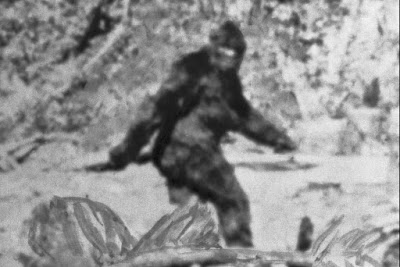
A frame from the legendary Patterson-Gimlin film.
Do you believe in Bigfoot? Or do you think the idea is nothing more than legend cooked up by a bunch of crazed kooksters?

The legend of Bigfoot in his many names and guises is one of those topics that will persist in the imagination and mythology (some say science) of mankind forever. Every few years a new sighting is claimed that keeps the legend going and numerous individuals have made it their life's work to search out and prove to the world that the existence of the elusive, hairy beast also called Sasquatch here in the Pacific Northwest, truly exists.

This story, from popularmechanics.com, tells the history of  the brutish biped, from early sightings, to the famous Patterson-Gimlin film, to the present day.

Science Meets Legend: The Story of Our Search for Bigfoot
For centuries, people have reportedly seen this mythical primate-like animal in the woods of North America.
By Matt Blitz, Oct 8, 2018

The film is mostly three-and-a-half minutes of grainy fall foliage, men riding horses, and jerky pans. The footage comes across as just someone having fun with their new camera. But, about two minutes in, the lens of a rented 16mm Cine Kodak camera catches something strange.

“We were just riding out alongside the creek, riding along enjoying the warm sunshine day,” says Bob Gimlin, “Then, across the creek, there was one standing. Everything happened so fast.”

What Gimlin's camera sees is a strange, large, ape-like figure limbering on its hind legs across a clearing. For a brief moment, the animal appears to look directly at the camera, and, then, it’s gone. This is the famed Patterson-Gimlin film reportedly shot in October 1967 in the heavily wooded forests of Northern California, and it is one of the most heavily analyzed pieces of film in American history.

To some, this is definitive proof that Bigfoot is as real as mountain gorillas or narwhals. For others, it’s a hoax alongside videos claiming to show ghosts, aliens, and lizard people. But Gimlin knows exactly what he saw that day. “It walked upright and for quite a long ways. It didn’t look like a bear. I’ve been in the woods my whole life,” 86-year-old Gimlin tells Popular Mechanics, “There’s no doubt in my mind at all what it was.”

This elusive, possibly fictitious animal goes by a number of different names—Bigfoot, Sasquatch, Yowie, Skunk Ape, Yayali—and for centuries, people across North America have had sightings.

Many Native American cultures have written and oral legends that tell of a primate-type creature roaming the continent's forests. In these tales, the animals are sometimes more human-like and, other times, more ape-like. In the mythology of the Kwakiutl tribe that once heavily populated the western coast of British Columbia, Dzunukwa is a big, hairy female that lives deep in the mountainous forests.

According to the legend, she spends most of her time protecting her children and sleeping, hence why she’s rarely seen. In fact, the name “Sasquatch” comes from Halkomelem, a language spoken by several First Nation peoples that occupied the upper Northwest into British Columbia.

In California, there are century-old pictographs drawn by the Yokuts that appear to show a family of big giant creatures with long, shaggy hair. Called “Mayak datat” by the tribe, the image bears a resemblance to the commonly-held vision of Bigfoot.

“Some tribes really love Bigfoot, they have a great relationship with him,” says Kathy Moskowitz Strain, author of the book Giants, Cannibals & Monsters: Bigfoot in Native Culture and archaeologist with the U.S. Forest Service, “To other tribes though, like the Miwoks, he’s an absolute orge, a monster, and something best left alone.”

To this day, Strain says, many of the tribesmen she does field research with believe that Bigfoot walks among us. “I’ve been in the field with tribal members where something strange happens and they always blame it on a Bigfoot,” says Strain.

Native Americans weren’t the only ones seeing this hairy, primate creature roaming the wilds of America. 19th and early 20th century newspapers had whole sections devoted to the miners, trappers, gold prospectors, and woodsmen claiming to have seen “wild men,” “bear men,” and “monkey men.”

Most famously, in 1924, a group of prospectors hunkering down in a cabin along the shoulder of Mount St. Helen in Washington state claimed they were attacked late one night by a group of “ape-men.” Later, one of the prospectors admitted that they weren’t unprovoked attacks. He had taken potshots at the creatures earlier in the day.

Even then, as noted in Chad Arment’s 2006 book Historical Bigfoot, these accounts like the ones from the prospectors in 1924 were often regarded with a general sense of skepticism often due to the unreliable nature of the witnesses.

“It’s hard to know what came out of the bottom of a whiskey bottle and what’s real,” says former NPR producer Laura Krantz who’s a host of the new podcast Wild Thing, which digs deep into the search for Bigfoot. 

There were also times when one animal was confused for another, possibly explaining the origin of the name “bigfoot.” Newspaper accounts show that “Bigfoot” was a common nickname for particularly large, aggressive grizzly bears who ate cattle, sheep, and attacked humans. It wasn’t until 1958 when a California tractor operator named Jerry Crew “found” a series of huge muddy footprints that the term was popularized in reference to the primate-like animals.
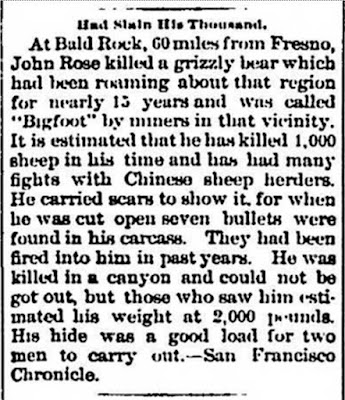
From the Placerville Mountain Democrat (1895).

That same year, another man named Ray Wallace also said he had discovered large prints belonging to Bigfoot. Upon his death in 2002, it was revealed that this was a hoax.
It was in the mid-20th century when Bigfoot stepped from local lore to national phenomenon.

In 1961, naturalist Ivan Sanderson published his book “Abominable Snowmen: Legend Come to Life.” In the book, Sanderson uses footprints, eye witnesses, and bone samples as potential evidence of “sub-humans” living on five continents across the world, including North America’s Sasquatch and the Himalayas’ Yeti (though others believe that the Yeti is a totally different species).

Sanderson’s work caught enough people’s attention that William Straus, a well-regarded primate evolutionary biologist at John Hopkins University, reviewed it for Science Magazine saying Sanderson’s standards for evidence are “unbelievably low” and that the evidence is “anything but convincing.” 

Nonetheless, Strauss admits it would be foolish and quite unscientific to say that the creatures Sanderson describes absolutely don’t exist.

Sanderson’s book was followed the Patterson-Gimlin film six years later. Gimlin says it happened so fast that he considers himself and Roger Patterson pretty lucky that they were able to get any footage at all of the hairy, mythical animal lumbering along only yards away from them.

When he watched the footage for the first time a few days later, Gimlin was pretty pessimistic that this would be enough to convince anyone. “I didn’t think the film was that good. I saw it [with my two eyes] better than that,” says Gimlin. Yet, it became a phenomenon.

Some, like former Director of the Primate Biology Program at the Smithsonian Institution John Napier, saw it as a well-done, elaborate hoax. But not everyone saw it that way, including Grover Krantz.

A professor of physical anthropology at Washington State University and “a leading authority in hominoid evolution” and primate bone structures, Krantz also believed in Sasquatch. His unwavering belief came from eyewitnesses, the creature’s gait in the Patterson-Gimlin film, and most importantly, the anatomical structure of found footprints. It was the dermal ridges, where sweat pores open on palms and soles, depicted in the prints that left him convinced that at least some were authentic.

His working theory was that Sasquatch was part of the hominid family, the same one humans shared with apes, and was a descendant of thought-to-be long extinct humongous primate species that once lived in Asia appropriately named Gigantopithecus. At some point, million of years ago, it had crossed the Bering Strait when it was still a land bridge into North America and evolved into its own species on this continent.

“Grover was eclectic. That’s a good word describe him” says Jeff Meldrum, author of the book Sasquatch: Legend Meets Science, a professor of anatomy at Idaho State University, and a one-time colleague of Krantz’s. “There were many ideas that he had that were a decade or two ahead of his time and... when he pursued some of these ideas, he would be ridiculed.”
When asked about the possibility of Sasquatch existing, Krantz was always unequivocal saying that he “guaranteed” it.
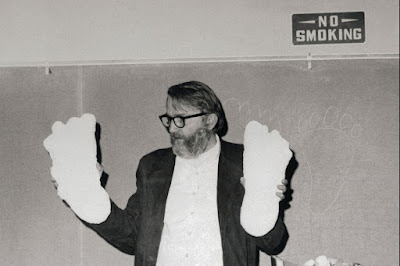
Grover Krantz with Sasquatch foot castings, 1974.
Krantz’s conviction in Bigfoot didn’t help his academic career, though. Passed over for promotions and nearly missed getting tenure at Washington State, he knew the only way he would be able to convince his colleagues of this primate’s existence was by producing a body.
So, Krantz was known to spend his nights in the middle of the Pacific Northwest old growth forests with a shotgun quite literally hunting Bigfoot. He rationizled this by saying it was the only way to get scientific community to believe him and that, technically, it wasn’t against the law.

“It has not yet been established that the Sasquatch exists,” Krantz once wrote, “To pass laws against harming sasquatches presently makes little more sense than protecting unicorns.”
Krantz died in 2002 as a complex figure in the eyes of the scientific community, highly respected for his work in primate evolution yet mocked for his belief in Bigfoot. However, during Krantz’s life and after it, the search for Bigfoot took on a life of its own. More sightings, films, and books, some from respected researchers, emerged. Bigfoot documentaries captured the public’s imagination. Harry lived with the Hendersons and entertained the masses. Even Jane Goodall, the famed chimpanzee expert, admits that there’s a possibility that a undiscovered large primate may exist in the world. 
In 2006, Laura Krantz, at the time an NPR reporter based in D.C., read an article about the quirky anthropologist who shared her last name. “It originally didn’t ring any bells... he just seemed like an eccentric weirdo.”

But, then, she saw that he was also from Salt Lake City, like her father’s family—they were related. As Krantz’s grandfather told her at the time, “Oh, yeah. Grover. That was my cousin. He used to come to the family picnics and measure people’s heads with a caliper.” This began Krantz’s own journey into the wilderness in search of Bigfoot, which she documented for her new podcast Wild Thing, which aired its first episode on October 2nd.

She acknowledges, much like her cousin Grover, that without a body (or skeleton), it’s hard to convince others that this long-lost primate still exists in North America’s backwoods. “A lot of people who think Bigfoot is out there, they realize... that there’s a lack of evidence,” says Krantz, “The kind of real proof that would actually make people sit up and take notice doesn’t actually exist at this point.”

But the things she’s observed during her research for the podcast has changed her mind about the possibility of Bigfoot.

“I went from ‘Bigfoot is a legend’ to I can’t just say out of hand that Bigfoot never existed or doesn’t exist now,” says Krantz, “I can’t fully dismiss it anymore.”

Sunday, July 29, 2018

WEIRD, WEIRD WORLD


"RAT WORM" CAUGHT ON TAPE
A strange piece of footage circulating online shows a nightmarish mystery creature that resembles some kind of horrifying cross between a rat and worm. The jaw-dropping video was taken by a British woman named Bex Deen who was aghast when she noticed the oddity seemingly slithering around on her backyard porch. She subsequently posted the footage online in the hopes that someone could identify the weird creature.

For those who may be understandably afraid to watch the unsettling video, the footage shows a strange creature that appears to be about five inches long and sports a tail which is nearly the same length. As Deen looks on in horror, wondering what the monstrous thing may be, the little beast proceeds to slither along the sideboards of her porch in an undulating fashion that is both riveting and repulsive at the same time. Remarkably, rather than whack the creature with a rolled up newspaper, she reportedly decided to let it live, saying "I let him slither off to join his alien friends wherever they may be."

As to what the weird creature may have been, the consensus online seems to be that it is an uncharacteristically-large rat-tailed maggot which, since Deen opted not to kill it, will likely transform into a drone fly at some point in the not-too-distant future. The puzzling appendage is, in fact, not a tail, but a breathing tube which the bug uses in the event that it winds up underwater.

[SOURCE: Coast to Coast AM.]


ANOTHER CLAIM THAT THE SHROUD OF TURIN IS A FAKE


The authenticity of the Shroud of Turin is being called into question once again via a forensic study that suggests that the image contained on the cloth is a fabrication. The controversial piece of linen, which some believe to be the burial cloth of Jesus Christ, has been the subject of a seemingly unending debate that stretches back centuries. The latest twist in the Turin saga comes courtesy of a newly-published paper detailing a rather ingenious technique used to 'test' the image on the Shroud.

In the study, researchers attempted to see if the blood flow from wounds thought to be afflicting the person on the Shroud would actually match the depiction seen on the cloth. To pull off this feat, they enlisted a human volunteer who was outfitted with a small tube that dripped human blood from where the crucifixion nail would have been. Additionally, since the story of Jesus states that he was also suffering from a stab wound in his abdomen, researchers incorporated this injury into the study using a somewhat similar method involving a mannequin.

Despite positioning their test subjects in a number of different ways, the scientists behind the study found that the largely natural bloodstain patterns could not account for the legendary Shroud image. Although they matched in some instances, those respective overlaps left other parts of the picture incomplete. By looking at the whole depiction found on the cloth and comparing it to what was produced by the study, one of the researchers told the website LiveScience, "you realize these cannot be real bloodstains from a person who was crucified and then put into a grave, but actually handmade by the artist that created the shroud."

Although the new study is quite intriguing, longtime students of the Shroud mystery can be forgiven for being wary about the news as it is merely the latest in a long line of much-heralded research projects promising to have settled the case once and for all. In the last year alone, there were claims that the faint impression of coins found on the eyes of the Shroud image proved it was the burial cloth of Jesus as well as a study of the 'nanoparticles' found on the cloth which indicated that they came from "tortured blood." As such, it's a safe bet that, at some point in the not-too-distant future, we'll be hearing about yet another set of researchers who have come up with their own way of looking at the Shroud and produced some fantastic findings as well.

[SOURCE: Coast to Coast AM.}


HUMANOID CREATURE WASHES UP ON CHINESE BEACH
Beachgoers in China were left baffled by the discovery of a bizarre creature boasting an almost humanoid appearance. One report claims that onlookers were aghast by the strange find and refused to get too close to the oddity, likely because it resembled a dismembered person. Fortunately, one brave individual stepped forward to engage the creature and, as luck would have it, the impromptu encounter was caught on film.

In the footage, a man sporting a smile suggesting amusement can be seen holding the creature up for the camera. The showcase allows viewers to see that the monstrous find looks to possess limbs akin to a person and, using a fair amount of imagination, even a face. As if its human-like shape is not chilling enough, the 'foot' of the creature actually moves as if it is still alive! And, adding one last layer of strangeness to the proceedings, the sea debris seems to have been flattened on one side.

As is often the case with weird things which wash ashore, observers have offered a number of possible suggestions for what the creature may have been. Theories have ranged from the prosaic, like a mutated sea sponge, to the fantastic, such as a mangled mannequin. It would seem that the latter idea may be most likely as, according to the YouTube channel which posted the footage, acclaimed cryptozoologist and former C2C guest Karl Shuker examined the video and posited that the creature was likely a mass of sponge.

[SOURCE: Coast 2 Coast AM.]


PHOTO TAKEN OF BIGFOOT?


The Dulce Underground Base Conference on June 23-24 featured local and national researchers who examined the evidence for the mysterious and famed facility, as well as examining the impact of unexplained animal mutilations, which have been plaguing the area and the Jicarilla Apache tribe since the 1970s. The event also allowed local residents and others from the region to weigh in with their own experiences and in once case, an alleged photo of a Bigfoot.

A man from Pagosa Spings, Colorado (who has chosen to remain anonymous) shared an image he says he captured some thirteen years ago when he was on a pack horse camping trip near Square Top Mountain in the Arapaho and Roosevelt National Forests west of Denver, Colorado.

The night before the photo was taken, the witness recalled hearing strange noises during a violent lighting storm, which he recalled sounding like “loud snoring,” which he believed was coming from the other person in his tent. He "sat up and realized it wasn't him" and that the sounds were coming from outside, where he could see a large shadow moving about whenever lightning lit up the area.

The witness said that the photo was taken the next morning as he was trying to get an image of one of the pack guides, and he did not recall seeing anything unusual. When the film was developed, there appeared to be figure standing in the far background, which resembles what most of us commonly think of as a classic “bigfoot” creature. "You could see the daylight between its legs" he said, which was estimated to be some 50 yards from the camera.


STONEHENGE HAS BEEN VANDALIZED FOR HUNDREDS OF YEARS

A picnic party at Stonehenge, including Queen Victoria's son Prince Leopold (reclining, looking towards camera), c. 1877

In 1860, a concerned tourist wrote to the London Times decrying the “foolish, vulgar and ruthless practice of the majority of visitors” to Stonehenge “of breaking off portions of it as keepsakes.” Today, taking a hammer and chisel to a Neolithic monument seems like obvious vandalism, but during the Victorian era, such behavior was not only common but expected.

English antiquarian tourists, who were mostly upper class, had developed the habit of taking makeshift relics from the historical sites they visited during the 18th century. By 1830, the practice was so widespread that the English painter Benjamin Robert Haydon dubbed it “the English disease,” writing, “On every English chimney piece, you will see a bit of the real Pyramids, a bit of Stonehenge! […] You can’t admit the English into your gardens but they will strip your trees, cut their names on your statues, eat your fruit, & stuff their pockets with bits for their musaeums.”

For centuries, both locals and visitors had taken pieces of Stonehenge for use in folk remedies. As early as the 12th century, rumors of the stones’ healing properties appear in the writing of Geoffrey of Monmouth, and in 1707, Reverend James Brome wrote that their scrapings were still thought to “heal any green Wound, or old Sore.” In the 1660s, the English antiquarian John Aubrey reported a local superstition that “pieces or powder of these stones, putt into their wells, doe drive away the Toades.”

Eventually, tourists were not just taking from Stonehenge, but also leaving their mark, too. By the middle of the 17th century, tourist graffiti was appearing on the stones. The name of Johannes Ludovicus de Ferre—abbreviated “IOH : LVD : DEFERRE”—is etched, and so is the engraving “I WREN,” which may refer to Christopher Wren, the famed architect who designed St. Paul’s Cathedral.

As early as 1740, the archaeologist William Stukeley was decrying “the unaccountable folly of mankind in breaking pieces off [the stones] with great hammers,” and by the end of the 19th century, according an 1886 commenter, “Almost every day takes some fragment from the ruins, or adds something to the network of scrawling with which the surface of the stone is defaced.”

[SOURCE: ATLAS OBSCURA.]


ARTIST ILLUSTRATES WORLD'S MYTHICAL CREATURES

A Kotobuki, a creature consisting of all 12 signs in the Zodiac, from Japanese mythology. 

Every culture has its own distinctive mythological beasts. In Brazil, there’s the Headless Mule, a cursed creature whose decapitated head hovers above a fire-spewing neck as it gallops across the country. From Japan, the Kotobuki is a Zodiac Frankenstein’s monster: it consists of all 12 signs, from the nose of the rat to the tail of the snake. Peru has the Huayramama, which looks like a vast snake plus the billowing hair and face of an old woman.

With such rich and broad source material to draw from, the artist Iman Joy El Shami-Mader has lately been pursuing one very particular goal: she wants to illustrate as many mythical beasts as she can find. Since October 2017, El Shami-Mader has been illustrating one such creature a day, which she then features on her Instagram account. To keep up a steady supply of beasts to draw, El Shami-Mader initially worked from books. “It all started with the book Phantasmagoria—which is great—but there are many creatures that are only mentioned in passing or without any description at all,” she says. So she ordered more books, researched online, and tried her local library. “I’m from a tiny town in the Alps, so other than local creatures, there was little to be found.”

Lately she’s decided to try to crowdsource ideas to keep her project going. Through Instagram, she’s asked her followers to send stories and descriptions of mythical beasts she’s still missing. Her illustrated bestiary now spans mythologies from around the world and across a variety of time periods, and even includes the odd fictional character (she has a porg from Star Wars: The Last Jedi and an Owlbear from Dungeons & Dragons).

Where did the idea for this project come from?
It actually started as a stress-relief strategy and ‘self-challenge’ last fall. I was working five jobs and felt extremely drained and worn-out all the time. I really needed something to balance out the lack of creative expression I was feeling and to get my mind off things, at least for an hour a day.

A few years back I did a series of fairytale illustrations and came across many amazing creatures, like the Bøyg in Per Gynt. Since I always wanted to deepen my knowledge about these creatures, I ordered the book Phantasmagoria by Terry Beverton and it arrived on my doorstep on September 30, just in time for me to begin a daily monster-drawing challenge I’d set myself for the month of October. I started to use my lunch breaks to have a quick snack and do a drawing of a creature each day. I was fairly sure I would give up after a week, but it really helped with the stress; for an hour or two each day, all that was on my mind was bringing a creature to paper, nothing else. It was also great to learn about a new monster each day, so when October was over, I didn’t really want to stop.

Why mythical creatures?
I am generally a history buff and I love fairytales, sagas, myths and legends. In this already pretty epic realm, these beasts feel even more magical. I find them extremely interesting for so many reasons. They can give you an incredible insight to different cultures—what people were afraid of, and what simply was inexplicable at the time and needed to be put into a physical form. I feel like they also show humanity’s need to have a reason for both good and bad things happening. Sometimes they are a ray of hope, the only thing able to cure an incurable illness; other times they bring plagues and death. They are wise helpful spirits, and they are malicious tricksters. It can also be really funny—you can tell that some only exist because of the bad descriptions the scholars wrote down.
Tell us a little bit about how you research and plan how these illustrations will look.

When someone tells me about a new beast, I still try to do as much research as possible and find the best description available, either on the internet or by asking more people from that region about their version of it. Sometimes the descriptions are very detailed, which makes it easy to come up with a general idea of how proportions and form should be; other times it just says “aquatic creature” or that it has “serpentine appearance,” which makes it harder on one hand, because you cannot depict them “accurately” (as far as drawing a mythical creature can be, anyway), but on the other hand really lets your imagination run wild. I usually have an image in my head of how I’d like it to look. I start by slowly sketching out the first lines in pencil, then elaborate them a bit, and when I’m happy enough with the results I start tracing my pencil drawing with ink pens.

What’s the goal of this project?
Well, I’ve ‘tasted blood’ now, and am on a mission: I would love to create a complete illustrated bestiary. There are many great books on creatures out there, but so far I haven’t found a complete one. I know this is a Sisyphean task, but I’m motivated. I’d love to turn my findings into a book, or—even better—a series of books that can be continually expanded. For now there is only an idea, but a friend of mine is a composer and we were thinking of collaborating on a trilingual ‘monsters set to music’ book. My current priority, however, is finding as many mythical creatures as possible.

Tell us about your favorite mythical creatures in this project.
That is really hard to answer—they are all so unique. I love the Dijiang, because I feel it’s my spirit animal (living in a perpetual state of confusion, but fond of singing and dancing). I love the idea of a Valravne eating a king’s heart and thus gaining human knowledge and becoming evil (eating another human’s flesh was really thought to give you his strength at some point in history!). I think it’s amazing that the Chouyu falls asleep when it sees people, and that the Ovinnik holds a grudge against barns, but is appeased by pancakes.

But if I had to choose a favorite one, it would have to be the Squonk, a creature from the forests of Pennsylvania, who was always sad over its hideous appearance. All the love for the Squonk!

[SOURCE: Atlas Obscura.]