Showing posts with label Curt Swan. Show all posts

Friday, January 17, 2025

Popeye The Sailor Day!

(Nick Cardy)

It's Popeye Day. Not just here at the Dojo, but across the globe. And to celebrate here's a wonderful character who evokes the essence of Segar's epic creation. The earliest version of Segar's grumpy hero debuted on this date in 1929 and falls into the grew maw of the Public Domain this year. But that doesn't mean there haven't been versions before now. 

(Popeye's debut)

One of my favorite Popeye stories doesn't technically involve Popeye at all. Captain Strong, a virile and excitable sailor who gets even more so when he munches on a radioactive plant called "sauncha" gave Superman, the vaunted Man of Steel a run for his money in several DC comics.

Here are three pages from the first Captain Strong story from Action Comics #421 written by his creator Cary Bates and the superstar team of Curt Swan and Murphy Anderson.


The doughty sailorman survived and returned to give Superman what for in more issues of Action, as can be seen below.

(Nick Cardy)


Though he didn't always make the cover.

(Mike Grell)

Some years later he showed up in an issue of Superman itself.

(Ross Andru and Dick Giordano)

And years later still another issue of Action Comics, toward the end of that comics historic run.

(Marshall Rogers and Jerry Ordway)

I don't know what's become of Captain Strong in the DCU these days, but for sheer fun those stories were rock solid reliable.


But these days such things might seem old hat.

E.C. Segar and Friend

 Eat your spinach!

Rip Off

Friday, April 12, 2024

The Great Disaster!


The Great Disaster is the rather stupendous Showcase volume from DC which attempts to gather together the sundry tales which relate the retro-continuity saga of how the Earth fell victim to a rather surprising atomic war in October of 1986 and how human society dealt with that.

The book is divided into discrete sections. The first titled "Pre-Disaster Warnings" contains stories from the back of Weird War Tales concerning the "Emperor of Weehauken" by Sheldon Mayer and Alfredo Alcala, a man who travels from the future to our present day, and a Superman yarn which lays out the potential future as hinted at in pages of Kamandi the Last Boy on Earth by Jack Kirby.


The next section called "The Day After Doomsday" offers up over a dozen tiny vignettes from the back pages of Weird War Tales, The Unexpected, and The House of Mystery which give glimpses of life after society has crumbled. There's a distinct Twilight Zone tone to these brief yarns by Len Wein, Steve Skeates and others. My favorite is a trilogy of stories about the last man and woman on Earth named "Adam and Gertrude", with delightful artwork by Jack Sparling.


The third section is titled "Tales of the Atomic Knights" and reaches back to the masterfully crafted vintage stories from Strange Adventures by John Broome and Murphy Anderson. To my knowledge, all the Atomic Knight stories are here and that alone is worth the price of admission to this book. You'll believe that a profoundly average man dressed in an atomically-altered Medieval suit of armor can ride a gigantic mutated Dalmation across a surprisingly benign atomic wasteland -- you really will.


The next section titled "The Gods Return" begins with Jack Kirby's Atlas one-shot for the debut of 1st Issue Special and then offers up all twelve issues of Hercules Unbound.  The first six issues by Gerry Conway, Jose Luis Garcia-Lopez and Wally Wood are lush and vibrant, then the series takes a turn as writer David Michelinie and later Cary Bates finish up the saga with artwork by Walt Simonson under sundry inkers, his own to great effect in the last two issue. It is with these stories that the Atomic Knights return to DC lore, though in ways very surprising.


The penultimate section is titled "More Tales of the Post-Apocalyptic World" and offers up a quartet of stories from the back pages of Kamandi the Last Boy on Earth written by Gerry Conway, Paul Levitz, and David Anthony Kraft with artwork by Pablo Marcos and Mike Nasser. These tales feature a young ape named Urgall who teams up with a scheming rat named Otis and comely ape wench called Myra. And that is followed by "The Day After Doomsday" by Robin Snyder and Vic Catan which shows some poor misguided humans with a wild plot to repopulate the Earth. 


The volume closes out with "Alternate Endings" offering a post-Crisis view of the Atomic Knights from the pages of DC Comics Presents when Superman uncovers the "real secret" of the Gardner Grayle. How this one fits into the overall storyline is anyone's guess these days, but it's a snazzy story on its own as written by Dan Mishkin and Gary Cohn and drawn by Alex Saviuk and Frank McLaughlin. 

All in all this is a utterly fabulous book,  a truly sprawling collection of disparate stories by some talented writers and artists from the Silver and Bronze Ages of DC. The story of "The Great Disaster" is not all here, there's more revealed in the pages of Kamandi and OMAC and elsewhere, but the thread is here for those who wish to find out more about one of DC's most clever conceits.

Rip Off

Thursday, February 29, 2024

Amazing World Of Superman!


It's Superman's birthday. And the Dojo wraps up a week-long celebration of the Man of Steel with a look a real bit of offbeat memorabilia, a tome titled Amazing World of Superman. Originally published in 1973 to celebrate Superman Day in the little city of Metropolis, Illinois, this oversized tabloid-size tome is a wonderful collection of all sorts of Superman stories, images, and whatnots. 


The volume opens with "Superman in Superman Land", a story by writer Bill Finger and artists Wayne Boring and Stan Kaye. Originally appearing in Action Comics #210 from 1955 this yarn imagines a theme park dedicated to the "Man of the Tomorrow". We get lots of offbeat glimpses of this imaginary park before we are introduced to a mysterious character who turns out to be Lex Luthor (no surprise). He's concocted a scheme to incapacitate the "Man of Steel" with the ubiquitous Kryptonite and trap him inside a mock-up of Krypton, one meant to be exploded. It will surprise no one that the scheme fails. 

This if followed by a "How to Draw Superman" page by Curt Swan as well as page introducing us to the extended Superman family. Then there is a wonderful ten-page article detailing how comic books are conceived and manufactured. It's a nifty item because it's loaded with photos of the staff of DC at the time. 


Then we are treated to a brand new (then) "The Origin of Superman" written by E. Nelson Bridwell, and drawn by Carmine Infantino, Curt Swan and Murphy Anderson. This is a delightful fifteen-page black and white presentation which hits all the highlights right through Clark leaving his foster parents in Smallville and taking up his career in Metropolis. There is a particularly touching scene with Clark and his dying foster father. 


Then a special detached fold-out poster showcases a "Map of Krypton" in amazing colorful detail. This map was rendered by E. Nelson Bridwell and artist Sal Amendola. Then we get a page showing how Superman made it big in syndicated comic strips. 


"Metropolis, Illinois - Story of an American City" presents copious features and images from the celebration for the inaugural "Superman Day". We get a lot of backstory about how this event came to be with photos of a guy named Charles Chandler dressed as Superman making appearances in sundry places like the TV show To Tell the Truth. 


"The Superman Legend - Rogues' Gallery" has more art by Murphy Anderson and writing by Bridwell as we meet some of the best villains such as the aforementioned Lex Luthor, Brainiac, Parasite, Toyman, and others such as the Phantom Zone villains. "The Secrets of Superman's Fortress" takes us inside the Fortress of Solitude as drawn by "Swanderson". 

(Al Hirschfield)

"It's a Bird...It's a Plane...It's Superman" is all about the Broadway show which debuted in 1966. We get some nifty photos from that singular show. "Superman Salutes Nasa" is about Superman's connection to the OAO -2 (Orbital Astronomical Observatory). "Important Dates in Superman's Life" is a one-page item which hits the highlights from Superman's publishing history in comics, novels and appearances in other media. Sadly, and frankly strangely, I found no references to either the utterly wonderful Fleischer cartoons of the 40's nor to the pretty darn good Filmation cartoons of the 60's here or any other place it the book. 


We get two pages from "Superman's Mission for President Kennedy" which was marred when it first appeared by the tragic assassination of the thirty-fifth president of the United States. The story was published at the request of both President Johnson and the Kennedy clan. 


"The Superman Legend" returns with a look at Superboy's hideout beneath the Kent home and info on his costume written by Bridwell with art by Bob Brown, Wally Wood and Mike Exposito. (This was presented in black and white.)


The book closes with a photo album of sorts which features George Reeves, Kirk Allyn, and others from Superman's film and TV adventures. The final image is a full-page poster shot of Superman by Curt Swan and George Klein (in black and white).


This wonderful time capsule was reprinted by DC in a hand hardcover format in 2021. At a mere twenty bucks it was a bargain then and now. Happy Birthday to the Man of Steel. Now it's time to enjoy some of that vintage George Reeves taking on those little creepy Mole Men on my TV. 

Rip Off

Tuesday, February 27, 2024

Kryptonite Nevermore!


There's little doubt that Superman is the iconic superhero. Created in the Golden Age of comics, he led the way as comic books became a staple of society both in America and abroad. DC defended their star with lawsuits that chased away imitators and crippled competitors. Superman as first conceived by Jerry Siegel and Joe Shuster was an alien with a very liberal attitude toward society and the need for the powers that be to tend to the needs of the population. He quickly became a boy scout and a symbol for the status quo. When comics faltered Superman was strong enough to survive, even get his own TV show, and later in the Silver Age he thrived. 
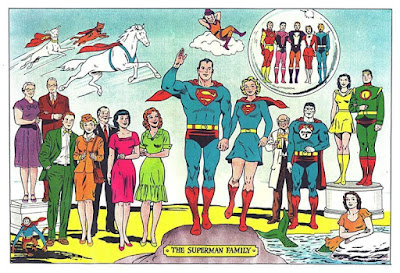

The editor of the Superman books was Mort Weisinger, a pioneer science fiction fan and longtime employee of DC. Under his leadership the Superman "family" had grown with Supergirl, Superboy, Krypto the Super Dog, Streaky the Super Cat, Comet the Super Horse, and, well you get the point. Far from being the sole survivor of Krypton, Superman discovered his kin in the Phantom Zone and in the bottle city of Kandor. To give their most powerful hero something to fear, "Kryptonite" was invented, first on the radio, then in copious amounts and varieties in the comics. The stories were entertaining and competently produced, but a new era of comics was coming into being and when Weisinger retired things began to really change. 
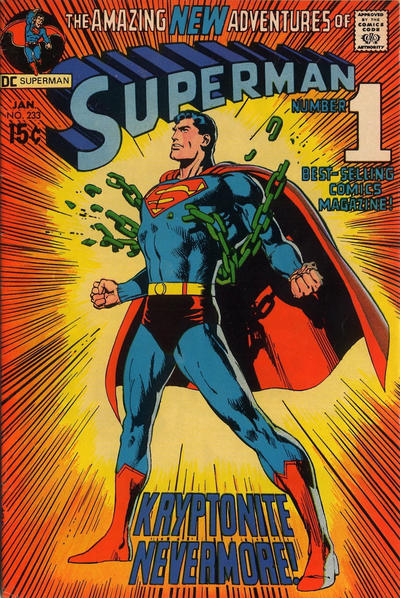

Julie (Be Original) Schwartz took the helm from his longtime friend Weisinger. And in keeping with the way he'd updated Batman some years before, he likewise brought a somewhat less childish approach to Superman. The first step was to rid the world of Kryptonite, a move which empowered Superman all the more. But the transformation came with a cost. The radiation which turned Kryptonite to an inert harmless material also created a weird doppleganger of Superman out of sand. 


As Superman adjusts he discovers he loses his powers from time to time and there seems to be a connection to his duplicate which seems always to be near. Superman's life is made even more complicated when Morgan Edge, the new owner of The Daily Planet and GBS News transfers Clark Kent from the paper to become a TV reporter. (Edge was the creation of Jack Kirby from the pages of Jimmy Olsen and as it turns out he was an agent of Darkseid.)


Superman's powers are further depleted by "The Devil's Harp", a device used by a down and out musician who transforms himself into a version of the god Pan. Denny O'Neil had been tagged by Schwartz to script the comic, bringing some of that famous relevant glamour he'd successfully elicited on Green Lantern. His partner on that book was knocking out some outstanding covers for the Superman series during this period, not the least of which was the amazing image of Superman bursting the Kryptonite chains.


I had read Superman comics before and while this issue was not the first I consider the beginning of my true interest in DC Comics as I bought several DC comics in the month this appeared. The cover is a knockout, a compelling image that demands to be read. The story switches up aliens for real demons and so falls a bit flat given my expectations. Still, it's another handsome story by Curt Swan and Murphy Anderson. 


Superman is still struggling with is diminished powers when all of sudden he thinks he might be infecting humans with a strange aliment from the stars. He tries to do his duty and save Lois from roving bandits and deadly ants (not kidding), but from a safe distance and that proves largely impossible. 


The conflict between Superman and his sand doppleganger comes to a head when Superman seeks the assistance of his strange counterpart and is rebuffed. Once again, he's battling terrorists and Lois gets herself involved and even creates dangers which the weakened Superman has to contend with. 


The beginning of the end of the storyline starts when Superman fails to stop a building from collapsing, though there was no loss of life. He's labeled a loser by some, but mostly feels that way himself. This story features inks by Dick Giordano and guest stars I Ching the mentor for Diana Prince who had given up her own powers over in the pages of Wonder Woman. Ching is able to fathom the problem, and enhances the "man" part of Superman. 


Things get worse when the identity of the sand "Superman" is revealed to be an alien from the dimension of  Quarm. The creature is only trying to stay alive in our dimension but at a great cost to Superman. A complication arises when another Quarmian arrives in our dimension and inhabits the shape of a Chinese demon. Diana Prince guest stars in this tale. 


It's a three-way battle as Superman must get the help of his sinister double to help defeat the vicious Quarmian. They succeed and then a battle begins between the two "Supermen" which seems to bring bout the very of life on Earth. Suffice it say we get better, and the solution (with the help of I Ching) involves Superman, at least as written by Denny O'Neil making do with fewer powers, which was the point of the storyline to begin with. In an afterward O'Neil says that the changes didn't last long as he left after a year and soon enough Superman was pushing around planets all over again.


Superman is larger than any one story told about him. He's well into his eighties and many is the yarn spun about the man from Krypton. But this tale from 1971 resonates with this particular fan because I was there when some of it originally went down. And it seems to be an above average attempt to make Superman less "Super" and more "Man" and that ain't wrong. 

Rip Off