Showing posts with label Rankin-Bass. Show all posts

Monday, December 23, 2024

The Last Unicorn!


 Charming is the ideal word to describe Peter Beagle's classic The Last Unicorn. First published in 1968, story by Beagle's account is the continuation of a story he told as a young boy. Admittedly with a great deal more wit and social awareness.  Fantasy was a hot commodity in 1968 as Tolkien's The Lord of the Rings available in paperback and was inspiring imitators. The Last Unicorn is not one of those. I first bought the paperback in 1975 and read it then. I don't know that I've read it since. 


We are introduced to the last Unicorn of the title just as she is becoming aware of her singular status. Since unicorns live outside of time, being immortal, the fact that the numbers were dwindling was not of great moment. Nothing was or is exactly. Once realizing the possibility she might be the last she leaves the security of her protected and isolated wood and heads into an impossible world of fantasy and modern cultural reference. 


The characters in this story are aware of fairy tales and to greater and lesser degrees attempt to fit into these classic roles. Beagle punctures the texture of the world he creates with modern references just often enough to keep the reader from relaxing and treating the story in a classic fantasy way. Anyway, the Unicorn is captured by a traveling sideshow and shown off for what she is, though it takes a false horn to allow regular folks to see the myth. She meets a magician named Schmendrick, there who does recognize here helps her to escape though that is a dangerous thing as well. The Unicorn is not the only real mythical beast in the show and the other is downright dangerous. 


One of Beagle's stated inspirations for the novel is The Colt from Moon Mountain by Dorothy Lathrop from 1941 which put a unicorn in Kansas of all places. 


The Unicorn and the Magician meet up with a gang of bandits and out of that group they hook up with a woman named Molly Grue who also can see the Unicorn for what she is. They travel to castle of King Haggard, who it seems is the man who has used a magical Red Bull to gather and imprison all the unicorns. To keep the Unicorn from becoming his next victim Magician changes her into a woman he names  Alamathea. The trio end up in Haggard's castle and eventually do find their way to the lair of the Red Bull and discover the secret of the missing unicorns. 


I found the book surprisingly challenging to read this time. Some of that had to do with me not getting enough sleep, but also it is that the text demands your full attention. It's well worth the effort. Beagle has written a smattering of sequel short stories which have appeared here and there. 


In 1982 the Rankin/Bass animation outfit joined forces with ITC Films to produce a perfectly fine adaptation of the novel. It's more geared for the younger set than is the novel, as nearly all the social commentary is removed. The core story remains and it's not unpleasant to watch. Although I did specifically have to watch something a bit tougher afterwards to get the some of the saccharin off. 

Rip Off

Saturday, May 25, 2024

The Animated Lord Of The Rings!


J.R.R. Tolkien's The Lord of the Rings had touched off a renaissance for fantasy literature. Publishers were agog to get something onto the racks that smacked of fantasy, whether it was in the vein of high fantasy as is Tolkien's classic or of a more blood-handed quality such as the works of Robert E. Howard, there was an absolute hunger for such stuff. But how to bring The Lord of the Rings to the big screen. 


It seemed too large a tale for the cinema, at least the cinema of the 70's which had seen the collapse of the studio system and the rise of independent filmmakers. Star Wars had pointed the way forward for movies, and multiple installments of epic stories seemed viable. So, it was decided to make The Lord of the Rings into a movie after all in 1978. Peter Beagle, author of The Last Unicorn was brought in to revise the screenplay by Chris Conkling. Animation was the format the format selected, and the director would be Ralph Bakshi. 
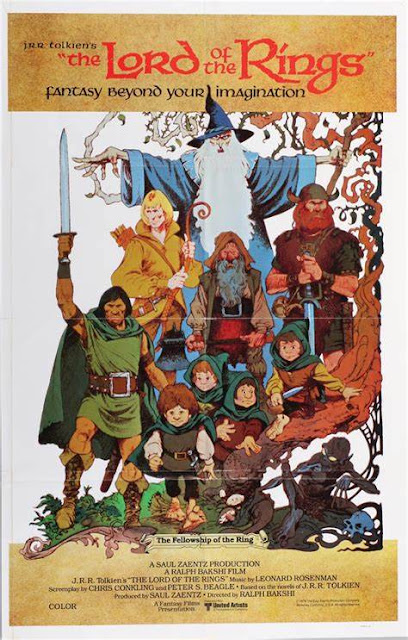

Ralph Bakshi was a wild card. He was a veteran animator, having risen up in Terrytoons and had gained some cache with is creation of The Mighty Heroes and other projects. He'd broken into cinema with Fritz the Cat which brought Robert Crumb's feline avatar to a public ready for the adult nature of the storytelling. Bakshi knew how to get an animated feature made and delivered, and outside the Disney studios he was nearly the only game in town. Artist Mike Ploog's work showed up a lot in the designs. He'd worked with Bakshi on Wizards, a science fiction fantasy which had the misfortune to debut the same week as Star Wars. British actors were brought on to do the voices. It was an epic effort to bring an epic story to the screen, and it was originally intended to be the first of two parts. Alas, we never go that sequel, at least not by the Bakshi team. 
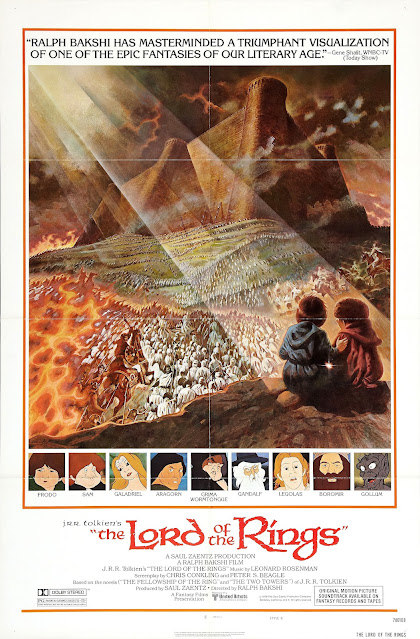

The movie is criticized today and was criticized at the time for the extensive use of rotoscoping to make the animation work, and the to give the work a greater sense of reality. Rotoscoping is looked down upon despite being one of the earliest techniques in animation and was used extensively by the Fleischer Studios in the 30's. That said, there more than a few sequences in the movie which don't really work. The rotoscoping doesn't always blend with the traditional animation and creates a jarring effect on the viewer. This movie unlike Wizards which used much the same styles required an approach which didn't take the viewer out of the movie. Here is an interview with Bakshi talking about the film. 
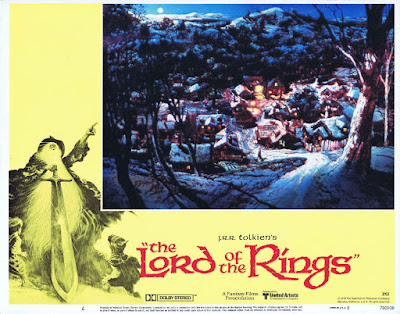

I give the movie high marks for its realization of the Shire and the bucolic regions adjacent to it. There are some gorgeous scenes with our characters moving through them. As the movie goes along and we get further away, that kind of thing diminishes. The Black Riders are also effectively realized in some places. They are favorites of mine, truly frightening creations.  Less successful is Sam Gamgee who comes across as a goofball. Frodo is okay but he and the other Hobbits look like they are about thirteen. The battle at the end of the movie is the low point, with the Orcs poorly realized and the sense of animation minimized. The strength of this production are the outstanding background paintings which successfully create a compelling world, not unlike the masterful backgrounds in the classic King Kong almost become a character. The movie ends abruptly with Gollum leading Frodo and Sam into Shelob's clutches and the heroes successful at Helm's Deep. 
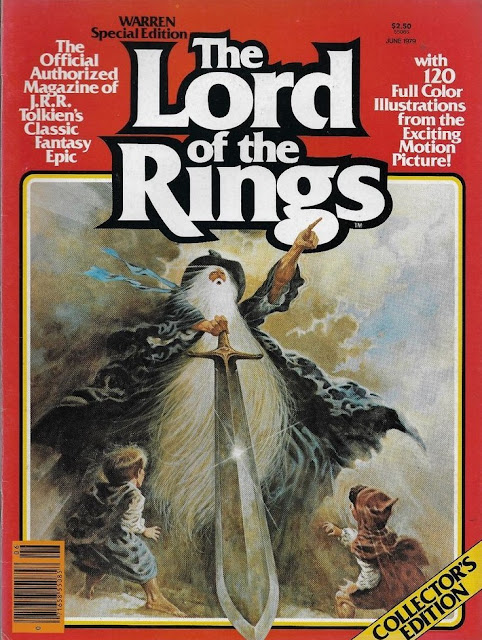

Despite a potent advertising program, the movie failed to live up to expectations in theaters. The sequel was cancelled, and Tolkien fans were left hanging with only half the story told. That is until the Rankin-Bass operation stepped in. They'd brought The Hobbit to the screen some few years before and now they'd wrap up Tolkien's greater epic in the bargain. But it wasn't part of a plan necessarily. 
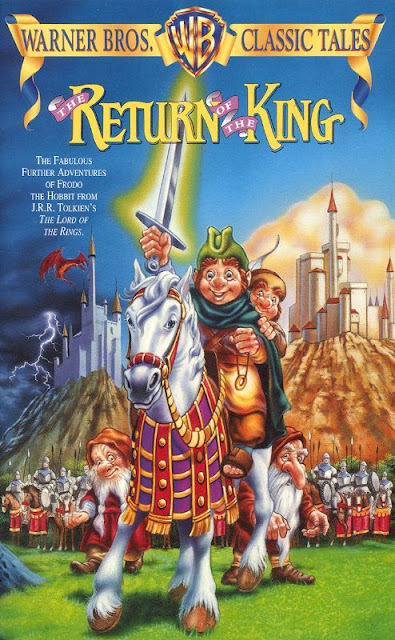

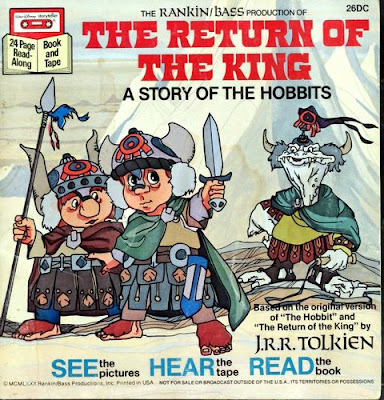
The Return of the King from 1980 has the Rankin-Bass operation picking up the story just about where Bakshi's movie had left off more or less with Frodo and Sam having survived Shelob but Frodo having been captured by Orcs. It is important to note that the production was not intended as a sequel to the Bakshi film. It's merely a fluke that the Rankin-Bass outfit started the story just about where Bakshi left off. The original title was Frodo -The Hobbit II, but better heads prevailed. The style shifted back to the Arthur Rackham inspired character designs, and the ambition was singular, to finish the story. Like The Hobbit before the Tolkien estate did not approve of this little outing and filed suit, but a deal was cut.  
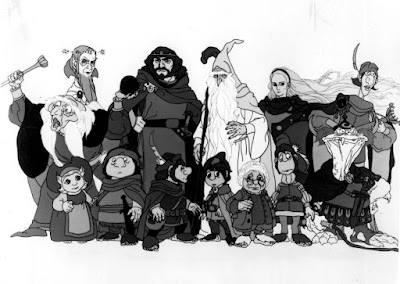

Joining veterans from The Hobbit such as Orson Bean (Frodo this time), John Huston (still Gandalf), and Brother Theodore (Gollum again) were Theodore Bikel (Aragorn), Roddy McDowell (Sam Gamgee), Casey Kasem (Merry Meriadoc), and others such as veterans John Stephenson and Don Messick among others. This 1980 production was done for television by the same Japanese outfit that had don The Hobbit


People bicker about it. Consider it a weak addition to the Tolkien world, and the Tolkien Estate even tried to stop its production. But for my part, I cherish it, for all its flaws for giving the story an ending it otherwise would not have. I rather liked The Hobbit and I like this one, though it has a harder path to walk. Despite the decision to only adapt the last novel for the sake of time, there still seems to be a terrible feeling of padding in the beginning of the story.  For Tolkien fans today it might seem a weak offering, but for us then it was a triumph if only a small one. The epic saga had been transformed into a story which walked and talked, if imperfectly. 


Two decades later, a New Zealand director would take on the story again, this time armed with new-fangled computer technology and people eager to do a greater justice to J.R.R. Tolkien's great story. But we'll get to that tomorrow. But first a song. 

Frodo of the Nine Fingers 

Music by Maury Laws
Lyrics by Jules Bass
Sung by Glenn Yarbrough

When Bilbo found that shiny ring
In Gollum's cave of gloom,
He never thought that it would turn
Into a ring of doom.

The Dragon Smaug, the Spiders too, 
The Goblish, the Evin-King,
They came to know the power of
The Hobbit and his ring. 

Frodo of the Nine Fingers
And the ring of doom.
It started with a Hobbit in
Gollum's cave of gloom.

The power of the ring, it grew,
And Gandalf sat in thought.
He knew that it must be destroyed
In fires where it was wrought. 

For is in evil hands it fell,
The earth would know its end.
No force of arms would win the day,
No army could contend. 

Frodo of the Nine Fingers
And the ring of the doom
Accepted a heavy burden
For the fires to consume.

Frodo of the Nine Fingers
And the ring of doom.
Why does he have nine fingers?
Where is the ring of doom?

We know of course. If you'd like to enjoy Ralph Bakshi's version of The Lord of the Rings, then check out this Internet Archive link. To see The Return of the King by the Rankin-Bass outfit check this Internet Achive link. 

Rip Off 

Tuesday, May 21, 2024

Music Of MiddleEarth!


The soundtrack composed by Leonard Rosenman for the 70's animated The Lord of the Rings is a moody and atmospheric affair. It evokes the film quite effectively. Ralph Bakshi has said that he prefers the sound in his films to be somewhat spare and not overwhelm the animation, but rather service it. This soundtrack does that rather well. No aspect of it stands out. I sometimes get the idea that Bakshi makes virtues out of limitations he faces in making his films, and that's not a negative when I say it. To listen to the soundtrack check out this link


Conversely in the Rankin-Bass The Hobbit the music is very topical and specific songs and motifs underlay every scene and to no small extent define the production. That's as it should be since, The Hobbit is actually a musical in its construction. Sometimes the characters sing the songs (the Dwarves for instance) but often tunes enhance and add details to a scene. This is also true to a lesser extent in the less compelling The Return of the King. Glenn Yarbrough's soulful voice does lend a a nifty folklore quality to the proceedings. To listen to this work check out this link. 


Some of my all-time favorite music is the material Howard Shore composed and directed for the three Peter Jackson films. His music is gorgeous and evokes the people and places and key events of the narrative most effectively. When I first got hold of these recordings soon after the films were first released, I'd listen to them on long drives and it not unlike watching the film which was very much fixed in my memory. I have not had that same experience with the music produced for the later, The Hobbit movies, despite the fact much of it is just as impressive. For The Fellowship of the Ring tracks go to this link. For The Two Towers tracks visit this link. And for The Return of the King music check out this link. 


Rick Wakeman's Songs of Middle Earth is whole other thing entirely. This is music meant to evoke the original Tolkien texts and at the same time be successful purely as music on its own. The movements are based on various locations mentioned in the saga such as the Shire, Lothlorlien, and Rivendell. One oddball mistake was misspelling Minas Tirith as "Minis Truth", which suggested to me someone's handwriting is pretty sloppy. Wakeman's rock roots show through some of the tunes and alas that modernity undermines his intention, if I understand it properly. It's still fun to listen to. To hear it check out this link


The first music I ever purchased related to The Lord of the Rings was The Road Goes Ever On: A Song Cycle. by Donald Swann. These are printed scores intended to encourage a reader of the works to take out the guitar and create their own music for Middle-Earth. Since I don't play, I've only ever read the lyrics, but the idea is a delightful one. 


My copy is the second edition, reprinting the original in the mid-70's when the books found a new fanbase. To hear a lecture and to see the music performed go here

 Rip Off

Saturday, May 18, 2024

The Animated Hobbit!


The Greatest Adventure or The Ballad of The Hobbit

Music by Maury Laws
Lyrics by Jules Bass
Sung by Glenn Yarbrough

The greatest adventure is what lies ahead.
Today and tomorrow are yet to be said.
The chances, the changes are all your s to make.
The mold of your life is in your hands to breaks. 

The greatest adventure is there if you're bold.
Let go of the moment that life makes you hold.
To measure the meaning can make you delay;
It's time to stop thinkin' and wasting the day.

The man who's a dreamer and never takes leave
Who thinks of the world that is just make-believe
Will never know passion, will never know pain.
Who sits by the window will one day see rain. 

The greatest adventure is what lies ahead.
Today and tomorrow are yet to be said.
The chances, the changes are all yours to make. 
The mold of life is in your hands to break.

The greatest adventure is what lies ahead.

I have to confess I have a soft spot in my heart for this gentle tune which wafts its way through the Rankin-Bass production of The Hobbit. This animated version of The Hobbit gets a lot of grief, but I have always rather liked it. The key to appreciating it, is to understand the limitations animation for television (or really anywhere) faced in the 1970's. The costs had forced producers to make all sorts of concessions and there are many in this presentation, but understanding and forgiving that, I have always been entertained by this delightful cartoon. For one thing, the shift to Asia was well underway in animation and Rankin-Bass used seasoned Japanese talent to animate this special. The animation is somewhat better than the Saturday morning TV of the time, but the real strength of this show is the distinctive and memorable character design. 


These are some of my favorite versions of Tolkien's characters. Gandalf is ideal, Smaug is cleverly presented as different kind of dragon with something of a feline head, and Gollum is as animalistic as in any rendition I'm aware of. These are all extreme versions and yet they work. The design of Bilbo and the Dwarves is less quixotic, but they work as well. Bilbo has large child-like eyes, but they are fitted on a bizarre squat frame. The Elves are presented not as ideals of human form but as strange bent creatures of Mirkwood. The Goblins (or Orcs in other places) are outlandish monsters as they should be. The art intentionally evokes the feel of Arthur Rackham, a classic illustrator of fairy tales and fantasy. 

(Arthur Rackham)

The low point of the presentation is the "Battle of the Five Armies" which is presented with some few elements of montage and a very unsatisfying image of dots and dust wiggling around on the screen. I can see the budget for the show drying up before my eyes as I watch this "climatic" scene. It does bring the whole effort down a notch, I have to admit. 
 

But what elevates it up a notch are the fantastic voice performances by Orson Bean as Bilbo, John Huston as Gandalf, Otto Preminger as the Elf King, Richard Boone as Smaug, Hans Conried as Thorin Oakenshield, and Brother Theodore as Gollum. Animation veterans Don Messick, John Stephenson, and Paul Frees are on hand to fill out a cast which sounds great. The key to the success of limited animation shows was the voice acting and The Hobbit hits it out of the park. Richard Boone of Paladin fame is a tremendous Smaug, at once imperious and menacing. Hans Conried stood out to me too this time, his voice was perfect for Thorin who has carry most of the water for the Dwarves, who don't have time to get much distinction. 


Much of this cast (Bean, Huston, and Theodore) will return when Rankin-Bass takes another crack at Tolkien. More on that later. In defense of this show, which is much frowned upon now, it won a Peabody for its screenplay and a Christopher for its message, which was uplifting and hopeful, and competed with Star Wars that year for the Hugo. People who crap on this show today don't know or remember what a dearth of material was available for fans of the fantastic in the 70's. Animation was the only viable way to bring a story like The Hobbit to life on the screen at the time and animation was not yet the province of studios brimming with computers but was made up of individual talents drawing and painting each and every image. 


The show is limited and has to cut out lots of stuff, but frankly with a few exceptions I thought it trimmed effectively and maintained a good momentum. This Hobbit was too short for sure, but that's better than being too long. At least the audience craves more and is not exhausted. More on that tomorrow. 

But before we go, I want to bring up another animated adaptation of The Hobbit. This one is from 1967 and it's only eleven minutes long. Take a look. 


This quaint but bizarre adaptation was developed at the last moment because the producer's option on The Hobbit movie rights were about to lapse, and he needed to generate and show a version of the story to retain them. He made the quickie, showed it for one day in NYC and so was able to hang on for another few years before ultimately relinquishing the rights. This one is far from a diligent adaptation of Tolkien's work, but I must confess it has offbeat charms. The next time we feel that maybe Rankin-Bass could've done better, we need to remember what might have been. 

To listen to little bits and bobs of the soundtrack of The Hobbit by Rankin-Bass check out this Internet Archive link

Rip Off

Saturday, October 31, 2009

Mad Monster Party!


This is a terrifically fun movie from Rankin-Bass. Their holiday specials were something to always anticipate back when I was young. Rudolph is still the absolute best holiday show ever, and I make a point to watch every year. And Mad Monster Party is just as good. I never saw this one on TV, but I did find it on VHS several years ago. More recently I started looking for it on dvd and was disappointed when the Halloween season started and I couldn't turn it up. Seems they were whipping up a new version with some extras. They're pretty good as these things go, giving you a pretty good glimpse of how this show was made and how it got on the air.


I'm a huge Boris Karloff fan, and so this is a must for my collection. Boris is oustanding in this movie, his rich voice giving it a gravity it would otherwise lack. Phyllis Diller is in this movie, and while she's pretty entertaining, her presence does unfortunately distract from the overall monster-rally effect of the show. I do like that they made her the Monster's Mate, an inspired notion and used her to best effect if use her they had to do. The guy who does the voices for most of the other characters is fantastic, and the chick who voices Francesca is amazingly sexy in such an offbeat role. This is a real treat.


With a script by Harvey Kurtzman and character designs by Jack Davis, this one has a lot of punch, more than the typical Rankin-Bass offering.


I'm also a King Kong fan, and so this movie though it can't use Kong's name does feature the big ape in I guess what you'd have to call a cameo. It's a curious addition to any Kong fan's collection, and a necessary one.

Rip Off

Thursday, July 23, 2009

King Kong Escapes!


The Rankin-Bass team are famous for their Christmas specials, most famously Rudolph the Red-Nosed Reindeer. But way back in the groovy decade of the 60's they tried to branch out a bit and bring back a classic monster, King Kong. The deal was complicated but essentially they contracted with Toho Studios, the home of Godzilla and the last known residence of Kong after his skuffle with Big G several years before in the 3rd Godzilla movie, to make a cartoon version of Kong's adventures for TV and also a couple of live-action movies starring the Big Ape. It all gets sort of complicated.

Well anyway, I've rounded up both volumes of the cartoons, and I landed the double set of Toho Kong films - Godzilla Vs. King Kong and King Kong Escapes. The former I'm familiar with, but it's been a very very long time since I've seen the latter film, which is pretty directly developed from the cartoon. Supposedly the damsel in the movie is supposed to be the girl from the cartoon, though that wouldn't really make sense given her attitudes about Kong in the first part of the movie. The long story short, I recommend this flick. It's very long and features some pretty interesting spins on both the original Kong flicks and on classic Toho big-suit movies. On "Mondo Island", Kong reprises his classic battles from the original 1933 flick, and there are scenes which remind me of the first Toho flick. The fight between Kong and MechaniKong (created by a guy named "Dr.Who" also from the cartoon) is pretty fun, with the suit-actors really giving the pair some vivid characterization. This movie even stars Rhodes Reason, brother of and lookalike for Rex Reason, the hero of This Island Earth, and his commanding presence is actually pretty good. This is kids stuff, but then that's what we're about here.


The movie and the cartoon attempt to blend Kong, spies (the family is named "Bond" for no small reason I suspect), Toho magic, and the whole Rankin-Bass zeitgeist into a single package. It's a heady brew, and while it misfires from time to time, overall the cartoon and the movie are pretty diverting entertainments.
This version of Kong has only been adapted to comics once that I know of, in the one-shot America's Best TV Comics which also features classic FF and Spidey material along with George of the Jungle, Journey to the Center of the Earth, and Casper stuff. The Flying Nun even shows up on the back cover. This comic book is a real artifact of the time.

Rip Off