Showing posts with label Hal Foster. Show all posts

Saturday, August 16, 2025

Prince Valiant Day!


Hal Foster was born on this date in 1892. It's impossible to overstate Foster's influence on the field of comic art. His Tarzan of the Apes pages helped define what an adventure would be, and his creation Prince Valiant is still being published and offers fans an incredible saga of a one brave man and his family. 


Hal Foster's Prince Valiant has proven over the decades to be a sturdy and popular adventure comic strip across the world.  So prevalent was the strip, a weekly visitor in many if not most homes, that in the early 50's Hasting House adapted the story of Valiant and his friends into lavishly illustrated children's books. Hal Foster's wonderful artwork became blended with text by Max Trell and later by James Flowers. Nostalgia Press reprinted some of these volumes in the 60's. 

I'm lucky now to own most of these handsome volumes. My local store got in an incomplete collection (missing the second volume) some months ago and I've been looking at them glowingly since. The price asked was very fair, but not insubstantial. I picked up the first volume, an example of the Nostalgia Press reprint because it was a bit cheaper and because I didn't want to let all of these slip through my fingers. It's beautiful.

Using some accumulated store credit, I was able to finally bring home the remaining five volumes. I wanted to wait and try to get a bit more credit accrued, but I became fearful the volumes would disappear before that ideal situation presented itself. Now my mission is to find the elusive second volume. These are very pretty books, all but one with slipcover and blessed with some of Foster's most attractive work throughout. Below is a look at the other covers in this charming series.


Rip Off

Sunday, February 6, 2022

The Sunday Funnies - Tarzan In The City Of Gold!


When the great Hal Foster left Tarzan to make more time for his masterpiece Prince Valiant it put the Ape Man in a hard place. Foster had become for many (including Burroughs himself) the definitive artist for the character and anyone who stepped in to fill his shoes was going to have a tough job. That person turned out to be Burne Hogarth who came to the strip in the middle of Don Garden's long saga "Tarzan int he City of Gold". Already the yarn had seen Tarzan wage a small-scale war alongside the citizens of the city against greedy invaders from the modern world. And for his efforts he'd been ordered into prison by the Queen who felt she had no choice when the miscreants seemed to hold all the cards.


But as the saga continues under Hogarth she suddenly relents and allows Tarzan to take command once again and to this end he attempts a different strategy and goes into the jungle to round up an army of wild beasts to counter the soldiers who want to ransack the city. He finds apes and lions and even elephants to help him after much effort and alongside the citizens they are able to eventually stave off the threats from the outside world. The city of the gold is safe and Tarzan makes a hasty exit to return to his old stomping grounds. 
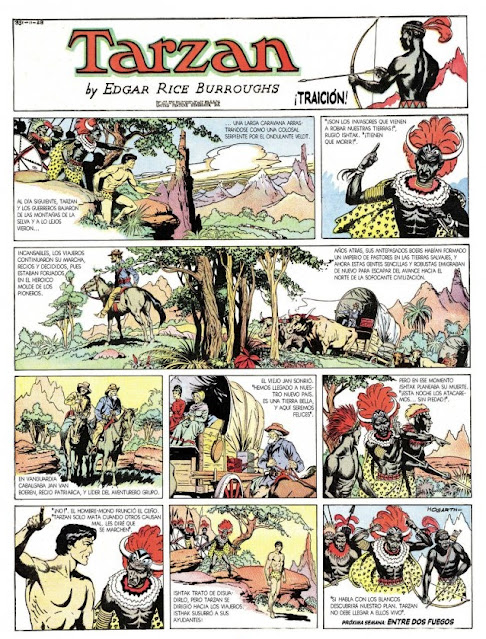

After a revitalizing Dum-Dum or two get those old ape juices flowing Tarzan heads home to his ranch but is almost immediately called away to help a tribe with some invaders. These invaders called the Boers are actually settlers who have bought the territories they are heading to and the chief of the tribe just wants to renege and kill them off with Tarzan's help. But the Ape Man gets wise and what follows is more akin to a classic Western than a jungle epic. We have wagons arranged in a defensive posture and guns and arrows and even eventually a cavalry save. There's plenty of intrigue in this one as well. 

Then it's a displaced Asian culture which come into view in "Tarzan and the Chinese".  Actually, it seems that we get a tiny version of the invasions of Genghis Khan into China. Tarzan finds a immense wall and crosses over into a new territory where despite his help and nobility he is doomed to die. But eventually the invasion of barbaric natives creates a need for someone of Tarzan's talents and the highly civilized Chinese are then able to defend themselves somewhat more effectively. Eventually of course Tarzan wins the day and heads out for regions he's more at home in. 
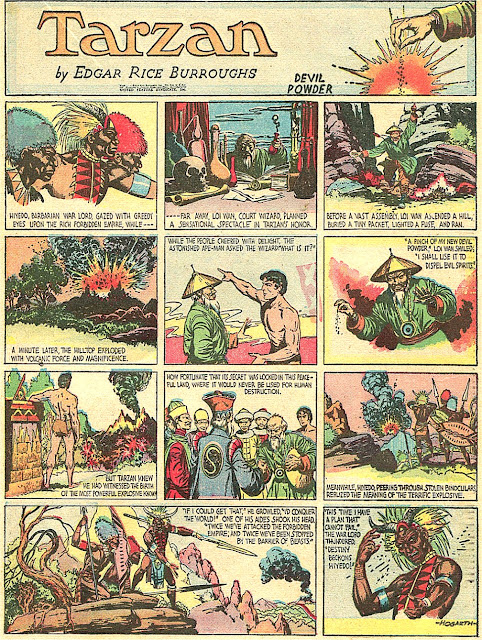

That brings him in conflict with a strange race of "Half-Men" in "Tarzan and the Pygmies". A villain named Marsada is leading yet another safari to find treasure and it finds trouble instead. The daughter of the man paying for the quest is quickly the object of desire of the baddie and is saved by Tarzan and whisked away into the trees not unlike his original romance with Jane, though he has not such intentions with this young lady named Linda. 

They are only saved from the savage "Half-Men" when a powerful band of women appear to help in "Tarzan and the Amazons". Then Tarzan becomes the object of desire for the most powerful of these savage women Kuleeah and he has to do his best to let her down easily, though it proves mostly impossible. It's all he can do save Linda and get beyond the reach of these women. 
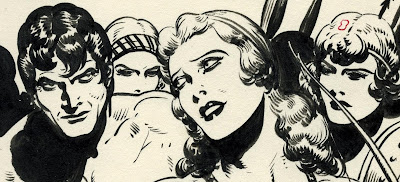

The final storyline in this volume has Tarzan once again meeting up with the Boer settlers and he must battle furiously to save them from a greedy villain named Klass Vanger who wants the diamonds he suspects is on the land owned by the Jan Van Boeren and his allies and works up the local natives with lies of the settlers breaking their promises to them. His daughter Matea falls under the spell of the villain despite the true love of a powerful man named Groot Carlis who fights alongside Tarzan to great effect. There is much back and forth intrigue in this storyline but as you'd expect by the end the lovers are united and the battle is won for the moment though danger sill lurks. 


We'll get a glimpse of that danger when we take on volume two of Burne Hogarth's Tarzan in Tarzan Versus The Barbarians next week. 

Rip Off

Sunday, January 30, 2022

The Sunday Funnies - Tarzan Of The Apes 1935-1937!


Tarzan The Sunday Comics 1935-1937 by Hal Foster brings to the modern reader the last of the acclaimed artist's work on ERB's most famous character. The comics were written as all of the run was to this point by Don Garden. Foster was well regarded by Edgar Rice Burroughs himself as an ideal artist for the strip, but alas no arrangements were made on his part nor of others in the mix to see to it that Foster was remunerated adequately. Simply put it made more financial sense for Foster to create his own strip and make all the money as opposed to continuing as part of big team. 

On his way out the door Foster had the chance to draw Vikings in "Tarzan and the Lost Vikings", a yarn begun in the second volume. Tarzan had rescued a Viking warrior and was taking him home and then that warrior's beloved Siegrida was kidnapped. Much of the stories here deal with how Tarzan was able to save her and later fend off her affections when she became the queen of her people. Women in this strip always seemed a fickle lot and Tarzan was either saving them from grave harm or trying to save himself from their jealous natures when he ultimately rejected them. Although Jane never appears in these strips after very beginning, she is nonetheless always present since Tarzan will have nothing to do with some beautiful women. Tarzan acts like a certain young Prince from Thule in many of the sea-going battle sequences. 


After he is able to get free of the Vikings he gets back to the jungle in "Tarzan and the Killers", and has to rescue yet another damsel named Gloria from a gang of avaricious white hunters led by two villains named Gorrey and Flint. They have come to the deep of Africa with a map pointing to vast gold deposits and the girl is the daughter of the man who made the map. There is intrigue and counter-intrigue as Tarzan always to do the right thing but often finding his efforts result in more trouble. There is a sense of repetition in this storyline a bit as Tarzan, who is always on the move often has to keep doing things he'd presumably taken care of before. His benevolence is almost never rewarded. 


And this leads us to the final story Foster worked on dubbed "Tarzan in the City of Gold". Yet another princess is on hand, this one named Nakonia, as Tarzan and the gang of criminals he'd been fighting before entering this lost land which is filled with gold and lions. Tarzan is seen as an enemy in the early days and is thrown to the lions, but his jungle breeding wins the day. The criminals take over the city and there then begins an odd extended storyline in which Tarzan becomes the leader of the opposition forces fighting to free the city from its new masters. We are treated to large battle scenes and extended sequences of ariel dogfights as modern war and technology comes to the depths of Africa. Tarzan almost gets lost in the melee and seems to be another hero altogether at times. There is a constant and frankly repetitive back and forth between Tarzan's forces and the villains and as Foster wraps up his run the baddies are in the ascendancy. It will be up to Burne Hogarth to finish this already too long saga. But more on that at a later date. 


There is an excellent essay fronting this collection by Tom Yeates talking about the influence of Foster on adventure comic strips and on Tarzan illustration as well. Nifty examples of work by such notables as Joe Kubert and Roy Krenkel help to illustrate the points Yeates seeks to make. We are treated to an explanation of where these strips have come from and as it turns out Mike Richardson, the big kahuna of Dark Horse used his own private set of Foster's Tarzan strips to supply the work. This explains why much of the stuff is at times muddy and even suffering minor damage in a few places. But any port in a storm and it's better to have the historically important strips in somewhat less than perfect form than not at all. 

Rip Off

Sunday, January 23, 2022

The Sunday Funnies - Tarzan Of The Apes 1933-1935!


When I read Brian D. Kane's essay which fronts Dark Horse's volume of Tarzan The Sunday Comics 1933-1935 by Hal Foster (the second of three) and discovered just how little Foster was getting paid for his efforts it's no surprise he would dump the "big palooka" as Foster called him for greener pastures in the Arthurian Age at King Features. He was getting just fifteen bucks a week for the Sunday page and while that's more impressive in the 1930's Great Depression era it still seems a paltry amount. It turns out he was the least paid of the operation with the writer and the others such as ERB himself reaping greater profits. But that said, the work Foster did on the Ape Man was definitive. 


In this volume we continue "The Egyptian Saga" and pick up Tarzan's adventures in a lost land which is occupied by a remnant of ancient Egypt. He'd been tussling with this gang for some weeks and would continue. The Queen Nikotris was a fickle chick who sometimes cried out for Tarzan to save her from some grisly raider and then at other times condemned him to death for insulting her dignity. Tarzan really hung out with this crowd longer than was logical, but his noble sense of justice and his pride indicate he stay and save not only the Queen but several of her subjects such as a young boy who is condemned to death by the religious zealots of the land. Back and forth he fights with the Egyptians and with some barbaric types until finally after months he finally is able to scale a mountain and get out of the valley. 


But given that it's Tarzan he quickly finds trouble when yet another princess named Mihrama from the modern world needs his help and he's battling pirates to save her in "Tarzana and the Mysterious Maiden". He also ends up contending with a whole menagerie of wild beasts and among is an ape named Boghdu who becomes in the long run a sturdy ally for the Ape Man. The action never ceases in this strip as Tarzan seems always on the move, often on the run to help this person or battle that creature to the death. The end up on an island which is lorded over by a cruel and greedy white man pretending to be a god named "Dester Molu". He proves a deadly nemesis for Tarzan. 


Finally, after getting off the island Tarzan ends up helping haughty young woman who crash lands in the jungle who does get a bit smitten with him and becomes a shade jealous. She's a brave and stout lass but has a tinge of cruelty to her as they end up encountering yet another lost society, this one comprised of Vikings. You can almost feel Foster warming up for his eventual transition to Camelot as we meet a brave Viking who has a young blonde woman named Sigreda who loves him to distraction. This volume ends in the middle of this saga of "Tarzan and the Lost Vikings", so more next week.


These adventures continue to read quickly and it's impossible to read them without immediately wanting to jump to next one. It must have been exquisite torture for Tarzan fans of the 30's to wait for weekly installments. This Ape Man is the ruggedly handsome ideal and as these strips develop, we see him becoming more and more the modern image of the hero we know. The strip was just part of the grand push which saw Tarzan not only continue to arrive in new novels, but movies were popping up all over as well. A great time to be a fan of Tarzan indeed. 

Rip Off

Sunday, January 16, 2022

The Sunday Funnies - Tarzan Of The Apes 1931-1933!


Hal Foster had been the first artist tapped to bring the adventures of Tarzan of the Apes to the daily newspaper. He adapted the first novel in a style not unlike that used in Big Little Books. After the first novel he departed the series and was replaced with the sturdy Rex Maxon. When the success of the strip provoked a Sunday page it was Maxon who began it. But within just a few months Hal Foster returned to the jungles of Tarzan and began his amazing journey which revolutionized adventure comic strips for all time. 


The big difference is that Foster was an illustrator, an artist who focused on advertising. When he came to do comics, he didn't relinquish his realism which had been the normal approach. He kept his worlds lush and remarkably familiar and real. Mark Evanier in the essay which fronts the first volume of Dark Horse's Tarzan The Sunday Comics he suggests that Edgar Rice Burroughs found in Foster's drawings the closest approximations to what he visualized in his head when he wrote them. Somehow Foster was able to make Tarzan and his allies and foes come alive not only for the broader audience of the comic strips but for Tarzan's creator as well. Also, it's important to note that these Sunday pages were, aside from magazine covers and book jackets, the first color Tarzan many readers were getting access. The Sunday pages of the 30's not at all unlike the advent of color on television in the 60's quickened the imagination in my opinion. 


Foster picked up the strip in the middle of a tale "Hawks of the Desert" which follows the Ape Man as he helps a friend who is connected to the French Foreign Legion. The Tarzan of this stretch reminded me much of good old Elmo Lincoln from the movie serial The Adventures of Tarzan. He looked a lot like like Frank Merrill who portrayed the Ape Man in Tarzan the Mighty and Tarzan the Tiger. After this adventure is wrapped up, with Foster doing little distinguish his art from that of Maxon's that had preceded it, we get several one-page stories about such things as Tarzan's first Christmas and some of his adventures in both English society and the jungle he so loves.

 
The first extended storyline Foster tackles on his own features about two strong women who end up as white goddesses for a local tribe. One is a tough as nails chick named Hulvia who was raised aboard a ship by her seafaring Dad, and who ended up stranded but took it in stride and took control. She falls in love and ironically is replaced by a brave woman named Lenida who tames lions but wears a black mask after she was mauled. Both of these women are fully capable though Hulvia does become a bit of a damsel-in-distress when she falls in love. From these adventures we get a quick visit from Tarzan's son Korak the Killer and then Tarzan treks off to rescue a friend who has gotten lost and injured in the Elephant's Graveyard. Wildy the graveyard leads to a valley filled with dinosaurs and Foster is getting more and more relaxed and using a greater variety of panel dimensions to tell the story. 


Tarzan too loses his Frank Merril shoulder strap and uses the simple loin cloth we've come to expect. Tarzan and his friend are then drawn into a wild series of adventures with a lost culture derived from ancient Egypt. Tarzan is thrown to the wild beasts as sacrifice but wows the crowd when he shows he can control them. Thus begins a back-and-forth struggle as the Egyptian society tries to cope with these challenges to their religion and a lack of food. He also must contend with the fickle passions of a princess who is not afraid to seek blood when she feels slighted. This first volume ends with Tarzan still contending with the Egyptians as he will do for much of the next volume. But that's next time. 

Rip Off

Sunday, January 9, 2022

The Sunday Funnies - Tarzan Of The Apes 1929!


It was 1929 and Tarzan of the Apes had become a significant feature in the popular culture of the time. Edgar Rice Burroughs had released fourteen novels featuring the character and around ten silent movies had been made starring the character. But since adventure comic strips were not so much a thing in 1929 Tarzan had yet to make a mark in the newspapers around the country. That is until ERB and some enterprising chaps decided to make it so and in doing that brought aboard a very talented advertising illustrator named Hal Foster. 


Several years ago IDW Publishing puit out the first year and more of the Tazarn of the Apes dailies as part of their The Library of American Comics Essential series. The tome gives the reader a nice historical essay for context by Henry G. Franke III and follows it up with the first four continuities of the strip. The four novels adapted for the comic strip were the first four written and published by ERB. The novels have been stripped down to around 15,000 words or about a tenth of their original lengths and the strip is arranged in a format of text and picture familiar to fans of the classic Big Little Books. 


A fellow named Joseph H. Neebe was the driving force behind the comic strips and arranged with ERB for the rights. It took a while for the format to be arrived at and for artists to be arranged. And still more time was required to sell the strip to the newspapers which had not had any experience with an adventure strip of this kind. Comic strips were mostly gags and light-hearted and the saga of Tarzan was hardly that. Neebe hired a writer named Ralph W. Palmer and a respected but unknown advertising artist named Hal R. Foster for the artwork. By do that Neebe transformed the comic strip as we understand it and laid the groundwork for much of what we think of as comic books themselves. 


The comic strip was eventually sold novel by novel with newspapers having the option to stop at the end of any yarn. Tarzan of the Apes debuted in America on January 7, 1929 but had already appeared in the British magazine Tit-Bits several months earlier making it the first adventure comic strip. Foster handled the art chores magnificently on the first sequence which adapted Tarzan of the Apes. But Foster then left for more lucrative work. Rex Maxon was tapped to take over and he began his long association with the Tarzan character despite complaints from ERB himself. Maxon's style is less ornate than Foster's but has just as much energy if not more. Maxon (with some anonymous help) went on to illustrated the next three Tarzan novels -- The Return of Tarzan, The Beasts of Tarzan, and The Son of Tarzan. The Foster adaptation of the first novel has been reprinted a few times but first as The Illustrated Tarzan Book No.1 seen at the top. 


The first two novels by ERB are among his finest work. They form one long story that establishes the character of Tarzan as we understand him and in this stripped-down illustrated format function quite well. Nicholas Rokoff is one of my absolute favorite fictional villains and he gets some good attention  in these wild yarns.  The Beasts of Tarzan and The Son of Tarzan are less effective narratives suffering from wacky plotting which in the case of the former undermines its climax, and in the former doesn't give the reader enough Tarzan, though Korak is a decent substitute. I hadn't read these last few novels in many years and it was nifty to get to revisit them in this fresh way. 


This tome is highly recommended and sets up the Hal Foster Sunday pages quite well. Those we will begin with next week. 

Rip Off

Sunday, September 19, 2021

The Sunday Funnies - Prince Valiant 1973-1974!


In Prince Valiant Volume 19: 1973-1974 by Foster and Murphy from Fantagraphics we have the first full volume not drawn completely by Hal Foster the creator of Prince Valiant in 1936. He is still writing the strip and laying it out, but John Cullen Murphy has taken over the primary art chores. In the volume begins with a reminiscence of Murphy by fellow comic strip maven Jerry Dumas


The saga picks up where it left off with the budding romance of Jacques the troubadour and the young acrobat Joan. They are married off post haste and the story quickly turns to Prince Arn who has found a friend in Boltarson, the son of Boltar, Prince Valiant's longtime ally and husband of Tillicum who was Arn's nurse. They head North and meet up with various adventures in which Boltarson questions Arn's bravery but quickly learns he has mistaken guile for guts. The duo make for Thule and soon Arn is sent on a mission to help install the new king of Holvik, who it turns out doesn't want the job. The heir Heidmar arranges to take the place of an ill-fated serf and rides off escaping his duties. The job of king goes to the untrustworthy Grimner and his chosen wife Princess Frieda. After that Arn encounters Lydia who stakes a firm claim on his young heart. When he is ordered to check on Grimner he is reluctant but does the job and helps to settle down the area which has been invaded by Wanderers. He is wounded and returns to Camelot where he convalesces thanks to Lydia while his father finishes his mission in Holvek. There is much treachery and both Grimner and Frieda end up dead and another is selected to be king, who it turns out is Lydia's brother. But when Arn sees Lydia meet her brother at the docks with much affection his tender affections are wounded so much he leaves Camelot without a word. Arn provisions a ship of Vikings but soon leaves them when they desire raiding over trade. He then grows up a bit and loses his fathers tunic design to fashion his own in red. He becomes a knight errant and soon has a clever squire in a loquacious fellow named Paul. They have adventures and even end up in a castle under siege. Seeing it is hopeless they escape but do rescue a lost young girl who they named "Squirrel". Paul becomes attached to her and eventually he marries and becomes a happy father of many. Arn then encounters Sir Gawain and the two go to fight jousts, some not fair at all. Meanwhile Lydia's brother is searching for Arn and eventually finds him and tells him the truth. Overcome with joy Arn is breathless to get to Thule. The two stalwarts find a hidden valley in which the people have been protected from invasion for two hundred years and later a castle in which the reluctant queen has been dead behind a locked door for over fifteen years while her mad lover waits for a word. Soon after and Arn  and Gawain part company when the latter heads home to Camelot. Arn encounters more Vikings, helps two young lovers find themselves and then when he gets to Thule he is reunited with Lydia at last. Prince Valiant becomes the focus when he goes to stop a giant warrior form terrorizing the district. He overcomes this threat with his usual cleverness and bravery. As the tome ends we are treated to the daydreams of young Galen and later yet another siege on a castle. But that story will be next time. 


The extra treat in this volume is a classic Hal Foster piece from 1942 -- The Song of Bernadette which was a Book-of-the-Month Club offering. The complete piece is here. This installment wraps up "The Sunday Funnies" for at least the next month or more. Hopefully I'll be able to get back to it in November and bring more Prince Valiant to the Dojo. Until then. 

Rip Off

Sunday, September 12, 2021

The Sunday Funnies - Prince Valiant 1971-1972!


The year 1971 saw the momentous shift in the venerable history of the Prince Valiant comic strip -- it's creator and artist Hal Foster at long last stepped away as the primary artist on the strip after thirty-five years or more in that post. He had searched for a successor and had found one in experienced comic strip artist John Cullen Murphy. The changing of the guard is showcased in Prince Valiant Volume 18: 1971-1972 by Foster and Murphy from Fantagraphics. 

(The last regular Prince Valiant by Hal Foster)

The stories in this volume begin with Prince Valiant searching for something to take his mind off his feud with his beloved Aleta. He finds distraction trying to protect a castle from some enemies fighting over a lovely damsel. Later he catches sight of Aleta's ship on the way to the Misty Isles but his pride stops him from calling out. He rambles around he at last meets a wise man in Merlin's cave who gives him the mission to win Aleta all over again. He finds Prince Arn soon after and the two of them sail to the Misty Isles. But it's a short voyage and they must travel overland where they meet Ben Ziara who can take them to North Africa. It is as they travel with Ziara when they find they must avoid invading Goths that Foster draws his final full Prince Valiant (with one exception... more later). Meanwhile Aleta and her family land in the Misty Isles where she enounters Ortho, a noble who appears at first helpful. Valiant and Arn are helping others protect themselves from the Goths but eventually get to the deserts where they encounter yet more strife.  While Aleta is trying to navigate her relationship with the attentive Ortho, Valiant and Arn see the utter destruction of a desert city which is first invaded and plundered then suffers from an immense earthquake. On the coast at last they encounter a ship sent by Ortho but whose captain has been given orders to kill Valiant by Ortho. Valiant soon figures this out and takes precautions which not only save his life and Arn's but put him into position to defend against the treacherous Ortho, who alas meets his end in another way. Valiant and Aleta are at long last reunited and the story leaves them to enjoy their rekindled romance. The twins Valeta and Karen trifle with love and marriage of an ignorant noble lad and end up making a happy couple but not the one everyone expected. Prince Arn then goes with a friend who is the new king of Dondaris. He proves essential in this new king being able to keep his fractious kingdom together when rebels with good cause rise up in the hinterlands. Dondaris is a land gone soft and Arn sees that only fair play and justice can save it from destruction. Valiant appears and then suffers the loss of the Singing Sword. He soon finds it and the thief finds due justice. But then Valiant comes to the kingdom of Atheldag where visitors must have stories to entertain a king who cannot sleep. Soon Val meets King Dashad who is a wastrel and knows little of the suffering of his people. Val takes him in hand and soon has toughened him up and instilled in him a sense of empathy for the common people. Then the story turns to a troubadour named Jaques who is  all too ready to woo women with his tender words and lovely songs. He too finds trouble and learns a lesson when he meets a young woman who becomes his wife after some trouble. 


This book starts with an essay by Brian Walker about his memories of both Foster and Murphy. It ends with an outstanding collection of incidental and advertising art by Foster of Prince Valiant for various folks and institutions. Lovely and some very funny stuff with our stalwart hero. The endpapers in this particular volume also feature some art used in the Hasings House volumes which told the Valiant saga in prose. All in all another handsome installment. Foster will continue to write and layout the strip for some years to come, but his signature disappears from the strip and some thought the strip might end. It didn't of course and is still going strong. 

More next time as the Prince Valiant saga continues. 

Rip Off

Sunday, September 5, 2021

The Sunday Funnies - Prince Valiant 1969-1970!


Prince Valiant Volume 17: 1969-1970 by Hal Foster from Fantagraphics is a notable volume in this venerable series in that it marks the beginning of the end of Hal Foster's connection to the strip. Now there is still a decade of Foster directing the series but as this tome closes out we see examples of three artists who were considered as viable candidates to take over these singular adventures in Camelot. More on that later. 

Gray Morrow

The saga picks up with the Valiant clan on the way back to Camelot from the Misty Isles and with the budding romance between Katwin and a rough and gruff sea captain named Helge who lost an arm fighting to save the aforementioned Katwin. After some coaxing the dour seaman is lured into romance and eventually marriage. Then we turn our attention to Sir Gawain who made his way to Camelot on land and who had much to explain as to why he turned up in King Arthur's court atop a mule. He relates several tales of woe but in most of them he prevails until the end when he is hoodwinked by a false magician and his lovely companion. Then Valian is sent to check up on the Saxons who after the Battle of Badon Hill have settled peaceably in the lands with Arthur's permission as long as they build no forts. They claim to be put upon by Vikings and since Val is a Viking it is thought he might be handy to solve the situation. With considerable cunning he turns back the threat of Thoric, a raider who was banished by Val's father King Aguar. Then he must put down a rogue Saxon who is hiding a hoard of weapons and preparing for war. We follow the Valiant family as young Galan seeks a unicorn (a goat) and the twins Valeta and Karen confront the confusions of chivalric romance. A young woman named Adele turns up and seeks to keep a promise made in childhood to be the wife of Geoffrey the poet and scholar, and Prnce Arn is useful in helping out. Arn then gets into trouble and is made a slave of a rogue named Llanwick  but he is able to turn the tables and burn Llanwick's castle down and Valiant shows up in time to help Arn out. Then King Arthur is miffed that his royal deer are diminished and blames Hugh the Fox, but later changes him mind and makes Hugh his warden. We then follow the adventures of a young knight named Dale MaKinnie who seeks to become a knight of the Round Table and gets a chance when he is sent to assist Lady Marvyn tabilize her hold on her territory. The situation becomes complication when a young woman named Matilda turns out to be a more worthy mate and becomes just that when Lady Marvyn accidently poisons herself. Prince Arn falls into the clutches of Moragan Le Fay who seeks revenge for Prince Valiant's victory over her nearly twenty years before. After Arn is saved Val and Aleta have a spat which causes them to have separate sleeping quarters for a time and as this volume ends with Val seeking to help a beautiful damsel in a castle tower their tiff is left unresolved. 

Wally Wood 

This volume begins with an essay by Brian M. Kane on the humor in the Prince Valiant strip and ends with a glimpse of Hal Foster's childhood sketchbooks. As mentioned above the most notable events in this book are sample strips by Wally Wood (one), Gray Morrow (three) and John Cullen Murphy (three) used by Foster to select a successor. We know that Murphy will win the prize though I must say that Morrow's efforts were especially tremendous. Wood's outing is excellent but falls just short of the other magnificent examples in capturing that Foster flavor. 

Rip Off
 

Sunday, August 29, 2021

The Sunday Funnies - Prince Valiant 1967-1968!


Prince Valiant Volume 16: 1967-1968 by Hal Foster from Fantagraphics is one of the more action-filled editions of the run in a while. 


The saga begins with Valiant trying to keep a kingdom together by convincing a young prince to do his duty. A tragedy convinces him he should and becomes a worthy leader. Then Valiant seeking some fun pals around with an acting troop though trouble comes when he and another young noble named Reynolde switch roles when they realize they look alike. It's all in good fun until a seedy actor tries to run a scam on a noble princess. Valiant is playing matchmaker a bit with the help of Aleta and Reynolde gets girl as does another young but dull-witted warrior named Bala. There is a great hunt in Camelot and Prince Arn runs up against a Berserker and his Mother, two deadly enemies. Then it's time to head to the Misty Isles yet again as Aleta is alerted to possible trouble. Valiant though has another mission along the way, to try and rescue Sir Gawain who is being held for ransom by a slave master named Balda Han. Valiant himself is made a slave though when he is reunited with Gawain it's not for long when uncover an ancient sword in a hidden tomb. Valiant and Gawain free the slaves and set them up in their own society but it falls apart soon after they leave because the slaves seem to know little about how else to live. Then it's off to the Misty Isles where Valiant and Gawain help Aleta with her problems. When she was last there she arranged for lucrative trade deals but that wealth has been hoarded by a few nobles and not shared with the populace at large. The navy has become slack and in general the people are weak and ripe for plunder. Valiant takes steps to toughen the nave and Aleta hands down edicts that make the nobles responsible to the rest of the population which made their wealth possible. Prince Arn is instrumental in laying waste to a hostile fleet of ships using the same savvy as his father had done so many times. The Valiant clan head back to Camelot, all of the kids growing up. Along the way home Aleta and the twins Valeta and Karen are kidnapped by a Mullah and Valiant and Arn fight ferociously to save them. Katwin, the children's nurse is also saved by the ship's captain who loses an arm in the process. But as he heals Katwin and he find they care for one another. 


In the extras this time there is a short essay by Greg Hildebrandt discussing Hal Foster's influence on his artwork. And there is a lengthy section about Hal Foster and  Prince Valiant's influence on Mardi Gras with lots of neat photographs of some resplendent floats and costumes. Next time changes are in the air as Hal Foster begins his search for an artist to take the helm of the strip as it enters a new decade. 

Rip Off

Sunday, August 22, 2021

The Sunday Funnies - Prince Valiant 1965-1966!


One thing which is missing from most of Fantagraphic's Prince Valiant Volume 15 -1965-1966 by Hal Foster is..er...well. Prince Valiant. As it turns out it's been fourteen years since Valiant followed the kidnapped Aleta to the New World and rescued her there only to have to spend a year among the Native Americans before heading back to Camelot. While there Aleta was held in high regard by the Indians and in fact there was a prophecy that her child born there would return and make great changes in the society. This is the story of how that prophecy was fulfilled. 


Prince Arn is the focus as he and his friend Hatha, the son of Boltar and Tillicum (a native from America) decide it's time they'd like to see their other homeland. So to that end Arn arranges a ship, a crew, and he and Hatha with Tillicum begin the crossing of the Atlantic. They go by way of Iceland and Greenland and eventually make landfall in the New World and Arn has many adventures there attempting to bring his version civilized ways to this new people. In ways he is successful and in others not so much. Foster treats Native American culture with a great deal of dexterity and respect, certainly more than most popular entertainments of the time and before. Eventually Arn is able to bring about changes in the Indian society which leads to the a time of relative peace and cooperation between the various tribes of the region and eventually even what is called the "Algonquin Nation". Then after over a year of adventures they head back to Thule in time for us to follow Prince Valiant's mission for King Arthur to find the reason for a potential threat from the Celts and the Caledonians beyond Hadrian's Wall. He finds that Mordred is the root of the problem and is skillful in undermining his efforts. Later we see Modred save himself with King Arthur with his skillful tongue. There are also a few vignettes about Valiant's very daughters and their first naive dalliances with chivalric romance. The volume ends with Valiant taking measures to see that a missing prince is found and a peaceful transition of power is made from his dying father. 


This volume is especially nifty in that it features an interview with Bob Fujitani (from Alter Ego no less) about his work on Dell's Prince Valiant comics in the Four Color run. The book also features a very handsome gallery of books which have over the years reprinted or adapted the Prince Valiant stories. Included are the Hastings House volumes, the amazing ad from Warren Comics for those books as well as the stunning artwork by Mike Kaluta for the covers of Marvel's short-lived Prince Valiant comic from the 1990's. 

More to come of course. 

Rip Off