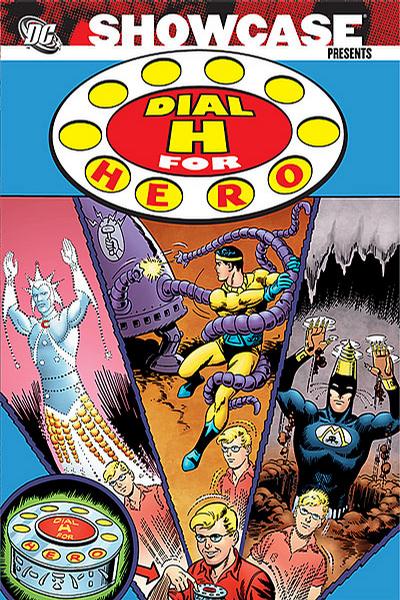
No single comic book showcases the wacky spirit of the 60's superhero boom better than Dial H for Hero which appeared in House of Mystery from 1966 to early 1968, the exact years that the Batman TV was hotting it up for superheroes everywhere. Robby Reed was a teenager who by dint of a strange mechanical device that resembled a telephone dial could become a seemingly limitless number of different superheroes to confront strange menaces that popped in and around his small town of Littleville. Co-created by writer Dave Wood and artist Jim Mooney, this series was weirdly exciting and mildly prosaic at the same time. Mooney's artwork is the essence of smooth but is not necessarily dynamic. Mooney's handsome work adorned all but three of the Dial H for Hero stories, and he did all the covers save for four. Dave Wood is not a writer well known today or really even at the time as credits were hard to come by in comics of the era. Along with Dial H for Hero which he wrote all the scripts for he was the writer on Challengers of the Unknown as well as various Bat-books over the years.
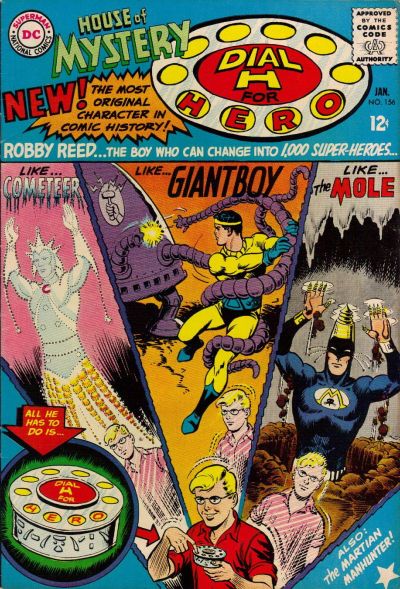
The story began in House of Mystery #156 and we follow Robby Reed, a precociously bright teenager who lives with his Grandfather and his housekeeper Miss Millie. A strange gang of high-tech villains are rampaging around the area attacking industries. Robby and a few pals are close to one attack and it cause a landslide that Robby gets caught up in which deposits him into a forgotten cavern where he finds the magical Dial. He dials the letters "H-E-R-O" and becomes Giant Boy to confront the mechanical menace. Later he becomes the heroes Cometeer and The Mole to confront further menacing machines from the Thunderbolt outfit. The leader alas escapes.
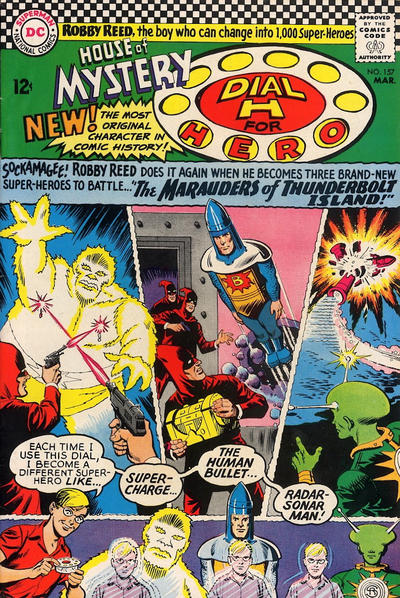
Robby picks up the fight against Thunderbolt in the very next issue and this time becomes the weird heroes Super-Charge, Human Bullet, and the exceedingly odd Radar-Sonar Man. The Thunderbolt gang are using an enormous submarine disguised as an island to perpetrate their crimes this time. Robby by becoming different superheroes is able to end the menace for the time being and the leader is captured in this issue.
Change ups in the Dial H scenario come early as in the third installments revelation that taking the Dial and dialing up V-I-L-L-A-I-N creates just that. A leader of the criminal gang called "Daffy the Great" gets his mitts on the Dial and becomes a baddie with immense powers. Robby has to become the heroes Quakemaster and later The Squid to confront him. Thankfully his powers are gone by the issues finale.
The Clay-Creep Clan is a big gang of thugs who join up with a fellow who can turn them into body-shifting supervillains for a time. They are running wild and requires that Robby become three different heroes again to put down the menace -- Hypno-Man, the Human Starfish, and the Mighty Moppet. As the series rumbles along the changes that Robby will undergo become stranger and stranger and this issue is only the beginning of that trend.
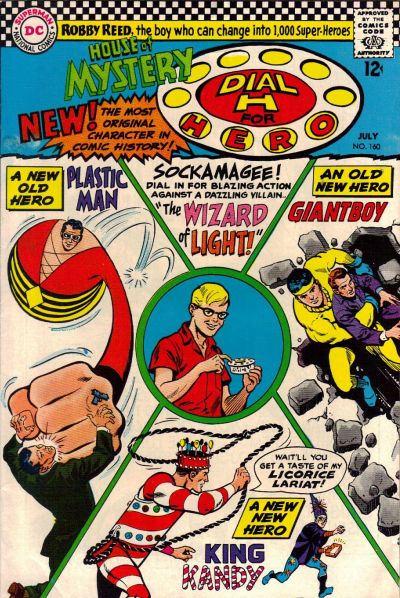
As in the next issue when Robby has to become three heroes yet again to end the menace of the baddie called the Wizard of Light. He returns to a role he'd adopted in his first adventure as Giant Boy and then he becomes a new hero called King Kandy. But the strangest change yet for Robby is when the Dial makes him into a version of the classic hero Plastic Man. DC was launching the Quality hero in his own series at the time and I guess this was an attempt to cross promote. It raises lots of questions about how the Dial does what it does, but those are questions alas we will never learn.
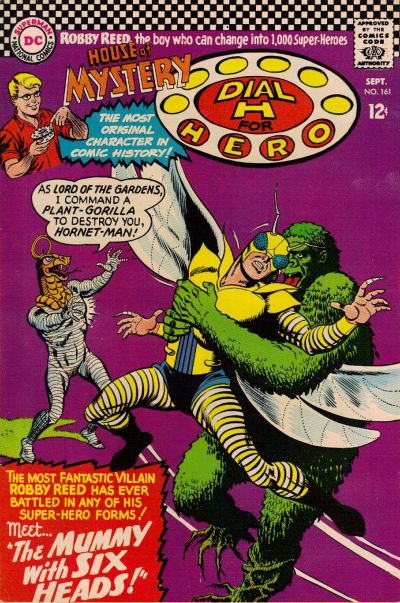
Things are little more straightforward in the next issue when the villain is the Mummy with Six Heads, a baddie who can invoke the power of different Egyptian gods depending on which head he wears. Robby has some real trouble this time out because the villain can create allies of his own. Robby becomes the heroes Magneto, Hornet-Man and Shadow Man. The latter evokes memories of the classic pulp hero with a similar name.
Littleville is overrun with monsters in the next issue of House of Mystery. Some villain has gained the power to make people into monsters and does so out of revenge on the town for putting him into jail. To beat this menace and do so without hurting the people who become monsters Robby must become the heroes Mr. Echo and Future Man
The changes keep coming. In this issue Robby must become twin superheroes called Castor and Pollux to battle a plague of giant insects in the nearby city of Zenith. The bugs are the work of a baddie called "Baron Bug". The twins are not sufficient to end the menace, so he dials up again and becomes King Coil, a living spring. Perhaps Robby's oddest change yet. The cover is by Carmine Infantino this time.
The bizarre villain Dr. Cyclops is on hand int he next installment of Dial H for Hero and it takes three superheroes to beat him. Robby becomes the aquatic Zip Tide, the heated Super-Nova and finally the mechanical Robby Robot to beat this villain.
House of Mystery #165 is perhaps my favorite issue and has a dandy cover. This was featured in some DC house ads and I desperately wanted to read this issue when I was a kid and find out about the "Freak Superheroes". The villain is Dr. Rigoro Mortis and he is assisted by Super-Hood the villain from the cover. Robby becomes the strange heroes Whoozis and Whatsis to save the day but they prove ineffective and it's the wild and wacky Howzis who is able to at last end the threat.
A pretty girl named Suzy moves in next door to Robby and later on a school field trip the strange folklore of a Cougar-Man comes to life. Robby becomes the Yankee Doodle Kid to battle the ferocious creature and later he transforms into Chief Mighty Arrow (with a horse named Wingy) when another folklore menace of a Giant Albatross threatens the town. Turns out the legends are brought to life by a machine a scientist is innocently using having been tricked by some hoods.
The Rainbow Raider is an exceedingly dangerous villain and Robbie uses the dial to become the rotund Balloon Boy, the wild Muscle Man, and Radar-Sonar Man once again to beat back the threat.
The leader of the Thunderbolt gang escapes jail and plots his revenge when exposure to radiation gives him powers as Moon Man. Robby must become The Hoopster, and a bizarre blend of two the original Dial H for Hero charactes as the Mole-Cometeer.
Suzy learns Robby's secret in the next issue and blackmails him into letting her try the Dial. She becomes the superheroine Gem Girl to battle the weird Terrible Toymaker. Their fracas reminded more than little of the Charlton duo Punch and Jewelee, though in this instance the characters are fighting one another. Robby for his part becomes Velocity Kid and alter Astro Man, a hero from space. Suzy gets knocked on the head and forgets the secret of Robby's identity by the end of the story. Too bad really as it made for a nice departure.
In the last issue drawn by Jim Mooney Robby becomes the Human Buzzsaw, the cavalier Don Juan and later Sphinx-Man. He cleverly uses the riddle of the Sphinx to end the threat of a cell of the old Thunderbolt gang.
With Dave Wood still on the scripting the series welcomes Frank Springer aboard as the new artist with Nick Cardy handling the cover art on House of Mystery #171. This time Robby tries to round up a gang led by Dr. Morhar and during the fracas all of them end up in a microscopic world ruled by creatures that are eager to invade the bigger Earth world. Morhar turns traitor and helps the aliens while Robby must become the heroes Super Viking, Go-Go, and Whirl-I-Gig. Go-Go used the powers of the dance floor such as the Frug and the Monkey to fight while Whirl-I-Gig had blades for limbs. Stranger and stranger it seemed the heroes were becoming.
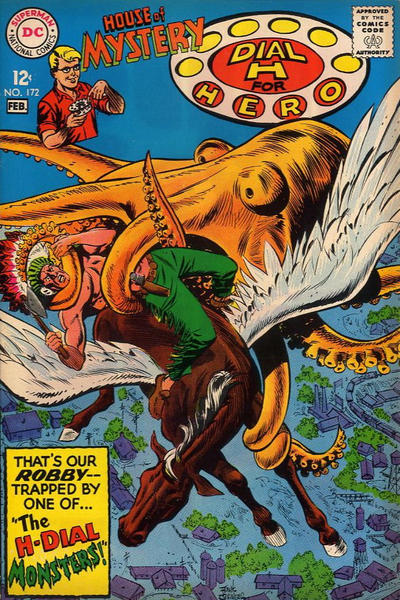
Springer's art is more dynamic in places than was Mooney's but the clarity of the storytelling is less effective. In his second issue Springer has to draw Robby as new hero I'll call Pendulum Man since no actual name is given in the story and later he returns to his Mighty Arrow identity. The complication this time out is that every time Robby changes he also seems to create a menace he must confront. Turns a boy who has the same birthday as Robby has been sucked into the Dial's vortex.
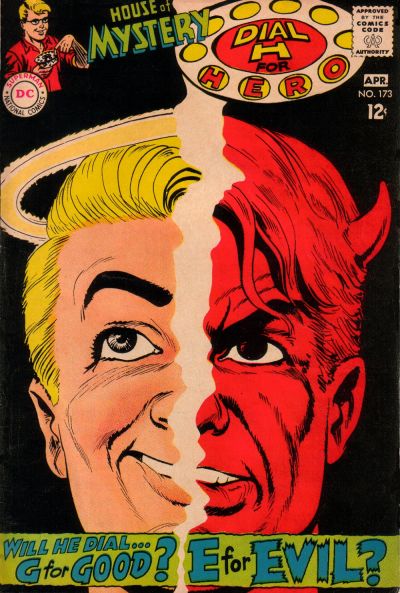
The series wraps up with a cover by Jack Sparling that hints at House of Mystery's return to more sinister storytelling. Dave Wood's final script is illustrated this issue by Sal Trapani and the three final heroes who are created are Gill Man, Icicle Man and Strata Man. The swerve this time out is that each time the hero has captured the baddies, this time a gang called the Speed Boys, he becomes evil and hides the loot they've stolen. He discovers that a device the gang uses makes this effect on him and by the story's end all is right once again in Littleville.
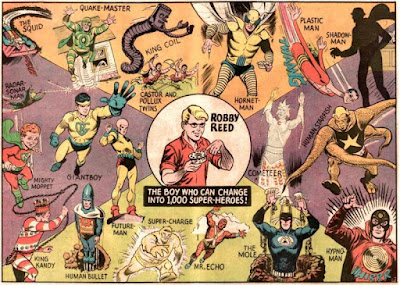
By my count there are eighteen issues of House of Mystery featuring Dial H for Hero and Robby turns into around forty-five different heroes depending on how you count it. Throw in a villain and a heroine and you have just shy of fifty transformations wrought by the mysterious Dial Robby Reed found in that cave. The Dial is never explained in the course of the series and there seemed to be no interest on Wood's part to do so. The complications that develop in later issues hint that the device is fragile but nothing is really revealed. The series is whopping good goofy fun to read but I suspect modern audiences would find it too childish to hold their attention. I just must be immature.
And that wraps up 2021! Sockamagee!
Rip Off