Showing posts with label Arthur Conan Doyle. Show all posts

Thursday, May 22, 2025

The Hound Of The Baskervilles Day!


Sir Arthur Conan Doyle was born on this date in 1859. He of course is most famous for the creation of Sherlock Holmes. He also created Professor Challenger, a gruff scientist who was unafraid of new ideas. Doyle himself became fascinated with spiritualism. 

When people ask which novel is my favorite, I often reply with The Hound of the Baskervilles by Arthur Conan Doyle. It was sometime in 1968 when I was eleven when this magnificent tale first came into my ken, and it left its marks for certain, perhaps less savage than the titular hound, but no less permanent. One of the earliest projects here at the Dojo was to serialize the novel. You can find the beginning of that long ago project here. Below is a copy of the Whitman book which lit intrigue into this most famous of Doyle's canon. 


Jim Steranko must really like Arthur Conan Doyle's Sherlock Holmes novel The Hound of the Baskervilles as well, as can be seen from the double-page spread below from Mediascene


Steranko not only did a first-rate pastiche of the classic Hound tale in Nick Fury, Agent of SHIELD #3, but he's also illustrated a sequel to that story by Michael Hardwick, titled Revenge of the Hound.

Here are some sample pages from Steranko's SHIELD/Sherlock story.


Here are a few of his illustrations for Hardwick's book. The portrait of Holmes at the top of this post is from this project as well. 


The painting above of the great detective also served as a cover for a revived Argosy Magazine.

Holmes and Watson might have rid Dartmoor of the Hound, but they could not rid the world of it fascinating terror. 

Rip Off

Wednesday, December 14, 2022

Sherlock Holmes - Return Of The Devil!


Return of the Devil is a relatively short two-part tale from Martin Powell and Seppo Makinen, revisiting again the world of Arthur Conan Doyle's famous detective Sherlock Holmes. This yarn follows on the success of Scarlet in Gaslight and A Case of Blind Fear.  In this one Watson and Holmes are nearing the end of their long partnership when word gets to Holmes that Irene Adler once again needs his assistance. It turns out it is not Adler directly but a colleague, a beautiful contralto named Violet Fortier who has been  hallucinating apparently and reveals that the Devil himself, in his horned and cloven-hoofed glory has visited her. Violet's sister Veronica appeals to Holmes for assistance and frankly just flat-out appeals to Watson who misses his late wife Mary terribly. Things get much more serious thought when Violet kills herself. Later Holmes himself is suffering from delusions, or at least he thinks they must be since he sees his old enemy Moriarty seemingly returned from his death so many years before.

There is an answer to all this, a somewhat mundane answer after it's all said and done, but this story introduces Alestair Crowley to the scene, a character who will play a much larger role in the next Powell-Makinen Holmes story, their last. More on that later.


I originally read Return of the Devil in its two-issue format years ago from Malibu's black and white Adventure Comics brand. I have never found the collected edition from Caliber's Tome Press seen above. But I feel fortunate to have the story in the second volume of Moonstone's Sherlock Holmes Mysteries.


NOTE: This is a Dojo Revised Classic Post. 

Rip Off

Tuesday, December 13, 2022

Sherlock Holmes - A Case Of Blind Fear!


Following on the success of Scarlet in Gaslight which dramatically pitted Arthur Conan Doyle's Sherlock Holmes against Bram Stoker's Dracula, Martin Powell and Seppo Makinen teamed up once again to take Doyle's great detective in a slightly different direction. This time the antagonist was plucked from the broad  and vivid canon of H.G. Wells, specifically his villainous creation, "The Invisible Man".

A Case of Blind Fear (outstanding title) actually works better as a Sherlock Holmes story than did the earlier Scarlet in Gaslight (which I still adore nonetheless). The super-scientific base for the murderous Griffin is challenging but somewhat less shocking to the 221B Baker Street milieu than the supernatural undead of Bram Stoker. The universe of Wells mingles better with the super-rational universe of Doyle.

Also unlike Scarlet in Gaslight, Holmes this time is in full command of his wits, save for those which are slightly blunted by the confusing absence of Dr. John Watson and the untimely arrival of "The Woman" herself, the beautiful and distracting Irene Adler. In fact it is the personal story of Watson and his wife Mary which is the center of attention this time out, as Watson's old life comes back to literally haunt him. 

Powell's writing is at his usual excellent standard here, if anything firmer and more nimble with loads of echoes from the classic Holmes canon. Makinen's artistic storytelling is improved since the earlier effort, reading cleanly and doing a wonderful job of rendering the hardest thing imaginable, the unseen itself. Making an invisible man a threat can be more difficult in the broad comic book world, but it is accomplished with gusto here. The story also makes superb use of vintage Holmes villain Captain Moran, making him something truly vile and repulsive. The villainy is ripe and potent in this one.

Hard to find, but worth the effort, I heartily recommend A Case of Blind Fear. Here are the covers for the original Eternity Comics limited series (Malibu's black and white brand).


And here's a striking cover for the Caliber Comics 1996 collected version of the tale.


I read this story in Volume One of Moonstone's Sherlock Holmes Mysteries which collects the Powell-Makinen stories. There is a second volume in this set, and I'll be attending to that soon.


NOTE: This is a Dojo Revised Classic Post. 

Rip Off

Monday, December 12, 2022

Sherlock Holmes - Scarlet In Gaslight!


Where and exactly when I picked up Scarlet in Gaslight I don't recollect. But this masterful story of Sherlock Holmes facing off against Dracula made a huge impression. I first read the story as a collection from Malibu Comics from 1988. This slightly smaller version of the tale does some injustice to Seppo Makinen's elegant and vibrant artwork but the tale remains intact.

There have been many stories written pitting Arthur Conan Doyle's supremely logical consulting detective against Bram Stoker's supremely evil lord of the undead, but in this comics telling Martin Powell gives adds a flavorful dash of humanity to Holmes and oddly enough to Dracula too. Both are rich personalities with specific motivations and particular worldviews. In the case of Holmes, his confrontation with the startling reality of the undead rocks his world of reason and carefully groomed intellect and his mind falls into disorder. In the case of Dracula, his craving for control is frustrated by evil folks who seek use him as a weapon in their battle against a peaceful world. Both of our protagonists overcome their conflicts and that makes this story hum so effectively.


Seppo Makinen's artwork in these stories has a real flavor to it. Unlike so much of the comic art produced in the modern day, there is a real style and whimsy to Makinen's supple lines. The artwork improves as the story progresses, suggesting that Makinen gains his footing a bit through the tale, and by the end he is in full control of the storytelling and the textures. This is a black and white story, produced originally for Malibu's black and white "Eternity Comics" brand in waning days of what we now dub the "Black and White Boom". It's a story best told in black and white, not only to preserve Makinen's lush linework, but to retain the frosty atmosphere the story so successfully develops.


The story has proven a success and has been reprinted a number of times over the intervening years by several publishers.


I most recently read the tale in the Moonstone version of Sherlock Holmes story by Powell and Makinen. There are two volumes in this handsome set despite the rather mundane and uninspired cover artwork. Building on the critical success of Scarlet in Gaslight, the two did several more Holmes stories pitting the detective against some very odd foes. I'll have more to say on those at a later date.

But I give Scarlet in Gaslight my highest recommendation. If you have not yet read this stunning tale of reason versus madness then seek it out and give it a go. It's one of the best stories of Sherlock Holmes not written by Doyle and one of the best stories produced in the comic book format ever.

NOTE: This is a Dojo Revised Classic Post. 

Rip Off

Friday, December 9, 2022

Sherlock Holmes - The Martian Menace!


I had high hopes for this 2020 Sherlock Holmes pastiche The Martian Menace. Sadly, the book does not live up to my expectations, but that doesn't mean it's not a worthy effort. The story in this one begins soon after the first Mars invasion, when as we all know the invaders were defeated by the smallest thing God in his wisdom had put upon the Earth -- disease germs. Well, it turns out the Martians came back a few years later and this time they came seeking rapprochement with mankind, claiming the first wave of noxious killers were not representative of the true Martian breed. Still the Martians effectively began colonizing the planet, using their advanced technology to lure mankind into complacency. It's at this moment when a Martian consults the famous detective about the violent death of a high-ranking Martian. Sherlock solves that case swiftly but that's only the beginning of a tale which sees the boys from Baker Street rocket to the Red Planet. And that's the weakness. 


Brown does not present the Martian culture with much imagination. Aside from their bizarre appearance (and that seems to fade away as the tales progresses), they might well pass for an advanced Earth culture. With startling few changes in detail, Holmes and Watson might just as well have been battling Mongo. The communications between species seems much too simple and the nature of the Martian cities seems frankly not alien enough. The Martians feel too much like humans, and not a truly bizarre alien being with thoughts and feelings unlike those of human beings. 

Much of the action of the book is supplied by Holmes and Watson, along with select human allies like C.K. Chesterton and George Bernard Shaw against "Simulacrums" or robotic duplicates of human beings who have been devised by the Martians to help along with humanity's acceptance of the Martian presence. Their ultimate goal is the destroy mankind and take over the planet and that threat is only staved off by a combination of human and Martians who seek to stop this heinous act. 


In its favor is that the novel reads quite swiftly, and events happen with express speed. I didn't get bored reading the novel, but I was always wishing for more invention and novelty. It all seemed too predictable for a book about alien invaders. I suspect too that Sherlock Homes fans will be disappointed too in that the great detective does little actually detecting. On the upside the infamous Professor Moriarty plays an important role in the story as well, many roles as it turns out. 

This is a breezy read, good for passing the time, but like any such fare will be forgotten almost as soon as it is consumed. I cannot recommend it save to those diehards who like Sherlock Holmes or War of the Worlds or both. To those of us in that category it's a novelty to be enjoyed despite its flaws. 

Rip Off

Monday, December 5, 2022

Sherlock Holmes - The War Of The Worlds!


I first read this wonderful pastiche two decades ago when I stumbled across the Warner paperback edition in my local library. I was just thumbing through the rather sparse paperback science fiction section and there it was. I knocked out to find two of my favorite things (Sherlock Holmes and War of the Worlds) had been blended together in what seemed a delightful brew. 


A story blending two of my favorite yarns was irresistible. I snatched it up, raced home and read it almost immediately. I confess I contemplated keeping it, but honesty prevailed, and I returned it to the library. But my good deed was not rewarded as alas that library copy, I enjoyed went missing and I was unable to find another until some years ago Titan Books started to reprint some of the more memorable Sherlock Holmes pastiches.


The saga began in 1969 in the pages of The Magazine of Fantasy and Science Fiction when Wade Wellman assisted by his famous father Manly W. Wellman wrote "The Adventure of the Martian Client". The younger Wellman had been inspired by the movie A Study in Terror which had the Baker Street sleuth tackling Jack the Ripper. 


Several years later in 1972 they revisited the concept in another issue of TMoFandSF with the story "Venus, Mars, and Baker Street".

The idea seemed too good to let go and so they worked up a few more installments and created the patchwork "novel" Sherlock Holmes - The War of the Worlds which came out from Avon in 1975. This is the edition I first read.

The story reveals its origins in its construction. We first meet Sherlock Holmes when in partnership with Professor Edward Challenger he locates and plumbs the depths of a mysterious crystal egg found in an out of the way curio shop. The pair realize they are seeing a distant location, another world in fact, the world of Mars.

Soon enough the world becomes award of the Martians when the cylinders begin to drop. We follow first Holmes and then later Challenger in separate adventures as try to survive the onslaught of the Martian machines. But all the while they plot what might work to defeat the invaders.

Watson joins the team as the inevitable end of the invasion becomes evident. There are lots of fun bits of business calling back to the classic H.G. Wells story which spawned the fun, but the Wellmans seem to want to present in Holmes and the braggart Challenger a more defiant humanity than does Wells, a humanity who doesn't shrink in times of war but rises to face the challenge.

If you're a fan of either Sherlock Holmes or The War of the Worlds, or like me both, you must read this wonderful saga. It will offer up fascinating insights into both.

And I haven't even mentioned Sherlock's fascinating relationship with Mrs. Hudson. Hoo Boy!

NOTE: This is a Dojo Revised Classic Post. 

Rip Off

Saturday, December 3, 2022

The League Of Extraordinary Gentlemen - Empire Dreams!


Someone says to you that they will write a story teaming up many famous and infamous characters of the 18th and 19th centuries in a sprawling grand adventure set in a never-never land of world history, and they are incredibly unpleasant to each other to boot. Sounds a little fishy but Alan Moore and Kevin O'Neill pulled it off when they gave the world The League of Extraordinary Gentlemen. The team is composed of a woman who has suffered a savage attack from forces of darkness, a famous white hunter who has become addicted to opium, a timid chap who changes into a man-eating monster, a murderous and lecherous fellow who cannot be seen, and a blood-thirsty pirate driven by revenge. This is a rollicking comic book tale with a stunning approach to grand old characters in that it gives them no respect whatsoever, they are forced to earn the reader's admiration all over again and some actually do.


This title has been out over twenty years, so spoilers seem unnecessary but but tread carefully because I divulge secrets below. 


The story begins with Wilhemina (Mina) Murray (from Bram Stoker's Dracula) being given a mission by the mysterious and rotund Mr. Campion Bond on the behalf of his downright enigmatic boss known only as "M". Her mission to round up a bunch of bizarre men who will form a task force to operate on behalf of M. Her first stop is an opium den where she finds a dissolute Alan Quatermain (of She and other novels by H. Rider Haggard). Next she and a reluctant Quatermain are introduced to Captain Nemo (from Jules Vernes novels 20,000 Leagues Under the Sea and The Mysterious Island) and his enormous vessel the Nautilus which whisks them to Paris to discover another member, the savage Mr. Edward Hyde (Robert Louis Stevenson's creation from Dr. Jekyll and Mr. Hyde). 


After capturing Hyde, who reverts to the meager Dr. Jekyll, the outfit returns to England to visit a girl's school where strange things are afoot. Girls are seemingly being impregnated by supernatural means, but it is shown it is in fact the transparent Hawley Griffin (from H.G. Well's novel The Invisible Man) who is doing the knocking up. 


Fully assembled this "League" is given its mission, to track down and find some lost "Cavorite" (a mineral which defies gravity from Well's From the Earth to the Moon) that has fallen into the hands of an unnamed Asian villain called the "Devil Doctor" (Fu Manchu from many novels by Sax Rohmer). This villain plans to use the Cavorite to power an immense vehicle which give him power in London and elsewhere. 


The League finds the Cavorite and after bloody and ferocious fighting liberate on the behalf of "M". The mysterious M is not Mycroft Holmes as Mina had surmised but the "Napolean of Crime", Professor James Moriarty (Arthur Conan Doyle's creation from his Sherlock Holmes canon). Moriarty wants the Cavorite for his own air vehicle to give him the power and aid him in his battle against the Devil Doctor. 


We learn how Moriarty survived the Reichenbach Falls incident and then we are treated to the details of his scheme. Also listening in was the invisible Griffen who savagely assumes a policeman's identity to travel across London to tell his colleagues. They realize the mistake they have made and prepare to battle Moriarty's forces in defense of London. 


The war between Moriarty's air forces and Fu Manchu's forces spills across the sky of London. The League uses a balloon to infiltrate Moriarty's ship and then proceed to bring down his forces, in a most brutal manner. Moriarty is defeated when clinging to the Cavorite he slips out of sight into the sky. The League is recognized for their valor by Mycroft Holmes who assumes Moriarty's position. They agree to stay together as the skiy is brightened by the harbinger of a Martian invasion. 


Also included in each issue of the six-issue run and combined in the rear of the collection is "Allan and the Sundered Veil". This is prequel of sorts for the League story in which Allan Quatermain is summoned to a remote estate and given a drug which causes him to slip out of sync with time. In this other world of timelessness, he encounters Randolph Carter (H.P. Lovecraft's supernatural hero) and Captain John Carter (the stalwart of many Mars stories by Edgar Rice Burroughs). The former is a seeker of weird mysteries and the latter a Civil War soldier who found himself for a time on the planet Mars. They are joined by a Time Traveler (from the Well's novel of the same name) who travels in a strange vehicle and end up fighting ferocious man-beasts in the future known as Mi-Go or Morlocks. Eventually they are stranded on a giant crystal of time and eventually return to their worlds. Quatermain is quite shattered by his adventure and seeks the solace of Opium where he will be discovered by Mina Murray. 


The League of Extraordinary Gentleman is a delightful brew of the familiar and the bizarre. Moore uses his encyclopedic knowledge of literature to feather the story with all sorts of references. Kevin O'Neill's bizarre but compelling treats these giants of literature with more vigor than respect, making them come alive all over again in this strange and wonderful tale. The story is a brutal one, and not for the faint of heart. It's filled with the whole panoply of passions people get up to, so the reader should be warned that this is not the calm and polite world in which these creatures usually inhabit. It's a raucous world filled enormous buildings and bewildering architecture of all sorts. It's a ton of fun and the best thing is that there is a second volume which to my mind is even better. 

More on that tomorrow. 

Rip Off

Monday, April 11, 2022

Dojo Classics - The Lost World And Other Stories!


I've spent the last several days enjoying the robust and often combative personality of Professor George Edward Challenger in the Wordsworth collection The Lost World & Other Stories. Challenger is Sir Arthur Conan Doyle's other great literary creation after the truly iconic Sherlock Holmes.
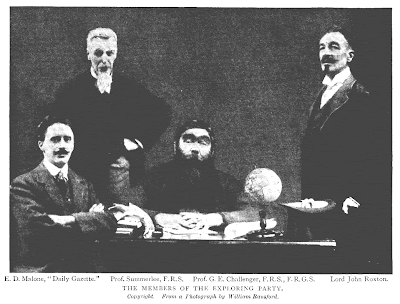
(That's Doyle himself in the center posing as Challenger in this bogus picture taken to advertise The Lost World.)

Professor Challenger is the main character in five Doyle stories, three novels and two short stories written from 1912 to 1929. Easily the most famous is the first titled The Lost World, which has been adapted to film and television several times mostly because it does a bang-up job of pitting measly humans against dinosaurs and other assorted primitive creatures.


The Lost World written and published in 1912 introduces to Professor Challenger and some other memorable characters. Narrated from the perspective of young and energetic newspaperman Edward T. Malone, the tale sets itself up to be a series of dispatches from Malone about an expedition led by Challenger and two other men, Professor Summerlee and Lord John Roxton. This stalwart band travel to South America to follow up on clues Challenger had discovered on a previous expedition which indicate, at least to Challenger, that dinosaurs may well survived deep in the unexplored territory. Summerlee, an aged academic is brutally skeptical and goes to disprove Challenger's claims. Roxton, a dashing adventurer of no small reputation goes along to prove Challenger's claims and to seek some thrills.

It's unlikely few don't know this story already, so I won't belabor those details. Suffice it to say this is at least the third time I've read this saga, the first time in decades, and I enjoyed it immensely. Doyle is able, through the sardonic voice of Malone present highly memorable characters, not the least of which is the incendiary Challenger who is overcome with his own genius and is not squeamish about proving himself right. But this reading suggested to me that the titular "Lost World" might be more than a hidden land of prehistoric survivals and may well speak to the life not lived by so many folks as they satisfy themselves with the humdrum of daily existence. Malone goes adventuring to impress a girl only to find the object of his love less interested than expected. His lessons are meant to be our lessons I suspect.


The Poison Belt is the next Challenger novel, presented first in 1913, this is a much shorter and extraordinarily droll tale in which the Earth is suddenly overcome by some poison in the very fabric of space. The life all over the entire planet seemingly dies and doomsday is upon it. Challenger and the whole gang from the previous novel extend their lives by using oxygen in a sealed room at Challenger's estate as the world solemnly dies around them. Some of the passages are hilarious as they demonstrate to an over-the-top degree the famous British reserve. His comments on what it might take to forestall a golfer are quite funny.  Perhaps my favorite scene is this conversation between Challenger and his decidedly loyal butler and chauffeur Austin.

"Presently Austin laid the cigarettes upon the table and was about to withdraw.
"Austin!" said his master.
"Yes, sir?"
"I thank you for your faithful service." A smile stole over the servant's gnarled face.
"I've done my duty, sir."
"I'm expecting the end of the world to-day, Austin."
"Yes, sir. What time, sir?"
"I can't say, Austin. Before evening."
"Very good, sir." The taciturn Austin saluted and withdrew."


Later after the world has been passed through the belt and the group has surprisingly survived, they explore the dead world by motorcar, even going to London and parts between. Once again, the story is told from Malone's perspective and though less broad than the first tale, nonetheless offers many great scenes which make strong comment on the nature of then modern society.


The Land of Mists written and published in 1926 is the one Challenger story I've never read before. And sadly it's not one I'd recommend to others. It's an episodic, overlong and sometimes tedious narrative bent on proving that Spiritualism is a legitimate philosophy and goes to great lengths to demonstrate that those who profess belief in such psychic phenomenon are repressed and abused by the larger society. The story is not told this time from perspective of Malone and that hurts it immediately as the narrative voice lacks punch. The story deals less with Challenger and more with Malone and Challenger's daughter Enid who investigate various spiritualist individuals and gatherings moving from skepticism to belief as they go. The story then shifts and momentarily gets quite good and downright exciting as Lord John Roxton turns up and he and Malone go ghost-busting in a certified haunted house. But then all too quickly the narrative goes quiet again and eventually Challenger himself, who is hardly in the story at all really, must confront the deaths of his comrade Professor Summerlee and his own beloved wife who was such a charming part of the earlier adventures. As far as I can make out, the "Land of Mists" referred to is our world and the lack of clarity those who disbelieve in Spiritualism suffer from. This is not a great novel alas, though easily the longest in the collection.
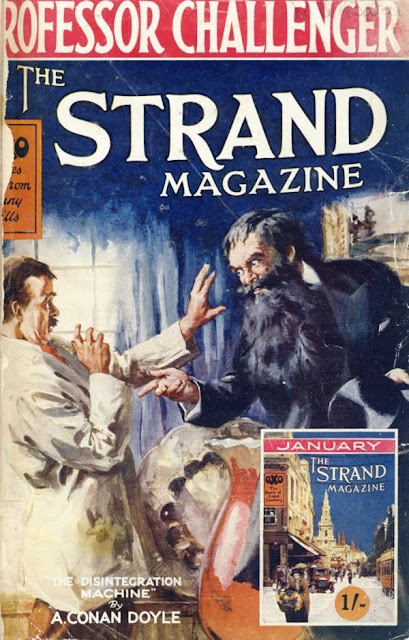

"The Disintegration Machine" from 1929 is a wonderful hoot of a short story, again told from Malone's perspective. In this one Challenger and Malone confront a mad doctor named Theodore Nemor who demonstrates the all-too dangerous success of his machine on both Malone and Challenger before the latter has a turn.

"When the World Screamed" from 1928 closes out this charming collection by telling how Challenger using vast resources inherited from an African rubber baron schemes to dig deep into the skin of the Earth and make his own personal introduction to an Earth Challenger insists is much like an Echidna, a living thing through and through with a tough skin protecting it. This story is told by Peerless Jones, an expert in artesian well digging. Malone is on hand to share in this hair-raising romp.

These tales combine to paint a picture of Professor George Edward Challenger, a scientist who powered by his intellect and his ego sees no limit to the explorations of humanity. There is a bracing hubris to Challenger which is easy to celebrate safely within the confines of such compelling fiction. Doyle's other great character is well worth the effort (for the most part) and I heartily recommend all save one of these classic adventures.

Rip Off