Showing posts with label Frank Brunner. Show all posts

Monday, May 18, 2026

The Pocket Book Doctor Strange!


These two volumes of Doctor Strange from Pocket Books gather together almost all of Steve Ditko's epic run on the character he created. The covers are by Frank Brunner who was most associated with the character at this time in the late 70's. 

Rip Off

Thursday, October 9, 2025

Doctor Weird Day!


Jim Starlin was born on this date in 1949. He made his mark at Marvel with stellar runs on Captain Marvel and Warlock. His creation of Thanos has given the MU a villain worthy of the entire universe itself. Starlin's The Death of Captain Marvel is one of Marvel's finest productions and that death has never been undone to my knowledge. But before all that, there was Doctor
Weird. 


Created by Howard Keltner, a fan-talent and part of the "Texas Trio", Dr. Weird has gotten a life in comics outside his fanboy beginnings. Keltner is not timid about saying that Mr. Justice, the old MLJ hero was Weird's inspiration.


I first chanced on the good Doctor in a Caliber Comics reprint of vintage Dr. Weird stories by now-famous writer George R.R. Martin and now-famous comics artist Jim Starlin. They kindle with the robust energy of youth and have a vigor and life missing from most modern comics, overcome by ironic commentary. Starlin's artwork is very like the stuff he first showed up at Marvel with on Iron Man and Captain Marvel, a fusion of Kirby and Kane and others, a synthesis of what was good in comics art at the time. The special reprints the contents of the two Dr. Weird issues published by Keltner along with a few other short tales.


The stories are a blend of science and sorcery. The Doctor is a lost time traveler who dies before he was born creating a paradox that gives him a weird unlife in which he's given the mission to use vast powers to help mankind in the 20th century. The threats are cults and demons and whatnot, vaguely Lovecraftian with a comics twist.


Dr. Weird got a few issues from Caliber of new adventures but these don't have the same magic somehow. Then he was folded into the Big Bang universe and had some fun things happen there. I've seen a few other issues advertised but I don't have those.


He's also shown up at Hamster Press in some classic reprints from the 60's with artwork Landon Chesney and others, really fine stuff. Howard Keltner his creator apparently sold the rights to the Big Bang guys, but I don't know where they reside now since Keltner passed away. Dr. Weird is good reading for fans of vintage comic book heroes and fans of Jim Starlin. 


When Jim Starlin broke into Marvel, he brought with him a new character named Drax the Destroyer. Drax was introduced in the pages of Iron Man, but soon became a central part of the battle against Thanos, the Mad Titan. 


Here we see Jim Starlin's Drax the Destroyer in full on destroyin' mode as he attacks the Mad God Thanos with Death looking on. Since Drax is risen from the dead and Thanos worships death, it's a most appropriate image. This is the classic Drax, the original design which I have to believe was based in part on Dr.Weird, a fanzine hero Starlin had worked on previously.


Here's that double page spread from Captain Marvel #32 in all its original black and white glory. Beautiful!

Rip Off

Friday, November 29, 2024

Warp The Phantasmagorical!


I'm rather a fan of Warp. After reading the detailed article in Comic Book Creator from Twomorrows Publishing, I'm even more fascinated by this Broadway play which attempted to translate the excitement and philosophy of Marvel Comics to the live action stage. With so much attention these days on the cinematic Marvel Universe, it behooves us all to take a glance at what was the first attempt to translate the adventures of those kinds of heroes to a live setting.


The article interviews the creators of the play Stuart Gordon and Edmund St.Bury (pen name for Lenny Kleinfeld) among others who were involved in the earliest days. Chicago's Organic Theater was one more hippie experiment in 1971 trying to put on thought-provoking drama in a time when lots of pop culture seemed to be designed to be enjoyed while high. The play Warp falls into that category. Early attempts to get permission to adapt Marvel Comics outright were rebuffed and the creators took it upon themselves to write their own "Marvel" comic story.


A normal man, a humble bank teller turns out to be the cosmically super-powered Lord Cumulus and heir to Fen-Ra becomes a hero battling the dark forces of his brother Lord Chaos and along the way encounters beautiful babes such as the warrior-chick Sargon and the insect queen Valeria. Lots more happens and other characters abound, but you get the gist. We have the makings of a cosmic hero saga. The play's narrative was divided into three parts and produced and performed over the course of several nights. In the days of small theater, the physical requirements of the show proved too much for some of the actors and the costuming was at once quaint and daring, making full use of the handsome bodies of the young actors who occupied the roles.


After a few years on the low-rent stages of Chicago it was thought a good idea to bring the play to Broadway. The production was upscaled, and circumstances were such that it started right out on the Big White Way as opposed to spending some useful months off-Broadway to hone the show to its larger setting. It proved disastrous and the show closed quickly.


Part of moving the play to Broadway involved redesigning aspects of the production and for that the greatest artist of the time was brought in, Neal Adams. Adams was at the height of his powers and brought his considerable talent to give the production a flair and a polish it might have been  lacking. While his designs might've been better suited to a comic page than a live stage, they were evocative and memorable. Adams also did many promotional pieces for the production which did a great job of selling the play in advance. 


It was revived in Chicago some years later which led eventually to a comic book adaptation by First Comics, one of the early publishers of the 80's looking to find purchase in the new Direct Sales market. The series lasted less than twenty issues, but the first nine are some of my favorite comics, adapting the three plays. Featuring artwork by Frank Brunner and writing by Peter B. Gillis, they are delightful comics, though the creators of the play say the series strips out the humor which was a vital part of the plays themselves.


A Warp movie might be fun too while I'm thinking about it. Given moder special effects, it could be a wonder to behold. 


Here is a collection with the first nine issues. I don't have it, but I wish I did.

 This Post is a Revised Dojo Classic. 

Rip Off

Tuesday, October 29, 2024

The Complete Web Of Horror!


I was a bit too young to enjoy thoroughly the horror comic magazines of the early 70's. When Marvel pushed into the zone with Monsters Unleashed and Dracula Lives, I began to notice them. I'd bought a random issue of Eerie, but I never got them as a regular thing. So Web of Horror was totally off my charts in 1969 when it debuted. I've long been fascinated by the short-lived magazine, mostly because of the outstanding talent associated with. I like everyone else am a Berni Wrightson fan and guys of like Mike Kaluta and Frank Brunner always get my attention. I was less plugged into Jeff Jones, but, I liked all the work by him I encountered. He came into focus when The Studio was set up with Jones joining Kaluta, Wrightson and Barry Windsor-Smith in attempts to market portfolios and such. 


When Fantagraphics announced they were going to at long last publish a reprint of the series I was immensely pleased and pre-ordered a copy as soon as I was able to do so. Now I have it my clutches to help celebrate Halloween. 


Terry Bisson, Clark Dimond, and Dana Marie Andra all write essays explaining how Web of Horror came to be. His boss Robert Sproul, the guy behind Cracked magazine, was the guy with the deep pockets and so he was the guy Bisson and Dimond approached about a magazine in the Warren magazine vein. Bisson already worked for Sproul. Bission had connections to the young artists filling the pages of fanzines at the time. So, he corralled Wrightson, Kaluta, Reese, along with Frank Brunner, Wayne Howard, the painfully underrated Bruce Jones, and veterans such as Syd Shore and Otto Binder to fashion just such a magazine. 


With writers such as Nicola Cuti tapped to join in, these young turks set about making some tasty monster mags. I'm particularly impressed by Ralph Reese, who brings a hard edge to his fantasy yarns. Wrightson of course is tapping into that classic Ghastly and EC vein he is famous for and Kaluta offered up some dreamy fantasy images. Jeff Jones was brought in for some awesome covers. (He did issues one and two and Wrightson did issues three and the unfortunate four.) Wayne Howard is a fave and his story kicks off the first issue, but alas it's his only contribution. (His second was never published.) The Brothers Ussher by Dimond and artist Donald Norman is set up to be a continuing saga, but it has only one installment. 


The title only lasted three issues. And that's largely because some of its critical benefactors abandoned it. Brisson admits to a severe lack of professionalism when he just dropped out and headed west to find a commune. The artists tried to pick up the pieces, but those pieces were scattered here and yon. Frank Brunner rescued some already submitted artwork scheduled for the fourth issue which never came to be, mostly because Sproul himself ducked out to Florida.  Many of those abandoned but finished stories showed up in other black and white magazine, one I remember reading in a Marvel magazine. 


This handsome volume has all the published issues, the unpublished fourth issue and even a story eventually published in For Monsters Only. To be able to behold and enjoy all these lush stories by the likes of Wrightson and Kaluta and others is a grand treat, especially knowing that all too many of these creators have passed on. I do have one small bicker and that's that the bio for Nicola Cuti made no mention of his co-creation E-Man, my favorite superhero, but that's a small oversight. This volume is well and truly time capsule full of treasure from an era when I was a young man and sopping up comics at fantastic rate. This takes me back to when comics were fun and just a little scary as well. 

Rip Off

Friday, February 25, 2022

Marvel Horrors - Brothers Of Darkness!


In the early 70's Marvel made itself the hometown for horror. After a few decades of unrelenting pressure, the Comics Code of America had been forced to change its guidelines, guidelines mostly intended to expunge horror comics. When those alterations were made the door swung open for comic book folks to have at it. And they did with gusto. The second volume of Essential Marvel Horror presents several of Marvel's monstrous attempts at scoring a comic book hit. They'd done so with Tomb of Dracula and Werewolf by Night, but they saw more opportunities. That drive to find the next hit monster combined with the constant Marvel need to ride trends to distraction resulted in a few horror comics that blended classic horror with the rise in interest of black heroes. 
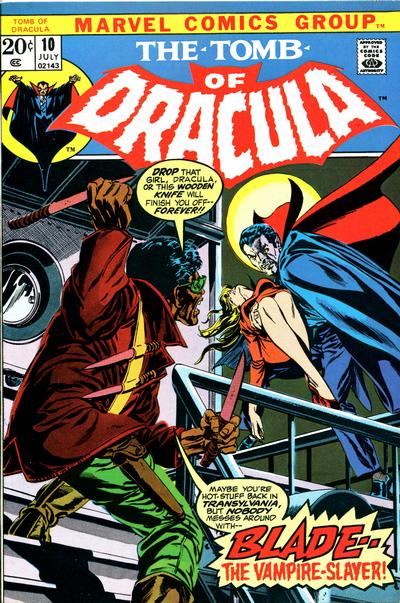

Marvel created their first horror blaxploitation character in the form of Blade who suddenly appeared in the pages of Tomb of Dracula to battle the eponymous vampire and would do so for many years. Blade is likely Marvel's most famous black character as a consequence of the movie trilogy starring Wesley Snipes. I hasten to add also that Blade's adventures are not in the collection under discussion. 
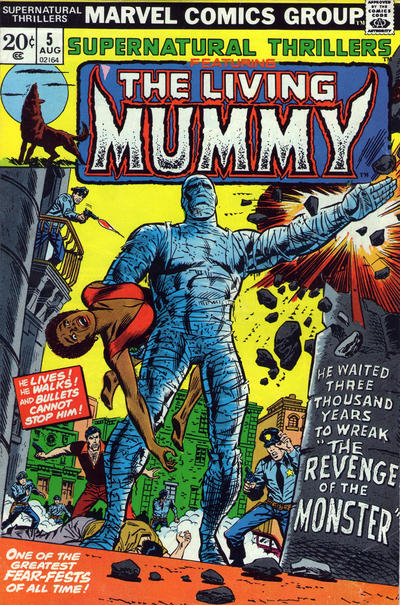

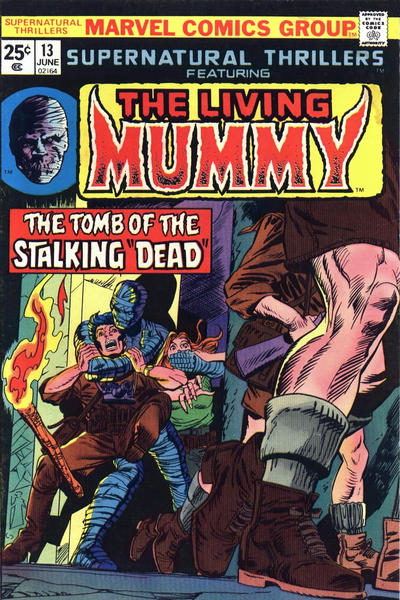
In Supernatural Thrillers #5 Marvel struck amber with The Living Mummy. This was a comic by writer Steve Gerber and artist Rich Buckler which reveled in the mummy movies which had been a staple of both Universal and Hammer film studios but bonded that classic terror with a black protagonist. The Living Mummy was actually an African prince named N'Kantu. N'Kantu was a noble giant who labored alongside his people who had been made slaves to build a pyramid for the Pharoah. In this story which had decided feel of a one-off we see the Mummy rise and rampage through the streets of Cairo having been invoked through the power of an ancient scarab wielded by a scientist named appropriately enough Doctor Scarab. He is joined by a young black couple who are menaced by the Mummy. By the end of this story the Mummy is out of commission.
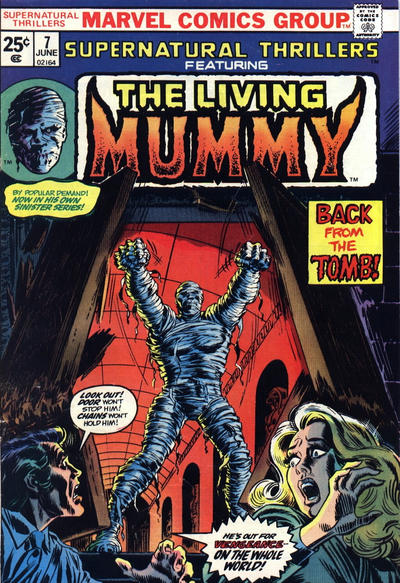

Sales must've been good because by the seventh issue he was back, this time in NYC menacing the City that Never Sleeps. We learn more about N'Kantu's origins before he is swept off to another dimension suddenly. This installment begins Val Mayerik's long tenure on the series with Steve Gerber on the script. Because of this the Mummy feels a bit like a dessicated version of Swamp Thing in these stories. 


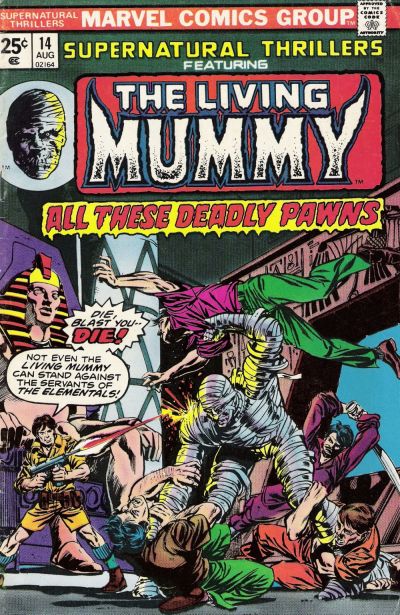
That feeling is even more pronounced when the Mummy meets a quartet of other-dimensional gods called the Elementals who drop him right back into the streets of Cairo. These four (Hydron, Magnum, Hellfire, and Zephyr) godlings evoke the powers of water, earth, fire, and wind. They want the Mummy to bring them the scarab which is still in the possession of the Living Pharoah. 


Tony Isabella takes over the writing chores as N'Kantu battles the minions of the Living Pharoah but fails to get his musty mitts on the scarab in question. 


The scarab has been stolen by a team of thieves named Old Dan and The Asp. Trying to find them and the scarab the Mummy gets involved in the local warfare which always seems to define the region of the Mid-East. 


The old team of Dr. Scarab and his two aides return as Zephyr turns on her colleagues to assist the Asp and Old Dan from harm. The Mummy and this erzatz little army brace themselves for what is billed as "The War that Shook the World". 
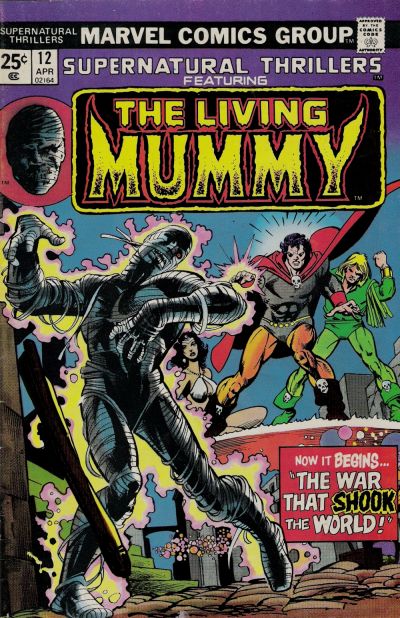


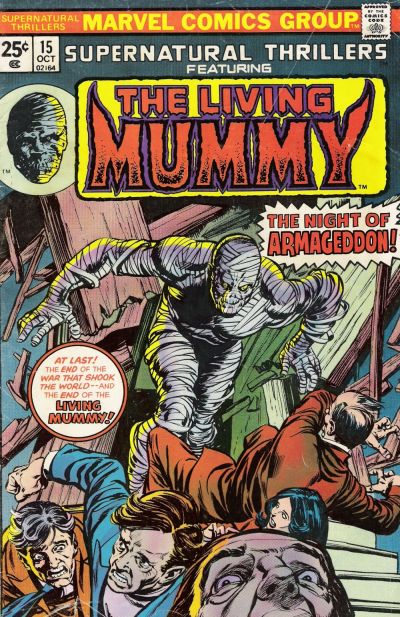
"The War that Shook the World" fills up the final four issues of the Mummy's tale in Supernatural Thrillers. Isabella writes the first two installments before John Warner steps in for the final two. Val Mayerik who is getting a plotting credit on most of his issues last until the penultimate issue when he is replaced by Tom Sutton. The war waged by the mad trio of Hellfire, Hydron, and Magnum largely destroys Cairo and the area around it before the city is whisked away to another dimension which allows our heroes to gain an advantage. Truth told it's hard for N'Kantu to hold his own in a comic which is swiftly filling with side characters. The fact that he can't speak limits him I guess, but like the Swamp Thing we end up focused on others despite his awesome presence. It will come as no surprise that the good guys win but not without casualties of many kinds. 


And then there was Brother Voodoo. Thanks to an essay written by Tony Isabella for Tales of the Zombie we know that Stan Lee first thought up Brother Voodoo and wanted to revive the venerable Strange Tales title. Roy Thomas stepped in to flesh out the character before handing it off to Len Wein who wrote all the Strange Tales stories. The costume was designed by John Romita with assitance from both Roy and John Romita Jr. it turns out. The art chores were turned over to Gene Colan with the hope that the Colan magic might strike twice as it had done before with Tomb of Dracula. It didn't. 
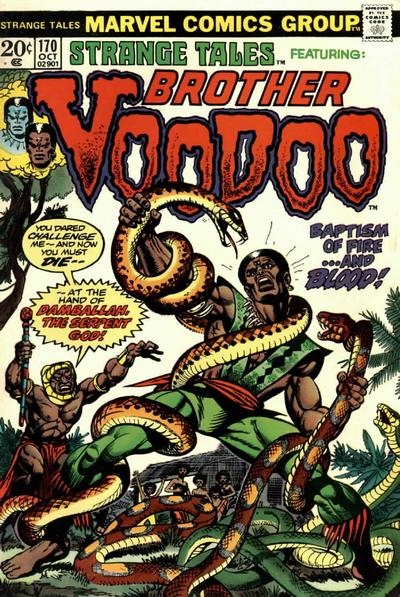

We first meet Brother Voodoo in the debut issue flying to Haiti but in flashback we learn of his origin. That tale takes up both Strange Tales #169 and #170 in which we meet Papa Jambo who had trained Jericho Drum's twin brother, who was killed in action. Now it's Jericho's duty to take on the role and as turns out his brother's ghost as well which dwells inside him and gives him greater strength. He's also impervious to fire and has other magical tricks as well. He defeats Damballah the Serpent God who had killed his brother and becomes a Voodoo version of Dr. Strange located in New Orleans and Haiti as well. 
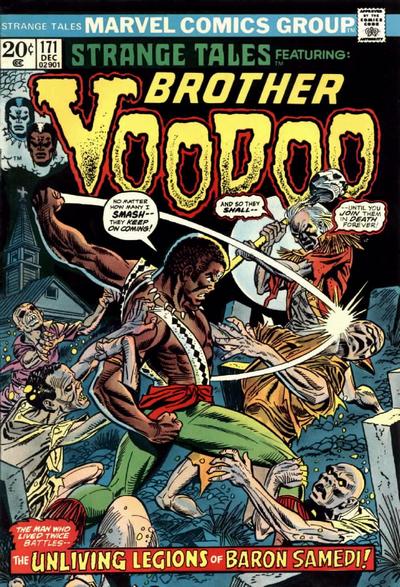

We discover the reason Drum was flying back to Haiti in the third installment when Brother Voodoo must battle some "Zuvembies" (apparently despite loosening of restriction in the Comics Code, the word "Zombie" was still verboten in color comics) and their leader Baron Samedi. There is more to this scheme than mere magic when agents of the Advanced Idea Mechanics also get involved. With his victory in this issue the unusual origin tale comes to a close. 


The next issue has Brother Voodoo save a nurse named Loralee Tate, the daughter of the local Chief of Detectives in New Orleans. She has been selected by a cult for sacrifice and Brother Voodoo must battle to save her. The artwork in this issue is stellar. Dan Adkins had inked the first two installments with fine effect and Frank Giaoia did a dandy job on the third, but Dick Giordano's inks over Gene Colan's pencils in this issue and next are outstanding and makes me angry they didn't do more together. 


Brother Voodoo wraps up his four-color career (for the most part) in Strange Tales #173 where he battles to save Loralee from the cult led by the Black Talon. When the story closes it looks like both she and Jericho Drumm are soon to be dead. 


We'd have to wait for a story in Tales of the Zombie #6 to give us the finale. Doug Moench scripts using Len Wein's plot and Gene Colan is joined by Frank Chiramonte on inks. There are few twists and turns and a few risings from the grave before this last regular Brother Voodoo story comes to a close. 


Brother Voodoo's next stop is alongside Spider-Man in Marvel Team-Up #24 battling a Voodoo lord named Moondog. The two heroes take on cultists in the streets of NYC and as you'd suspect save the day in full-color glory. The story was written by Wein with art by Jim Mooney and Sal Trapani. 


The Brother Voodoo saga comes to a close in a story by Dough Moench and Tony DeZuniga in Tales of the Zombie #10. In this one Jericho Drumm is again drawn back to Haiti where more "zuvembies" are shambling around and menacing the locals. It's odd that despite the fact they can use the word "zombie" in this story since it's beyond the reach of the Comics Code they still use the oddball version of the word. Brother Voodoo has yet another desperate battle against the undead (for real this time) and saves the day but barely and not without some personal cost. But that's it. 


Both Brother Voodoo and the Living Mummy disappeared for the most part after these adventures. They were part of a wave of exploitation that ran its course both in terms of black heroes and comic book horror. Both of course have resurfaced from time to time and Brother Voodoo even became an Avenger (like everyone else) but that was after my time with modern comics. 

Rip Off